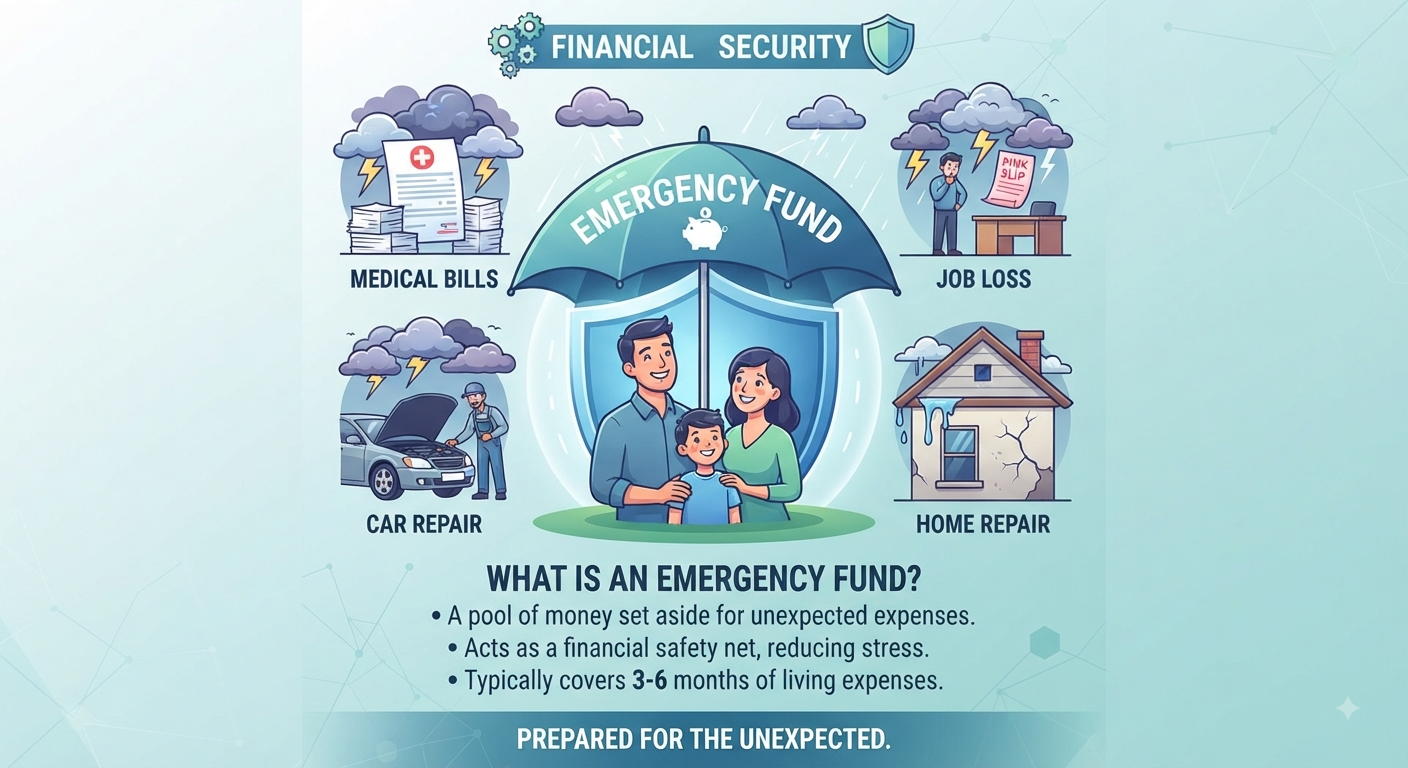
Insurance is boring. Nobody dreams of buying term life insurance or comparing disability policies. Yet skipping insurance might be the most expensive financial mistake you ever make.
Consider this: One serious car accident could wipe out your entire net worth. A major health issue could force you into bankruptcy even if you have savings. A house fire could destroy everything you own. An unexpected death could leave your family in financial crisis.
According to the CDC, 45% of Americans would struggle to cover a $1,000 medical emergency. Over 25% of working-age adults lack disability insurance despite it being crucial protection. And approximately 40% of families lack adequate life insurance.
These gaps don’t just create financial hardship—they create catastrophic financial ruin.
Insurance isn’t exciting, but it’s essential. It’s the financial equivalent of a seatbelt: you hope you never need it, but when you do, it’s literally life-changing.
The problem? Insurance is confusing. Dozens of types exist. Coverage amounts are unclear. Policies are dense with jargon. Most people buy whatever their agent recommends without understanding what they’re actually purchasing.
This comprehensive guide cuts through the complexity. You’ll understand insurance fundamentals, which types you actually need, how much coverage is appropriate, and how to get the best rates. We’ll skip the sales pitch and focus on actual protection.
By the end, you’ll know exactly what insurance to buy and why—no confusion, no overwhelm, just clarity.
Let’s protect your financial future.
Why Insurance Matters: The Math of Financial Ruin
Before diving into specific types, let’s understand why insurance matters at all.
The Problem: Uninsured Risk
Imagine these scenarios:
Scenario 1: Car Accident
- You cause serious injury to another person
- Medical bills: $250,000
- Permanent disability: Ongoing costs
- Legal judgment against you: $500,000
- Your liability insurance limit: $100,000
- Your responsibility: $650,000 out-of-pocket
Without adequate insurance, you’re financially destroyed.
Scenario 2: House Fire
- Your home’s replacement cost: $400,000
- Your savings: $50,000
- Insurance coverage: $0 (let it lapse)
- Your out-of-pocket cost: $400,000
- Your actual resources: $50,000
- Your problem: Homeless and broke
Scenario 3: Unexpected Death
- Your salary: $60,000/year
- Your dependents’ needs for 20 years: $1,200,000
- Your life insurance: $0
- Your family’s reality: Financial devastation
These aren’t hypotheticals. They happen constantly.
How Insurance Solves This
Insurance transfers catastrophic financial risk to an insurance company in exchange for regular premium payments.
The Basic Math:
Without Insurance:
- You pay: $0 (until disaster)
- Disaster happens: You pay $500,000 + devastation
With Insurance:
- You pay: $50-$100/month ($600-$1,200/year)
- Disaster happens: Insurance pays, you pay deductible ($500-$2,500)
Net savings in catastrophic scenario: $498,000-$499,500
That’s the power of insurance. It trades small, predictable payments for protection against catastrophic, unpredictable losses.
The Seven Essential Types of Insurance
Most people need 4-7 types of insurance. Let’s examine each:
1. Health Insurance (Essential)
Health insurance covers medical expenses from doctor visits to hospitalization.
Why You Need It:
- Average emergency room visit: $1,200-$2,500
- Average hospital stay: $15,000-$35,000
- Cancer treatment: $150,000-$500,000+
- Without coverage: You pay everything out-of-pocket
Types of Health Insurance:
Employer-Sponsored (most common in US):
- Employer pays 50-80% of premium
- You pay rest through payroll deduction
- Covers you immediately upon enrollment
- Portable (you can take it with you under COBRA)
Individual Plans (ACA Marketplace):
- You pay entire premium
- Subsidies available based on income
- Penalty-free if income changes
- Can switch plans during open enrollment
Medicare (age 65+):
- Government insurance for seniors
- Options: Original Medicare or Medicare Advantage
- Subsidized by taxes (you’ve been funding it your entire career)
Medicaid (low income):
- Government insurance, varies by state
- Free or extremely low-cost
- Income and asset limits apply
Key Metrics to Understand:
| Term | Meaning |
|---|---|
| Premium | Monthly/yearly cost you pay |
| Deductible | Amount you pay before insurance kicks in |
| Co-pay | Fixed amount per visit ($20, $40, $60, etc.) |
| Co-insurance | Percentage of cost you pay after deductible |
| Out-of-pocket max | Maximum you pay in a year before insurance covers 100% |
| Network | Doctors/hospitals covered by your plan |
Example Plan:
- Premium: $400/month
- Deductible: $1,500
- Co-pay: $30 for doctor visit
- Coinsurance: 20% after deductible
- Out-of-pocket max: $5,500
This means:
- First $1,500 of medical costs: You pay everything
- Next $20,000 of costs: You pay 20%, insurance pays 80%
- Beyond $5,500 out-of-pocket: Insurance pays 100%
What It Covers:
✅ Preventive care (exams, screenings, vaccinations)
✅ Doctor visits
✅ Hospital stays
✅ Prescription drugs
✅ Mental health services
✅ Emergency care
What It Doesn’t Cover:
❌ Cosmetic procedures (unless medically necessary)
❌ Experimental treatments
❌ International care (usually)
❌ Dental (usually)
❌ Vision (usually)
How to Choose:
Low health care usage (healthy, young):
- Choose plan with high deductible, low premium
- Saves money monthly
- High deductible = lower insurance costs
High health care usage (chronic conditions, frequent visits):
- Choose plan with low deductible, higher premium
- Saves money on actual care
- Worth higher monthly cost
2. Life Insurance (Essential if you have dependents)
Life insurance pays a death benefit to your beneficiaries when you die, replacing lost income.
Who Needs It:
- You have children
- You have a spouse depending on your income
- You have substantial debts (mortgage, student loans)
- Others depend on your income
Who Doesn’t Need Much:
- Single with no dependents
- Wealthy with substantial assets
- Children with no dependents
- Retired with sufficient assets
Two Main Types:
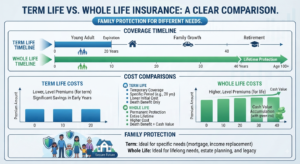
Term Life Insurance (temporary coverage):
- Coverage for specific term (10, 20, 30 years)
- Pays death benefit only if you die during term
- Expires after term (no payout)
- Extremely affordable ($15-40/month for substantial coverage)
- Best for: Most people
- Example: 30-year-old buys 20-year term for $50/month, $500,000 benefit
- Dies during term: Family gets $500,000
- Dies after term expires: Family gets $0
- Reaches age 50 (term expires): Coverage ends, no payout
Whole Life Insurance (permanent coverage):
- Covers your entire life
- Pays death benefit whenever you die
- Builds cash value you can borrow against
- Extremely expensive ($200-400+/month for same $500,000 benefit)
- Includes investment component
- Best for: High net worth individuals with specific estate planning needs
Comparison:
| Factor | Term | Whole |
|---|---|---|
| Cost | $50/month | $250/month |
| Coverage duration | 10-30 years | Lifetime |
| Best for | Most people | Wealthy individuals, estate planning |
| Death benefit | Guaranteed if you die during term | Guaranteed whenever you die |
| Cash value | No | Yes |
How Much Life Insurance Do You Need?
General Rule: 10-12x your annual income
Examples:
- $50,000 income: $500,000-$600,000 coverage
- $75,000 income: $750,000-$900,000 coverage
- $100,000 income: $1,000,000-$1,200,000 coverage
Alternative Calculation: Calculate what your dependents need:
- Years until retirement: 30 years
- Annual expenses needed: $50,000
- Total needed: $1,500,000 coverage
Cost Example:
Healthy 30-year-old buying 20-year term:
- $500,000 benefit: $20-30/month
- $1,000,000 benefit: $35-50/month
- $1,500,000 benefit: $50-70/month
Incredibly cheap for life-changing protection.
Key Points:
✅ Get quotes from multiple companies (rates vary significantly)
✅ Term life is usually best choice for most people
✅ Get coverage while young (rates increase with age)
✅ No medical exam often available for smaller amounts
✅ Annual review recommended (as life changes, needs change)
Read more: Our dedicated life insurance guide covers term vs whole life in detail.
3. Disability Insurance (Essential if you work)
Disability insurance replaces your income if you become unable to work due to illness or injury.
Why It Matters:
Council of Disability Awareness reports:
- 37% of disability claims last 90+ days
- Average disability lasts 34.6 weeks
- Most people can’t afford lost income for more than 1-2 months
- Disability (not death) is biggest threat to financial security for working adults
What It Covers:
- Illness or injury preventing work
- Surgery recovery
- Accident-related disability
- Cancer treatment
- Major depression or anxiety
- Back injuries
Two Types:
Short-Term Disability (3-6 months):
- Replaces 50-66% of income
- Waiting period: 0-14 days (how long before benefits start)
- Monthly benefit: $2,000-$5,000 example
- Duration: 3-6 months typically
Long-Term Disability (until retirement):
- Replaces 50-66% of income
- Waiting period: 90 days to 12 months (you wait this long before benefits start)
- Monthly benefit: $2,000-$5,000 example
- Duration: Until age 65 (or lifetime, depending on policy)
Coverage Needs:
Calculate your monthly expenses:
- Rent/mortgage: $1,500
- Food: $400
- Utilities: $200
- Insurance: $300
- Transportation: $300
- Other: $300
- Total monthly: $3,000
You’d want $3,000/month coverage (though many policies max at $5,000-$6,000).
Cost:
- Short-term: $15-30/month
- Long-term: $30-60/month
- Together: $50-80/month for complete protection
Employer Coverage:
Many employers offer free or subsidized disability insurance:
- Check if available during enrollment
- Usually covers 50-60% of salary
- Often has waiting period of 90 days
- Highly valuable benefit (don’t ignore it)
Individual Policy (if employer doesn’t offer):
- Own-occupation definition: Pays if can’t do your specific job
- Any-occupation definition: Pays if can’t do any job
- Own-occupation is better but more expensive
- Shop for best rates (varies significantly by insurer)
Key Points:
✅ Most important insurance for working adults
✅ 25% of working-age adults will experience disability lasting 90+ days
✅ Often available through employer (check your benefits)
✅ Own-occupation policies are worth the extra cost
✅ Don’t wait—apply while young and healthy (premiums increase with age)
4. Auto Insurance (Required by law)
Auto insurance protects you from liability if you cause an accident and covers damage to your vehicle.
What’s Required (varies by state):
Most states require:
- Liability coverage (bodily injury and property damage)
- Minimum limits: 25/50/25 (minimum $25,000 per person, $50,000 per accident bodily injury, $25,000 property damage)
- Note: Minimums are dangerously low—one serious accident exceeds these limits
Coverage Types:
Liability (REQUIRED):
- Bodily injury: Pays for injuries you cause others ($25,000-$100,000+ per person)
- Property damage: Pays for damage you cause others’ property ($25,000-$100,000)
- Recommended minimums: 100/300/100 (protects you better than state minimums)
Collision (REQUIRED if financing car):
- Covers damage to your vehicle from collision
- Deductible options: $500, $750, $1,000+
- Higher deductible = lower premium
- Don’t need if car worth <$3,000 (collision payout limited to car’s value)
Comprehensive (REQUIRED if financing car):
- Covers non-collision damage: theft, fire, vandalism, weather
- Deductible options: $250-$1,000
- Essential if car is valuable or in high-risk area
Uninsured/Underinsured Motorist:
- Protects you if hit by uninsured or inadequately insured driver
- Important because 12-25% of drivers uninsured
- Recommended: Match your liability limits
Medical Payments (No-Fault):
- Covers medical expenses regardless of fault
- Small amount ($1,000-$5,000)
- Useful but limited
Cost Example:
25-year-old buying auto insurance on $20,000 vehicle:
- Liability 100/300/100: $80-120/month
- Collision ($750 deductible): $30-50/month
- Comprehensive ($500 deductible): $15-30/month
- Total: $125-200/month
Ways to Lower Premiums:
✅ Bundle home + auto (10-25% discount)
✅ Increase deductible ($500 → $1,000 saves $10-20/month)
✅ Good driving record (no accidents/tickets)
✅ Good credit score (better drivers statistically)
✅ Low annual mileage (less exposure = lower risk)
✅ Safety features (airbags, anti-theft systems)
✅ Defensive driving course (insurer discount)
✅ Pay in full (avoid monthly payment fees)
✅ Shop annually (rates change, competition exists)
Key Points:
✅ State minimums are dangerously low—buy higher limits
✅ Shop every 2-3 years (rates change, companies compete)
✅ Bundle discounts with home insurance save hundreds
✅ Don’t drop collision/comprehensive if financing vehicle
✅ Higher deductible = lower premium (balance wisely)
5. Homeowners Insurance (Essential if you own)
Homeowners insurance protects your home and possessions from damage and covers liability if someone is injured on your property.
What It Covers:
Dwelling (structure):
- Your home’s structure
- Attached structures (deck, garage)
- Permanent fixtures (built-in appliances)
- Coverage options:
- Replacement cost: What it costs to rebuild ($350,000-$500,000+)
- Actual cash value: Replacement cost minus depreciation (usually 20-30% less)
- Recommended: Replacement cost
Personal property (contents):
- Furniture, electronics, clothing, appliances
- Usually covers 50-75% of dwelling coverage
- Individual items sometimes limited (jewelry, art)
- Coverage options: Replacement cost or actual cash value
Liability:
- If someone injured on your property
- Someone sues you
- Covers legal defense and damages
- Typical coverage: $100,000-$300,000
- Recommended: $300,000+ (umbrella policy for more)
Additional living expenses:
- If home uninhabitable from covered damage
- Pays for temporary housing, food, transportation
- Usually 20-30% of dwelling coverage
What It Doesn’t Cover:
❌ Flood (requires separate flood insurance)
❌ Earthquake (requires separate earthquake insurance)
❌ Routine maintenance
❌ Wear and tear
❌ Damage from war or civil unrest
❌ Intentional damage
Cost Example:
$400,000 home in moderate-risk area:
- Dwelling: $800-1,200/year ($67-100/month)
- Personal property: Included
- Liability: Included
- Additional living expenses: Included
- Total: $800-1,500/year
Discounts Available:
✅ Bundle with auto insurance (15-25% discount)
✅ New construction (5-10% discount)
✅ Safety features: alarm, fire extinguisher, sprinklers (5-15%)
✅ Updated roof (significant discount)
✅ Loyalty (long-time customer discount)
✅ Good credit
✅ Pay in full
Key Points:
✅ Required if you have mortgage (lender mandates coverage)
✅ Choose replacement cost coverage (worth the extra cost)
✅ Review coverage annually (home improvements increase value)
✅ Bundle with auto for significant savings
✅ Separate flood insurance available (highly recommended in flood-prone areas)
✅ Document possessions (photos/video for claims)
Read more: Our homeowners insurance guide covers everything you need to know.
6. Renters Insurance (Essential if you rent)
Renters insurance protects your possessions and covers liability if someone is injured in your apartment.
Important: Landlord’s insurance covers the building, NOT your belongings. You must buy your own coverage.
What It Covers:
Personal property:
- Furniture, electronics, clothing, etc.
- Typically $20,000-$50,000 coverage
- Individual items may be limited (jewelry, electronics)
Liability:
- If someone injured in your apartment
- Legal defense and damages
- Usually $100,000-$300,000
Additional living expenses:
- If apartment becomes uninhabitable
- Temporary housing during repairs
- Usually $10,000-$20,000
What It Doesn’t Cover:
❌ Damage to building (landlord’s responsibility)
❌ Damage from roommate (if you can prove it)
❌ Flood damage
❌ Valuable items over limits
Cost:
Renters insurance is shockingly cheap:
- $15,000-$25,000 coverage: $10-15/month
- $25,000-$50,000 coverage: $15-25/month
- Average: $180-200/year
For context, one valuable item (laptop, TV, camera) costs more than a year of insurance.
How Much to Buy:
Calculate your possessions’ value:
- Electronics: $3,000
- Furniture: $5,000
- Clothing: $2,000
- Other items: $1,000
- Total: ~$11,000
Buy coverage for 110-120% of total = $12,000-$13,000 minimum.
Key Points:
✅ Incredibly inexpensive (less than a streaming service)
✅ Protects your possessions and liability
✅ Required by some landlords
✅ Includes liability coverage (one lawsuit could cost more than you own)
✅ Often offers roommate discount
✅ Easy to increase coverage if needed
Read more: Our homeowners and renters insurance guide covers both comprehensively.
7. Umbrella Liability Insurance (Optional but recommended)
Umbrella insurance covers liability beyond your home and auto insurance limits.
Example:
You’re in serious car accident, causing $500,000 in damages:
- Your auto insurance liability limit: $100,000
- Your responsibility: $400,000
With $1,000,000 umbrella policy:
- Auto insurance pays: $100,000
- Umbrella policy pays: $400,000
- Your responsibility: $0
Who Needs It:
- Homeowners (someone injured on property)
- Parents (children cause damage/injury)
- High net worth individuals (more to protect)
- Anyone with significant assets
- Drivers with accident risk
Who Doesn’t Need It:
- Renters with minimal possessions
- Young adults with few assets
- No dependents or dependents
Cost:
Umbrella coverage is extremely inexpensive:
- $1,000,000 coverage: $150-250/year
- $2,000,000 coverage: $250-400/year
Requirements:
Most insurers require:
- Auto insurance: $100,000+ liability limit
- Homeowners insurance: $300,000+ liability limit
- Good driving record (no major accidents/violations)
Key Points:
✅ Extremely affordable ($12-30/month)
✅ Protects against catastrophic liability claims
✅ Only works if underlying coverage requirements met
✅ Often offered by home/auto insurers (can bundle)
✅ Worth buying if you own home or have significant assets
✅ One major lawsuit could exceed your net worth
Insurance You Probably Don’t Need
1. Credit Life Insurance
What it is: Insurance that pays off credit card debt if you die
Why you don’t need it:
- Extremely expensive (400-500% markup over term life)
- Term life insurance is much cheaper and flexible
- Your debt doesn’t transfer to heirs (except co-signers)
- Other heirs could pay from your estate
Better alternative: Buy adequate term life insurance instead
2. Extended Warranties
What it is: Extended coverage for appliances, electronics beyond manufacturer warranty
Why you don’t need it:
- Mark-up of 200-400% over actual failure rate
- Most products last warranty period anyway
- Credit cards often extend manufacturer warranties
- Self-insure: Save money monthly instead
Better alternative: Save monthly amount instead; buy replacements from savings if needed
3. Payment Protection Insurance (PPI)
What it is: Insurance that covers loan/credit card payments if you lose income
Why you don’t need it:
- Extremely expensive relative to coverage
- Often has many exclusions
- Disability insurance covers same protection better
- Heavily regulated due to mis-selling
Better alternative: Get disability insurance instead
4. Cancer/Critical Illness “Specific” Insurance
What it is: Insurance covering only cancer, heart attack, or other specific illnesses
Why you don’t need it:
- Health insurance already covers these
- Much more expensive than term life for same benefit
- Gaps in coverage (what about other serious illnesses?)
Better alternative: Adequate health and disability insurance
5. Accidental Death Insurance
What it is: Insurance paying only if death is accidental, not natural
Why you don’t need it:
- Death is death (does your family care if it’s accidental?)
- Much more expensive than term life
- Restricted benefits (many deaths don’t qualify)
Better alternative: Term life insurance (covers all death causes)
How Much Insurance to Buy: The Calculations
Health Insurance: Coverage Needs
If employed: Your employer likely offers coverage
- Enroll regardless of cost (employer subsidy makes it cheap)
- Choose plan based on expected health care usage
If self-employed/unemployed: Buy individual plan
- ACA Marketplace offers subsidies based on income
- Check Healthcare.gov for availability and costs
- Enroll during open enrollment (Nov 1 – Dec 15)
If 65+: Enroll in Medicare
- Sign up at age 65 (avoid lifetime penalties)
- Choose between Original Medicare and Medicare Advantage
- Enroll during Annual Enrollment Period (Oct 15 – Dec 7)
Life Insurance: Coverage Calculation
Method 1: Income Multiple
Annual income: $60,000
Multiple: 10x
Coverage needed: $600,000
Method 2: Expenses Calculation
- Years to retirement: 30
- Annual expenses needed: $50,000
- Inflation adjustment: 3% annually (compound over 30 years)
- Total needed: ~$1,400,000
Method 3: Debt + Expenses
- Mortgage balance: $300,000
- Other debts: $50,000
- Years to retirement: 25
- Annual living expenses: $60,000
- Total needed: $300,000 + $50,000 + ($60,000 × 25) = $1,850,000
What to Actually Buy:
Pick the highest number from three methods = your coverage need
Disability Insurance: Income Replacement
Monthly expenses:
$3,000
Buy coverage for: $3,000/month
Most policies replace 50-66% of income (after-tax replacement):
- If income: $60,000/year ($5,000/month)
- 60% replacement: $3,000/month benefit
- Perfect for your needs
Auto Insurance: Liability Limits
Minimum coverage (required in most states): 25/50/25
Recommended coverage: 100/300/100
Cost difference: Usually $10-15/month more for recommended
Protection value: Priceless in serious accident
Homeowners Insurance: Dwelling Coverage
Don’t underestimate replacement cost:
- Calculate rebuild cost (per-square-foot × home size)
- Add land value separately (only structure is insured)
- Increase value 5-10% for inflation during claim
- Get formal appraisal if unsure
Umbrella Insurance: Coverage Amount
Determine based on:
- Net worth (protect against lawsuits)
- Home value
- Liability risks (pool, trampoline, sports, etc.)
- Usually $1,000,000 minimum, $2,000,000+ recommended
How to Get the Best Insurance Rates
Insurance premiums vary significantly between companies for identical coverage. Shopping matters.
Strategy 1: Bundle Home + Auto Insurance
Bundling discounts: 10-25%
Example:
- Auto insurance alone: $120/month
- Home insurance alone: $100/month
- Separate total: $220/month
- Bundled together: $180/month (18% savings)
- Annual savings: $480
Bundling discounts are the single biggest rate reduction available.
Strategy 2: Increase Deductibles
Higher deductible = Lower premium
Auto insurance example:
- $500 deductible collision: $45/month
- $1,000 deductible collision: $35/month
- Annual savings: $120
Only increase deductible if you can afford to pay it from savings.
Strategy 3: Shop Annually or Bi-Annually
Insurance rates change yearly due to:
- Personal factors (age, accidents, claims)
- Market competition
- Company profitability
- Economic factors
Time investment: 1-2 hours
Potential savings: $400-800/year
Getting quotes from 5-7 companies takes 30-45 minutes with online quote tools.
Strategy 4: Improve Your Credit Score
Insurance companies use credit scores to set rates (correlates with claims risk).
Credit score impact:
- Excellent (750+): Best rates
- Good (700-749): Standard rates
- Fair (650-699): Higher rates (+15-25%)
- Poor (<650): Much higher rates (+40-100%+)
Improving credit score from 650→700 = $200-300/year savings on insurance.
Strategy 5: Maintain Continuous Coverage
Lapses in coverage signal risk and increase future rates.
Even short gaps (15+ days) result in rate increases of 5-10%.
Strategy: Never let coverage lapse, even switching between companies.
Strategy 6: Take Defensive Driving Course
Insurance discounts: 5-15% (often 2-3 years)
Cost: $15-30 (often free online)
Savings: $100-300 over discount period
ROI: Fantastic
Strategy 7: Good Driving Record
No accidents or traffic violations = best rates
Each accident adds 20-40% to rates for 3-5 years
Each violation adds 10-20% to rates for 3-5 years
Strategy 8: Usage-Based Insurance
Telematics programs (mobile app or device) monitor driving and offer discounts.
Programs: Snapshot (Progressive), Milewise (Nationwide), On-Time (Safeco)
Savings: 10-30% for safe drivers
Requirements:
- Download app or plug in device
- Drive safely (smooth acceleration, no hard braking)
- Limited high-risk driving times
Strategy 9: Loyalty Discounts
Staying with same insurer 3+ years often triggers loyalty discounts (5-10%).
However: Don’t assume loyalty = best rate. Shop anyway.
Strategy 10: Annual Review and Comparison
Action plan:
- Gather current quotes (5-7 companies)
- Note exact coverage being compared
- Calculate total annual cost
- Note all available discounts
- Switch if savings exceed switching hassle
Tools:
- Insurance.com
- The Zebra
- Insurify
- Direct company websites
Time investment: 1-2 hours annually
Potential savings: $300-800/year
Insurance Mistakes to Avoid
Mistake 1: Buying Life Insurance When You Don’t Need It
Error: Single person with no dependents buying substantial life insurance
Result: Wasting $50-100/month on unnecessary coverage
Solution: Only buy if someone depends on your income or you have significant debts
Mistake 2: Choosing Whole Life When You Need Term
Error: Believing whole life is “better” because it lasts lifetime
Reality:
- Cost difference: $50/month term vs. $250/month whole life (same benefit)
- 99% of people don’t need whole life
- Term coverage for fixed time period (while dependents are young) makes more sense
Solution: Buy term life unless you have estate planning needs requiring permanent coverage
Mistake 3: Accepting Employer’s Default Coverage
Error: Not reviewing benefits during enrollment, accepting defaults
Reality:
- Default plans may not match your needs
- Better options might be available
- Missing enrollment windows means losing coverage for year
Solution: Actively review all plan options during enrollment
Mistake 4: Not Understanding Your Coverage
Error: Buying insurance without reading policy details
Result:
- Not knowing coverage limits
- Assuming coverage exists when it doesn’t
- Surprises when making claims
Solution: Read policy documents before buying; ask questions if unclear
Mistake 5: Skipping Health Insurance
Error: Being uninsured or under-insured
Result:
- $100,000+ medical debt from single event
- Bankruptcy from healthcare costs
- Unnecessary suffering
Solution: Enroll in any available coverage (employer, ACA, Medicaid, Medicare)
Mistake 6: Skipping Disability Insurance
Error: Assuming won’t happen to you
Reality:
- 37% of disabilities last 90+ days
- Average disability lasts 34.6 weeks
- Most people can’t survive financially on savings alone
Solution: Buy disability insurance while working (essential protection)
Mistake 7: Under-Insuring Your Home
Error: Choosing replacement cost coverage that’s too low
Reality:
- Costs to rebuild significantly underestimated
- Insurance limits liability (won’t cover shortage)
- You lose out-of-pocket if underinsured
Solution: Get formal replacement cost estimate; buy coverage matching full amount
Mistake 8: Assuming Landlord’s Insurance Covers Your Stuff
Error: Believing landlord’s property insurance covers your belongings
Reality:
- Landlord’s insurance covers building only
- Your belongings = your responsibility
- One theft could cost thousands
Solution: Buy renters insurance (only $15/month)
Mistake 9: Not Comparing Quotes
Error: Buying from first insurer quoted
Result:
- Paying 20-40% more than necessary
- Missing available discounts
- Locked into overpaying for years
Solution: Get 5-7 quotes before buying any insurance
Mistake 10: Lowballing Liability Coverage
Error: Buying minimum required auto/home liability limits
Reality:
- Serious accident exceeds minimums (leaving you exposed)
- One lawsuit could wipe out net worth
- Slightly higher limits cost little more
Solution: Buy 100/300/100 auto + 300,000 home liability + umbrella
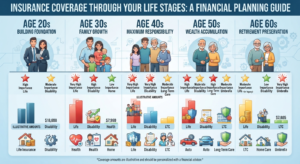
Insurance During Different Life Stages
Age 20-30: Building Stage
Insurance Needs:
- Health insurance (employer or ACA)
- Term life insurance (if dependents)
- Disability insurance (protect your income)
- Auto insurance (required by law)
- Renters insurance (cheap protection)
Not needed yet:
- Homeowners (unless you own)
- Umbrella (minimal assets to protect)
- Whole life (focus on building wealth)
Age 30-40: Family Stage
Insurance Needs:
- Health insurance (employer or ACA)
- Adequate term life ($500,000-$1,500,000 depending on situation)
- Disability insurance
- Auto insurance
- Homeowners insurance (likely have mortgage)
- Umbrella insurance ($1,000,000)
Optional:
- 529 plans for education (technically not insurance but related)
Age 40-50: Peak Earning Stage
Insurance Needs:
- Health insurance
- Term life ($500,000-$1,000,000)
- Disability insurance
- Auto insurance
- Homeowners insurance
- Umbrella insurance ($1,000,000-$2,000,000)
Consider:
- Long-term care insurance (if in family)
- Whole life if estate planning needs
Age 50-65: Pre-Retirement Stage
Insurance Needs:
- Health insurance
- Term life (reducing—less needed as nest egg builds)
- Disability insurance (until retirement)
- Auto insurance
- Homeowners insurance
- Umbrella insurance
New consideration:
- Long-term care insurance (covers nursing home, in-home care)
- Verify Medicare eligibility at 65
Age 65+: Retirement Stage
Insurance Needs:
- Medicare (required at 65 for most)
- Supplemental insurance (Medicare gap coverage)
- Auto insurance
- Homeowners insurance
- Umbrella insurance
Reduced needs:
- Life insurance (minimal if no dependents)
- Disability insurance (likely retired)
- Long-term care insurance (if not already purchased)
Frequently Asked Questions About Insurance
Is disability insurance really necessary if I have some savings?
Most people underestimate how quickly savings deplete in unemployment/disability. Average disability lasts 34.6 weeks:
- Monthly expenses: $3,000
- Average disability cost: $3,000 × 34.6 weeks ÷ 4.33 weeks = $23,800
Many people can cover 1-2 months; few can cover 8+ months. Disability insurance is essential for working adults.
What happens to my health insurance if I lose my job?
Two options:
- COBRA: Extend your employer coverage for 18 months at full cost (expensive)
- ACA Marketplace: Buy individual plan (often cheaper than COBRA, especially with subsidies)
You have 60 days to enroll in COBRA from job loss. Don’t wait.
Can I use health insurance from one state if I move to another?
Insurance follows you across state lines. However:
- Coverage details may change
- Provider networks may be different
- Rates might be different
- You may need to switch plans during open enrollment
Contact your insurer immediately upon moving to understand any changes.
Should I buy insurance directly from a company or through an agent?
Both are fine. Consider:
- Direct: Easier to compare quotes, lower pressure, transparent pricing
- Agent: Personalized guidance, can ask questions, sometimes finds better deals
Either way, compare multiple quotes before buying.
Why does my homeowners insurance keep going up if nothing has changed?
Common reasons:
- Inflation: Home replacement costs increasing
- Increased claims in your area (company paying more claims = raising rates)
- Increased reinsurance costs: Company’s insurance costs rising
- Age of roof/home: Older homes cost more to insure
- Claims history: Your previous claims increase rates
Solution: Shop annually to find better rate.
What’s the difference between CPP (Canada) and SSI (US) disability?
This guide focuses on private disability insurance. Social Security provides limited disability benefits (must be long-term and severe). Most working people should supplement with private disability insurance.
Can I have both short-term and long-term disability insurance?
Yes, and many people do:
- Short-term covers immediate gap while income lost
- Long-term takes over after short-term expires
Together they provide complete coverage during disability.
Should I drop coverage while unemployed to save money?
No. Going without coverage creates catastrophic risk:
- Health emergency during unemployment = bankruptcy
- Accident without auto insurance = license suspension
- Damage to home without insurance = losing house
Use COBRA, ACA, or state insurance programs. Coverage is cheaper than the risk.
Is it worth buying insurance with higher deductibles?
Only if:
- You have emergency fund to cover deductible
- Cost savings are meaningful ($20+/month)
- You’re comfortable potentially paying deductible
Deductibles range from $250-$2,500. Only increase if you can truly afford it.
How often should I review my insurance coverage?
Annually minimum. More frequently if life changes:
- Income increase/decrease
- Marriage/divorce
- Birth of child
- Home purchase
- Major accident or health event
- Job change
- Moving to new area
Annual review ensures coverage still matches needs.
Take Action: Your Insurance Assessment
30-Day Insurance Audit Plan
Week 1: Inventory Current Coverage
- List all insurance policies (health, life, disability, auto, home, renters, other)
- Note coverage amounts and deductibles
- Record premium costs
- Note policy renewal dates
- Identify gaps in coverage
Week 2: Assess Needs
- Calculate life insurance needed
- Determine disability insurance need
- Evaluate home/auto coverage adequacy
- Consider liability risk (umbrella need)
- Review health insurance plan appropriateness
Week 3: Get Quotes
- Request 5-7 quotes for each major policy
- Note discounts available
- Compare identical coverage
- Calculate total annual costs
- Note application requirements
Week 4: Act
- Apply for new policies if switching
- Keep old policies active during transition
- Update beneficiary designations
- Document all policies in one place
- Set calendar reminder for annual review
Conclusion: Insurance Protects Your Future
Insurance isn’t exciting. It doesn’t show up on Instagram. It doesn’t compound like investments. But it’s absolutely essential.
One accident. One illness. One theft. One lawsuit. Any of these could destroy everything you’ve worked to build—unless insurance protects you.
The math is clear:
- Catastrophic events cost $100,000-$1,000,000+
- Insurance costs $100-500/month
- Choosing not to buy insurance is essentially betting you won’t need it
- Statistically, most people will need it
The core insurance checklist:
✅ Health insurance (required, essential)
✅ Life insurance (essential if dependents exist)
✅ Disability insurance (essential while working)
✅ Auto insurance (required by law)
✅ Homeowners/Renters insurance (required if financing, essential otherwise)
✅ Umbrella insurance (highly recommended if you own property)
Protecting your financial future isn’t about finding the cheapest insurance—it’s about having enough coverage at a reasonable cost. Smart shopping can save 20-40% annually, but adequate coverage is more important than saving 5% by under-insuring.
Review coverage now. Get quotes. Close any gaps. Your future self—protected against life’s biggest financial risks—will thank you.
Ready to complete your financial protection? Explore these related guides:
- Life Insurance Explained: Term vs Whole Life and How Much You Need – Detailed life insurance guidance
- Health Insurance Guide: Choose the Right Plan and Save Money – Navigate health insurance decisions
- Disability Insurance: Protect Your Income From Unexpected Events – Comprehensive disability protection guide
Leave a Reply