Category: Insurance & Protection

  • Homeowners and Renters Insurance: Essential Coverage Explained

    Homeowners and Renters Insurance: Essential Coverage Explained

    Your home is likely the most valuable asset you own. Yet many people protect it with inadequate or nonexistent insurance.

    Consider these scenarios:

    Scenario 1: House fire
    Your $400,000 home burns down. Replacement cost: $450,000 (inflation, upgraded materials). Your insurance coverage: $250,000. Your personal responsibility: $200,000 (paid from personal assets or bankruptcy).

    Scenario 2: Apartment theft
    Burglary while you’re at work. $15,000 in electronics, furniture, and clothing stolen. Your coverage: $0 (no renters insurance). Your personal responsibility: $15,000 (paid from savings or credit cards).

    Scenario 3: Liability lawsuit
    Guest slips on icy steps and breaks leg. Medical bills: $50,000. Lawsuit damages: $100,000. Your liability insurance limit: $50,000. Your personal responsibility: $50,000 out-of-pocket.

    These aren’t hypothetical. They happen constantly—and without proper insurance, they’re financially catastrophic.

    Yet homeowners and renters insurance is surprisingly affordable:

    • Homeowners: $800-$1,500/year
    • Renters: $150-$200/year

    In this comprehensive guide, you’ll understand what homeowners and renters insurance actually covers, how to calculate adequate coverage, how to find the best rates, and exactly what to do if disaster strikes.

    Whether you own or rent, proper property insurance is essential protection.

    Let’s ensure your home and possessions are protected.


    Understanding Property Insurance: The Basics

    Before diving into specifics, let’s understand what property insurance does.

    The Purpose of Property Insurance

    Property insurance protects you from financial loss due to:

    • Damage to property: Fire, weather, theft, vandalism
    • Liability: If someone is injured on your property

    It’s not flood or earthquake insurance (separate policies). It’s not paying for normal maintenance. It’s specifically protecting against unexpected property damage and liability.

    Who Needs Property Insurance

    Homeowners with mortgage: Required by lender (non-negotiable)

    Homeowners without mortgage: Not required by law, but essential protection

    Renters: Not required by law, but essential protection (landlord’s insurance doesn’t cover your stuff)

    Landlords with rental properties: Required by mortgage lender and essential

    How Property Insurance Works

    When damage occurs:

    1. You experience loss (fire, theft, weather damage)
    2. You contact insurance company to file claim
    3. Insurance company assigns adjuster
    4. Adjuster investigates and assesses damage
    5. Insurance company pays claim (minus deductible)
    6. You use proceeds to repair/replace

    Important: Insurance pays for actual damage/loss, not profit.

    Example:

    • Your TV purchased for $1,000 five years ago
    • Current value: $300 (depreciation)
    • Insurance pays: $300 (actual cash value)
    • Insurance does NOT pay: Original $1,000 cost

    Homeowners Insurance: Complete Coverage Guide

    Homeowners insurance protects your home and belongings, plus provides liability coverage.

    What Homeowners Insurance Covers

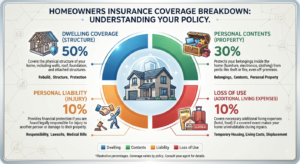
    Homeowners insurance has multiple coverage components:

    Coverage A: Dwelling (Structure)

    What it covers:

    • Home structure (walls, roof, foundation)
    • Attached structures (garage, deck, shed)
    • Permanent fixtures (built-in appliances, fixtures)
    • Cost to rebuild your home

    What it doesn’t cover:

    • Land (insurance covers structure, not the ground)
    • Yard/landscaping (sometimes partial coverage)
    • Personal property (covered under separate coverage)
    • Detached structures over certain value

    How much to buy:

    Critical: Buy enough to FULLY rebuild your home.

    Calculation:

    Rebuilding cost per square foot: $150-$250 (varies by location and quality)
    Home size: 2,000 square feet
    Rebuild cost: 2,000 × $150-$250 = $300,000-$500,000

    Common mistake: Insuring for original purchase price instead of rebuild cost.

    Example:

    • Bought house for $300,000 in 2005
    • Today’s rebuild cost: $500,000
    • Insuring for $300,000: Underinsured by $200,000

    Action: Get formal replacement cost estimate from insurance company or appraiser.

    Coverage options:

    Actual Cash Value (ACV):

    • What it pays: Replacement cost minus depreciation
    • Example: $50,000 roof damage, roof is 15 years old (50% life remaining)
    • Pays: $25,000 (50% of replacement cost)
    • Cost: Cheaper premium
    • Problem: Gap between what insurance pays and actual repair cost

    Replacement Cost (RC):

    • What it pays: Full replacement cost, no depreciation deduction
    • Example: $50,000 roof damage, roof is 15 years old
    • Pays: Full $50,000 (no depreciation deduction)
    • Cost: Higher premium ($100-200/year more)
    • Recommended: Almost always worth the cost

    Guaranteed/Extended Replacement Cost:

    • What it pays: Up to 120-150% of dwelling limit
    • Example: Dwelling limit $400,000, pays up to $480,000-$600,000
    • Cost: Slightly higher premium
    • Best for: Inflation protection

    Recommendation: Buy replacement cost coverage, not actual cash value.

    Coverage B: Other Structures

    What it covers:

    • Detached garage
    • Shed
    • Pool house
    • Guest house
    • Fence (sometimes)

    Coverage amount:

    • Usually 10-20% of dwelling coverage
    • Example: $400,000 dwelling = $40,000-$80,000 other structures

    When it matters:

    • Valuable detached structures
    • Expensive pool houses or guest houses
    • Consider increasing limit if structures valuable

    Coverage C: Personal Property (Contents)

    What it covers:

    • Furniture
    • Electronics (TV, computer, stereo)
    • Clothing
    • Appliances
    • Jewelry
    • Art
    • Sports equipment

    How much it covers:

    • Usually 50-75% of dwelling coverage
    • Example: $400,000 dwelling = $200,000-$300,000 contents

    Valuation options:

    Actual Cash Value:

    • Pays based on current market value (with depreciation)
    • Example: 5-year-old couch bought for $2,000, now worth $500, insurance pays $500
    • Cheaper premium

    Replacement Cost:

    • Pays what it costs to buy new item
    • Example: Same couch costs $2,000 new, insurance pays $2,000 (if limit allows)
    • Higher premium ($100-200/year more)
    • Recommended: Better coverage

    Important limits:
    Some items have sub-limits (maximum payout):

    • Jewelry: Often $1,500-$5,000 limit
    • Electronics: Sometimes $2,500-$5,000
    • Art/collectibles: Often limited
    • Cash: Usually $200-$500

    Solution for high-value items: Schedule them separately (floater policy).

    Calculate how much you need:

    • Walk through home, list all possessions
    • Estimate replacement cost for each category
    • Total the amounts
    • Buy dwelling × 50-75% at minimum
    • Consider higher limit if you have valuable items

    Example:

    • Furniture: $10,000
    • Electronics: $8,000
    • Clothing: $4,000
    • Kitchen items: $3,000
    • Bedroom items: $4,000
    • Living room items: $5,000
    • Miscellaneous: $6,000
    • Total: $40,000

    If dwelling is $400,000, should have $200,000+ contents coverage.

    Coverage D: Loss of Use (Additional Living Expenses)

    What it covers:

    • Temporary housing if home becomes uninhabitable
    • Meals and food
    • Transportation
    • Other living expenses during repairs

    How it works:

    Home damaged by fire, uninhabitable for 3 months:

    • Monthly living expenses increased by: $2,000 (temporary housing adds to normal expenses)
    • 3 months × $2,000 = $6,000
    • Insurance covers: Full $6,000

    Coverage amount:

    • Usually 20-30% of dwelling coverage
    • Example: $400,000 dwelling = $80,000-$120,000 loss of use

    Recommendation: Accept whatever limit insurance offers (rarely a limiting factor).

    Coverage E: Liability Protection

    What it covers:

    • If someone injured on your property
    • Legal defense (your attorney paid by insurance)
    • Medical bills for injured person
    • Damages if sued

    How it works:

    Guest slips on icy steps, breaks leg:

    • Medical bills: $50,000
    • Ongoing care: $20,000
    • Pain and suffering damages: $30,000
    • Total claim: $100,000

    If liability limit is $300,000:

    • Insurance pays: Full $100,000
    • Your responsibility: $0

    If liability limit is $50,000:

    • Insurance pays: $50,000
    • Your responsibility: $50,000

    Coverage amounts:

    • Typical offered: $100,000-$300,000
    • Recommended: $300,000-$500,000
    • High-risk properties (pool, trampoline): $500,000+

    When to increase:

    • You have pool or trampoline
    • You have pets (liability risk)
    • Frequent guests
    • High net worth (more attractive lawsuit target)

    Cost: Increasing from $100,000 to $300,000 usually costs only $10-20/year.

    Recommendation: Buy at least $300,000 (cheap upgrade with significant protection increase).

    Coverage F: Medical Payments

    What it covers:

    • Medical bills for anyone injured on your property (regardless of fault)
    • Automatic coverage, no lawsuit needed

    How it works:

    Neighbor slips on your driveway (no negligence on your part), breaks arm:

    • Medical bills: $5,000
    • No lawsuit needed
    • Medical payments covers: Full $5,000

    Coverage amounts:

    • Usually $1,000-$5,000
    • Default is often sufficient for most situations

    When to increase:

    • Frequent guests
    • High injury risk environment (pool, sports activities)
    • Rarely necessary to increase

    What Homeowners Insurance Doesn’t Cover

    Water damage from floods: Excluded (requires separate flood insurance)

    Earthquake damage: Excluded (requires separate earthquake insurance)

    Routine maintenance: Not insurance claim (normal wear and tear)

    Intentional damage: Not covered (if you intentionally cause damage)

    Neglect: Not covered (damage from lack of maintenance)

    Business use: Not covered (operating business from home usually excluded)

    Certain weather: Some policies exclude wind/hail damage (especially in high-risk areas)

    Important: Know what’s NOT covered in your policy.

    Homeowners Insurance Costs

    Typical annual premiums:

    • Basic homeowners: $800-$1,200/year
    • Average home value $350,000: $1,000-$1,500/year
    • High-risk area: $1,500-$3,000+/year

    What affects cost:

    1. Home value: Higher value = higher premium
    2. Age of home: Older = higher cost (roof age critical)
    3. Location: High-crime areas cost more
    4. Weather risk: Areas with hurricanes, tornadoes cost more
    5. Deductible: Higher deductible = lower premium
    6. Construction type: Wood frame more expensive than brick
    7. Distance to fire station: Rural homes cost more
    8. Claims history: Previous claims increase rates
    9. Credit score: Better credit = lower rates
    10. Safety features: Alarm systems, fire extinguishers reduce cost

    Deductible options and cost impact:

    $500 deductible: Base premium
    $1,000 deductible: 10-15% savings ($100-150/year)
    $2,500 deductible: 25-30% savings ($250-350/year)
    $5,000 deductible: 40-50% savings ($400-600/year)

    Sweet spot: $1,000 deductible (balances reasonable savings with manageable out-of-pocket).

    Example cost breakdown (mid-sized home, good credit, no claims):

    • Dwelling: $400,000 = $900/year
    • Contents: $200,000 = $100/year
    • Liability: $300,000 = $50/year
    • Loss of use: $100,000 = $30/year
    • Medical payments: $5,000 = $20/year
    • Total: ~$1,100/year ($92/month)

    Homeowners Insurance Discounts

    Bundle discount: Home + auto = 10-25% savings

    New construction: 5-10% discount

    Updated roof: 5-10% discount (newer roof = less weather risk)

    Updated electrical/plumbing: 5-10% discount

    Alarm system: 5-10% discount

    Fire extinguisher: 2-5% discount

    Security system: 5-15% discount

    Good credit: 5-15% discount

    No claims: Maintained 3+ years = 5-10% discount

    Loyalty discount: Customer 3+ years = 5-10% discount

    Paid-in-full: Annual payment vs monthly = 2-5% discount

    Multiple discounts: Can stack significantly (often 20-40% total)

    Action: After enrolling, contact insurance to ensure all discounts applied.


    Renters Insurance: Protection for Apartment Dwellers

    Renters insurance protects your possessions and provides liability coverage. Critical for renters, yet most don’t have it.

    What Renters Insurance Covers

    Coverage A: Personal Property (Contents)

    What it covers:

    • All your possessions in rental unit
    • Furniture
    • Electronics
    • Clothing
    • Kitchen items
    • Bedroom items
    • Everything you own in apartment

    What it doesn’t cover:

    • Landlord’s property (walls, appliances, fixtures)
    • Vehicles (covered under auto insurance)
    • High-value items (unless scheduled separately)

    Coverage amount:

    • Typical: $20,000-$50,000
    • Calculate what you own (see homeowners section)
    • Most people need $25,000-$40,000

    Valuation:

    • Actual cash value (depreciated value): Cheaper
    • Replacement cost (new item cost): Better, slightly more expensive

    Recommendation: Replacement cost is worth small premium increase.

    Sub-limits (maximums for specific items):

    • Jewelry: Often $2,500 limit
    • Electronics: Often $2,500 limit
    • Valuable items: May be limited

    Solution: Schedule valuable items separately for full coverage.

    Coverage B: Liability Protection

    What it covers:

    • If someone injured in your apartment
    • Legal defense
    • Damages if sued

    How it works:

    Friend visits, slips on your wet floor, breaks arm:

    • Medical bills: $15,000
    • Damages: $25,000
    • Total: $40,000

    If liability limit is $300,000:

    • Insurance pays: Full $40,000
    • Your responsibility: $0

    If liability limit is $50,000:

    • Insurance pays: $50,000
    • Your responsibility: $0 (stays within limit)

    Coverage amounts:

    • Typical offered: $100,000-$300,000
    • Recommended: $300,000 (same as homeowners)
    • Cost difference minimal ($10-15/year between $100k and $300k)

    When to increase:

    • Frequent visitors
    • High injury risk activities
    • Generally, $300,000 is standard and sufficient

    Coverage C: Medical Payments

    What it covers:

    • Medical bills for anyone injured in your apartment
    • No lawsuit needed
    • Covers regardless of your fault

    Coverage amount:

    • Usually $1,000-$5,000
    • $1,000 typically sufficient

    Rarely necessary to increase.

    Coverage D: Loss of Use (Additional Living Expenses)

    What it covers:

    • Temporary housing if apartment becomes uninhabitable
    • Meals
    • Other living expenses

    How it works:

    Apartment damaged by fire, uninhabitable for 1 month:

    • Temporary housing: $1,500/month additional cost
    • Insurance covers: Full $1,500
    • 1 month = $1,500 total covered

    Coverage amount:

    • Usually adequate at default amounts
    • Rarely limiting factor

    What Renters Insurance Doesn’t Cover

    Landlord’s responsibility: Insurance only covers your stuff, not building damage

    Flood damage: Requires separate flood insurance

    Roommate damage: Damage caused by roommate intentionally usually not covered

    Maintenance issues: Normal wear and tear not covered

    Business use: Operating business from apartment usually excluded

    Renters Insurance Costs

    Typical annual cost: $150-$300/year ($12-25/month)

    Extremely affordable considering coverage provided.

    What affects cost:

    1. Coverage amount: Higher coverage = higher cost
    2. Location: High-crime areas cost more
    3. Building safety: Buildings with better security, fire suppression = lower cost
    4. Claims history: Previous claims increase rates
    5. Credit score: Better credit = lower rates
    6. Deductible: Higher deductible = lower cost

    Deductible impact:

    $250 deductible: Base premium ($200/year example)
    $500 deductible: 10% savings ($180/year)
    $1,000 deductible: 20% savings ($160/year)

    Sweet spot: $500 deductible (balances savings with manageable out-of-pocket).

    Why renters insurance is cheap:

    Insurance companies pay less frequent claims (theft, fire rare in apartments). Risk lower than homeowners = cheaper insurance.

    Example cost breakdown:

    • Personal property ($30,000): $100/year
    • Liability ($300,000): $40/year
    • Medical payments ($1,000): $10/year
    • Loss of use ($10,000): $10/year
    • Total: ~$160/year ($13/month)

    Renters Insurance Discounts

    Bundle discount: Renters + auto = 10-20% savings

    Good credit: 5-10% discount

    No claims: 3+ years = 5-10% discount

    Loyalty discount: Customer 3+ years = 5-10% discount

    Paid-in-full: Annual payment vs monthly = 2-5% discount

    Safety features: Fire extinguisher, alarm system = 5-10% discount

    Multi-policy: Multiple policies with same insurer = 10-25% discount

    Discounts stack: Can achieve 20-40% total discount.

    Why Renters Don’t Buy It (And Why They Should)

    Common reasons renters skip coverage:

    1. “It’s expensive” (Actually $13/month—less than one coffee)
    2. “My landlord’s insurance covers my stuff” (No, landlord’s covers building only)
    3. “I don’t have much stuff” (Even basic possessions worth $15,000+)
    4. “I’m never home” (Theft/fire can happen anytime)
    5. “It won’t happen to me” (Burglary affects 1 in 36 households annually)

    Reality check:

    Average apartment contents value: $25,000
    Cost to replace without insurance: $25,000
    Cost of renters insurance: $160/year
    Payoff from single theft or fire: Enormous

    The math is irrefutable: Renters insurance is the best financial bargain available.


    Comparing Homeowners and Renters Insurance

    Key Similarities

    Feature Homeowners Renters
    Personal property coverage Yes Yes
    Liability protection Yes Yes
    Medical payments Yes Yes
    Additional living expenses Yes Yes
    Deductible options Yes Yes
    Discount opportunities Yes Yes
    Can add riders Yes Yes

    Key Differences

    Feature Homeowners Renters
    Dwelling/structure Yes (covers home) No (landlord’s responsibility)
    Contents $200,000-$500,000 typical $20,000-$50,000 typical
    Annual cost $800-$1,500 $150-$300
    Required by lender Yes (if mortgage) Usually no
    Deductible typical $500-$1,000 $250-$500
    Coverage scope Home + belongings Belongings only

    How to Get Homeowners or Renters Insurance

    Step 1: Determine Coverage Needed

    For homeowners:

    • Get replacement cost estimate for home
    • Walk through home, estimate contents value
    • Determine liability limit needed ($300,000 minimum recommended)
    • Note special features (pool, trampoline, valuable items)

    For renters:

    • Walk through apartment, list contents
    • Estimate total value (usually $25,000-$40,000)
    • Choose liability limit ($300,000 recommended)
    • Note high-value items needing separate schedule

    Step 2: Get Quotes from Multiple Companies

    Online quote tools:

    • InsWeb
    • The Zebra
    • Insurify
    • Direct company websites (State Farm, Progressive, Allstate, Geico, etc.)

    In-person quotes:

    • Local independent insurance agents
    • Company-specific agents

    Get quotes from 5-7 companies (rates vary 20-40%).

    Step 3: Compare Quotes

    Key metrics to compare:

    • Premium amount (annual and monthly)
    • Deductible options available
    • Coverage amounts (dwelling, liability, contents)
    • Discounts available
    • Replacement cost vs actual cash value
    • Additional riders/endorsements

    Use comparison spreadsheet:

    Company Premium Deductible Dwelling Contents Liability Discounts
    Company A $950 $1,000 $400k $200k $300k 25%
    Company B $1,050 $500 $400k $200k $300k 20%
    Company C $900 $1,000 $400k $200k $300k 30%

    Step 4: Review Coverage Details

    Before purchasing, verify:

    • Deductible amount (check you understand what you’ll pay)
    • Coverage limits adequate
    • Replacement cost (not actual cash value) for dwelling and contents
    • Liability limit at least $300,000
    • Special coverage for high-value items if needed
    • Discounts properly applied
    • Company reputation (good customer service rating)

    Step 5: Purchase and Set Up

    Finalize purchase:

    • Choose company with best value (not necessarily cheapest)
    • Complete application
    • Arrange payment (monthly or annual)
    • Set up automatic payments

    After purchase:

    • Download policy documents
    • Save in safe place (physical and digital)
    • Create inventory with photos/video
    • Document all coverage details
    • Update beneficiaries if applicable
    • Note renewal date (annual review reminder)

    Step 6: Annual Review

    Every year during renewal:

    • Review coverage limits (adequate?)
    • Check if new discounts available
    • Verify all discounts still applied
    • Compare quotes from competitors
    • Switch if better deal found (1-3 hour investment for $100-200 savings)

    What to Do When Disaster Strikes: Filing Claims

    Understanding the claims process helps you get paid faster and more completely.

    Step 1: Document the Damage (Before Repairs)

    Critical: Do NOT repair damage before insurance adjuster sees it.

    What to do:

    • Take photos/video of all damage
    • Document everything visible
    • Note any damaged items (furniture, electronics, clothing)
    • Don’t move items (may need to verify condition)
    • List any items lost to theft/fire

    Example:

    • Fire damage: Photograph walls, ceilings, damaged furniture
    • Theft: Photograph broken lock, areas where items were
    • Water damage: Photograph affected areas, stains, damage progression

    Step 2: Contact Insurance Company

    Call your agent or company claim line:

    • Report claim with date and time damage occurred
    • Describe what happened
    • Request claim number
    • Ask about claims process timeline
    • Get claim adjuster contact information

    Important: Report promptly. Most policies have time limits (usually 30-60 days).

    Step 3: Meet with Claims Adjuster

    Adjuster will:

    • Inspect property and damage
    • Document findings with photos
    • Ask detailed questions about what happened
    • Request documentation (receipts, warranties, etc.)
    • Assess repair/replacement costs
    • Determine coverage and deductible

    What to prepare:

    • Original receipts (if you have them, though not always required)
    • Warranty information
    • List of damaged items with descriptions
    • Photos you took documenting damage
    • Any documentation of pre-loss condition (home inspection, appraisal, etc.)

    What to say:

    • Be honest and thorough
    • Describe exactly what happened
    • Provide all requested information
    • Ask questions if you don’t understand something
    • Don’t agree to settlement immediately if uncomfortable

    Step 4: Provide Documentation

    Adjuster requests:

    • Original receipts for items (if available)
    • Bank/credit card statements showing purchases
    • Warranties
    • Serial numbers
    • Photos of items before damage
    • Repair estimates

    If you don’t have receipts:

    • You can still be covered (insurance knows most people don’t keep receipts)
    • Provide descriptions of items and approximate purchase price/time
    • Insurance can research typical prices
    • Estimated depreciation applied

    Step 5: Settlement

    Insurance company offers settlement:

    • Initial offer includes:
      • Payment for covered loss
      • Minus deductible
      • Minus depreciation (if ACV policy; not if replacement cost)

    Options:

    • Accept settlement and sign release
    • Negotiate if amount seems too low
    • Request itemized breakdown if unclear
    • Request appraisal if significant disagreement about value

    Typical timeline: 30-60 days from claim filing to settlement.

    Step 6: Repairs and Replacement

    Use settlement funds for:

    • Home repairs
    • Item replacement
    • Temporary housing (if covered)

    Important: Insurance doesn’t require you to use specific contractors. Choose your own. Get multiple repair quotes if needed.


    Common Homeowners and Renters Insurance Mistakes to Avoid

    Mistake 1: Underinsuring Home Value

    Error: Insuring $250,000 home for $300,000 thinking it’s adequate

    Reality: Rebuild cost often exceeds purchase price. Old $300k house might cost $450k to rebuild today.

    Solution: Get formal replacement cost estimate. Update coverage regularly (home values change).

    Mistake 2: Choosing Actual Cash Value Instead of Replacement Cost

    Error: Saving $100-150/year by choosing ACV

    Reality: When damage occurs, depreciation reduces payout significantly.

    Example:

    • 10-year-old roof costs $12,000 to replace
    • ACV policy pays: $6,000 (50% depreciated)
    • You pay: $6,000 out-of-pocket
    • Replacement cost policy pays: Full $12,000

    Solution: Buy replacement cost. Small premium increase provides huge protection.

    Mistake 3: Not Documenting Possessions

    Error: Relying on memory to list what you own if there’s a loss

    Reality: When disaster occurs, you’re stressed and forget items. Insurance can’t cover items you didn’t mention.

    Solution: Create home inventory NOW:

    • Walk through every room
    • List furniture, electronics, appliances
    • Take photos/video
    • Store list somewhere safe (cloud storage, email to yourself)
    • Update annually

    Value of inventory: Claims settle 10-20% faster and 15-25% higher with documentation.

    Mistake 4: Buying Minimum Liability Coverage

    Error: Accepting $50,000-$100,000 liability limit

    Reality: One serious injury lawsuit easily exceeds $100,000.

    Example:

    • Permanent injury: $500,000+ damages
    • Your limit: $100,000
    • Your responsibility: $400,000 out-of-pocket

    Solution: Buy $300,000+ liability (costs only $10-20/year more than $100k).

    Mistake 5: Skipping Renters Insurance

    Error: Assuming you don’t have valuable possessions needing insurance

    Reality: Average apartment has $20,000-$30,000 in possessions. Theft/fire can happen anytime.

    Solution: Buy renters insurance ($160/year is cheapest insurance bargain available).

    Mistake 6: Not Comparing Quotes Annually

    Error: Keeping same policy year after year

    Reality: Rates change. Better deals available. Competitor often cheaper.

    Solution: Every 2-3 years, get 3-5 quotes. Switch if better deal found.

    Typical savings: $200-400/year switching to cheaper competitor.

    Mistake 7: Not Using Available Discounts

    Error: Not claiming all eligible discounts

    Reality: Discounts can save 20-40% total.

    Common missed discounts:

    • Bundle discount (not bundling home + auto)
    • Safety features (alarm system, fire extinguisher)
    • Updated roof
    • Good credit
    • Paid-in-full (annual vs monthly)

    Solution: After purchasing, call agent and ask: “What discounts am I missing?”

    Mistake 8: High-Value Items Without Special Coverage

    Error: Assuming jewelry, art, electronics fully covered

    Reality: Policy sub-limits (maximum payouts) often too low.

    Example:

    • You own $10,000 diamond ring
    • Jewelry sub-limit: $2,500
    • Insurance pays: Only $2,500
    • You lose: $7,500

    Solution: Schedule valuable items separately on floater policy (small additional cost).

    Mistake 9: Unclear Coverage Gaps

    Error: Not knowing what ISN’T covered

    Common exclusions:

    • Flood damage (need separate flood insurance)
    • Earthquake damage (need separate earthquake insurance)
    • Maintenance/neglect (damage from poor upkeep)
    • Intentional damage

    Solution: Read your policy. Understand exclusions. Buy separate policies for excluded risks if relevant.

    Mistake 10: Not Updating Coverage When Home Improvements Increase Value

    Error: Buying $500k coverage when home now worth $600k

    Reality: Coverage becomes inadequate as home value increases.

    Solution: Update coverage annually. After major improvements, reassess and increase limits.



    Special Coverage: Floods and Earthquakes

    Standard homeowners insurance doesn’t cover floods or earthquakes. If you’re in high-risk areas, separate policies essential.

    Flood Insurance

    Why separate policy required:

    Floods are excluded from standard homeowners insurance because:

    • Extremely expensive to insure
    • Risk concentrated in specific areas
    • Standard insurers can’t profitably offer it

    Who needs flood insurance:

    • Located in flood zone (check FEMA flood map: msc.fema.gov)
    • History of flooding in area
    • Property near river, stream, or low elevation
    • Required if mortgage lender in designated flood zone

    How much coverage:

    • Dwelling: Up to $250,000
    • Contents: Up to $100,000

    Cost:

    • Low-risk area: $300-500/year
    • Moderate-risk area: $500-1,000/year
    • High-risk area: $1,000-3,000+/year

    How to buy:

    Contact insurance agent for National Flood Insurance Program (NFIP) policy or private flood insurance options.

    Earthquake Insurance

    Why separate policy required:

    Earthquakes excluded from standard homeowners insurance because:

    • Rare but extremely expensive when they occur
    • Concentration of risk in specific areas
    • Standard insurers can’t profitably offer it

    Who needs earthquake insurance:

    • California, Oregon, Washington, Alaska, Hawaii (highest risk)
    • Any area with seismic activity
    • Older home in seismic area (higher damage risk)

    How much coverage:

    • Dwelling: Up to full home value
    • Contents: 15-25% of dwelling coverage typical

    Cost:

    • Low-risk area: $200-400/year
    • Moderate-risk area: $400-800/year
    • High-risk area: $800-2,000+/year

    Deductible:

    • Often 10-20% of coverage amount (higher than standard)
    • Example: $400,000 coverage = $40,000-$80,000 deductible

    How to buy:

    Contact insurance agent. Earthquake insurance available through private carriers or California Earthquake Authority (if California resident).


    Frequently Asked Questions About Property Insurance

    If I have a mortgage, can I drop homeowners insurance?

    Legally: Yes, no law requires it
    Practically: No, lender requires it as mortgage condition
    Reality: If you drop it, lender will buy force-placed insurance (much more expensive, less comprehensive)

    Bottom line: You’ll have it whether you choose to or not. Buy it directly for better rates and coverage.

    What if I’m a renter and my landlord requires me to have renters insurance?

    Some landlords require renters insurance as part of lease.

    It’s actually good news: Forces you to have important protection.

    Cost: Only $150-300/year, reasonable requirement.

    Where to buy: Same places as renters shopping independently (insurers, agents, online).

    Can I get a discount if I bundle homeowners and auto insurance?

    Yes, significant discount:

    • Typical bundle discount: 10-25%
    • Savings example: $1,100 homeowners + $1,200 auto = $2,300
    • With 20% bundle discount: $1,840
    • Savings: $460/year

    It’s worth bundling even if one insurer is slightly more expensive on individual policy (discount often outweighs higher base rate).

    How often should I review my homeowners/renters insurance?

    Minimum: Annually (policy renewal)

    Better: Every time you:

    • Make significant home improvement
    • Buy valuable items (jewelry, electronics, art)
    • Move (new property, new area)
    • Change life situation (marriage, children, business)
    • Experience claim (adjust coverage based on experience)

    Shop for better rates: Every 2-3 years, get quotes from competitors.

    If I experience a claim, will my rates increase?

    Usually yes, depending on:

    At-fault claims (you caused damage):

    • Likely to increase rates 10-25%
    • Increase lasts 3-5 years
    • Rate increase varies by insurer

    Not-at-fault claims (weather, theft):

    • Less likely to increase rates
    • If increased, smaller amount (5-10%)
    • Some insurers don’t increase for weather

    No claims: After 3-5 years, you become eligible for loyalty discount.

    What documents should I keep safe?

    Essential to save:

    • Original homeowners/renters policy
    • Coverage details (limits, deductible, policy numbers)
    • Recent appraisal or home inspection
    • Home improvement receipts
    • Expensive item receipts
    • Photos of home and contents
    • List of valuable items
    • Insurance claim documents (if any)

    Storage:

    • Fireproof safe at home
    • Cloud storage (digital backup)
    • Safety deposit box at bank

    Can I insure my home for more than it’s worth?

    No, insurance companies prevent “overinsurance”:

    Insurance is designed to restore you to pre-loss condition, not profit from loss.

    Why: Prevents fraudulent claims and incentive to cause damage.

    The limit: Insurance won’t pay more than replacement/actual cash value.

    If I improve my home, do I need to notify my insurance company?

    Yes, significant improvements should be reported:

    Improvements that increase home value:

    • New roof
    • New electrical/plumbing
    • Room addition
    • Major kitchen/bathroom remodeling
    • Swimming pool addition
    • Security system addition

    Why: These improvements often REDUCE risk (new roof means less weather damage risk), which should LOWER your rates.

    Reality: Many people improve homes and never tell insurance company—missing opportunities for rate reductions.

    What’s the difference between actual cash value and replacement cost?

    Actual Cash Value (ACV):

    • What it pays: Current market value minus depreciation
    • Example: 10-year-old couch bought for $2,000, worth $500 today, insurance pays $500
    • Cost: Cheaper premium ($200/year example)
    • Problem: Gap between what insurance pays and what new item costs

    Replacement Cost (RC):

    • What it pays: Full cost to replace with new item
    • Example: Same couch costs $2,000 new, insurance pays $2,000
    • Cost: Higher premium ($300/year example)
    • Benefit: No gap, covers full replacement cost

    Recommendation: Replacement cost is worth the $100/year premium difference.

    What happens if I’m underinsured and need major repairs?

    Example scenario:

    Home insured for $300,000, actual rebuild cost $400,000.
    House catches fire, needs $300,000 in repairs (total is fully destroyed).

    What happens:

    • Insurance pays: $300,000 (your policy limit)
    • Actual cost: $300,000
    • Gap: $0 (lucky in this example, but catastrophic if damage exceeded rebuild cost)

    Coinsurance clause (sometimes applies):

    Many policies have clause requiring you to insure for 80-90% of replacement cost.

    If you insure for LESS:

    • Insurance company may apply “coinsurance penalty”
    • You pay larger portion of loss

    Example with coinsurance:

    • Home rebuild cost: $400,000
    • You insure for: $300,000 (75% of value)
    • Damage amount: $80,000
    • Coinsurance penalty applies
    • You pay more than just deductible

    Avoid this: Insure for full replacement cost to avoid penalties.

    Is there liability coverage if my dog bites someone?

    Yes, homeowners/renters liability covers:

    Dog bite injury claims:

    • Medical bills
    • Damages for permanent scarring
    • Pain and suffering

    How it works:

    Your dog bites guest, causing injuries:

    • Claim filed against your homeowners insurance
    • Insurance covers (up to liability limit)
    • You’re protected

    Some exclusions:

    • Certain breeds may be excluded (check your policy)
    • Prior bite history might affect coverage
    • Intentional harm not covered

    Note: High-risk breeds (pit bulls, etc.) may have exclusions or require special endorsement (additional cost).


    Take Action: Your Property Insurance Action Plan

    30-Day Property Insurance Checklist

    Week 1: Assess Current Situation

    Homeowners:

    •  Review current policy documents
    •  Note dwelling coverage amount
    •  Note contents coverage amount
    •  Note liability limit
    •  Note deductible
    •  Note policy expiration date
    •  Get home replacement cost estimate (call insurer or get appraisal)
    •  Compare estimated rebuild cost to current dwelling coverage

    Renters:

    •  Determine if you have renters insurance (check apartment documents)
    •  If yes, review policy and note coverage amounts
    •  If no, plan to purchase

    Week 2: Get Quotes

    •  Visit 5-7 insurance websites (InsWeb, The Zebra, direct insurers)
    •  Enter home/apartment information
    •  Get quotes for your desired coverage
    •  Create comparison spreadsheet
    •  Note which company has best value (not just cheapest)
    •  Check company ratings (JD Power, AM Best)

    Week 3: Make Decision

    •  Choose insurance company with best value
    •  Verify coverage amounts meet your needs
    •  Confirm replacement cost (not ACV) for dwelling/contents
    •  Verify liability limit at least $300,000
    •  Complete application
    •  Schedule policy start date

    Week 4: Finalize and Prepare

    •  Complete insurance application
    •  Set up automatic payment (monthly or annual)
    •  Download policy documents
    •  Save documents (cloud storage + physical backup)
    •  Create home inventory (walk through, list contents, take photos/video)
    •  Note policy number, deductible, claim process
    •  Set calendar reminder for annual review

    Ongoing Maintenance

    Quarterly:

    •  Review any home improvements made
    •  Note valuable items purchased
    •  Update inventory list

    Annually:

    •  Review coverage limits (still adequate?)
    •  Get 2-3 quote comparisons
    •  Verify all discounts applied to your policy
    •  Switch if better deal found

    When life changes:

    •  Major home improvement: Update coverage
    •  Expensive item purchase: Consider scheduling
    •  Change jobs: Verify coverage still adequate
    •  Marriage/children: May affect liability needs

    Conclusion: Property Insurance Protects Your Most Valuable Assets

    Your home and possessions represent years of financial sacrifice and hard work. Losing them to preventable catastrophe is devastating.

    Yet proper property insurance is remarkably affordable:

    • Homeowners: $800-1,500/year ($67-125/month)
    • Renters: $150-300/year ($12-25/month)

    These small investments protect against financial devastation worth hundreds of thousands of dollars.

    The core principles:

    ✅ Buy adequate dwelling coverage: Full replacement cost, updated annually
    ✅ Buy adequate contents coverage: 50-75% of dwelling coverage minimum
    ✅ Buy sufficient liability: Minimum $300,000 (cheap upgrade)
    ✅ Choose replacement cost: Worth small premium increase
    ✅ Document possessions: Photos/video of everything you own
    ✅ Schedule valuable items: Special coverage for high-value goods
    ✅ Bundle home + auto: 10-25% savings
    ✅ Use available discounts: Safety features, good credit, loyalty
    ✅ Shop every 2-3 years: Better deals available regularly
    ✅ Update when home improves: New roof, renovations should reduce rates

    Your home isn’t just walls and furniture—it’s your sanctuary, your nest egg, your security. Protect it properly.

    Ready to complete your financial protection? Explore these related guides:

  • Disability Insurance: Protect Your Income From Unexpected Events

    Disability Insurance: Protect Your Income From Unexpected Events

    You’re more likely to become disabled than to die before retirement.

    That’s not meant to scare you—it’s meant to wake you up.

    According to the Council for Disability Awareness, a 35-year-old worker has a 37% chance of experiencing a disability lasting 90+ days before retirement. Compare that to a 10% lifetime probability of dying before age 65.

    Yet most people have life insurance but skip disability insurance entirely. They protect their family against the unlikely event of death but leave themselves completely exposed to the far more likely event of disability.

    The financial consequence is devastating: lose your income for 90 days and most people’s savings evaporate. Lose it for a year and financial ruin becomes likely.

    Disability insurance solves this problem. It replaces your income if you become unable to work due to illness or injury, allowing you to pay bills and maintain your lifestyle while recovering.

    The irony? Disability insurance is shockingly affordable—often $30-$100/month for comprehensive protection. Yet 25% of working-age Americans have no disability coverage.

    In this comprehensive guide, you’ll understand disability insurance completely: what it covers, types available, how much you need, what determines your cost, and exactly which type is best for your situation.

    By the end, you’ll understand why disability insurance might be the single most important insurance you own.

    Let’s protect your most valuable asset: your income.


    Why Disability Insurance Matters: The Harsh Reality

    Before discussing disability insurance details, let’s understand why it’s essential.

    The Probability Problem

    You’re much more likely to become disabled than to die:

    Probability of 90+ day disability before retirement age:

    • Age 25: 53%
    • Age 35: 37%
    • Age 45: 26%
    • Age 55: 15%

    Probability of death before retirement age (65):

    • Age 25: 12%
    • Age 35: 10%
    • Age 45: 8%
    • Age 55: 5%

    The insight: Disability is 2-5x more likely than death during working years.

    Yet insurance ownership is reversed: most people have life insurance but skip disability.

    The Financial Impact

    Scenario: 35-year-old accountant with $60,000 salary

    Without disability insurance, 6-month disability:

    • Monthly expenses: $4,000
    • Income during disability: $0
    • Total needed over 6 months: $24,000
    • Savings accumulated: $10,000
    • Monthly loss: $14,000
    • Total deficit over 6 months: $84,000

    This person must:

    • Drain emergency fund ($10,000 gone)
    • Rack up $74,000 in debt
    • Sell assets
    • Declare bankruptcy
    • Potentially lose home/car

    With disability insurance replacing $3,000/month:

    • Monthly expenses: $4,000
    • Insurance benefit: $3,000
    • Monthly shortfall: $1,000
    • 6-month total shortfall: $6,000
    • Financial outcome: Manageable, no debt

    Difference: Bankruptcy vs. manageable hardship. All for $50/month in disability insurance.

    Common Disabilities

    People think “disability” means permanent paralysis. Reality is different:

    Most common causes of disability claims:

    1. Back injuries: 26% of claims
    2. Cancer: 9% of claims
    3. Arthritis/joint disorders: 8% of claims
    4. Pregnancy complications: 5% of claims
    5. Heart disease: 5% of claims
    6. Mental health issues: 5% of claims
    7. Slip and fall injuries: 4% of claims
    8. Fractures: 4% of claims
    9. Herniated disc: 3% of claims
    10. Other: 26% of claims

    Key insight: Most disabilities aren’t permanent injuries. They’re temporary conditions causing temporary income loss. But even temporary becomes catastrophic without income replacement.

    Average Disability Length

    Council for Disability Awareness data:

    • 37% of disabilities last 90+ days
    • Average disability duration: 34.6 weeks (8 months)
    • Long-term disabilities (beyond 1 year): 15% of claims
    • Permanent disabilities: ~8% of claims

    This means:

    • Most disabilities are recoverable (you’ll return to work)
    • But they cause 2-8 months of income loss
    • Income loss is catastrophic without insurance

    Understanding Disability Insurance: What It Actually Covers

    Disability insurance replaces income if you become unable to work. Simple concept, but important details exist.

    What “Disability” Actually Means

    Medical definition: You have a condition preventing you from working.

    Insurance definition (varies by policy): You cannot perform the duties of your own occupation (own-occupation definition) OR you cannot perform any occupation you’re qualified for (any-occupation definition).

    Example:

    Surgeon develops hand arthritis, can’t perform surgery:

    • Own-occupation definition: Qualifies for disability (can’t do surgeon work)
    • Any-occupation definition: Might not qualify (could work as a medical consultant)

    Key insight: Own-occupation definition is much better. Pay more for it.

    What Disability Insurance Covers

    Short-term disability typically covers:

    ✅ Illness preventing work (flu, pneumonia, appendicitis)
    ✅ Injury preventing work (broken leg, surgery recovery)
    ✅ Pregnancy/childbirth complications
    ✅ Mental health conditions (depression, anxiety)
    ✅ Chronic disease flare-ups
    ✅ Medical procedure recovery
    ✅ Cancer treatment side effects

    Long-term disability covers the same conditions, but for extended periods.

    What Disability Insurance Doesn’t Cover

    ❌ Pre-existing conditions (typically 12-month waiting period)
    ❌ Conditions from illegal activity (no coverage if injured while committing crime)
    ❌ Injuries from alcohol/drug intoxication (varies by policy)
    ❌ Self-inflicted injuries (suicide, self-harm)
    ❌ War-related injuries (excluded in most policies)
    ❌ Cosmetic surgery complications (unless medically necessary)

    Most exclusions are reasonable. The important thing: legitimate illnesses/injuries are covered.


    Two Types of Disability Insurance

    Two distinct types exist: short-term and long-term. Many people use both.

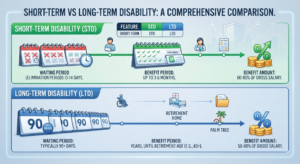
    Short-Term Disability Insurance (STD)

    Short-term disability covers the initial period after you become disabled, typically 3-6 months.

    How Short-Term Disability Works

    Timeline example:

    You develop serious back injury on January 1st:

    • January 1-7: Waiting period (you’re off work, no benefit yet)
    • January 8: First STD benefit begins
    • January 8 – June 30: You receive 60% of salary
    • July 1: STD period ends, long-term disability begins (if applicable)

    Key components:

    Benefit period (waiting period):

    • 0-14 days typical (how long you wait before benefits start)
    • Shorter = better, but costs more
    • Some policies have no waiting period

    Replacement percentage:

    • 50-66% of salary typical
    • If earning $5,000/month, receive $3,000/month
    • Rarely replaces 100% (discourages shirking)

    Maximum benefit:

    • $2,000-$5,000/month typical cap
    • High earners hit this limit
    • Benefits may not fully replace high income

    Duration:

    • 3-6 months typical
    • Some extend to 12 months
    • Varies by policy and employer

    Short-Term Disability Cost

    Employer-provided (most common):

    • Free to employee (employer pays)
    • Sometimes employee can pay for better coverage
    • Cost to employer: $0.50-$1.00 per $100 of payroll

    Individual short-term disability:

    • $20-$50/month typical
    • Varies by age and health

    Example cost: 35-year-old buying individual STD

    • $2,000/month benefit, 90-day waiting period: $25/month
    • $3,000/month benefit, 30-day waiting period: $40/month
    • $4,000/month benefit, 14-day waiting period: $55/month

    Short-Term Disability Advantages

    ✅ Immediate income replacement (covers initial disability months)
    ✅ Affordable ($20-$50/month)
    ✅ Short waiting period (often available)
    ✅ Covers temporary conditions (perfect for most disabilities)
    ✅ Often provided by employer (free coverage)
    ✅ No long-term commitment (coverage ends after 3-6 months)

    Short-Term Disability Disadvantages

    ❌ Limited duration (only 3-6 months)
    ❌ Temporary disabilities longer than duration not fully covered
    ❌ May require proof of disability (medical documentation needed)
    ❌ Possible integration with other benefits (reduces if you get workers comp)
    ❌ May not be available to self-employed (employer plans only)


    Long-Term Disability Insurance (LTD)

    Long-term disability covers extended disabilities, from several months to retirement age.

    How Long-Term Disability Works

    Timeline example:

    You develop cancer diagnosis in January:

    • January: Diagnosed, unable to work
    • January 1-90 days: STD covers if available, or you use savings
    • April 1: LTD begins (after STD ends)
    • April – December: Receive 60% salary
    • Throughout treatment and recovery: Covered
    • Return to work: Benefits stop
    • Never return to work: Benefits continue to age 65

    Key components:

    Elimination period (waiting period):

    • 90-365 days typical (how long you wait before benefits start)
    • Overlaps with short-term disability
    • 90 days common for employer plans
    • Longer waiting period = lower premium

    Replacement percentage:

    • 50-66% of salary typical
    • Usually coordinated with Social Security (reduced if you get SSDI)
    • High earners may not be fully replaced

    Maximum benefit:

    • $3,000-$7,000/month typical
    • High earners capped at this amount
    • Own-occupation plans sometimes higher

    Duration:

    • “To age 65” typical (from benefit start to retirement)
    • “Lifetime” sometimes available
    • Some plans have maximum benefit period (5-10 years)

    Long-Term Disability Cost

    Employer-provided (most common):

    • Often free to employees (employer subsidizes)
    • Cost to employer: $0.30-$0.75 per $100 of payroll
    • Sometimes employee can buy additional coverage

    Individual LTD:

    • $30-$100/month typical
    • Varies by age, health, occupation
    • Own-occupation definition costs more

    Example cost: 35-year-old buying individual LTD

    • $2,000/month benefit, 90-day elimination: $35/month
    • $3,000/month benefit, 90-day elimination: $50/month
    • $4,000/month benefit, 90-day elimination: $65/month
    • $4,000/month benefit, own-occupation definition: $85/month

    Long-Term Disability Advantages

    ✅ Extended coverage (months to retirement age)
    ✅ Covers serious, prolonged disabilities (where most risk is)
    ✅ Reasonable cost ($30-$100/month)
    ✅ Coordinated with STD (both together provide comprehensive protection)
    ✅ Portable (if individual policy, continue if you change jobs)
    ✅ Own-occupation option available (better definition of disability)
    ✅ Often indexed for inflation (benefits increase with cost of living)

    Long-Term Disability Disadvantages

    ❌ Long waiting period (90-365 days before benefits start)
    ❌ Partial income replacement (50-66%, not 100%)
    ❌ Integration with other benefits (SSDI reduces benefit)
    ❌ Offset provisions (workers comp, unemployment reduce benefit)
    ❌ Cost of living adjustments often limited (benefits don’t keep pace with inflation)
    ❌ May require proof of ongoing disability (medical exams periodically)


    Employer vs Individual Disability Insurance

    Where you get disability insurance matters.

    Employer-Provided Disability Insurance

    How it works:

    Your employer provides group disability insurance covering all employees. Simple.

    Typical coverage:

    Short-term disability:

    • 60% income replacement
    • 3-6 month duration
    • 0-14 day waiting period
    • Often free to employees

    Long-term disability:

    • 60% income replacement
    • To age 65
    • 90-180 day elimination period
    • Often free to employees

    Advantages:

    ✅ Free or subsidized (employer pays most/all cost)
    ✅ Guaranteed approval (no medical underwriting)
    ✅ Payroll deduction (automatic, never miss payment)
    ✅ Group rates (cheaper than individual)
    ✅ Comprehensive (STD + LTD often bundled)

    Disadvantages:

    ❌ Coverage ends when you leave job (need individual backup)
    ❌ Tax-deductible benefits taxed as income (if employer paid, benefits taxed)
    ❌ Employer-controlled definitions (not negotiable)
    ❌ Possible offset provisions (SSDI, workers comp reduce benefit)
    ❌ May have integration with Social Security (Medicare offset)
    ❌ Limited customization (one-size-fits-all)

    Important tax issue: If employer pays disability insurance premium, benefits are taxable income. If you pay premium (out-of-pocket or after-tax), benefits are tax-free.

    Example:

    • Monthly disability benefit: $3,000
    • If employer-paid: You owe taxes on $3,000 (roughly $750 taxes owed)
    • If employee-paid: You keep full $3,000 (no taxes)

    This difference can be significant over months/years of disability.

    Individual Disability Insurance

    How it works:

    You buy policy directly from insurance company, coverage follows you.

    Coverage customization:

    You control:

    • Benefit amount ($1,000-$10,000+/month possible)
    • Elimination period (0-365 days)
    • Definition of disability (any-occupation vs own-occupation)
    • Benefit duration (to age 65, lifetime, 5-year, etc.)
    • Cost-of-living adjustments
    • Occupational exclusions

    Advantages:

    ✅ Portable (continues if you change jobs)
    ✅ Tax-free benefits (if you paid premium out-of-pocket)
    ✅ Ownership (yours, can’t be cancelled by employer)
    ✅ Customizable (you choose all terms)
    ✅ Own-occupation definition available (better protection)
    ✅ No integration with SSDI (you keep full benefit + Social Security)

    Disadvantages:

    ❌ More expensive than employer group coverage
    ❌ Requires medical underwriting (must pass health exam)
    ❌ You pay full premium (no employer subsidy)
    ❌ Coverage gaps if unemployed (need to bridge between jobs)
    ❌ More complex (many options to choose)

    When to buy individual policy:

    • Self-employed (no employer coverage)
    • Freelancer/independent contractor
    • Plan to change jobs frequently (portability matters)
    • Employer coverage inadequate
    • Want own-occupation definition
    • Want better tax treatment

    How Much Disability Insurance Do You Need?

    Calculate based on your actual expenses and income replacement philosophy.

    Method 1: Income Replacement Percentage

    Calculation:

    Monthly gross income: $5,000
    Choose replacement percentage: 60%
    Coverage needed: $3,000/month

    Reasoning: 60% of gross income provides 75-85% of net income (accounting for taxes not owed during disability).

    Typical percentages:

    • 50% replacement: Bare minimum, encourages return to work
    • 60% replacement: Sweet spot, maintains reasonable lifestyle
    • 70% replacement: Comfortable, minimal lifestyle reduction
    • 80%+ replacement: Rare, insurance companies resist overinsuring

    Action: Choose 60% of gross income as target.

    Method 2: Expense-Based Calculation

    Calculate actual monthly expenses:

    • Rent/mortgage: $1,500
    • Food: $400
    • Utilities: $200
    • Insurance: $300
    • Transportation: $200
    • Minimum debt payments: $300
    • Other necessities: $300
    • Total: $3,200/month

    Coverage needed: $3,200/month

    This ensures you can cover actual living expenses during disability.

    Method 3: Income Plus Buffer

    Calculate:

    Monthly expenses: $3,000
    Buffer for unexpected costs: 20%
    Total coverage: $3,600/month

    This covers living expenses plus small margin for unexpected disability-related costs (medical copays, equipment, etc.).

    Recommended Approach

    Use Method 1 or 2, whichever is higher:

    Example scenario:

    • Gross monthly income: $5,000
    • 60% of gross: $3,000
    • Actual monthly expenses: $2,800
    • Coverage needed: $3,000 (choose higher amount)

    This ensures you can cover living expenses while having margin of safety.

    High Earners and Coverage Caps

    Problem: Insurance companies cap benefits.

    High earner making $15,000/month:

    • 60% of income: $9,000/month
    • Insurance cap: $5,000/month maximum
    • Gap: $4,000/month uncovered

    Solution options:

    1. Buy maximum available ($5,000/month)
    2. Buy multiple policies (some insurers allow this)
    3. Negotiate with employer (they might offer higher cap for employees)
    4. Accept partial coverage (better than nothing)
    5. Build larger emergency fund (cover gap with savings)

    Recommendation: Buy whatever maximum your insurer allows. Partial coverage better than no coverage.


    What Determines Your Disability Insurance Cost

    Several factors affect your premium.

    1. Age (Biggest Factor)

    Insurance cost roughly doubles every 10 years:

    35-year-old buying $3,000/month LTD benefit:

    • Cost: $50/month

    45-year-old buying same:

    • Cost: $90-$110/month

    55-year-old buying same:

    • Cost: $180-$220/month

    Action: Buy disability insurance while young (rates locked for years).

    2. Health Status

    Pre-existing conditions increase premiums:

    Healthy applicant: Standard rates

    Controlled high blood pressure: +15-25% premium

    Diabetes (controlled): +25-50% premium

    Back problems: +50-100% premium

    Mental health conditions: +25-100% premium (varies significantly)

    Serious conditions: May be declined for coverage

    Action: Apply while healthy. Once you have coverage, it’s generally protected even if health changes.

    3. Occupation

    More dangerous occupations cost more:

    Low-risk: Office worker, accountant, manager ($30-50/month for $3,000 benefit)

    Medium-risk: Teacher, nurse, retail manager ($50-80/month)

    High-risk: Construction, manufacturing, law enforcement ($80-150+/month)

    Extremely high-risk: May be declined for coverage

    Why: Higher disability claim rate = higher insurance cost.

    4. Income Level

    Higher income = higher premiums (proportional to benefit amount):

    $2,000/month benefit: $25-40/month
    $3,000/month benefit: $40-60/month
    $4,000/month benefit: $55-80/month
    $5,000/month benefit: $70-100/month

    Plus insurers apply higher percentage rates to higher incomes (charging 1.5-2% of income vs 0.75% for lower incomes).

    5. Definition of Disability

    Own-occupation definition costs more:

    Any-occupation definition: $50/month (you must be unable to do ANY job you’re qualified for)

    Own-occupation definition: $65-75/month (you must be unable to do YOUR specific job)

    Why: Own-occupation is better for you (easier to qualify for benefits), so you pay more.

    Recommendation: Buy own-occupation definition. The 25-50% cost increase is worth it.

    6. Elimination Period (Waiting Period)

    Longer waiting period = lower premium:

    14-day elimination: $80/month (fastest benefits)
    30-day elimination: $70/month
    60-day elimination: $60/month
    90-day elimination: $50/month
    180-day elimination: $40/month

    Choice: 90 days is sweet spot for most people (you use emergency fund/STD first 90 days, then LTD kicks in).

    7. Benefit Duration

    Longer duration = higher premium:

    5-year benefit maximum: $40/month
    To age 65: $60/month
    Lifetime benefit: $75+/month

    Recommendation: “To age 65” is standard and appropriate. You’ll likely return to work or reach retirement before benefits end.

    8. Cost-of-Living Adjustments (COLA)

    With COLA, benefits increase annually:

    Without COLA: $50/month premium
    With annual 3% COLA: $65/month premium

    Value: If disabled for 10 years, COLA ensures $3,000 benefit doesn’t lose purchasing power.

    Recommendation: Include COLA if affordable ($10-15 extra/month). Over long disability, inflation matters.


    How to Get Disability Insurance

    Step 1: Determine If Employer Coverage Is Sufficient

    Review your employer plan:

    • Short-term disability: What’s the benefit amount and duration?
    • Long-term disability: What’s the benefit amount and elimination period?
    • Definition: Own-occupation or any-occupation?
    • Tax treatment: Will benefits be taxed?
    • Portability: Can you keep coverage if you leave?

    Is it adequate?

    If STD + LTD together replace 60% of income with no waiting period = probably adequate.

    If gaps exist (low benefit amount, long elimination period, any-occupation definition) = buy individual policy to supplement.

    Step 2: Get Individual Quotes If Needed

    Online quote tools:

    • PolicyGenius
    • SelectQuote
    • eHealthinsurance
    • Direct insurer websites (Guardian, Principal, Unum, Metlife)

    What to provide:

    • Age and gender
    • Occupation and job duties
    • Annual income
    • Current health status
    • When coverage needed

    Get quotes for:

    • $2,000/month benefit
    • $3,000/month benefit
    • $4,000/month benefit
    • Choose desired elimination period and definition

    Step 3: Compare Quotes

    Key metrics to compare:

    • Monthly premium (obvious)
    • Definition of disability (own-occupation preferred)
    • Elimination period (90 days typical)
    • Benefit duration (to age 65 standard)
    • Cost-of-living adjustments (included?)
    • Partial disability rider (covered?)
    • Portability (can you take it if you change jobs?)
    • Renewability (can they cancel you?)

    Don’t just choose cheapest. Evaluate total value.

    Step 4: Apply

    Application process:

    1. Online application: 20-30 minutes
    2. Health questions: Detailed health history
    3. Medical records: Company may request from your doctor
    4. Medical exam: For larger benefits, blood/urine test (done at home, 30 minutes)
    5. Underwriting: 2-4 weeks for approval
    6. Approval and setup: Coverage begins upon approval

    Step 5: Review Employer Coverage

    If you have employer plan:

    • Review it annually (benefits may change)
    • Understand your specific benefits
    • Know elimination period (coordinate with individual policy)
    • Understand tax treatment (taxable or not?)
    • Confirm portability if you might change jobs

    Step 6: Keep Policies Current

    Annual review:

    • Confirm coverage still active
    • Verify premium amount (should stay same if locked in)
    • Update beneficiary if applicable
    • Note coverage details (elimination period, benefit amount, definition)
    • Maintain policy documents

    Common Disability Insurance Mistakes to Avoid

    Mistake 1: Assuming You Won’t Become Disabled

    Error: “I’m young and healthy, disability won’t happen to me”

    Reality: 37% of 35-year-olds will have 90+ day disability before retirement. You’re statistically likely to need it.

    Solution: Buy coverage now while young and premiums are cheap.

    Mistake 2: Relying Only on Employer Coverage

    Error: Thinking employer STD + LTD is sufficient protection

    Reality: Employer coverage ends when you leave job. Need individual backup for portability.

    Solution: Buy individual long-term policy as backup, especially if self-employed or changing jobs frequently.

    Mistake 3: Choosing Any-Occupation Definition

    Error: Picking any-occupation definition to save $10-15/month

    Reality: Any-occupation is hard to qualify for. Own-occupation is better protection.

    Solution: Buy own-occupation definition. The cost difference is worthwhile.

    Mistake 4: Choosing Too Long Elimination Period

    Error: Picking 180-365 day elimination to minimize premium

    Reality: Can’t survive 6-12 months without income. No emergency fund supports that.

    Solution: Choose 90-day elimination period (covers with STD or emergency fund).

    Mistake 5: Underestimating Income Replacement Needed

    Error: Buying $1,500/month benefit when expenses are $3,000/month

    Reality: Insufficient benefit forces you into debt during disability.

    Solution: Calculate actual expenses, buy coverage matching 60% of gross income (whichever is higher).

    Mistake 6: Not Buying Enough Coverage Due to Cost

    Error: “Individual policy is $60/month, that’s too much”

    Reality: 1-month disability costs $3,000+ in lost income. $60/month is incredible bargain.

    Solution: Buy coverage. Cost is tiny relative to risk.

    Mistake 7: Skipping Individual Policy If Employer Coverage Exists

    Error: “Employer covers me, don’t need individual”

    Reality: Employer coverage disappears when you leave job. Individual policy continues.

    Solution: Buy individual policy as backup, especially if you might change jobs.

    Mistake 8: Not Understanding Tax Treatment

    Error: Assuming all disability benefits are tax-free

    Reality: If employer paid premiums, benefits are taxable. If you paid premiums, benefits are tax-free.

    Solution: Understand your specific plan’s tax treatment. May want to pay own premium to get tax-free benefits.

    Mistake 9: Ignoring Partial Disability Rider

    Error: Not adding partial/residual disability rider to policy

    Reality: Many disabilities don’t prevent all work (can work part-time). Rider covers this.

    Solution: Add partial disability rider (small additional cost, valuable protection).

    Mistake 10: Not Reviewing Coverage When Income Increases

    Error: Buying $3,000/month benefit at 30, never updating despite income doubling to $100k by age 40

    Reality: Coverage becomes insufficient as income increases.

    Solution: Review coverage every 5 years. Increase benefits if income increased significantly.


    Frequently Asked Questions About Disability Insurance

    How long does disability insurance take to process a claim?

    Initial processing: 30-60 days to review claim
    Approval: If approved, benefits usually start within 30 days
    If denied: You have appeal period (usually 30-60 days)

    Total timeline: 2-4 months from claim submission to first benefit, assuming approval.

    What if I’m self-employed?

    Employer disability insurance: Not available (no employer)

    Solution: Buy individual long-term disability policy

    Availability: Some insurers restrict coverage for self-employed or gig workers. Shop carefully.

    Cost: Often higher than employed people (higher claim risk if you’re sole income source)

    Recommendation: Self-employed should prioritize disability insurance (no employer backup).

    Can I get disability insurance if I have a pre-existing condition?

    Yes, but expect higher premiums.

    Insurance companies will:

    • Ask detailed health history
    • Request medical records
    • Possibly require medical exam
    • Charge 25-200% more depending on condition severity

    Some conditions may be declined: Very severe conditions may be uninsurable.

    Solution: Apply with multiple insurers. Different companies have different underwriting standards.

    What’s the difference between workers’ compensation and disability insurance?

    Workers’ Compensation:

    • Covers injuries/illness from work only
    • Provided by employer (required by law)
    • Replaces partial income (60-66%)
    • Medical bills covered
    • You don’t pay premium

    Disability Insurance:

    • Covers any illness/injury preventing work
    • Personal insurance you buy
    • Replaces income percentage (50-66%)
    • Medical bills NOT typically covered
    • You pay premium

    Example:

    • Back injury from work: Workers’ comp covers
    • Back injury from personal activity: Disability insurance covers
    • Both: Both can work together (though integrated, so total may be capped)

    If I’m approved for Social Security Disability Insurance (SSDI), how does that affect my private disability insurance?

    Integration/offset: Most private policies reduce benefits if you receive SSDI.

    Example:

    • Private LTD benefit: $3,000/month
    • SSDI approval: $1,500/month
    • Your actual LTD payment: $1,500/month ($3,000 – $1,500 SSDI)
    • Total income: $1,500 + $1,500 = $3,000

    Some policies don’t integrate. Verify this during purchase.

    Better policy: Own-occupation with no integration clause. Pay more but receive full benefit even if SSDI approved.

    Can I get disability insurance if I’m unemployed?

    Employed: Yes, straightforward

    Recently unemployed: Possibly, if can show recent income history

    Long-term unemployed: Difficult. Need proof of income to insure against.

    Solution: Buy coverage while employed. Once you have it, coverage continues through employment gaps.

    What if I return to work part-time during disability?

    Partial/residual disability rider: Covers this scenario.

    Example:

    • Full benefit: $3,000/month (if completely unable to work)
    • Return to part-time work earning $1,500/month
    • Residual benefit: $1,500/month (gap between pre-disability income and current)
    • Total income: $1,500 (work) + $1,500 (insurance) = $3,000

    Most modern policies include this. Verify it’s in your policy.

    How do I prove I’m disabled?

    Insurance company requires:

    • Medical records documenting condition
    • Doctor’s statement about work capacity
    • Treatment plans and progress notes
    • Sometimes independent medical exam (at insurer’s cost)
    • Ongoing medical records if disability extends

    Don’t exaggerate. Insurance companies verify claims. Fraud is federal crime.

    Be honest and thorough: Provide all requested documentation promptly.

    Can disability insurance be cancelled?

    Employer plans: Can be cancelled by employer, but usually with notice

    Individual policies: Generally guaranteed renewable (cannot be cancelled as long as you pay premium)

    Exception: Fraud or non-disclosure of facts during application could void policy

    Peace of mind: Individual policy is truly yours once issued. Can’t be cancelled (except for non-payment).

    Is there a waiting period to receive benefits after disability begins?

    Yes, the elimination period.

    This is the waiting period before benefits begin.

    Common elimination periods:

    • 14-30 days: Short-term, covers immediately
    • 90 days: Standard long-term, you use emergency fund/savings for first 3 months
    • 180+ days: Cheaper premium but long gap

    Strategy: Pair STD (covers first 3-6 months) with LTD (kicks in after STD).

    Should I buy disability insurance if I have substantial savings?

    Even with savings, yes.

    Example:

    • Monthly expenses: $4,000
    • Savings: $100,000
    • 100% disability: $48,000/year (savings last ~2 years)

    Two-year disability can happen: (37% of disabilities exceed 90 days, some exceed 1 year)

    Savings rate after recovery: Once disabled, can’t save. Need disability insurance to avoid depleting emergency fund entirely.

    Recommendation: Even with savings, buy coverage. Protects your nest egg.


    Disability Insurance and Your Complete Financial Plan

    Disability insurance doesn’t exist in isolation.

    How It Fits Together

    With emergency fund: First-line defense

    • Emergency fund: Covers 3-6 months of living expenses
    • Disability insurance: Covers extended income loss
    • Together: Complete protection against income loss

    With life insurance: Both protect dependents

    • Life insurance: If you die
    • Disability insurance: If you can’t work but survive
    • Together: Complete family protection

    With health insurance: Covers medical expenses

    • Health insurance: Covers doctor bills, medical costs
    • Disability insurance: Covers living expenses while recovering
    • Together: Complete medical and income protection

    With retirement savings: Building long-term wealth

    • Disability insurance: Protects income while building wealth
    • Retirement accounts: Grow the wealth
    • Together: Income protection while building nest egg

    With budgeting: Ensures affordability

    • Disability insurance: Added expense ($30-100/month)
    • Budgeting: Ensures cost fits your budget
    • Together: Sustainable financial planning

    Learn more about complete insurance protection for full financial security.


    Take Action: Your Disability Insurance Action Plan

    30-Day Disability Insurance Checklist

    Week 1: Assess Current Situation

    •  Review employer disability insurance plan (if available)
      •  Note STD benefit amount
      •  Note STD duration
      •  Note LTD benefit amount
      •  Note LTD elimination period
      •  Note definition (any-occupation or own-occupation)
      •  Confirm tax treatment of benefits
    •  Calculate current monthly expenses
    •  Determine desired coverage amount (60% of gross income or actual expenses, whichever higher)
    •  Assess if coverage gaps exist

    Week 2: Research Individual Policy (If Needed)

    •  Visit PolicyGenius, SelectQuote, or direct insurer websites
    •  Get quotes for desired benefit amount
    •  Request own-occupation definition quotes
    •  Compare quotes from 3-5 companies
    •  Note premium differences
    •  Review policy definitions carefully

    Week 3: Choose and Apply

    •  Select best-value policy
    •  Complete online application (20-30 minutes)
    •  Submit health information
    •  Schedule medical exam if required
    •  Follow up on application status

    Week 4: Finalize and Document

    •  Receive and review policy documents
    •  Confirm all terms match what you selected
    •  Set up automatic premium payment
    •  Save policy documents in safe place
    •  Create spreadsheet with all coverage details:
      •  STD benefit amount and duration
      •  LTD benefit amount and duration
      •  LTD elimination period
      •  Definition of disability
      •  Premium amount
      •  Tax treatment
      •  Contact information for claims

    Post-Implementation:

    •  Annual review during policy anniversary
    •  Update coverage if income increases significantly
    •  Verify continuous coverage (never miss premium)
    •  Document any life changes that might affect coverage

    Conclusion: Disability Insurance Protects Your Greatest Asset

    Your income is your greatest financial asset.

    A 35-year-old with 30 years until retirement earning $50,000/year has a lifetime earnings potential of $1.5 million. Lose that income for a year and you lose $50,000 of that potential—forever.

    Yet most people buy life insurance to protect a temporary asset (their family’s lifestyle, if they die) but skip disability insurance protecting their actual greatest asset (their ability to earn income).

    The statistical reality: You’re 3-5x more likely to experience a prolonged disability than to die before retirement.

    The financial reality: Disability insurance costs $30-100/month—a fraction of what you spend on coffee, streaming services, or eating out.

    The peace of mind: Knowing that if you become unable to work due to illness or injury, your income is protected. Your family maintains stability. You recover without financial devastation.

    That’s the power of disability insurance.

    Key principles to remember:

    ✅ Buy now while young: Rates locked in for decades
    ✅ Buy adequate amount: 60% of gross income minimum
    ✅ Choose own-occupation definition: Worth the cost difference
    ✅ Use 90-day elimination: Pairs with STD and emergency fund
    ✅ Pair STD + LTD: Together provide complete protection
    ✅ Buy individual if self-employed: No employer backup
    ✅ Buy individual as backup: If you might change jobs
    ✅ Include COLA rider: Protects against inflation over long disability
    ✅ Include partial disability: Covers part-time work situations
    ✅ Review annually: Increase if income increases

    Your ability to work is what creates your paycheck. Disability insurance protects your paycheck.

    Don’t protect just your life—protect your livelihood.

    Ready to complete your financial protection? Explore these related guides:

  • Health Insurance Guide: Choose the Right Plan and Save Money

    Health Insurance Guide: Choose the Right Plan and Save Money

    Health insurance is confusing. Not accidentally confusing—intentionally confusing. Complex language, obscure metrics, dozens of plan options—it’s designed so you’ll just pick something and stop asking questions.

    But health insurance decisions directly impact your financial security and health outcomes. Choosing the wrong plan could cost you thousands in unnecessary premiums or leave you bankrupt from unexpected medical bills.

    Yet most people understand their health insurance plan poorly:

    • 68% of Americans don’t understand the difference between a deductible and co-insurance
    • 72% don’t know what their annual out-of-pocket maximum is
    • 56% incorrectly believe their copay covers everything related to that visit
    • 45% would struggle to pay a $1,000 unexpected medical bill

    These gaps in understanding don’t just create confusion—they create financial disaster.

    This comprehensive guide cuts through the jargon and complexity. You’ll learn what health insurance actually covers, understand every metric that matters (deductibles, copays, coinsurance, out-of-pocket maximums), discover how to compare plans intelligently, and implement strategies to save thousands annually on both premiums and medical costs.

    Whether you’re choosing from employer options, shopping the ACA marketplace, or understanding Medicare, you’ll know exactly which plan offers the best value for your situation.

    Let’s make health insurance simple and ensure you get the protection you need at a cost you can afford.


    Health Insurance Fundamentals: Understanding the Basics

    Before choosing a plan, you need to understand what health insurance actually does and how it works.

    The Purpose of Health Insurance

    Health insurance is designed to protect you from catastrophic medical expenses by:

    1. Sharing costs: You and the insurer split medical expenses
    2. Limiting exposure: Your maximum out-of-pocket cost is capped
    3. Negotiating rates: Insurers negotiate lower rates with providers
    4. Preventing bankruptcy: Protects you from $500,000 medical bills

    The fundamental exchange:

    You pay monthly premiums and share costs on medical expenses. In return, insurance limits your maximum financial exposure to manageable levels.

    The Healthcare System’s Hidden Secret

    Most people don’t realize: Your health insurance doesn’t pay doctors directly. You do.

    Here’s how it actually works:

    1. You see doctor
    2. Doctor bills insurance company for $300
    3. Insurance company pays 80%, you pay 20%
    4. You receive bill for your 20% ($60)
    5. You pay the doctor

    This is why understanding YOUR responsibility (copays, coinsurance, deductibles) is crucial—you’re actually paying most of it.

    The Insurance Negotiation

    Insurance companies have one superpower: negotiating rates down.

    Without insurance:

    • Doctor’s charge: $1,000
    • You pay: $1,000

    With insurance:

    • Doctor’s usual charge: $1,000
    • Negotiated rate (insurance discount): $300
    • Insurance pays: $240 (80%)
    • You pay: $60 (20%)
    • Savings: $700 (70% discount)

    Just having insurance (even before using it) saves you massive amounts through negotiated rates.


    Health Insurance Metrics: The Six Numbers That Matter

    Health insurance plans vary by six key metrics. Understanding each is crucial for comparing plans.

    1. Monthly Premium

    Definition: The amount you pay each month for insurance coverage, regardless of whether you use it.

    Examples:

    • Individual plan: $150-400/month
    • Family plan: $400-1,500/month
    • Employer plan: You pay 0-30%, employer pays 70-100% (deducted from paycheck)

    Important: Premium is separate from costs when you actually use medical services.

    Key insight: Cheaper premium doesn’t mean cheaper overall plan. A plan with $100/month premium but high deductible might cost more total than $200/month plan with low deductible.

    2. Deductible

    Definition: Amount you must pay out-of-pocket before insurance starts paying anything.

    How it works:

    You have $1,500 deductible:

    • Year starts: $0 spent
    • January visit ($300): You pay full $300 (insurance pays $0)
    • February visit ($200): You pay full $200 (insurance pays $0)
    • March visit ($400): You pay full $400, but now $900 spent toward deductible
    • April visit ($800): You’ve paid $1,500 total, deductible met! Insurance now pays percentage

    Key insight: Higher deductible = lower premium, but you pay more upfront before insurance helps.

    Deductible types:

    Plan Type Typical Deductible
    Bronze ACA $5,000-$7,000
    Silver ACA $2,000-$3,500
    Gold ACA $500-$1,500
    Platinum ACA $0-$500
    PPO Employer $500-$2,500
    HMO Employer $0-$1,500
    HSA-compatible $1,500-$7,000

    3. Copay (Co-payment)

    Definition: Fixed amount you pay for specific services (doctor visit, prescription drug).

    Examples:

    • Doctor visit copay: $25, $40, or $50
    • Specialist visit copay: $50, $75, or $100
    • Urgent care copay: $75-$100
    • Emergency room copay: $250-$500
    • Generic drug copay: $10-$15
    • Brand-name drug copay: $25-$50

    How copays work:

    You have plan with $40 copay for doctor visits:

    • See doctor: You pay $40 at visit
    • Doctor’s bill: $150
    • Insurance pays: $110
    • You pay: $40 (copay)
    • Insurance discount: $0 (you still responsible for balance beyond copay… actually no, insurance negotiates that)

    Important distinction:

    • Copays are typically INSTEAD OF coinsurance
    • You don’t pay deductible AND copay (confusing, but usually one or other)
    • Copays count toward out-of-pocket maximum

    4. Coinsurance

    Definition: Percentage of medical costs you pay after deductible is met.

    How it works:

    You have plan with $1,500 deductible and 20% coinsurance:

    1. January: Doctor visit ($300)
      • You pay: $300 (full amount, toward deductible)
      • Insurance pays: $0
      • Deductible remaining: $1,200
    2. February-March: More visits total $1,400
      • You pay: $1,400 (toward deductible)
      • Insurance pays: $0
      • Deductible met: $0 remaining
    3. April: Doctor visit ($500)
      • Deductible met, so coinsurance applies
      • You pay: $100 (20% coinsurance)
      • Insurance pays: $400 (80%)

    Key insight: Coinsurance applies AFTER deductible, and represents your percentage share of costs.

    Common coinsurance percentages:

    • 10% coinsurance: You pay 10%, insurance pays 90%
    • 20% coinsurance: You pay 20%, insurance pays 80%
    • 30% coinsurance: You pay 30%, insurance pays 70%

    5. Out-of-Pocket Maximum (OOP Max)

    Definition: Maximum amount you’ll pay in a year (deductible + copays + coinsurance). After this, insurance pays 100%.

    How it works:

    You have plan with:

    • $1,500 deductible
    • $40 copay for doctor visits
    • 20% coinsurance
    • $5,000 out-of-pocket maximum

    Year scenario:

    • January-March: Pay $1,500 (deductible) + $200 (copays)
    • April-October: Pay $2,100 (copays and coinsurance toward OOP)
    • Total paid so far: $3,800
    • November: Major surgery ($50,000)
      • Your coinsurance would be: 20% of $50,000 = $10,000
      • But you’ve already paid $3,800 toward OOP max
      • You only pay: $5,000 – $3,800 = $1,200 additional
      • Insurance pays: $48,800
    • Year total out-of-pocket: $5,000 (OOP maximum)
    • Insurance paid: $51,000+

    Key insight: Out-of-pocket maximum is your financial safety net. Once hit, insurance covers everything at 100%.

    OOP Maximum ranges:

    Plan Type Individual OOP Max Family OOP Max
    Bronze ACA $7,000-$8,550 $14,000-$17,100
    Silver ACA $6,000-$7,000 $12,000-$14,000
    Gold ACA $3,000-$4,000 $6,000-$8,000
    Platinum ACA $1,000-$2,000 $2,000-$4,000
    Employer PPO $2,500-$5,000 $5,000-$10,000
    Employer HMO $1,500-$4,000 $3,000-$8,000

    6. Network Status

    Definition: Whether your doctor/hospital is “in-network” (has contract with insurance) or “out-of-network” (no contract).

    Cost difference:

    In-network visit ($300 usual charge):

    • Negotiated rate: $150
    • Insurance pays: $120 (80%)
    • You pay: $30

    Out-of-network visit ($300 usual charge):

    • No negotiation, full charge: $300
    • Insurance pays: $60 (20%)
    • You pay: $240

    That’s 8x more expensive out-of-network!

    Key insight: Always verify providers are in-network before scheduling. Out-of-network care is financially devastating.


    Health Insurance Plan Types

    Several types of health insurance exist, each with different cost structures and flexibility.

    1. Health Maintenance Organization (HMO)

    How it works:

    You choose a primary care physician (PCP) who coordinates all your care. Referrals required for specialists. Must use in-network providers.

    Cost structure:

    • Premium: Low
    • Deductible: Low ($0-$1,500) or none
    • Copays: Fixed ($25-$50 per visit)
    • Coinsurance: Minimal
    • Out-of-pocket max: Moderate ($1,500-$4,000)

    Example:

    • Monthly premium: $150
    • Doctor visit copay: $30
    • Specialist copay: $60 (with referral)
    • Emergency room copay: $150
    • Out-of-pocket max: $3,000

    Advantages:
    ✅ Lowest premiums
    ✅ Low/predictable copays
    ✅ Often no deductible
    ✅ Care coordination (PCP manages all care)
    ✅ Preventive care often free

    Disadvantages:
    ❌ Must use in-network providers (out-of-network only in emergencies)
    ❌ Need referrals for specialists
    ❌ Less flexibility in choosing doctors
    ❌ Doesn’t cover out-of-area routine care

    Best for: Healthy people wanting low premiums, willing to follow plan rules for specialist access.

    2. Preferred Provider Organization (PPO)

    How it works:

    Choose any provider in or out of network. In-network costs less, out-of-network costs more. No referrals required.

    Cost structure:

    • Premium: Higher than HMO
    • Deductible: Higher ($500-$2,500)
    • Copays: Fixed ($30-$50 for in-network)
    • Coinsurance: Higher out-of-network (20-40%)
    • Out-of-pocket max: Higher ($2,500-$5,000)

    Example:

    • Monthly premium: $300
    • In-network doctor copay: $40
    • Out-of-network doctor: 30% coinsurance
    • Specialist copay (no referral): $60
    • Emergency room copay: $250
    • Out-of-pocket max: $4,000

    Advantages:
    ✅ Flexibility to see any provider
    ✅ No referrals needed
    ✅ Higher out-of-network benefits than HMO
    ✅ Access out-of-area providers
    ✅ More choice in doctors

    Disadvantages:
    ❌ Higher premiums than HMO
    ❌ Higher deductibles
    ❌ Out-of-network care expensive
    ❌ More complex cost sharing
    ❌ Less coordinated care (no PCP)

    Best for: People who want flexibility and are willing to pay more for it, those with specialists out-of-network.

    3. Point of Service (POS)

    How it works:

    Hybrid of HMO and PPO. Choose PCP, get referrals, but can see out-of-network providers at higher cost.

    Cost structure:

    • Premium: Between HMO and PPO
    • Deductible: Low-moderate
    • Copays: In-network low, out-of-network higher
    • Coinsurance: Out-of-network applies
    • Out-of-pocket max: Moderate

    Advantages:
    ✅ Lower premiums than PPO
    ✅ More flexibility than HMO
    ✅ Out-of-network access if needed

    Disadvantages:
    ❌ Still need referrals
    ❌ Still have PCP requirement
    ❌ Out-of-network costs high
    ❌ Not as flexible as PPO

    Best for: People wanting HMO cost with some PPO flexibility.

    4. Exclusive Provider Organization (EPO)

    How it works:

    In-network providers are required. No out-of-network coverage except emergencies. No referrals needed.

    Cost structure:

    • Premium: Low-moderate
    • Deductible: Moderate
    • Copays: In-network fixed
    • Out-of-network: Not covered (except emergencies)
    • Out-of-pocket max: Moderate

    Advantages:
    ✅ Lower premiums than PPO
    ✅ No referrals required
    ✅ Flexible specialist access (in-network)

    Disadvantages:
    ❌ No out-of-network coverage
    ❌ Rigid network requirement
    ❌ Travel outside service area problematic

    Best for: People willing to commit to network, wanting lower cost than PPO.

    5. High Deductible Health Plan (HDHP)

    How it works:

    Low premiums, high deductibles, and eligibility for Health Savings Account (HSA). You pay more upfront, but HSA savings can be used for medical expenses.

    Cost structure:

    • Premium: Lowest
    • Deductible: High ($1,500-$7,000)
    • Copays: None (coinsurance until deductible met)
    • Coinsurance: After deductible
    • Out-of-pocket max: High ($2,800-$7,000 individual)

    Example:

    • Monthly premium: $100
    • Annual deductible: $3,000
    • Coinsurance: 20% after deductible
    • Out-of-pocket max: $6,500
    • Eligible for HSA: Yes

    Advantages:
    ✅ Lowest premiums
    ✅ HSA savings account (triple tax advantage)
    ✅ Greater control over healthcare spending
    ✅ Accumulate HSA funds year to year

    Disadvantages:
    ❌ High out-of-pocket costs
    ❌ Not ideal if frequent medical care needed
    ❌ Requires discipline to use HSA properly

    Best for: Healthy people wanting to save on premiums, those comfortable with high deductible, people planning to use HSA strategically.

    Important: Learn about Health Savings Accounts below.

    6. Catastrophic Health Plan

    How it works:

    Very low premiums, very high deductible. Only cover preventive care before deductible. Designed for young, healthy people.

    Cost structure:

    • Premium: Extremely low ($20-$50/month)
    • Deductible: Very high ($7,000+)
    • Preventive care: Free (before deductible)
    • Coinsurance: After deductible
    • Out-of-pocket max: High ($8,550)

    Advantages:
    ✅ Extremely low premiums
    ✅ Preventive care free
    ✅ Protects against catastrophic medical costs
    ✅ For young, healthy people

    Disadvantages:
    ❌ Expensive if need regular care
    ❌ High out-of-pocket costs
    ❌ Not available to everyone (usually under 30)

    Best for: Young, healthy people without chronic conditions, wanting cheap protection against catastrophic illness.


    How to Compare Health Insurance Plans

    Comparing plans requires looking at all six metrics together, not just premium.

    The Complete Comparison Framework

    Step 1: Calculate annual premium costs

    Individual plan options:

    • Plan A: $150/month = $1,800/year
    • Plan B: $250/month = $3,000/year
    • Plan C: $200/month = $2,400/year

    Step 2: List all key metrics

    Metric Plan A Plan B Plan C
    Annual Premium $1,800 $3,000 $2,400
    Deductible $3,000 $500 $1,500
    Doctor copay $40 $25 $30
    Specialist copay $60 $50 $60
    ER copay $150 $250 $100
    Out-of-pocket max $6,000 $4,000 $4,500
    Prescription copay $15/$40/$65 $10/$30/$50 $12/$35/$60

    Step 3: Calculate worst-case scenario

    If you had major medical event:

    • Plan A: $1,800 premium + $6,000 OOP max = $7,800 maximum exposure
    • Plan B: $3,000 premium + $4,000 OOP max = $7,000 maximum exposure
    • Plan C: $2,400 premium + $4,500 OOP max = $6,900 maximum exposure

    Step 4: Consider actual healthcare needs

    Healthy person without chronic conditions:

    • Preventive care: Maybe $200-500/year actual costs
    • Plan A estimate: $1,800 + $200 (preventive copays) = $2,000
    • Plan B estimate: $3,000 + $100 (preventive copays) = $3,100
    • Plan C estimate: $2,400 + $150 (preventive copays) = $2,550

    Plan A wins for healthy people.

    Person with chronic condition (monthly doctor visits, prescriptions):

    • 12 doctor visits × $40 copay = $480
    • Monthly prescription $50 × 12 = $600
    • Additional tests/visits = $300
    • Total medical costs before insurance: ~$2,000

    Plan B analysis (with $500 deductible):

    • Premium: $3,000
    • Deductible: $500
    • Doctor visits: 12 × $25 = $300 (after deductible met)
    • Prescription: 12 × $30 = $360
    • Additional: $300
    • Total: $3,000 + $500 + $300 + $360 + $300 = $4,460

    Plan A analysis (no deductible):

    • Premium: $1,800
    • Doctor visits: 12 × $40 = $480
    • Prescription: 12 × $15 = $180 (generic) or $40 × 12 = $480 (brand)
    • Additional: $300 (copay for tests)
    • Total: $1,800 + $480 + $480 + $300 = $3,060

    Plan A wins even with chronic condition due to lower premium.

    Step 5: Check provider networks

    • Is your doctor in-network for each plan?
    • Are your specialists covered?
    • If out-of-area, does plan cover?

    One out-of-network visit can cost thousands. This is critical.

    Using Online Plan Comparison Tools

    Healthcare.gov (if using ACA Marketplace):

    1. Enter zip code
    2. Enter age
    3. Enter income (for subsidies)
    4. See all available plans
    5. Click “Compare” for side-by-side view
    6. Review costs and coverage

    Employer portal (if choosing from employer plans):

    1. Log into benefits portal
    2. Click “Compare Plans”
    3. Use comparison tool
    4. Usually shows costs and coverage clearly

    Other tools:

    • eHealthinsurance.com
    • Insurify.com
    • Kaiser.org (if available in your area)
    • UnitedHealthcare.com
    • Aetna.com
    • Cigna.com

    Health Savings Accounts (HSAs): The Secret Weapon

    HSAs are one of the most powerful financial tools available but poorly understood.

    What Is an HSA?

    An HSA is a savings account specifically for medical expenses, available only if you have a High Deductible Health Plan (HDHP).

    Key features:

    • Tax-deductible contributions: Reduce your taxable income
    • Tax-free growth: Money invested grows without taxes
    • Tax-free withdrawals: For qualified medical expenses, no taxes owed
    • Portable: Belongs to you, not your employer
    • Accumulates year-to-year: Unused funds carry forward (unlike FSA)
    • Investment options: Can invest in stocks, bonds, mutual funds

    HSA Triple Tax Advantage

    No other account offers this:

    1. Tax-deductible contributions

    • You contribute $3,850 (individual limit)
    • Reduces your taxable income by $3,850
    • Saves ~$1,155 in federal taxes (at 30% rate)

    2. Tax-free growth

    • $3,850 invested at 8% returns
    • After 20 years: $17,963
    • All growth tax-free (compared to brokerage account where you’d owe capital gains taxes)

    3. Tax-free withdrawals (for medical expenses)

    • Withdraw $500 for doctor visit
    • Zero taxes owed
    • In regular brokerage account, you’d owe income tax + capital gains tax

    Total advantage: Triple tax benefit that no other account offers

    HSA Contribution Limits (2024)

    Coverage Type Limit
    Individual $3,850/year
    Family $7,750/year
    Catch-up (age 55+) +$1,000/year

    Is the limit enough?

    Average person spends $3,000-$5,000/year on medical expenses (insurance + out-of-pocket). Contributing the maximum covers most expenses while saving on taxes.

    HSA vs FSA: Which Is Better?

    Both are savings accounts for medical expenses, but with key differences:

    Feature HSA FSA
    Contribution limit $3,850 individual, $7,750 family $3,300 individual
    Tax-free growth Yes No
    Portable Yes (yours forever) No (employer plan)
    Carry-over unused Yes (accumulates) No (use-it-or-lose-it)
    Investment options Yes Usually not
    Withdrawals Anytime for medical Limited withdrawal windows

    HSAs are superior in almost every way. FSAs are only better if your employer is extremely generous with contributions.

    HSA Strategy: The Ultimate Tax Loophole

    Advanced HSA users optimize the account strategically:

    Year 1 Strategy:

    • Contribute maximum: $3,850
    • Don’t withdraw for medical expenses
    • Pay medical expenses out-of-pocket instead
    • Let HSA grow and invest

    Over 20 years:

    • Contributions: $3,850 × 20 = $77,000
    • Growth at 8%: Plus $84,963
    • Total in HSA: $161,963

    At retirement:

    • You’ve saved $23,250 in taxes (30% of contributions)
    • Your account has grown tax-free
    • You can withdraw for medical expenses tax-free
    • Best of all: After age 65, you can withdraw for ANY reason (though non-medical withdrawals taxed as income—still, you got the tax deduction upfront)

    The key: HSA is essentially a second retirement account if you can afford to pay medical expenses out-of-pocket.

    Who Should Open an HSA?

    Good candidates:
    ✅ Healthy person choosing HDHP
    ✅ Can afford high deductible without stress
    ✅ Can afford to pay medical expenses out-of-pocket
    ✅ Plans to invest HSA funds (don’t just leave in savings)
    ✅ Has multiple years until needing funds

    Poor candidates:
    ❌ Person with chronic conditions needing frequent care
    ❌ Can’t afford high deductible
    ❌ Need constant access to funds
    ❌ Won’t invest HSA funds


    Choosing Your Health Insurance: Step-by-Step

    Step 1: Determine Available Options

    If employed:

    • Check employer’s benefits portal
    • Note all available plans
    • Gather plan documents

    If self-employed/unemployed:

    • Visit Healthcare.gov (open enrollment Nov 1 – Dec 15)
    • Enter income and household information
    • View all available plans in your zip code

    If 65+:

    • Enroll in Medicare (apply at age 65)
    • Choose Original Medicare or Medicare Advantage
    • Consider supplemental coverage

    If under 26:

    • Check if parents’ employer plan still covers you
    • Often cheaper than individual plan

    Step 2: Assess Your Healthcare Needs

    Honest assessment:

    • How often do I see doctor? (0 = very healthy, 4+ = chronic conditions)
    • Do I take medications? (expensive prescription habits?)
    • Do I have specialists? (if yes, are they in-network?)
    • Upcoming medical procedures? (know costs in advance)
    • Am I comfortable with high deductible? (can afford $3,000+ out-of-pocket?)

    Based on answers:

    Very healthy, no medications, no doctor visits:

    • Catastrophic or HDHP (cheapest option)
    • Focus on lowest premium
    • Out-of-pocket max acceptable

    Occasional doctor visits, few medications:

    • HDHP with HSA (leverage tax advantages)
    • Or Silver/Gold ACA plan
    • Balance premium and deductible

    Chronic condition, multiple medications, frequent visits:

    • Gold or Platinum plan (lower deductible)
    • PPO for provider flexibility
    • Don’t choose HDHP (high deductible counterproductive)

    High medical needs:

    • Platinum plan (lowest deductible, highest premium)
    • PPO for out-of-network flexibility
    • HSA irrelevant (medical costs will exceed HSA contribution limit anyway)

    Step 3: Check Provider Networks

    Critical step: Verify doctors are in-network

    1. Get your doctor’s name and tax ID
    2. Visit insurance company’s provider search tool
    3. Search for your doctor
    4. Confirm they accept the plan
    5. Repeat for all specialists

    One out-of-network visit can cost $500-$2,000 extra. This step matters.

    Step 4: List Your Top 3 Plans

    Using comparison framework above:

    1. Write down all key metrics
    2. Calculate worst-case scenario (OOP max)
    3. Estimate actual costs based on your healthcare needs
    4. Note which providers are in-network
    5. Rank by total estimated cost

    Step 5: Choose and Enroll

    Employer plan:

    • Enroll through benefits portal
    • Coverage starts on specified date
    • Download plan documents for reference

    ACA Marketplace:

    • Create account at Healthcare.gov
    • Enter household information
    • Shop plans
    • Apply for subsidies (if eligible)
    • Enroll before deadline
    • Coverage starts Jan 1 (if enrolled by Dec 15)

    Medicare:

    • Visit Medicare.gov
    • Create account
    • Compare plans
    • Enroll during Annual Enrollment Period (Oct 15 – Dec 7)

    Health Insurance Costs: What You Actually Pay

    Understanding all the costs helps you predict total annual expenses.

    Employer-Sponsored Insurance Costs

    Your costs (typical):

    • Premium: You pay 15-30%, employer pays 70-85%
    • Deductible: $500-$2,000 (varies by employer)
    • Copay: $25-$50 per visit
    • Coinsurance: 10-20% after deductible
    • Out-of-pocket max: $2,500-$6,000

    Example annual costs (employer plan):

    • Your premium: $2,000/year (if you pay 20% of $10,000 employer plan)
    • Preventive care: $0 (usually free)
    • 2 doctor visits at $40 copay: $80
    • 1 urgent care at $100 copay: $100
    • 1 specialist referral at $75 copay: $75
    • Total: $2,255/year

    ACA Marketplace Costs

    Your costs depend on income:

    Example: $45,000 income, individual, no employer coverage

    • Unsubsidized premium: $250/month = $3,000/year
    • With tax credit subsidy (80% subsidy): $50/month = $600/year
    • Deductible: $1,500
    • Copay: $30-$50
    • Coinsurance: 20%
    • Out-of-pocket max: $3,000

    Cost if healthy (few medical visits):

    • Subsidized premium: $600
    • Deductible: $0 (if no visits)
    • Preventive care: $0
    • Total: $600/year

    Cost if multiple medical needs:

    • Subsidized premium: $600
    • Deductible met: $1,500
    • Doctor visits after deductible: 5 visits × $30 = $150
    • Additional coinsurance: $300
    • Total: $2,550/year

    Medicare Costs (Age 65+)

    Your costs (typical):

    • Part A premium: $0 (if paid Medicare taxes 10+ years)
    • Part B premium: $164/month = $1,968/year
    • Part D (prescription): $20-$50/month = $240-$600/year
    • Supplemental insurance: $100-$200/month = $1,200-$2,400/year
    • Deductible: $1,660 (Part A), $240 (Part B)
    • Coinsurance: 20% after deductible

    Total annual cost (basic Medicare):

    • Premiums: ~$2,600
    • Out-of-pocket max: ~$7,500
    • Realistic annual cost if using services: $3,500-$5,000

    Strategies to Save Money on Health Insurance

    Strategy 1: Choose Appropriate Plan for Your Health Status

    Mismatch between plan choice and health needs costs the most money.

    Example:

    Healthy person choosing expensive Platinum plan:

    • Pays $500/month premium = $6,000/year
    • Uses minimal medical services
    • Could have chosen HDHP for $150/month = $1,800/year
    • Wasted: $4,200/year

    Person with chronic condition choosing HDHP:

    • Pays $150/month premium = $1,800/year
    • Has $3,500 deductible
    • Needs frequent doctor visits and expensive medication
    • Annual out-of-pocket: $4,500+
    • Total: $6,300/year
    • Could have chosen Gold plan for $350/month = $4,200/year, with $1,500 OOP max
    • Cost if major medical event: $4,200 + $1,500 = $5,700
    • Savings: $600+/year

    Action: Match plan to actual healthcare needs, not aspirational health.

    Strategy 2: Use HSA Strategically

    If you have HDHP with HSA:

    • Contribute maximum ($3,850/year)
    • Pay medical expenses out-of-pocket if possible
    • Let HSA grow and invest
    • Accumulate receipts for future tax-free withdrawals

    Annual tax savings: ~$1,155 (at 30% marginal tax rate)

    Over 10 years: $11,550 in tax savings before even considering investment growth.

    Strategy 3: Use Preventive Care (It’s Free)

    All plans cover preventive care at no cost:

    ✅ Annual physical exam
    ✅ Health screenings (mammogram, colonoscopy, etc.)
    ✅ Vaccinations
    ✅ Contraceptive services
    ✅ Genetic counseling for hereditary cancers
    ✅ Depression screening
    ✅ Blood pressure screening

    Use these benefits. They’re literally free and prevent expensive problems later.

    Strategy 4: Use Generic Medications

    Brand-name vs generic:

    • Brand-name prescription copay: $40-$60
    • Generic prescription copay: $10-$15
    • Cost difference: $30-$45 per prescription

    Person taking 3 medications monthly:

    • Brand-name cost: 3 × $50 × 12 = $1,800/year
    • Generic cost: 3 × $12 × 12 = $432/year
    • Savings: $1,368/year

    Ask your doctor: Is a generic available? 99% of the time, yes, and equally effective.

    Strategy 5: Ask for Negotiated Rates

    Hospitals have massive price variations:

    • MRI scan: $300-$3,000 depending on facility
    • Knee surgery: $15,000-$50,000
    • Childbirth: $8,000-$30,000

    Before major procedure:

    1. Get price quote from facility
    2. Call insurance company for negotiated rate
    3. Compare to other hospitals
    4. Choose facility with lowest cost

    Potential savings: 30-70% on major procedures.

    Strategy 6: Shop Plans During Open Enrollment

    Plans change every year:

    • Premiums increase
    • Deductibles change
    • New plans offered
    • Existing plans discontinued

    Every year, your current plan might not be best option anymore.

    Action: Every November, review new plan options and switch if better deal exists.

    Typical annual opportunity: Save $500-$2,000 by switching to better plan.

    Strategy 7: Use Employer FSA or HSA Match

    Many employers match HSA contributions:

    If employer offers 50% match on HSA contributions:

    • You contribute: $3,850
    • Employer contributes: $1,925
    • Total: $5,775
    • That’s free money.

    Use it.

    Strategy 8: Appeal Denied Claims

    Insurance companies deny claims hoping you’ll give up.

    • 15-30% of initial claims are denied
    • 50%+ of appealed denials are overturned

    If claim denied:

    1. Don’t panic
    2. Call insurance company
    3. Ask why it was denied
    4. Request appeal
    5. Provide additional documentation
    6. Resubmit

    Potential recovery: $1,000-$10,000+ in previously denied claims.

    Strategy 9: Check For Billing Errors

    Medical billing errors are common:

    • 49% of medical bills contain errors
    • Average error: $1,000-$5,000

    If you receive large medical bill:

    1. Request itemized bill from provider
    2. Cross-reference with insurance explanation
    3. Check for duplicate charges
    4. Verify services were actually provided
    5. Dispute errors

    Potential savings: 10-30% of bill through error correction.

    Strategy 10: Use Telemedicine for Minor Issues

    Telemedicine visit costs vs office visit:

    • Telemedicine: $40-$75
    • Office visit copay: $40-$60
    • But avoids deductible if high-deductible plan

    For minor issues (cold, rash, etc.):

    • Telemedicine often covered (no copay)
    • Faster than office visit
    • Available nights/weekends

    Annual savings: $200-$400 from telemedicine use.


    Special Enrollment Periods: When You Can Change Plans

    Normally, you can only change health insurance during annual open enrollment. But life events allow changes anytime:

    Qualifying Life Events

    You can change plans immediately if you experience:

    ✅ Marriage: Change within 60 days
    ✅ Divorce: Change within 60 days
    ✅ Birth of child: Add child within 30 days
    ✅ Adoption: Change within 60 days
    ✅ Loss of coverage: Change within 60 days (from job loss, plan termination)
    ✅ Employer plan changes: Change if coverage became less affordable
    ✅ Gain Medicaid/Medicare eligibility: Change within 60 days
    ✅ Relocation to new zip code: Change if no plans in new area

    Important: Document the event (marriage certificate, divorce decree, birth certificate, job termination letter) and submit within timeframe.

    Missed deadline? You must wait until next annual open enrollment.


    Common Health Insurance Mistakes to Avoid

    Mistake 1: Choosing Based on Premium Alone

    Error: “Plan X costs $50/month, Plan Y costs $150/month, so Plan X is better”

    Reality: Plan Y might have $500 deductible while Plan X has $3,000. If you use medical services, Plan Y is cheaper overall.

    Solution: Compare total cost (premium + deductible + expected copays/coinsurance), not just premium.

    Mistake 2: Assuming Copay Covers Everything

    Error: “I have a $40 copay for doctor visits, so that’s all I owe”

    Reality: Copay is just the office visit. Bloodwork, imaging, labs still have separate charges that may not be covered by copay.

    Solution: Ask doctor upfront: “What’s the total cost for this visit and all recommended tests?”

    Mistake 3: Not Checking Provider Networks

    Error: Choosing plan without verifying your doctor is in-network

    Result: Seeing “in-network” doctor for $40 copay, then receiving $500 bill because doctor was out-of-network

    Solution: Verify network status before selecting plan.

    Mistake 4: Forgetting Annual Preventive Care

    Error: “I’m healthy, don’t need annual physical”

    Reality: Annual preventive care is free and catches expensive problems early.

    Solution: Schedule annual physical, mammogram, colonoscopy, etc.

    Mistake 5: Not Understanding Out-of-Pocket Maximum

    Error: “I have a $50 deductible, so I’ll never spend more than that”

    Reality: Out-of-pocket maximum is deductible + copays + coinsurance. Could be $5,000.

    Solution: Know your actual out-of-pocket maximum (your real financial worst-case).

    Mistake 6: Paying Out-of-Network When Better Option Exists

    Error: Seeing doctor you really like, but they’re out-of-network

    Result: Paying 30-40% more for same service

    Solution: If possible, use in-network providers. If must use out-of-network, understand the extra cost.

    Mistake 7: Ignoring HSA Opportunity

    Error: Having HDHP with HSA eligibility but not opening HSA

    Result: Missing out on triple tax advantage and free money.

    Solution: If HDHP eligible, open and max out HSA.

    Mistake 8: Not Shopping Plans Annually

    Error: Keep same plan year after year

    Reality: Best plan changes every year as options change and your needs change

    Solution: Every November, review new options and switch if better deal exists.

    Mistake 9: Not Appealing Denied Claims

    Error: Receive denial, accept it

    Reality: 50%+ of appealed denials are overturned

    Solution: Always appeal denied claims.

    Mistake 10: Skipping Open Enrollment

    Error: “I don’t think I need to do anything, my coverage continues”

    Reality: If you don’t re-enroll, you might lose coverage or be automatically assigned to different plan

    Solution: Re-enroll during open enrollment every year, even if keeping same plan.


    Frequently Asked Questions About Health Insurance

    What’s the difference between in-network and out-of-network?

    In-network: Provider has contract with insurance company, negotiated rates apply. You pay copay or coinsurance (after deductible) based on plan.

    Out-of-network: Provider has no contract. You pay significantly more (often 30-40% more). Insurance often covers less.

    Example:

    • In-network doctor visit negotiated rate: $150
    • You pay: $40 copay, insurance pays: $110
    • Out-of-network doctor charges: $250
    • Insurance pays: $60 (20% of $300 usual charge)
    • You pay: $190 (8x more than in-network)

    Can I change plans mid-year if I’m unhappy?

    Only if you have a qualifying life event (marriage, job loss, birth, relocation). Otherwise, you must wait for annual open enrollment.

    Exception: If your employer makes plan changes that significantly affect coverage or cost, you may get special enrollment window.

    What if I can’t afford health insurance premiums?

    ACA subsidy: If income below 400% of poverty line, you qualify for tax credits reducing premiums 50-90%.

    Medicaid: If income very low (varies by state), Medicaid covers you for free or minimal cost.

    Catastrophic plan: Cheapest option ($20-50/month), covers preventive care and protects against catastrophic illness.

    Don’t go without coverage. One medical emergency costs $20,000-$200,000.

    Is telemedicine covered by my insurance?

    Usually yes: Most plans cover telemedicine visits, often with same copay as office visit (sometimes free).

    Check your plan or call insurance company to verify coverage and what the copay is.

    Can I buy health insurance outside of open enrollment without qualifying event?

    No. Outside of open enrollment (Nov 1 – Dec 15), you cannot buy ACA marketplace plans unless you have qualifying life event.

    Exception: Employer plans and direct insurance enrollment sometimes available anytime.

    What’s the penalty for not having health insurance?

    As of 2024, there’s no federal tax penalty for lacking health insurance. However:

    Reality: Medical emergency without insurance could bankrupt you. Don’t skip coverage to avoid small penalty.

    Should I defer medical care to save money?

    Never. Deferring preventive care or urgent medical needs to save money is false economy:

    • Untreated condition worsens
    • Eventually you need expensive emergency care
    • Prevention is always cheaper than treatment

    Get needed care. Insurance exists to protect you.

    How does health insurance work with HSA?

    HSA is separate account:

    • Contributes to HSA during open enrollment
    • Funds accumulate in HSA
    • Use HSA funds to pay for qualified medical expenses
    • HSA funds can be invested

    If you have HDHP with HSA: Use HSA to pay deductible, then insurance takes over.

    Can I use my health insurance in another state?

    Yes, you can use your insurance nationwide:

    • In-network providers apply nationwide
    • Must use your plan’s network in that state
    • Out-of-network coverage same rules apply (more expensive)

    If moving permanently: You can change plans during special enrollment period.


    Health Insurance and Your Complete Financial Plan

    Health insurance isn’t isolated—it integrates with your overall financial security.

    How Health Insurance Fits In

    With life insurance: Protects your family

    • Life insurance: Death benefit to family
    • Health insurance: Protects you while living
    • Together: Complete protection

    With disability insurance: Protects your income

    • Health insurance: Covers medical costs
    • Disability insurance: Replaces income if can’t work
    • Together: Income and health protected

    With emergency fund: Safety net for medical costs

    • Emergency fund: Covers unexpected expenses
    • Health insurance: Covers medical costs
    • Together: Financial resilience

    With HSA: Tax-advantaged medical savings

    • HSA: Saves for medical expenses
    • Other retirement accounts: Build wealth
    • Together: Diversified savings approach

    Learn more about complete insurance protection for full financial security.


    Take Action: Your Health Insurance Action Plan

    Open Enrollment Checklist (Annual, Nov 1 – Dec 15)

    2 Weeks Before Open Enrollment Closes:

    •  Gather current plan documents
    •  List any healthcare needs/changes since last year
    •  Get plan comparison from employer or Healthcare.gov
    •  Review all available options
    •  Write down all plan metrics (premium, deductible, OOP max, copays)

    1 Week Before Deadline:

    •  Verify your doctors are in-network for each plan
    •  Calculate total estimated cost for each plan
    •  Select top choice plan
    •  Share plan comparison with spouse (if applicable)
    •  Get coverage with your selection

    During Open Enrollment:

    •  Enroll in chosen plan through portal or Healthcare.gov
    •  Verify confirmation of enrollment
    •  Download new plan documents
    •  Update beneficiary designations if needed
    •  Set calendar reminder for when coverage starts

    After Enrollment:

    •  Verify coverage effective date
    •  Download ID cards (digital and physical)
    •  Update healthcare providers with new plan info
    •  Explore whether HSA/FSA available
    •  Set annual review reminder for next November

    Mid-Year Health Insurance Check

    Every 6 months:

    •  Verify any life changes (job, marriage, children)
    •  Check if eligible for special enrollment (if changes occurred)
    •  Review medical spending year-to-date
    •  Verify deductible progress (if high-deductible plan)
    •  Ensure current plan still meeting needs

    Conclusion: Health Insurance Protects Your Financial Future

    Health insurance doesn’t prevent you from getting sick—but it prevents bankruptcy when you do.

    One serious illness could cost $50,000-$500,000. Health insurance limits your exposure to manageable amounts.

    The key understanding:

    Health insurance isn’t about choosing the plan with the lowest premium. It’s about choosing the plan that balances:

    • ✅ Affordable monthly premium
    • ✅ Manageable deductible
    • ✅ Predictable copays
    • ✅ Reasonable out-of-pocket maximum
    • ✅ In-network providers you actually use

    A $100/month plan is worthless if you can’t afford the $5,000 deductible when you need care.

    A $300/month plan is wasteful if you’re healthy and rarely see doctors.

    The best plan is the one matching your actual health situation and financial capacity.

    Remember these core principles:

    ✅ Know your six metrics: Premium, deductible, copay, coinsurance, OOP max, network
    ✅ Compare total cost, not just premium: Add premium + realistic medical costs
    ✅ Verify providers are in-network: Before committing to plan
    ✅ Use preventive care: It’s free, prevents expensive problems
    ✅ Choose generic medications: Almost as effective, cheaper
    ✅ Max out HSA if eligible: Triple tax advantage is unbeatable
    ✅ Shop annually: Best plan changes every year
    ✅ Appeal denied claims: Half get overturned
    ✅ Negotiate major procedures: 30-70% savings possible

    Your health insurance decision directly impacts your financial security. Make it thoughtfully.

    Ready to complete your financial protection? Explore these related guides:

  • Complete Insurance Guide: Protect Your Financial Future

    Complete Insurance Guide: Protect Your Financial Future

    Insurance is boring. Nobody dreams of buying term life insurance or comparing disability policies. Yet skipping insurance might be the most expensive financial mistake you ever make.

    Consider this: One serious car accident could wipe out your entire net worth. A major health issue could force you into bankruptcy even if you have savings. A house fire could destroy everything you own. An unexpected death could leave your family in financial crisis.

    According to the CDC, 45% of Americans would struggle to cover a $1,000 medical emergency. Over 25% of working-age adults lack disability insurance despite it being crucial protection. And approximately 40% of families lack adequate life insurance.

    These gaps don’t just create financial hardship—they create catastrophic financial ruin.

    Insurance isn’t exciting, but it’s essential. It’s the financial equivalent of a seatbelt: you hope you never need it, but when you do, it’s literally life-changing.

    The problem? Insurance is confusing. Dozens of types exist. Coverage amounts are unclear. Policies are dense with jargon. Most people buy whatever their agent recommends without understanding what they’re actually purchasing.

    This comprehensive guide cuts through the complexity. You’ll understand insurance fundamentals, which types you actually need, how much coverage is appropriate, and how to get the best rates. We’ll skip the sales pitch and focus on actual protection.

    By the end, you’ll know exactly what insurance to buy and why—no confusion, no overwhelm, just clarity.

    Let’s protect your financial future.


    Why Insurance Matters: The Math of Financial Ruin

    Before diving into specific types, let’s understand why insurance matters at all.

    The Problem: Uninsured Risk

    Imagine these scenarios:

    Scenario 1: Car Accident

    • You cause serious injury to another person
    • Medical bills: $250,000
    • Permanent disability: Ongoing costs
    • Legal judgment against you: $500,000
    • Your liability insurance limit: $100,000
    • Your responsibility: $650,000 out-of-pocket

    Without adequate insurance, you’re financially destroyed.

    Scenario 2: House Fire

    • Your home’s replacement cost: $400,000
    • Your savings: $50,000
    • Insurance coverage: $0 (let it lapse)
    • Your out-of-pocket cost: $400,000
    • Your actual resources: $50,000
    • Your problem: Homeless and broke

    Scenario 3: Unexpected Death

    • Your salary: $60,000/year
    • Your dependents’ needs for 20 years: $1,200,000
    • Your life insurance: $0
    • Your family’s reality: Financial devastation

    These aren’t hypotheticals. They happen constantly.

    How Insurance Solves This

    Insurance transfers catastrophic financial risk to an insurance company in exchange for regular premium payments.

    The Basic Math:

    Without Insurance:

    • You pay: $0 (until disaster)
    • Disaster happens: You pay $500,000 + devastation

    With Insurance:

    • You pay: $50-$100/month ($600-$1,200/year)
    • Disaster happens: Insurance pays, you pay deductible ($500-$2,500)

    Net savings in catastrophic scenario: $498,000-$499,500

    That’s the power of insurance. It trades small, predictable payments for protection against catastrophic, unpredictable losses.


    The Seven Essential Types of Insurance

    Most people need 4-7 types of insurance. Let’s examine each:

    1. Health Insurance (Essential)

    Health insurance covers medical expenses from doctor visits to hospitalization.

    Why You Need It:

    • Average emergency room visit: $1,200-$2,500
    • Average hospital stay: $15,000-$35,000
    • Cancer treatment: $150,000-$500,000+
    • Without coverage: You pay everything out-of-pocket

    Types of Health Insurance:

    Employer-Sponsored (most common in US):

    • Employer pays 50-80% of premium
    • You pay rest through payroll deduction
    • Covers you immediately upon enrollment
    • Portable (you can take it with you under COBRA)

    Individual Plans (ACA Marketplace):

    • You pay entire premium
    • Subsidies available based on income
    • Penalty-free if income changes
    • Can switch plans during open enrollment

    Medicare (age 65+):

    • Government insurance for seniors
    • Options: Original Medicare or Medicare Advantage
    • Subsidized by taxes (you’ve been funding it your entire career)

    Medicaid (low income):

    • Government insurance, varies by state
    • Free or extremely low-cost
    • Income and asset limits apply

    Key Metrics to Understand:

    Term Meaning
    Premium Monthly/yearly cost you pay
    Deductible Amount you pay before insurance kicks in
    Co-pay Fixed amount per visit ($20, $40, $60, etc.)
    Co-insurance Percentage of cost you pay after deductible
    Out-of-pocket max Maximum you pay in a year before insurance covers 100%
    Network Doctors/hospitals covered by your plan

    Example Plan:

    • Premium: $400/month
    • Deductible: $1,500
    • Co-pay: $30 for doctor visit
    • Coinsurance: 20% after deductible
    • Out-of-pocket max: $5,500

    This means:

    • First $1,500 of medical costs: You pay everything
    • Next $20,000 of costs: You pay 20%, insurance pays 80%
    • Beyond $5,500 out-of-pocket: Insurance pays 100%

    What It Covers:
    ✅ Preventive care (exams, screenings, vaccinations)
    ✅ Doctor visits
    ✅ Hospital stays
    ✅ Prescription drugs
    ✅ Mental health services
    ✅ Emergency care

    What It Doesn’t Cover:
    ❌ Cosmetic procedures (unless medically necessary)
    ❌ Experimental treatments
    ❌ International care (usually)
    ❌ Dental (usually)
    ❌ Vision (usually)

    How to Choose:

    Low health care usage (healthy, young):

    • Choose plan with high deductible, low premium
    • Saves money monthly
    • High deductible = lower insurance costs

    High health care usage (chronic conditions, frequent visits):

    • Choose plan with low deductible, higher premium
    • Saves money on actual care
    • Worth higher monthly cost

    2. Life Insurance (Essential if you have dependents)

    Life insurance pays a death benefit to your beneficiaries when you die, replacing lost income.

    Who Needs It:

    • You have children
    • You have a spouse depending on your income
    • You have substantial debts (mortgage, student loans)
    • Others depend on your income

    Who Doesn’t Need Much:

    • Single with no dependents
    • Wealthy with substantial assets
    • Children with no dependents
    • Retired with sufficient assets

    Two Main Types:

    Term Life Insurance (temporary coverage):

    • Coverage for specific term (10, 20, 30 years)
    • Pays death benefit only if you die during term
    • Expires after term (no payout)
    • Extremely affordable ($15-40/month for substantial coverage)
    • Best for: Most people
    • Example: 30-year-old buys 20-year term for $50/month, $500,000 benefit
      • Dies during term: Family gets $500,000
      • Dies after term expires: Family gets $0
      • Reaches age 50 (term expires): Coverage ends, no payout

    Whole Life Insurance (permanent coverage):

    • Covers your entire life
    • Pays death benefit whenever you die
    • Builds cash value you can borrow against
    • Extremely expensive ($200-400+/month for same $500,000 benefit)
    • Includes investment component
    • Best for: High net worth individuals with specific estate planning needs

    Comparison:

    Factor Term Whole
    Cost $50/month $250/month
    Coverage duration 10-30 years Lifetime
    Best for Most people Wealthy individuals, estate planning
    Death benefit Guaranteed if you die during term Guaranteed whenever you die
    Cash value No Yes

    How Much Life Insurance Do You Need?

    General Rule: 10-12x your annual income

    Examples:

    • $50,000 income: $500,000-$600,000 coverage
    • $75,000 income: $750,000-$900,000 coverage
    • $100,000 income: $1,000,000-$1,200,000 coverage

    Alternative Calculation: Calculate what your dependents need:

    • Years until retirement: 30 years
    • Annual expenses needed: $50,000
    • Total needed: $1,500,000 coverage

    Cost Example:

    Healthy 30-year-old buying 20-year term:

    • $500,000 benefit: $20-30/month
    • $1,000,000 benefit: $35-50/month
    • $1,500,000 benefit: $50-70/month

    Incredibly cheap for life-changing protection.

    Key Points:

    ✅ Get quotes from multiple companies (rates vary significantly)
    ✅ Term life is usually best choice for most people
    ✅ Get coverage while young (rates increase with age)
    ✅ No medical exam often available for smaller amounts
    ✅ Annual review recommended (as life changes, needs change)

    Read more: Our dedicated life insurance guide covers term vs whole life in detail.


    3. Disability Insurance (Essential if you work)

    Disability insurance replaces your income if you become unable to work due to illness or injury.

    Why It Matters:

    Council of Disability Awareness reports:

    • 37% of disability claims last 90+ days
    • Average disability lasts 34.6 weeks
    • Most people can’t afford lost income for more than 1-2 months
    • Disability (not death) is biggest threat to financial security for working adults

    What It Covers:

    • Illness or injury preventing work
    • Surgery recovery
    • Accident-related disability
    • Cancer treatment
    • Major depression or anxiety
    • Back injuries

    Two Types:

    Short-Term Disability (3-6 months):

    • Replaces 50-66% of income
    • Waiting period: 0-14 days (how long before benefits start)
    • Monthly benefit: $2,000-$5,000 example
    • Duration: 3-6 months typically

    Long-Term Disability (until retirement):

    • Replaces 50-66% of income
    • Waiting period: 90 days to 12 months (you wait this long before benefits start)
    • Monthly benefit: $2,000-$5,000 example
    • Duration: Until age 65 (or lifetime, depending on policy)

    Coverage Needs:

    Calculate your monthly expenses:

    • Rent/mortgage: $1,500
    • Food: $400
    • Utilities: $200
    • Insurance: $300
    • Transportation: $300
    • Other: $300
    • Total monthly: $3,000

    You’d want $3,000/month coverage (though many policies max at $5,000-$6,000).

    Cost:

    • Short-term: $15-30/month
    • Long-term: $30-60/month
    • Together: $50-80/month for complete protection

    Employer Coverage:

    Many employers offer free or subsidized disability insurance:

    • Check if available during enrollment
    • Usually covers 50-60% of salary
    • Often has waiting period of 90 days
    • Highly valuable benefit (don’t ignore it)

    Individual Policy (if employer doesn’t offer):

    • Own-occupation definition: Pays if can’t do your specific job
    • Any-occupation definition: Pays if can’t do any job
    • Own-occupation is better but more expensive
    • Shop for best rates (varies significantly by insurer)

    Key Points:

    ✅ Most important insurance for working adults
    ✅ 25% of working-age adults will experience disability lasting 90+ days
    ✅ Often available through employer (check your benefits)
    ✅ Own-occupation policies are worth the extra cost
    ✅ Don’t wait—apply while young and healthy (premiums increase with age)


    4. Auto Insurance (Required by law)

    Auto insurance protects you from liability if you cause an accident and covers damage to your vehicle.

    What’s Required (varies by state):

    Most states require:

    • Liability coverage (bodily injury and property damage)
    • Minimum limits: 25/50/25 (minimum $25,000 per person, $50,000 per accident bodily injury, $25,000 property damage)
    • Note: Minimums are dangerously low—one serious accident exceeds these limits

    Coverage Types:

    Liability (REQUIRED):

    • Bodily injury: Pays for injuries you cause others ($25,000-$100,000+ per person)
    • Property damage: Pays for damage you cause others’ property ($25,000-$100,000)
    • Recommended minimums: 100/300/100 (protects you better than state minimums)

    Collision (REQUIRED if financing car):

    • Covers damage to your vehicle from collision
    • Deductible options: $500, $750, $1,000+
    • Higher deductible = lower premium
    • Don’t need if car worth <$3,000 (collision payout limited to car’s value)

    Comprehensive (REQUIRED if financing car):

    • Covers non-collision damage: theft, fire, vandalism, weather
    • Deductible options: $250-$1,000
    • Essential if car is valuable or in high-risk area

    Uninsured/Underinsured Motorist:

    • Protects you if hit by uninsured or inadequately insured driver
    • Important because 12-25% of drivers uninsured
    • Recommended: Match your liability limits

    Medical Payments (No-Fault):

    • Covers medical expenses regardless of fault
    • Small amount ($1,000-$5,000)
    • Useful but limited

    Cost Example:

    25-year-old buying auto insurance on $20,000 vehicle:

    • Liability 100/300/100: $80-120/month
    • Collision ($750 deductible): $30-50/month
    • Comprehensive ($500 deductible): $15-30/month
    • Total: $125-200/month

    Ways to Lower Premiums:

    ✅ Bundle home + auto (10-25% discount)
    ✅ Increase deductible ($500 → $1,000 saves $10-20/month)
    ✅ Good driving record (no accidents/tickets)
    ✅ Good credit score (better drivers statistically)
    ✅ Low annual mileage (less exposure = lower risk)
    ✅ Safety features (airbags, anti-theft systems)
    ✅ Defensive driving course (insurer discount)
    ✅ Pay in full (avoid monthly payment fees)
    ✅ Shop annually (rates change, competition exists)

    Key Points:

    ✅ State minimums are dangerously low—buy higher limits
    ✅ Shop every 2-3 years (rates change, companies compete)
    ✅ Bundle discounts with home insurance save hundreds
    ✅ Don’t drop collision/comprehensive if financing vehicle
    ✅ Higher deductible = lower premium (balance wisely)


    5. Homeowners Insurance (Essential if you own)

    Homeowners insurance protects your home and possessions from damage and covers liability if someone is injured on your property.

    What It Covers:

    Dwelling (structure):

    • Your home’s structure
    • Attached structures (deck, garage)
    • Permanent fixtures (built-in appliances)
    • Coverage options:
      • Replacement cost: What it costs to rebuild ($350,000-$500,000+)
      • Actual cash value: Replacement cost minus depreciation (usually 20-30% less)
      • Recommended: Replacement cost

    Personal property (contents):

    • Furniture, electronics, clothing, appliances
    • Usually covers 50-75% of dwelling coverage
    • Individual items sometimes limited (jewelry, art)
    • Coverage options: Replacement cost or actual cash value

    Liability:

    • If someone injured on your property
    • Someone sues you
    • Covers legal defense and damages
    • Typical coverage: $100,000-$300,000
    • Recommended: $300,000+ (umbrella policy for more)

    Additional living expenses:

    • If home uninhabitable from covered damage
    • Pays for temporary housing, food, transportation
    • Usually 20-30% of dwelling coverage

    What It Doesn’t Cover:

    ❌ Flood (requires separate flood insurance)
    ❌ Earthquake (requires separate earthquake insurance)
    ❌ Routine maintenance
    ❌ Wear and tear
    ❌ Damage from war or civil unrest
    ❌ Intentional damage

    Cost Example:

    $400,000 home in moderate-risk area:

    • Dwelling: $800-1,200/year ($67-100/month)
    • Personal property: Included
    • Liability: Included
    • Additional living expenses: Included
    • Total: $800-1,500/year

    Discounts Available:

    ✅ Bundle with auto insurance (15-25% discount)
    ✅ New construction (5-10% discount)
    ✅ Safety features: alarm, fire extinguisher, sprinklers (5-15%)
    ✅ Updated roof (significant discount)
    ✅ Loyalty (long-time customer discount)
    ✅ Good credit
    ✅ Pay in full

    Key Points:

    ✅ Required if you have mortgage (lender mandates coverage)
    ✅ Choose replacement cost coverage (worth the extra cost)
    ✅ Review coverage annually (home improvements increase value)
    ✅ Bundle with auto for significant savings
    ✅ Separate flood insurance available (highly recommended in flood-prone areas)
    ✅ Document possessions (photos/video for claims)

    Read more: Our homeowners insurance guide covers everything you need to know.


    6. Renters Insurance (Essential if you rent)

    Renters insurance protects your possessions and covers liability if someone is injured in your apartment.

    Important: Landlord’s insurance covers the building, NOT your belongings. You must buy your own coverage.

    What It Covers:

    Personal property:

    • Furniture, electronics, clothing, etc.
    • Typically $20,000-$50,000 coverage
    • Individual items may be limited (jewelry, electronics)

    Liability:

    • If someone injured in your apartment
    • Legal defense and damages
    • Usually $100,000-$300,000

    Additional living expenses:

    • If apartment becomes uninhabitable
    • Temporary housing during repairs
    • Usually $10,000-$20,000

    What It Doesn’t Cover:

    ❌ Damage to building (landlord’s responsibility)
    ❌ Damage from roommate (if you can prove it)
    ❌ Flood damage
    ❌ Valuable items over limits

    Cost:

    Renters insurance is shockingly cheap:

    • $15,000-$25,000 coverage: $10-15/month
    • $25,000-$50,000 coverage: $15-25/month
    • Average: $180-200/year

    For context, one valuable item (laptop, TV, camera) costs more than a year of insurance.

    How Much to Buy:

    Calculate your possessions’ value:

    • Electronics: $3,000
    • Furniture: $5,000
    • Clothing: $2,000
    • Other items: $1,000
    • Total: ~$11,000

    Buy coverage for 110-120% of total = $12,000-$13,000 minimum.

    Key Points:

    ✅ Incredibly inexpensive (less than a streaming service)
    ✅ Protects your possessions and liability
    ✅ Required by some landlords
    ✅ Includes liability coverage (one lawsuit could cost more than you own)
    ✅ Often offers roommate discount
    ✅ Easy to increase coverage if needed

    Read more: Our homeowners and renters insurance guide covers both comprehensively.


    7. Umbrella Liability Insurance (Optional but recommended)

    Umbrella insurance covers liability beyond your home and auto insurance limits.

    Example:

    You’re in serious car accident, causing $500,000 in damages:

    • Your auto insurance liability limit: $100,000
    • Your responsibility: $400,000

    With $1,000,000 umbrella policy:

    • Auto insurance pays: $100,000
    • Umbrella policy pays: $400,000
    • Your responsibility: $0

    Who Needs It:

    • Homeowners (someone injured on property)
    • Parents (children cause damage/injury)
    • High net worth individuals (more to protect)
    • Anyone with significant assets
    • Drivers with accident risk

    Who Doesn’t Need It:

    • Renters with minimal possessions
    • Young adults with few assets
    • No dependents or dependents

    Cost:

    Umbrella coverage is extremely inexpensive:

    • $1,000,000 coverage: $150-250/year
    • $2,000,000 coverage: $250-400/year

    Requirements:

    Most insurers require:

    • Auto insurance: $100,000+ liability limit
    • Homeowners insurance: $300,000+ liability limit
    • Good driving record (no major accidents/violations)

    Key Points:

    ✅ Extremely affordable ($12-30/month)
    ✅ Protects against catastrophic liability claims
    ✅ Only works if underlying coverage requirements met
    ✅ Often offered by home/auto insurers (can bundle)
    ✅ Worth buying if you own home or have significant assets
    ✅ One major lawsuit could exceed your net worth


    Insurance You Probably Don’t Need

    1. Credit Life Insurance

    What it is: Insurance that pays off credit card debt if you die

    Why you don’t need it:

    • Extremely expensive (400-500% markup over term life)
    • Term life insurance is much cheaper and flexible
    • Your debt doesn’t transfer to heirs (except co-signers)
    • Other heirs could pay from your estate

    Better alternative: Buy adequate term life insurance instead


    2. Extended Warranties

    What it is: Extended coverage for appliances, electronics beyond manufacturer warranty

    Why you don’t need it:

    • Mark-up of 200-400% over actual failure rate
    • Most products last warranty period anyway
    • Credit cards often extend manufacturer warranties
    • Self-insure: Save money monthly instead

    Better alternative: Save monthly amount instead; buy replacements from savings if needed


    3. Payment Protection Insurance (PPI)

    What it is: Insurance that covers loan/credit card payments if you lose income

    Why you don’t need it:

    • Extremely expensive relative to coverage
    • Often has many exclusions
    • Disability insurance covers same protection better
    • Heavily regulated due to mis-selling

    Better alternative: Get disability insurance instead


    4. Cancer/Critical Illness “Specific” Insurance

    What it is: Insurance covering only cancer, heart attack, or other specific illnesses

    Why you don’t need it:

    • Health insurance already covers these
    • Much more expensive than term life for same benefit
    • Gaps in coverage (what about other serious illnesses?)

    Better alternative: Adequate health and disability insurance


    5. Accidental Death Insurance

    What it is: Insurance paying only if death is accidental, not natural

    Why you don’t need it:

    • Death is death (does your family care if it’s accidental?)
    • Much more expensive than term life
    • Restricted benefits (many deaths don’t qualify)

    Better alternative: Term life insurance (covers all death causes)


    How Much Insurance to Buy: The Calculations

    Health Insurance: Coverage Needs

    If employed: Your employer likely offers coverage

    • Enroll regardless of cost (employer subsidy makes it cheap)
    • Choose plan based on expected health care usage

    If self-employed/unemployed: Buy individual plan

    • ACA Marketplace offers subsidies based on income
    • Check Healthcare.gov for availability and costs
    • Enroll during open enrollment (Nov 1 – Dec 15)

    If 65+: Enroll in Medicare

    • Sign up at age 65 (avoid lifetime penalties)
    • Choose between Original Medicare and Medicare Advantage
    • Enroll during Annual Enrollment Period (Oct 15 – Dec 7)

    Life Insurance: Coverage Calculation

    Method 1: Income Multiple
    Annual income: $60,000
    Multiple: 10x
    Coverage needed: $600,000

    Method 2: Expenses Calculation

    • Years to retirement: 30
    • Annual expenses needed: $50,000
    • Inflation adjustment: 3% annually (compound over 30 years)
    • Total needed: ~$1,400,000

    Method 3: Debt + Expenses

    • Mortgage balance: $300,000
    • Other debts: $50,000
    • Years to retirement: 25
    • Annual living expenses: $60,000
    • Total needed: $300,000 + $50,000 + ($60,000 × 25) = $1,850,000

    What to Actually Buy:
    Pick the highest number from three methods = your coverage need

    Disability Insurance: Income Replacement

    Monthly expenses:
    $3,000

    Buy coverage for: $3,000/month

    Most policies replace 50-66% of income (after-tax replacement):

    • If income: $60,000/year ($5,000/month)
    • 60% replacement: $3,000/month benefit
    • Perfect for your needs

    Auto Insurance: Liability Limits

    Minimum coverage (required in most states): 25/50/25
    Recommended coverage: 100/300/100

    Cost difference: Usually $10-15/month more for recommended
    Protection value: Priceless in serious accident

    Homeowners Insurance: Dwelling Coverage

    Don’t underestimate replacement cost:

    • Calculate rebuild cost (per-square-foot × home size)
    • Add land value separately (only structure is insured)
    • Increase value 5-10% for inflation during claim
    • Get formal appraisal if unsure

    Umbrella Insurance: Coverage Amount

    Determine based on:

    • Net worth (protect against lawsuits)
    • Home value
    • Liability risks (pool, trampoline, sports, etc.)
    • Usually $1,000,000 minimum, $2,000,000+ recommended


    How to Get the Best Insurance Rates

    Insurance premiums vary significantly between companies for identical coverage. Shopping matters.

    Strategy 1: Bundle Home + Auto Insurance

    Bundling discounts: 10-25%

    Example:

    • Auto insurance alone: $120/month
    • Home insurance alone: $100/month
    • Separate total: $220/month
    • Bundled together: $180/month (18% savings)
    • Annual savings: $480

    Bundling discounts are the single biggest rate reduction available.

    Strategy 2: Increase Deductibles

    Higher deductible = Lower premium

    Auto insurance example:

    • $500 deductible collision: $45/month
    • $1,000 deductible collision: $35/month
    • Annual savings: $120

    Only increase deductible if you can afford to pay it from savings.

    Strategy 3: Shop Annually or Bi-Annually

    Insurance rates change yearly due to:

    • Personal factors (age, accidents, claims)
    • Market competition
    • Company profitability
    • Economic factors

    Time investment: 1-2 hours
    Potential savings: $400-800/year

    Getting quotes from 5-7 companies takes 30-45 minutes with online quote tools.

    Strategy 4: Improve Your Credit Score

    Insurance companies use credit scores to set rates (correlates with claims risk).

    Credit score impact:

    • Excellent (750+): Best rates
    • Good (700-749): Standard rates
    • Fair (650-699): Higher rates (+15-25%)
    • Poor (<650): Much higher rates (+40-100%+)

    Improving credit score from 650→700 = $200-300/year savings on insurance.

    Strategy 5: Maintain Continuous Coverage

    Lapses in coverage signal risk and increase future rates.

    Even short gaps (15+ days) result in rate increases of 5-10%.

    Strategy: Never let coverage lapse, even switching between companies.

    Strategy 6: Take Defensive Driving Course

    Insurance discounts: 5-15% (often 2-3 years)

    Cost: $15-30 (often free online)
    Savings: $100-300 over discount period
    ROI: Fantastic

    Strategy 7: Good Driving Record

    No accidents or traffic violations = best rates

    Each accident adds 20-40% to rates for 3-5 years
    Each violation adds 10-20% to rates for 3-5 years

    Strategy 8: Usage-Based Insurance

    Telematics programs (mobile app or device) monitor driving and offer discounts.

    Programs: Snapshot (Progressive), Milewise (Nationwide), On-Time (Safeco)

    Savings: 10-30% for safe drivers

    Requirements:

    • Download app or plug in device
    • Drive safely (smooth acceleration, no hard braking)
    • Limited high-risk driving times

    Strategy 9: Loyalty Discounts

    Staying with same insurer 3+ years often triggers loyalty discounts (5-10%).

    However: Don’t assume loyalty = best rate. Shop anyway.

    Strategy 10: Annual Review and Comparison

    Action plan:

    1. Gather current quotes (5-7 companies)
    2. Note exact coverage being compared
    3. Calculate total annual cost
    4. Note all available discounts
    5. Switch if savings exceed switching hassle

    Tools:

    • Insurance.com
    • The Zebra
    • Insurify
    • Direct company websites

    Time investment: 1-2 hours annually
    Potential savings: $300-800/year


    Insurance Mistakes to Avoid

    Mistake 1: Buying Life Insurance When You Don’t Need It

    Error: Single person with no dependents buying substantial life insurance

    Result: Wasting $50-100/month on unnecessary coverage

    Solution: Only buy if someone depends on your income or you have significant debts

    Mistake 2: Choosing Whole Life When You Need Term

    Error: Believing whole life is “better” because it lasts lifetime

    Reality:

    • Cost difference: $50/month term vs. $250/month whole life (same benefit)
    • 99% of people don’t need whole life
    • Term coverage for fixed time period (while dependents are young) makes more sense

    Solution: Buy term life unless you have estate planning needs requiring permanent coverage

    Mistake 3: Accepting Employer’s Default Coverage

    Error: Not reviewing benefits during enrollment, accepting defaults

    Reality:

    • Default plans may not match your needs
    • Better options might be available
    • Missing enrollment windows means losing coverage for year

    Solution: Actively review all plan options during enrollment

    Mistake 4: Not Understanding Your Coverage

    Error: Buying insurance without reading policy details

    Result:

    • Not knowing coverage limits
    • Assuming coverage exists when it doesn’t
    • Surprises when making claims

    Solution: Read policy documents before buying; ask questions if unclear

    Mistake 5: Skipping Health Insurance

    Error: Being uninsured or under-insured

    Result:

    • $100,000+ medical debt from single event
    • Bankruptcy from healthcare costs
    • Unnecessary suffering

    Solution: Enroll in any available coverage (employer, ACA, Medicaid, Medicare)

    Mistake 6: Skipping Disability Insurance

    Error: Assuming won’t happen to you

    Reality:

    • 37% of disabilities last 90+ days
    • Average disability lasts 34.6 weeks
    • Most people can’t survive financially on savings alone

    Solution: Buy disability insurance while working (essential protection)

    Mistake 7: Under-Insuring Your Home

    Error: Choosing replacement cost coverage that’s too low

    Reality:

    • Costs to rebuild significantly underestimated
    • Insurance limits liability (won’t cover shortage)
    • You lose out-of-pocket if underinsured

    Solution: Get formal replacement cost estimate; buy coverage matching full amount

    Mistake 8: Assuming Landlord’s Insurance Covers Your Stuff

    Error: Believing landlord’s property insurance covers your belongings

    Reality:

    • Landlord’s insurance covers building only
    • Your belongings = your responsibility
    • One theft could cost thousands

    Solution: Buy renters insurance (only $15/month)

    Mistake 9: Not Comparing Quotes

    Error: Buying from first insurer quoted

    Result:

    • Paying 20-40% more than necessary
    • Missing available discounts
    • Locked into overpaying for years

    Solution: Get 5-7 quotes before buying any insurance

    Mistake 10: Lowballing Liability Coverage

    Error: Buying minimum required auto/home liability limits

    Reality:

    • Serious accident exceeds minimums (leaving you exposed)
    • One lawsuit could wipe out net worth
    • Slightly higher limits cost little more

    Solution: Buy 100/300/100 auto + 300,000 home liability + umbrella


    Insurance During Different Life Stages

    Age 20-30: Building Stage

    Insurance Needs:

    • Health insurance (employer or ACA)
    • Term life insurance (if dependents)
    • Disability insurance (protect your income)
    • Auto insurance (required by law)
    • Renters insurance (cheap protection)

    Not needed yet:

    • Homeowners (unless you own)
    • Umbrella (minimal assets to protect)
    • Whole life (focus on building wealth)

    Age 30-40: Family Stage

    Insurance Needs:

    • Health insurance (employer or ACA)
    • Adequate term life ($500,000-$1,500,000 depending on situation)
    • Disability insurance
    • Auto insurance
    • Homeowners insurance (likely have mortgage)
    • Umbrella insurance ($1,000,000)

    Optional:

    • 529 plans for education (technically not insurance but related)

    Age 40-50: Peak Earning Stage

    Insurance Needs:

    • Health insurance
    • Term life ($500,000-$1,000,000)
    • Disability insurance
    • Auto insurance
    • Homeowners insurance
    • Umbrella insurance ($1,000,000-$2,000,000)

    Consider:

    • Long-term care insurance (if in family)
    • Whole life if estate planning needs

    Age 50-65: Pre-Retirement Stage

    Insurance Needs:

    • Health insurance
    • Term life (reducing—less needed as nest egg builds)
    • Disability insurance (until retirement)
    • Auto insurance
    • Homeowners insurance
    • Umbrella insurance

    New consideration:

    • Long-term care insurance (covers nursing home, in-home care)
    • Verify Medicare eligibility at 65

    Age 65+: Retirement Stage

    Insurance Needs:

    • Medicare (required at 65 for most)
    • Supplemental insurance (Medicare gap coverage)
    • Auto insurance
    • Homeowners insurance
    • Umbrella insurance

    Reduced needs:

    • Life insurance (minimal if no dependents)
    • Disability insurance (likely retired)
    • Long-term care insurance (if not already purchased)

    Frequently Asked Questions About Insurance

    Is disability insurance really necessary if I have some savings?

    Most people underestimate how quickly savings deplete in unemployment/disability. Average disability lasts 34.6 weeks:

    • Monthly expenses: $3,000
    • Average disability cost: $3,000 × 34.6 weeks ÷ 4.33 weeks = $23,800

    Many people can cover 1-2 months; few can cover 8+ months. Disability insurance is essential for working adults.

    What happens to my health insurance if I lose my job?

    Two options:

    1. COBRA: Extend your employer coverage for 18 months at full cost (expensive)
    2. ACA Marketplace: Buy individual plan (often cheaper than COBRA, especially with subsidies)

    You have 60 days to enroll in COBRA from job loss. Don’t wait.

    Can I use health insurance from one state if I move to another?

    Insurance follows you across state lines. However:

    • Coverage details may change
    • Provider networks may be different
    • Rates might be different
    • You may need to switch plans during open enrollment

    Contact your insurer immediately upon moving to understand any changes.

    Should I buy insurance directly from a company or through an agent?

    Both are fine. Consider:

    • Direct: Easier to compare quotes, lower pressure, transparent pricing
    • Agent: Personalized guidance, can ask questions, sometimes finds better deals

    Either way, compare multiple quotes before buying.

    Why does my homeowners insurance keep going up if nothing has changed?

    Common reasons:

    1. Inflation: Home replacement costs increasing
    2. Increased claims in your area (company paying more claims = raising rates)
    3. Increased reinsurance costs: Company’s insurance costs rising
    4. Age of roof/home: Older homes cost more to insure
    5. Claims history: Your previous claims increase rates

    Solution: Shop annually to find better rate.

    What’s the difference between CPP (Canada) and SSI (US) disability?

    This guide focuses on private disability insurance. Social Security provides limited disability benefits (must be long-term and severe). Most working people should supplement with private disability insurance.

    Can I have both short-term and long-term disability insurance?

    Yes, and many people do:

    • Short-term covers immediate gap while income lost
    • Long-term takes over after short-term expires

    Together they provide complete coverage during disability.

    Should I drop coverage while unemployed to save money?

    No. Going without coverage creates catastrophic risk:

    • Health emergency during unemployment = bankruptcy
    • Accident without auto insurance = license suspension
    • Damage to home without insurance = losing house

    Use COBRA, ACA, or state insurance programs. Coverage is cheaper than the risk.

    Is it worth buying insurance with higher deductibles?

    Only if:

    1. You have emergency fund to cover deductible
    2. Cost savings are meaningful ($20+/month)
    3. You’re comfortable potentially paying deductible

    Deductibles range from $250-$2,500. Only increase if you can truly afford it.

    How often should I review my insurance coverage?

    Annually minimum. More frequently if life changes:

    • Income increase/decrease
    • Marriage/divorce
    • Birth of child
    • Home purchase
    • Major accident or health event
    • Job change
    • Moving to new area

    Annual review ensures coverage still matches needs.


    Take Action: Your Insurance Assessment

    30-Day Insurance Audit Plan

    Week 1: Inventory Current Coverage

    •  List all insurance policies (health, life, disability, auto, home, renters, other)
    •  Note coverage amounts and deductibles
    •  Record premium costs
    •  Note policy renewal dates
    •  Identify gaps in coverage

    Week 2: Assess Needs

    •  Calculate life insurance needed
    •  Determine disability insurance need
    •  Evaluate home/auto coverage adequacy
    •  Consider liability risk (umbrella need)
    •  Review health insurance plan appropriateness

    Week 3: Get Quotes

    •  Request 5-7 quotes for each major policy
    •  Note discounts available
    •  Compare identical coverage
    •  Calculate total annual costs
    •  Note application requirements

    Week 4: Act

    •  Apply for new policies if switching
    •  Keep old policies active during transition
    •  Update beneficiary designations
    •  Document all policies in one place
    •  Set calendar reminder for annual review

    Conclusion: Insurance Protects Your Future

    Insurance isn’t exciting. It doesn’t show up on Instagram. It doesn’t compound like investments. But it’s absolutely essential.

    One accident. One illness. One theft. One lawsuit. Any of these could destroy everything you’ve worked to build—unless insurance protects you.

    The math is clear:

    • Catastrophic events cost $100,000-$1,000,000+
    • Insurance costs $100-500/month
    • Choosing not to buy insurance is essentially betting you won’t need it
    • Statistically, most people will need it

    The core insurance checklist:

    ✅ Health insurance (required, essential)
    ✅ Life insurance (essential if dependents exist)
    ✅ Disability insurance (essential while working)
    ✅ Auto insurance (required by law)
    ✅ Homeowners/Renters insurance (required if financing, essential otherwise)
    ✅ Umbrella insurance (highly recommended if you own property)

    Protecting your financial future isn’t about finding the cheapest insurance—it’s about having enough coverage at a reasonable cost. Smart shopping can save 20-40% annually, but adequate coverage is more important than saving 5% by under-insuring.

    Review coverage now. Get quotes. Close any gaps. Your future self—protected against life’s biggest financial risks—will thank you.

    Ready to complete your financial protection? Explore these related guides: