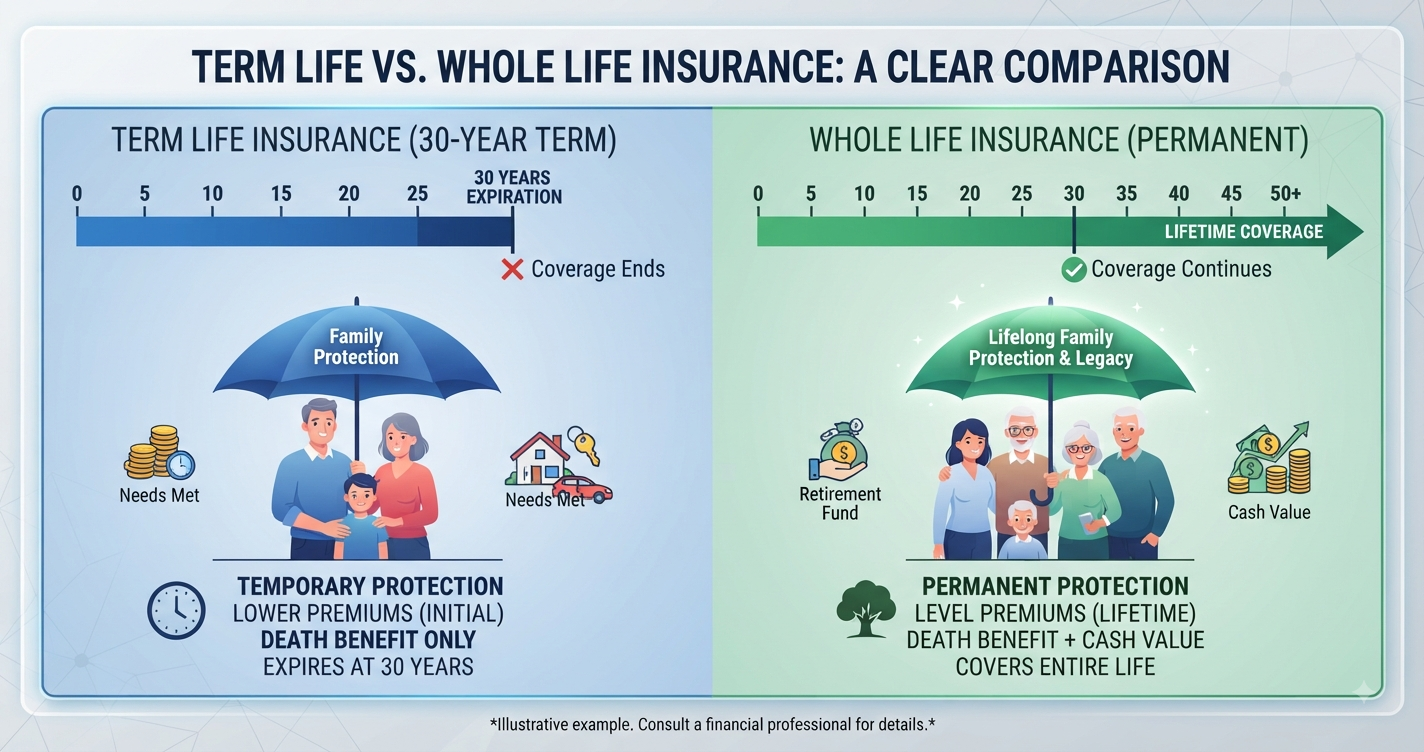
Life insurance is one of the most misunderstood financial products. People either avoid it entirely (dangerous) or buy the wrong type (expensive).
The confusion starts with a simple question: “Should I buy term or whole life insurance?”
The answer determines whether you’ll spend $50/month or $300/month for the same death benefit—a difference of $300,000 over a lifetime.
Most people buying whole life insurance don’t need it. Most people who actually need life insurance aren’t buying enough. And the sales tactics used to sell whole life insurance (often by well-meaning agents) create unnecessary expense.
Here’s the truth: For 95% of people, term life insurance is the objectively better choice. Period.
But understanding why—and knowing the rare situations where whole life makes sense—is crucial for making the right decision.
In this comprehensive guide, you’ll discover the complete comparison between term and whole life insurance, understand the math behind each option, calculate exactly how much coverage you need, learn what determines your premiums, and know exactly which type is best for your situation.
By the end, you’ll understand life insurance better than 99% of people and make a confident, informed decision.
Let’s dive in and remove the confusion.
The Fundamental Question: What Is Life Insurance?
Before comparing types, let’s understand what life insurance actually does.
Life Insurance’s Core Purpose
Life insurance pays a lump-sum benefit to your beneficiaries (people you designate) when you die. That’s it. Simple.
The purpose: Replace your income if you die, so dependents maintain their standard of living.
Who needs it:
- You have children
- You have a spouse depending on your income
- You have significant debts (mortgage, student loans)
- Others financially depend on you
Who doesn’t need much:
- Single with no dependents
- Wealthy with substantial assets
- Retired with sufficient passive income
- Children without dependents
The Insurance Math
Life insurance solves a basic financial problem:
Without insurance:
- You die
- Your income stops immediately
- Your family loses $3,000-$10,000/month income
- They scramble to survive financially
With insurance:
- You die
- Insurance pays $500,000 lump sum
- Family invests it at 4% returns
- Family receives $20,000/year income indefinitely
- Financial security maintained
Cost comparison:
- Monthly life insurance premium: $50
- Annual cost: $600
- 30-year cost: $18,000
- Death benefit: $500,000
- Net value if you die: $482,000 (after subtracting premiums paid)
The leverage is incredible. You pay $18,000 over your lifetime to protect $500,000 of family income.
Term Life Insurance: The Simple, Affordable Option
Term life insurance is straightforward: You pay monthly premiums for a specific “term” (time period). If you die during that term, your beneficiaries get the death benefit. If you survive the term, the coverage expires.
How Term Life Works
Simple example:
You’re age 30 and buy a 20-year term life policy with $500,000 death benefit.
- Years 1-20: You pay $40/month, have $500,000 coverage
- Year 20 (age 50): Term expires, coverage ends
- Scenario A (you die at age 45): Family receives $500,000 death benefit
- Scenario B (you die at age 55): Family receives $0 (coverage expired)
This is why the term length matters: You need enough coverage during the years your family depends on your income.
Term Lengths Available
Most insurance companies offer:
- 10-year term: Coverage for 10 years
- 15-year term: Coverage for 15 years
- 20-year term: Coverage for 20 years (most popular)
- 30-year term: Coverage for 30 years
- Term to age 65: Coverage until age 65 (essentially 30-40 year term depending on current age)
Costs increase dramatically with term length:
30-year-old buying $500,000 coverage:
- 10-year term: $20-25/month
- 20-year term: $30-45/month
- 30-year term: $50-75/month
Longer terms cost more because insurer’s risk extends further.
Term Life Costs: What Determines Your Premium
Your life insurance premium depends on:
1. Age (biggest factor)
Costs roughly double every 10 years:
- Age 25: $15/month for $500,000 coverage
- Age 35: $25-30/month for same coverage
- Age 45: $50-60/month for same coverage
- Age 55: $100-150/month for same coverage
Action: Buy while young (premiums locked for entire term)
2. Health Status
Excellent health: Standard rates
Good health: Standard rates (vast majority qualifies)
Health issues: Premium increases of 25-200% depending on severity
- High blood pressure (controlled): +25-50%
- Diabetes (controlled): +50-100%
- Heart disease: +100-300%
- Cancer history: +200-500%
- Smoking: +100-200%
Action: Quit smoking (saves hundreds annually)
3. Smoking Status
Smokers pay 2-4x more than non-smokers.
$500,000 20-year term for 35-year-old:
- Non-smoker: $35/month
- Smoker: $75-140/month
Annual difference: $480-$1,260
Action: If considering life insurance as motivation to quit smoking—do it now (savings alone pay for program)
4. Coverage Amount
Higher death benefits cost more (proportionally):
- $250,000 coverage: $20/month
- $500,000 coverage: $30/month
- $1,000,000 coverage: $55/month
- $2,000,000 coverage: $100/month
Note: Cost per $1,000 of coverage actually decreases with larger amounts (economy of scale).
Action: Buy adequate coverage (savings per dollar of coverage is better with larger policies)
5. Gender (women pay less)
Women live longer, statistically, so insurance costs 20-40% less:
35-year-old buying $500,000 20-year term:
- Men: $40-45/month
- Women: $25-30/month
Action: Unfortunately not controllable, but explains rate differences
6. Medical Exam vs No Medical Exam
Medical exam required ($1,000+ coverage):
- Blood test
- Urine test
- Health history
- Blood pressure check
- Takes 2-4 weeks to underwrite
No medical exam (smaller amounts):
- Quick approval (sometimes hours)
- Higher cost per dollar of coverage (25-50% more expensive)
- Limited to $100,000-$250,000 typically
Recommendation: Get medical exam if buying substantial coverage (savings on lower rates outweigh exam hassle)
Term Life Cost Examples
Healthy 30-year-old non-smoker:
- $500,000 20-year term: $30-40/month
- $1,000,000 20-year term: $50-65/month
- $1,500,000 20-year term: $70-90/month
Healthy 40-year-old non-smoker:
- $500,000 20-year term: $45-60/month
- $1,000,000 20-year term: $80-110/month
- $1,500,000 20-year term: $110-150/month
Healthy 50-year-old non-smoker:
- $500,000 20-year term: $100-130/month
- $1,000,000 20-year term: $180-230/month
- $1,500,000 20-year term: $250-320/month
Notice the dramatic cost increases after 40. This is why buying young matters.
Term Life Advantages
✅ Extremely affordable: $30-50/month for substantial coverage
✅ Simple: Easy to understand—pay premium, get death benefit if you die during term
✅ Flexible: Buy as much or little as you need
✅ No complexity: No investment components, cash value, loans—just insurance
✅ Perfect coverage timing: 20-year term while kids are young; coverage expires when they’re independent
✅ Can be converted: Some policies convertible to whole life later (without re-qualifying medically)
✅ Guaranteed rates: Premiums locked for entire term (won’t increase)
✅ Best value: Most coverage per dollar spent
✅ Renewable: Many policies allow renewal at end of term (at higher rates)
Term Life Disadvantages
❌ Coverage expires: After term ends, coverage is gone (you’re too expensive to replace at new age)
❌ Doesn’t build cash value: Premium payments don’t accumulate equity
❌ Renewing is expensive: Renewing at end of term costs much more (age increased)
❌ Less sophisticated: No investment component or policy loans
❌ Not for lifetime protection: Can’t use term to cover funeral costs if living to 90
Whole Life Insurance: The Permanent, Complex Option
Whole life insurance is fundamentally different from term. Instead of temporary coverage, it covers your entire life and includes an investment component.
How Whole Life Works
Basic structure:
You pay substantially higher premiums than term. The insurance company:
- Takes what’s needed for death benefit protection
- Invests the remaining premium in a cash value account
- Pays you interest on the cash value (typically 4-6% annually)
- You can borrow against the cash value
- The coverage lasts your entire life (whenever you die, beneficiaries get death benefit)
Simple example:
You’re age 35 and buy whole life policy with $500,000 death benefit.
- Year 1: You pay $250/month ($3,000/year)
- $40/month covers actual insurance cost
- $210/month accumulates in cash value account
- Cash value account: $2,520 (plus interest)
- Year 10: Cash value account: $35,000+ (depending on returns)
- You can borrow $35,000 from your policy
- Death benefit still $500,000
- Age 80 (still living): Cash value account: $200,000+
- You can withdraw or borrow funds
- Death benefit still $500,000 available for beneficiaries
- Whenever you die: Beneficiaries get $500,000 death benefit (regardless of age)
Whole Life Costs: What Determines Premium
Whole life premiums depend on:
1. Age (significant factor)
Whole life is much more expensive at younger ages because you have longer to live (more years of premiums to build cash value):
- Age 25: $150/month
- Age 35: $220/month
- Age 45: $350/month
- Age 55: $550/month
For $500,000 coverage, 20-year term compares to whole life as:
- Age 35: 20-year term $40/month vs whole life $220/month (5.5x more)
- Age 45: 20-year term $60/month vs whole life $350/month (5.8x more)
2. Coverage Amount
Like term insurance, larger death benefits cost more monthly.
3. Health Status
Same as term—better health = lower rates
4. Smoking Status
Smokers pay significantly more (100%+ premium increase)
5. Type of Whole Life
Standard whole life: Fixed premium, fixed death benefit, guaranteed cash value
Universal life: Flexible premium, flexible death benefit, varies with investment performance
Variable universal life: Your premiums invested in market-linked accounts, higher risk/reward
Indexed universal life: Premiums invested in stock market index, moderate risk
Each has different cost structures.
Whole Life Advantages
✅ Lifetime coverage: Protection for entire life (whenever you die)
✅ Builds cash value: Can borrow against accumulated funds
✅ Fixed premium: Payments never increase (don’t worry about renewing at old age)
✅ Forced savings: Some view it as “enforced savings plan”
✅ Loan availability: Can borrow against cash value at relatively low rates
✅ Estate planning tool: Can help cover estate taxes for wealthy individuals
✅ Guaranteed returns: Cash value guaranteed to grow (unlike stocks)
✅ Tax benefits: Death benefits tax-free to beneficiaries, cash value grows tax-deferred
Whole Life Disadvantages
❌ Extremely expensive: $200-400+/month vs. $40-60/month for term
❌ Complex: Hard to understand mechanics of cash value, investment, and insurance components
❌ Poor returns: Cash value typically earns 4-6% when you could earn 8-10% with index funds
❌ Expensive early: First 5-10 years, almost entire premium goes to commissions and fees, minimal cash value
❌ Complicated loans: Borrowing against policy reduces death benefit unless repaid
❌ Surrender charges: Canceling policy early results in losing significant portion of contributions
❌ Inflexible: Once premium set, hard to change coverage amount without new medical underwriting
❌ Overkill for most situations: Most people don’t need lifetime coverage (children grow up, mortgage gets paid)
❌ Poor investment option: Borrowing at 5% to get 4% return doesn’t make financial sense

Term vs Whole Life: The Direct Comparison
Cost Comparison Over 30 Years
Scenario: 35-year-old buying $500,000 coverage
20-year term life:
- Monthly premium: $40
- Annual cost: $480
- Total over 20 years: $9,600
- Coverage expires at age 55
- Total cost for protection: $9,600
Whole life (same death benefit):
- Monthly premium: $220
- Annual cost: $2,640
- Total over 20 years: $52,800
- Total over 30 years: $79,200
- Coverage continues for entire life
- Cash value after 20 years: $75,000-$90,000
The math:
If you die before age 55 (during 20-year term):
- Term: Family gets $500,000 death benefit (net gain: $490,400)
- Whole life: Family gets $500,000 death benefit (net gain: $447,200)
- Advantage: Term (same benefit, less paid in premiums)
If you live past age 55 (term expires):
- Term: No coverage (need to buy expensive renewal or do without)
- Whole life: Still have $500,000 coverage plus $75,000-$90,000 in cash value
- Advantage: Whole life
If you live to age 90:
- Term: Total premiums paid: $9,600 for 20 years of protection
- Whole life: Total premiums paid: $198,000 over 55 years of protection, plus $150,000-$200,000 in cash value
- Advantage: Depends on when you die
Return on Investment Comparison
If you view life insurance as investment:
Term life: Pure insurance, no investment component
Whole life: Blends insurance with forced investment
Compare to alternatives:
Pay $40/month for term (20-year), invest difference ($220-$40=$180/month) in index funds:
- 20-year term cost: $9,600
- Invested difference at 8% return: $64,000+
- Total assets: $64,000
- Insurance coverage: $500,000 death benefit
- Total protection: Same as whole life, but more flexibility
Compare to alternatives:
Pay $220/month for whole life:
- 20-year whole life cost: $52,800
- Cash value after 20 years: $75,000-$90,000
- Insurance coverage: $500,000 death benefit
- Total protection: Same as term + investment, but invested in insurance company’s portfolio (likely lower returns)
The verdict: Mathematically, term + index funds investing the difference outperforms whole life for most people.
Life Stage Comparison: When You’d Actually Need Coverage
Ages 0-25: Probably don’t need life insurance yet
- No dependents
- No mortgage
- No major debts
- Future income earning potential
Ages 25-35 (Starting families):
- ✅ PERFECT for term life insurance
- Young (cheap rates)
- Have kids (need protection)
- Career building (long earning years ahead)
- 30-year term makes sense (coverage to age 65)
Ages 35-50 (Family years):
- ✅ STILL need term life insurance
- Kids still dependent
- Mortgage substantial
- Working years remaining
Ages 50-65 (Pre-retirement):
- ✅ Term life still relevant (kids still dependent, mortgage years remaining)
- Consider reducing coverage as kids become independent
- 20-year term covers to retirement
Ages 65+ (Retirement):
- ❓ Life insurance becomes optional
- Kids independent
- Mortgage paid off
- Nest egg accumulated
- Only need coverage if:
- Still have young dependents (rare)
- Estate taxes exceed $12+ million (not most people)
- Want to leave inheritance (choose term, not whole)
Calculating Your Life Insurance Needs
This is the most important calculation you’ll do. Get it right.
Method 1: Income Replacement
How it works: Calculate years of income family needs replaced.
Calculation:
- Annual expenses needed: $50,000
- Years until retirement: 25 years
- Total needed: $1,250,000
- Add buffer (20%): $1,500,000
Use this if: You want family to maintain current lifestyle indefinitely.
Method 2: Debt Plus Expenses
How it works: Cover all debts plus years of living expenses.
Calculation:
- Mortgage balance: $300,000
- Other debts (car, student loans): $50,000
- Years of expenses (25 × $50,000): $1,250,000
- Total needed: $1,600,000
- Round to: $1,500,000-$1,750,000
Use this if: You want family to have home paid off and years of living expenses covered.
Method 3: Income Multiple
How it works: Simple rule of thumb (10-12x annual income).
Calculation:
- Annual income: $75,000
- Multiple: 10x
- Coverage needed: $750,000
Use this if: You want simple, quick calculation.
Note: This method is less precise but good for quick estimates.
Method 4: Detailed Analysis
How it works: Calculate exact expenses and timeline.
Calculation:
- Annual household expenses: $60,000
- Years of expenses needed:
- Child 1 (currently 8): $52,000 (10 years)
- Child 2 (currently 6): $60,000 (12 years)
- Spouse (until retirement): $60,000 (30 years)
- Total: $52,000 + $60,000 + $60,000 = $172,000 years
- Adjust for inflation (3%): $172,000 × 1.3 = $223,600
- Account for investment returns on benefit (4% earnings on remaining balance): Reduce by 15% = $190,000
- Add funeral/misc: $15,000
- Coverage needed: ~$200,000-$250,000
Use this if: You want precise, detailed calculation.
Recommended Approach
Use Method 2 for most people:
Calculation:
- Calculate total debts (mortgage, car loans, student loans, credit cards)
- Add 20 years × annual expenses
- Add $50,000 for final expenses and buffer
- This is your coverage target
Example:
- Mortgage: $250,000
- Car loan: $15,000
- Student loans: $30,000
- 20 years expenses at $50,000/year: $1,000,000
- Final expenses: $50,000
- Total: $1,345,000 → Round to $1,500,000
Is more coverage better?
Generally yes, as long as cost is reasonable. Extra $200,000 coverage often costs only $5-10/month extra. The margin of safety is worth minimal cost.
Is less coverage acceptable?
Only if you’re certain about timeline. If unsure, buy more. Underinsuring is bigger risk than slight overinsuring.
Who Should Buy Term Life Insurance
Term life is right for you if:
✅ You have dependents (children, spouse)
✅ You have a mortgage or other debts
✅ You’re building your career and earning potential
✅ You want maximum protection for minimal cost
✅ You’re under age 50
✅ You want coverage until retirement
✅ You’d rather invest money than buy whole life
✅ You want simple, straightforward insurance
✅ Your dependents will eventually become independent
Ideal term life candidate:
- Age: 30-50
- Family status: Married with children
- Financial situation: Mortgage, student loans, growing assets
- Goal: Protect family if something happens
- Philosophy: Simple, practical protection
Action: Buy 20-30 year term NOW while young and healthy.
Who Should Buy Whole Life Insurance
Whole life is appropriate for:
✅ Net worth over $2 million (considering estate taxes)
✅ Wealthy individual wanting lifetime coverage
✅ Complex estate planning situation
✅ Business owner needing corporate-owned life insurance
✅ Person who absolutely will not self-discipline to invest difference
✅ Want coverage guaranteed to age 120+
✅ Have maxed out other retirement saving options
Ideal whole life candidate:
- Age: 45-60 (already have substantial wealth)
- Net worth: $3 million+
- Financial situation: Mortgage paid, kids independent
- Goal: Estate planning and lifetime coverage
- Philosophy: Willing to pay premium for guaranteed lifetime coverage
Reality check: If this isn’t you, whole life probably isn’t appropriate.
Getting Life Insurance: The Process
Step 1: Determine Coverage Amount
Use one of the calculation methods above to determine how much coverage you need.
Typical amounts:
- Young family ($50k income): $500,000-$750,000
- Mid-career professional ($75k income): $750,000-$1,200,000
- High earner ($100k+ income): $1,000,000-$2,000,000
Step 2: Choose Term Length
General guidance:
- Age 25-35: 30-year term (covers to age 55-65)
- Age 35-45: 20-year term (covers to age 55-65)
- Age 45-55: 10-20 year term (covers to age 55-75)
Think about: When will dependents become independent? That’s your minimum term length.
Step 3: Get Quotes from Multiple Companies
Never buy from first company that quotes you. Get 5-7 quotes:
Online quote tools:
- PolicyGenius
- Term4Sale
- InsWeb
- Quotes.com
- Direct company websites (Heres Life, Term Life, etc.)
Comparison notes:
- Use identical coverage amounts
- Use identical term lengths
- Compare apples-to-apples (same death benefit)
- Note all companies quoting
Typical quote range:
30-year-old, $500,000 20-year term:
- Cheapest: $30-35/month
- Mid-range: $35-45/month
- Expensive: $45-60/month
Price variance is 50%+ between companies, so shopping matters.
Step 4: Apply
Choose cheapest quote and apply. Process:
- Online application: 15 minutes
- Health questions: Standard medical history
- Medical records: Company may request from your doctor (optional, speeds underwriting)
- Medical exam (if required): Blood/urine test, takes 30 minutes, done at home
- Underwriting: 2-4 weeks for approval
- Issued: You’re approved, coverage starts upon first premium payment
Step 5: Set Up Payment
- Monthly automatic payment from bank account (easiest)
- Annual payment (saves 5-10% vs monthly)
- Quarterly payment option
Recommendation: Set up automatic monthly payment so you never miss a premium.
Step 6: Name Your Beneficiaries
Beneficiary: Person who receives death benefit when you die
Primary beneficiary: First person to receive benefit (spouse, adult child, etc.)
Contingent beneficiary: Receives benefit if primary beneficiary predeceases you
Example:
- Primary: Your spouse
- Contingent: Your adult children (equally divided if both primary and spouse deceased)
Important: Update beneficiaries if life changes (marriage, divorce, new children, etc.)
Step 7: Annual Review
Every year during anniversary month:
- ✅ Verify beneficiaries still correct
- ✅ Confirm coverage amount still adequate
- ✅ Check if any life changes affect coverage needs
- ✅ Consider increasing if income increased significantly
Common Life Insurance Mistakes to Avoid
Mistake 1: Buying Whole Life When You Need Term
Error: Agent convinces you whole life is “better” long-term investment
Reality:
- Whole life costs 5-6x more than term
- Returns are lower than index funds
- Most people don’t need lifetime coverage
- Cost savings with term far exceed whole life “benefits”
Solution: Buy term unless you’re wealthy and have estate planning reasons for whole life
Mistake 2: Underestimating Coverage Needs
Error: Buying $250,000 coverage when you need $1,000,000
Result: Family has insufficient funds to maintain lifestyle; forced to sell home or reduce expenses
Solution: Calculate actual needs using Method 2 (debt + 20 years expenses); buy adequate coverage
Mistake 3: Waiting to Buy Until Older
Error: Age 40 thinking “I’ll buy at 50 since I’m healthier now”
Reality:
- Insurance is 2-3x more expensive at 50 than at 40
- Health changes happen (diabetes, heart issues develop)
- The longer you wait, the more expensive it becomes
Solution: Buy now while young and healthy; rates are locked for entire term
Mistake 4: Not Updating Beneficiaries
Error: Life insurance policy with ex-spouse listed as beneficiary
Result: Ex-spouse receives death benefit instead of current family
Solution: Update beneficiaries immediately upon life changes (marriage, divorce, new children)
Mistake 5: Buying No Life Insurance
Error: Thinking “insurance isn’t necessary” or “I’m healthy so won’t need it”
Reality:
- Death doesn’t discriminate by health
- Family left without income faces financial devastation
- Minimal cost protects against catastrophic outcome
Solution: If anyone depends on your income, buy life insurance (yes, you might not think so, but statistically people with dependents face scenarios where life insurance would be critical)
Mistake 6: Letting Policy Lapse
Error: Missing premium payment, coverage lapses
Result: Death during lapse period = no benefit
Solution: Set up automatic payment from bank account; impossible to miss payment
Mistake 7: Comparing Different Coverage Amounts
Error: Comparing quote of $500,000 coverage to quote for $750,000 coverage
Result: Higher priced quote seems worse, but might be cheaper per dollar of coverage
Solution: Always compare identical coverage amounts from different companies
Mistake 8: Trusting Agent’s Recommendation Blindly
Error: Agent recommends whole life; you buy without shopping
Reality: Agents earn 50-90% commission on whole life vs 40-50% on term
Solution: Get independent quotes from multiple companies; make decision yourself
Mistake 9: Buying Individual Policies When Group is Available
Error: Not enrolling in employer group life insurance
Reality: Employer coverage usually heavily subsidized (you pay $10-20/month, employer pays bulk)
Solution: Enroll in any employer group coverage available; supplement with individual term if needed
Mistake 10: Not Re-evaluating Needs Over Time
Error: Buy $500,000 coverage at age 30; never adjust as income increases
Result: Coverage becomes inadequate as financial obligations increase
Solution: Review and adjust coverage every 5 years or after major life changes
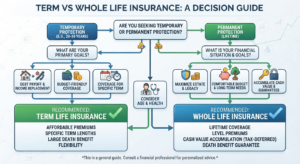
Frequently Asked Questions About Life Insurance
Should I buy life insurance if I’m young and single?
Generally no, unless you have significant debts (student loans) or dependents (rare at young age). Once you have a spouse depending on your income or children to support, buy term life immediately.
Can my employer’s group life insurance replace individual term life?
Employer coverage is usually too little ($50,000-$250,000 typically), though better than nothing. If you have significant dependents, buy individual term insurance supplementing employer coverage to reach appropriate total amount.
What happens when my 20-year term expires?
Coverage ends. You have three options:
- Buy a new policy (expensive if older or developed health issues)
- Renew existing policy with same company (much more expensive)
- Go without coverage (if you have built substantial assets)
This is why buying young matters—you lock in cheap rates while healthy.
Can I convert term life to whole life later?
Many policies include conversion option (check your policy). This lets you convert to whole life without new medical exam—though whole life is still expensive, at least you don’t need health exam.
Reality: Rarely makes financial sense to convert to whole life, but option exists.
Can I borrow against term life insurance?
No. Term insurance has no cash value, so nothing to borrow against. This is advantage of term (pure insurance) vs whole life (blended insurance + investment).
Should I buy return-of-premium term insurance?
Return-of-premium (ROP) term returns your premiums at end of term if you survive.
Example:
- Regular 30-year term: $50/month = $18,000 total cost
- ROP 30-year term: $95/month = $34,200 total cost
Costs nearly 2x as much for benefit that only matters if you survive the entire term.
Better approach: Buy regular term, invest the premium difference in index funds. You’ll accumulate more than ROP refund.
When ROP makes sense: You’re risk-averse and want guaranteed recovery of premiums. Otherwise, regular term is better value.
Can I get life insurance with pre-existing health conditions?
Yes, but rates are higher. Examples:
- Controlled hypertension: +25-50% premium
- Diabetes (controlled): +50-100% premium
- Heart disease: +100-300% premium
- Cancer history: +200-500% premium
You’ll still qualify; just pay more. Still worth buying for family protection.
Should I take the medical exam or choose no-exam coverage?
With exam:
- More thorough underwriting
- Lower premiums
- Coverage takes 2-4 weeks
- Required for larger amounts
Without exam:
- Faster approval (sometimes same day)
- Higher premiums (25-50% more expensive)
- Limited to $100,000-$250,000
- Better for small coverage amounts
Recommendation: Get medical exam for coverage over $300,000 (savings on lower rates worth the exam hassle).
Can I get life insurance without job/income?
Yes. Parents, spouses, or other caregivers without income can get coverage if someone else has insurable interest (someone dependent on you).
Examples:
- Stay-at-home parent
- Unemployed spouse
- Retired person
- Caregiver for disabled family member
Life insurance makes sense for anyone whose death would create financial hardship for others.
What if I’m rated “uninsurable” by one company?
Try other companies. Underwriting standards vary significantly between insurers. One company’s decline doesn’t mean all companies will decline.
What to do:
- Get declined? Try 3-4 other companies
- Work with broker who represents multiple insurers
- Be honest about health history
- Expect higher premiums but don’t give up
Should I buy life insurance at age 70+?
Depends. At 70+:
- Term insurance becomes very expensive (or unavailable)
- Whole life still available but very expensive
- Only makes sense if you have young dependents (rare)
- Consider instead:
- One-time large gift from investments to dependent
- Reducing estate taxes with whole life (for wealthy)
- Forgoing insurance if dependents self-sufficient
Most 70+ individuals skip new insurance and rely on accumulated assets.
Life Insurance and Your Complete Financial Picture
Life insurance doesn’t exist in isolation. It’s one piece of comprehensive financial protection.
How Life Insurance Fits In
With emergency fund: Insurance covers catastrophic loss (death)
- Emergency fund covers small problems (car repair, medical copay)
- Together: Complete financial safety net
With disability insurance: Both protect income
- Life insurance: Protects dependents if you die
- Disability insurance: Protects you if can’t work
- Together: Complete income protection
With retirement savings: Build long-term wealth
- Life insurance: Protects family while building wealth
- Retirement accounts: Grow the wealth
- Together: Financial security across all scenarios
With will/beneficiary designations: Control asset distribution
- Life insurance: Death benefit goes to beneficiaries
- Will: Everything else distributed per your wishes
- Together: Complete estate plan
With budgeting: Manage costs effectively
- Life insurance: One of core financial protections
- Budgeting: Ensures you can afford premiums
- Together: Integrated financial plan
Learn more about complete insurance protection for full picture.
Take Action: Your Life Insurance Plan
30-Day Life Insurance Action Plan
Week 1: Assess Your Need
- Determine if anyone depends on your income
- Calculate total coverage needed (use Method 2)
- Decide between term and whole life (99% choose term)
- Choose term length (20-30 years most common)
- Document these decisions
Week 2: Get Quotes
- Visit 5-7 quote websites
- Enter identical coverage amounts
- Enter identical term lengths
- Compare prices (spread sheets helps)
- Note top 3 cheapest companies
Week 3: Apply
- Choose cheapest qualified company
- Complete online application (15 minutes)
- Schedule medical exam if required
- Provide requested health information
- Follow up on application status
Week 4: Finalize
- Receive and review policy
- Confirm coverage amount and term length
- Update beneficiary designations
- Set up automatic monthly payment
- Schedule annual review reminder
Post-implementation:
- Review annually (policy anniversary)
- Update if life changes (marriage, children, income)
- Increase coverage if income increases significantly
- Continue building financial security with other protections
Conclusion: Protect Your Family’s Future
Life insurance is unsexy. It won’t make you rich. It won’t help you accumulate wealth. But it will protect your family from the most catastrophic financial scenario imaginable: your death.
The math is irrefutable:
- $40/month for term insurance
- $480/year
- $9,600 over 20 years
- Protects $500,000 of family income
That’s one of the best financial bargains available.
The choice is clear:
For 95% of people, term life insurance is the objectively correct choice. It provides:
- ✅ Maximum coverage
- ✅ Minimum cost
- ✅ Simple structure
- ✅ Flexibility
- ✅ Perfect timing with life stage
Whole life is rarely appropriate except for wealthy individuals with estate planning needs.
The biggest mistake: Waiting. Every year you delay:
- Rates increase
- Health may change
- Dependents remain unprotected
Buy now while young and healthy. Lock in cheap rates for 20-30 years. Know your family is protected.
The single most important financial decision for people with dependents is buying adequate term life insurance. Everything else—investing, budgeting, saving—assumes you’re alive to execute the plan.
Make this decision today. Your family’s financial security depends on it.
Ready to complete your financial protection? Explore these related guides:
- Complete Insurance Guide: Protect Your Financial Future – Comprehensive protection overview
- Disability Insurance: Protect Your Income From Unexpected Events – Complete disability protection guide
- Health Insurance Guide: Choose the Right Plan and Save Money – Navigate health insurance decisions
- Homeowners and Renters Insurance: Essential Coverage Explained – Property protection guide
- Best Budgeting Apps: Top Tools to Manage Your Money in 2025 – Manage insurance costs
Leave a Reply