
Health insurance is confusing. Not accidentally confusing—intentionally confusing. Complex language, obscure metrics, dozens of plan options—it’s designed so you’ll just pick something and stop asking questions.
But health insurance decisions directly impact your financial security and health outcomes. Choosing the wrong plan could cost you thousands in unnecessary premiums or leave you bankrupt from unexpected medical bills.
Yet most people understand their health insurance plan poorly:
- 68% of Americans don’t understand the difference between a deductible and co-insurance
- 72% don’t know what their annual out-of-pocket maximum is
- 56% incorrectly believe their copay covers everything related to that visit
- 45% would struggle to pay a $1,000 unexpected medical bill
These gaps in understanding don’t just create confusion—they create financial disaster.
This comprehensive guide cuts through the jargon and complexity. You’ll learn what health insurance actually covers, understand every metric that matters (deductibles, copays, coinsurance, out-of-pocket maximums), discover how to compare plans intelligently, and implement strategies to save thousands annually on both premiums and medical costs.
Whether you’re choosing from employer options, shopping the ACA marketplace, or understanding Medicare, you’ll know exactly which plan offers the best value for your situation.
Let’s make health insurance simple and ensure you get the protection you need at a cost you can afford.
Health Insurance Fundamentals: Understanding the Basics
Before choosing a plan, you need to understand what health insurance actually does and how it works.
The Purpose of Health Insurance
Health insurance is designed to protect you from catastrophic medical expenses by:
- Sharing costs: You and the insurer split medical expenses
- Limiting exposure: Your maximum out-of-pocket cost is capped
- Negotiating rates: Insurers negotiate lower rates with providers
- Preventing bankruptcy: Protects you from $500,000 medical bills
The fundamental exchange:
You pay monthly premiums and share costs on medical expenses. In return, insurance limits your maximum financial exposure to manageable levels.
The Healthcare System’s Hidden Secret
Most people don’t realize: Your health insurance doesn’t pay doctors directly. You do.
Here’s how it actually works:
- You see doctor
- Doctor bills insurance company for $300
- Insurance company pays 80%, you pay 20%
- You receive bill for your 20% ($60)
- You pay the doctor
This is why understanding YOUR responsibility (copays, coinsurance, deductibles) is crucial—you’re actually paying most of it.
The Insurance Negotiation
Insurance companies have one superpower: negotiating rates down.
Without insurance:
- Doctor’s charge: $1,000
- You pay: $1,000
With insurance:
- Doctor’s usual charge: $1,000
- Negotiated rate (insurance discount): $300
- Insurance pays: $240 (80%)
- You pay: $60 (20%)
- Savings: $700 (70% discount)
Just having insurance (even before using it) saves you massive amounts through negotiated rates.
Health Insurance Metrics: The Six Numbers That Matter
Health insurance plans vary by six key metrics. Understanding each is crucial for comparing plans.
1. Monthly Premium
Definition: The amount you pay each month for insurance coverage, regardless of whether you use it.
Examples:
- Individual plan: $150-400/month
- Family plan: $400-1,500/month
- Employer plan: You pay 0-30%, employer pays 70-100% (deducted from paycheck)
Important: Premium is separate from costs when you actually use medical services.
Key insight: Cheaper premium doesn’t mean cheaper overall plan. A plan with $100/month premium but high deductible might cost more total than $200/month plan with low deductible.
2. Deductible
Definition: Amount you must pay out-of-pocket before insurance starts paying anything.
How it works:
You have $1,500 deductible:
- Year starts: $0 spent
- January visit ($300): You pay full $300 (insurance pays $0)
- February visit ($200): You pay full $200 (insurance pays $0)
- March visit ($400): You pay full $400, but now $900 spent toward deductible
- April visit ($800): You’ve paid $1,500 total, deductible met! Insurance now pays percentage
Key insight: Higher deductible = lower premium, but you pay more upfront before insurance helps.
Deductible types:
| Plan Type | Typical Deductible |
|---|---|
| Bronze ACA | $5,000-$7,000 |
| Silver ACA | $2,000-$3,500 |
| Gold ACA | $500-$1,500 |
| Platinum ACA | $0-$500 |
| PPO Employer | $500-$2,500 |
| HMO Employer | $0-$1,500 |
| HSA-compatible | $1,500-$7,000 |
3. Copay (Co-payment)
Definition: Fixed amount you pay for specific services (doctor visit, prescription drug).
Examples:
- Doctor visit copay: $25, $40, or $50
- Specialist visit copay: $50, $75, or $100
- Urgent care copay: $75-$100
- Emergency room copay: $250-$500
- Generic drug copay: $10-$15
- Brand-name drug copay: $25-$50
How copays work:
You have plan with $40 copay for doctor visits:
- See doctor: You pay $40 at visit
- Doctor’s bill: $150
- Insurance pays: $110
- You pay: $40 (copay)
- Insurance discount: $0 (you still responsible for balance beyond copay… actually no, insurance negotiates that)
Important distinction:
- Copays are typically INSTEAD OF coinsurance
- You don’t pay deductible AND copay (confusing, but usually one or other)
- Copays count toward out-of-pocket maximum
4. Coinsurance
Definition: Percentage of medical costs you pay after deductible is met.
How it works:
You have plan with $1,500 deductible and 20% coinsurance:
- January: Doctor visit ($300)
- You pay: $300 (full amount, toward deductible)
- Insurance pays: $0
- Deductible remaining: $1,200
- February-March: More visits total $1,400
- You pay: $1,400 (toward deductible)
- Insurance pays: $0
- Deductible met: $0 remaining
- April: Doctor visit ($500)
- Deductible met, so coinsurance applies
- You pay: $100 (20% coinsurance)
- Insurance pays: $400 (80%)
Key insight: Coinsurance applies AFTER deductible, and represents your percentage share of costs.
Common coinsurance percentages:
- 10% coinsurance: You pay 10%, insurance pays 90%
- 20% coinsurance: You pay 20%, insurance pays 80%
- 30% coinsurance: You pay 30%, insurance pays 70%
5. Out-of-Pocket Maximum (OOP Max)
Definition: Maximum amount you’ll pay in a year (deductible + copays + coinsurance). After this, insurance pays 100%.
How it works:
You have plan with:
- $1,500 deductible
- $40 copay for doctor visits
- 20% coinsurance
- $5,000 out-of-pocket maximum
Year scenario:
- January-March: Pay $1,500 (deductible) + $200 (copays)
- April-October: Pay $2,100 (copays and coinsurance toward OOP)
- Total paid so far: $3,800
- November: Major surgery ($50,000)
- Your coinsurance would be: 20% of $50,000 = $10,000
- But you’ve already paid $3,800 toward OOP max
- You only pay: $5,000 – $3,800 = $1,200 additional
- Insurance pays: $48,800
- Year total out-of-pocket: $5,000 (OOP maximum)
- Insurance paid: $51,000+
Key insight: Out-of-pocket maximum is your financial safety net. Once hit, insurance covers everything at 100%.
OOP Maximum ranges:
| Plan Type | Individual OOP Max | Family OOP Max |
|---|---|---|
| Bronze ACA | $7,000-$8,550 | $14,000-$17,100 |
| Silver ACA | $6,000-$7,000 | $12,000-$14,000 |
| Gold ACA | $3,000-$4,000 | $6,000-$8,000 |
| Platinum ACA | $1,000-$2,000 | $2,000-$4,000 |
| Employer PPO | $2,500-$5,000 | $5,000-$10,000 |
| Employer HMO | $1,500-$4,000 | $3,000-$8,000 |
6. Network Status
Definition: Whether your doctor/hospital is “in-network” (has contract with insurance) or “out-of-network” (no contract).
Cost difference:
In-network visit ($300 usual charge):
- Negotiated rate: $150
- Insurance pays: $120 (80%)
- You pay: $30
Out-of-network visit ($300 usual charge):
- No negotiation, full charge: $300
- Insurance pays: $60 (20%)
- You pay: $240
That’s 8x more expensive out-of-network!
Key insight: Always verify providers are in-network before scheduling. Out-of-network care is financially devastating.
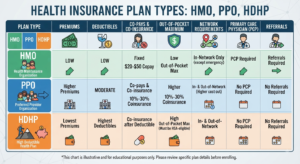
Health Insurance Plan Types
Several types of health insurance exist, each with different cost structures and flexibility.
1. Health Maintenance Organization (HMO)
How it works:
You choose a primary care physician (PCP) who coordinates all your care. Referrals required for specialists. Must use in-network providers.
Cost structure:
- Premium: Low
- Deductible: Low ($0-$1,500) or none
- Copays: Fixed ($25-$50 per visit)
- Coinsurance: Minimal
- Out-of-pocket max: Moderate ($1,500-$4,000)
Example:
- Monthly premium: $150
- Doctor visit copay: $30
- Specialist copay: $60 (with referral)
- Emergency room copay: $150
- Out-of-pocket max: $3,000
Advantages:
✅ Lowest premiums
✅ Low/predictable copays
✅ Often no deductible
✅ Care coordination (PCP manages all care)
✅ Preventive care often free
Disadvantages:
❌ Must use in-network providers (out-of-network only in emergencies)
❌ Need referrals for specialists
❌ Less flexibility in choosing doctors
❌ Doesn’t cover out-of-area routine care
Best for: Healthy people wanting low premiums, willing to follow plan rules for specialist access.
2. Preferred Provider Organization (PPO)
How it works:
Choose any provider in or out of network. In-network costs less, out-of-network costs more. No referrals required.
Cost structure:
- Premium: Higher than HMO
- Deductible: Higher ($500-$2,500)
- Copays: Fixed ($30-$50 for in-network)
- Coinsurance: Higher out-of-network (20-40%)
- Out-of-pocket max: Higher ($2,500-$5,000)
Example:
- Monthly premium: $300
- In-network doctor copay: $40
- Out-of-network doctor: 30% coinsurance
- Specialist copay (no referral): $60
- Emergency room copay: $250
- Out-of-pocket max: $4,000
Advantages:
✅ Flexibility to see any provider
✅ No referrals needed
✅ Higher out-of-network benefits than HMO
✅ Access out-of-area providers
✅ More choice in doctors
Disadvantages:
❌ Higher premiums than HMO
❌ Higher deductibles
❌ Out-of-network care expensive
❌ More complex cost sharing
❌ Less coordinated care (no PCP)
Best for: People who want flexibility and are willing to pay more for it, those with specialists out-of-network.
3. Point of Service (POS)
How it works:
Hybrid of HMO and PPO. Choose PCP, get referrals, but can see out-of-network providers at higher cost.
Cost structure:
- Premium: Between HMO and PPO
- Deductible: Low-moderate
- Copays: In-network low, out-of-network higher
- Coinsurance: Out-of-network applies
- Out-of-pocket max: Moderate
Advantages:
✅ Lower premiums than PPO
✅ More flexibility than HMO
✅ Out-of-network access if needed
Disadvantages:
❌ Still need referrals
❌ Still have PCP requirement
❌ Out-of-network costs high
❌ Not as flexible as PPO
Best for: People wanting HMO cost with some PPO flexibility.
4. Exclusive Provider Organization (EPO)
How it works:
In-network providers are required. No out-of-network coverage except emergencies. No referrals needed.
Cost structure:
- Premium: Low-moderate
- Deductible: Moderate
- Copays: In-network fixed
- Out-of-network: Not covered (except emergencies)
- Out-of-pocket max: Moderate
Advantages:
✅ Lower premiums than PPO
✅ No referrals required
✅ Flexible specialist access (in-network)
Disadvantages:
❌ No out-of-network coverage
❌ Rigid network requirement
❌ Travel outside service area problematic
Best for: People willing to commit to network, wanting lower cost than PPO.
5. High Deductible Health Plan (HDHP)
How it works:
Low premiums, high deductibles, and eligibility for Health Savings Account (HSA). You pay more upfront, but HSA savings can be used for medical expenses.
Cost structure:
- Premium: Lowest
- Deductible: High ($1,500-$7,000)
- Copays: None (coinsurance until deductible met)
- Coinsurance: After deductible
- Out-of-pocket max: High ($2,800-$7,000 individual)
Example:
- Monthly premium: $100
- Annual deductible: $3,000
- Coinsurance: 20% after deductible
- Out-of-pocket max: $6,500
- Eligible for HSA: Yes
Advantages:
✅ Lowest premiums
✅ HSA savings account (triple tax advantage)
✅ Greater control over healthcare spending
✅ Accumulate HSA funds year to year
Disadvantages:
❌ High out-of-pocket costs
❌ Not ideal if frequent medical care needed
❌ Requires discipline to use HSA properly
Best for: Healthy people wanting to save on premiums, those comfortable with high deductible, people planning to use HSA strategically.
Important: Learn about Health Savings Accounts below.
6. Catastrophic Health Plan
How it works:
Very low premiums, very high deductible. Only cover preventive care before deductible. Designed for young, healthy people.
Cost structure:
- Premium: Extremely low ($20-$50/month)
- Deductible: Very high ($7,000+)
- Preventive care: Free (before deductible)
- Coinsurance: After deductible
- Out-of-pocket max: High ($8,550)
Advantages:
✅ Extremely low premiums
✅ Preventive care free
✅ Protects against catastrophic medical costs
✅ For young, healthy people
Disadvantages:
❌ Expensive if need regular care
❌ High out-of-pocket costs
❌ Not available to everyone (usually under 30)
Best for: Young, healthy people without chronic conditions, wanting cheap protection against catastrophic illness.
How to Compare Health Insurance Plans
Comparing plans requires looking at all six metrics together, not just premium.
The Complete Comparison Framework
Step 1: Calculate annual premium costs
Individual plan options:
- Plan A: $150/month = $1,800/year
- Plan B: $250/month = $3,000/year
- Plan C: $200/month = $2,400/year
Step 2: List all key metrics
| Metric | Plan A | Plan B | Plan C |
|---|---|---|---|
| Annual Premium | $1,800 | $3,000 | $2,400 |
| Deductible | $3,000 | $500 | $1,500 |
| Doctor copay | $40 | $25 | $30 |
| Specialist copay | $60 | $50 | $60 |
| ER copay | $150 | $250 | $100 |
| Out-of-pocket max | $6,000 | $4,000 | $4,500 |
| Prescription copay | $15/$40/$65 | $10/$30/$50 | $12/$35/$60 |
Step 3: Calculate worst-case scenario
If you had major medical event:
- Plan A: $1,800 premium + $6,000 OOP max = $7,800 maximum exposure
- Plan B: $3,000 premium + $4,000 OOP max = $7,000 maximum exposure
- Plan C: $2,400 premium + $4,500 OOP max = $6,900 maximum exposure
Step 4: Consider actual healthcare needs
Healthy person without chronic conditions:
- Preventive care: Maybe $200-500/year actual costs
- Plan A estimate: $1,800 + $200 (preventive copays) = $2,000
- Plan B estimate: $3,000 + $100 (preventive copays) = $3,100
- Plan C estimate: $2,400 + $150 (preventive copays) = $2,550
Plan A wins for healthy people.
Person with chronic condition (monthly doctor visits, prescriptions):
- 12 doctor visits × $40 copay = $480
- Monthly prescription $50 × 12 = $600
- Additional tests/visits = $300
- Total medical costs before insurance: ~$2,000
Plan B analysis (with $500 deductible):
- Premium: $3,000
- Deductible: $500
- Doctor visits: 12 × $25 = $300 (after deductible met)
- Prescription: 12 × $30 = $360
- Additional: $300
- Total: $3,000 + $500 + $300 + $360 + $300 = $4,460
Plan A analysis (no deductible):
- Premium: $1,800
- Doctor visits: 12 × $40 = $480
- Prescription: 12 × $15 = $180 (generic) or $40 × 12 = $480 (brand)
- Additional: $300 (copay for tests)
- Total: $1,800 + $480 + $480 + $300 = $3,060
Plan A wins even with chronic condition due to lower premium.
Step 5: Check provider networks
- Is your doctor in-network for each plan?
- Are your specialists covered?
- If out-of-area, does plan cover?
One out-of-network visit can cost thousands. This is critical.
Using Online Plan Comparison Tools
Healthcare.gov (if using ACA Marketplace):
- Enter zip code
- Enter age
- Enter income (for subsidies)
- See all available plans
- Click “Compare” for side-by-side view
- Review costs and coverage
Employer portal (if choosing from employer plans):
- Log into benefits portal
- Click “Compare Plans”
- Use comparison tool
- Usually shows costs and coverage clearly
Other tools:
- eHealthinsurance.com
- Insurify.com
- Kaiser.org (if available in your area)
- UnitedHealthcare.com
- Aetna.com
- Cigna.com
Health Savings Accounts (HSAs): The Secret Weapon
HSAs are one of the most powerful financial tools available but poorly understood.
What Is an HSA?
An HSA is a savings account specifically for medical expenses, available only if you have a High Deductible Health Plan (HDHP).
Key features:
- Tax-deductible contributions: Reduce your taxable income
- Tax-free growth: Money invested grows without taxes
- Tax-free withdrawals: For qualified medical expenses, no taxes owed
- Portable: Belongs to you, not your employer
- Accumulates year-to-year: Unused funds carry forward (unlike FSA)
- Investment options: Can invest in stocks, bonds, mutual funds
HSA Triple Tax Advantage
No other account offers this:
1. Tax-deductible contributions
- You contribute $3,850 (individual limit)
- Reduces your taxable income by $3,850
- Saves ~$1,155 in federal taxes (at 30% rate)
2. Tax-free growth
- $3,850 invested at 8% returns
- After 20 years: $17,963
- All growth tax-free (compared to brokerage account where you’d owe capital gains taxes)
3. Tax-free withdrawals (for medical expenses)
- Withdraw $500 for doctor visit
- Zero taxes owed
- In regular brokerage account, you’d owe income tax + capital gains tax
Total advantage: Triple tax benefit that no other account offers
HSA Contribution Limits (2024)
| Coverage Type | Limit |
|---|---|
| Individual | $3,850/year |
| Family | $7,750/year |
| Catch-up (age 55+) | +$1,000/year |
Is the limit enough?
Average person spends $3,000-$5,000/year on medical expenses (insurance + out-of-pocket). Contributing the maximum covers most expenses while saving on taxes.
HSA vs FSA: Which Is Better?
Both are savings accounts for medical expenses, but with key differences:
| Feature | HSA | FSA |
|---|---|---|
| Contribution limit | $3,850 individual, $7,750 family | $3,300 individual |
| Tax-free growth | Yes | No |
| Portable | Yes (yours forever) | No (employer plan) |
| Carry-over unused | Yes (accumulates) | No (use-it-or-lose-it) |
| Investment options | Yes | Usually not |
| Withdrawals | Anytime for medical | Limited withdrawal windows |
HSAs are superior in almost every way. FSAs are only better if your employer is extremely generous with contributions.
HSA Strategy: The Ultimate Tax Loophole
Advanced HSA users optimize the account strategically:
Year 1 Strategy:
- Contribute maximum: $3,850
- Don’t withdraw for medical expenses
- Pay medical expenses out-of-pocket instead
- Let HSA grow and invest
Over 20 years:
- Contributions: $3,850 × 20 = $77,000
- Growth at 8%: Plus $84,963
- Total in HSA: $161,963
At retirement:
- You’ve saved $23,250 in taxes (30% of contributions)
- Your account has grown tax-free
- You can withdraw for medical expenses tax-free
- Best of all: After age 65, you can withdraw for ANY reason (though non-medical withdrawals taxed as income—still, you got the tax deduction upfront)
The key: HSA is essentially a second retirement account if you can afford to pay medical expenses out-of-pocket.
Who Should Open an HSA?
Good candidates:
✅ Healthy person choosing HDHP
✅ Can afford high deductible without stress
✅ Can afford to pay medical expenses out-of-pocket
✅ Plans to invest HSA funds (don’t just leave in savings)
✅ Has multiple years until needing funds
Poor candidates:
❌ Person with chronic conditions needing frequent care
❌ Can’t afford high deductible
❌ Need constant access to funds
❌ Won’t invest HSA funds
Choosing Your Health Insurance: Step-by-Step
Step 1: Determine Available Options
If employed:
- Check employer’s benefits portal
- Note all available plans
- Gather plan documents
If self-employed/unemployed:
- Visit Healthcare.gov (open enrollment Nov 1 – Dec 15)
- Enter income and household information
- View all available plans in your zip code
If 65+:
- Enroll in Medicare (apply at age 65)
- Choose Original Medicare or Medicare Advantage
- Consider supplemental coverage
If under 26:
- Check if parents’ employer plan still covers you
- Often cheaper than individual plan
Step 2: Assess Your Healthcare Needs
Honest assessment:
- How often do I see doctor? (0 = very healthy, 4+ = chronic conditions)
- Do I take medications? (expensive prescription habits?)
- Do I have specialists? (if yes, are they in-network?)
- Upcoming medical procedures? (know costs in advance)
- Am I comfortable with high deductible? (can afford $3,000+ out-of-pocket?)
Based on answers:
Very healthy, no medications, no doctor visits:
- Catastrophic or HDHP (cheapest option)
- Focus on lowest premium
- Out-of-pocket max acceptable
Occasional doctor visits, few medications:
- HDHP with HSA (leverage tax advantages)
- Or Silver/Gold ACA plan
- Balance premium and deductible
Chronic condition, multiple medications, frequent visits:
- Gold or Platinum plan (lower deductible)
- PPO for provider flexibility
- Don’t choose HDHP (high deductible counterproductive)
High medical needs:
- Platinum plan (lowest deductible, highest premium)
- PPO for out-of-network flexibility
- HSA irrelevant (medical costs will exceed HSA contribution limit anyway)
Step 3: Check Provider Networks
Critical step: Verify doctors are in-network
- Get your doctor’s name and tax ID
- Visit insurance company’s provider search tool
- Search for your doctor
- Confirm they accept the plan
- Repeat for all specialists
One out-of-network visit can cost $500-$2,000 extra. This step matters.
Step 4: List Your Top 3 Plans
Using comparison framework above:
- Write down all key metrics
- Calculate worst-case scenario (OOP max)
- Estimate actual costs based on your healthcare needs
- Note which providers are in-network
- Rank by total estimated cost
Step 5: Choose and Enroll
Employer plan:
- Enroll through benefits portal
- Coverage starts on specified date
- Download plan documents for reference
ACA Marketplace:
- Create account at Healthcare.gov
- Enter household information
- Shop plans
- Apply for subsidies (if eligible)
- Enroll before deadline
- Coverage starts Jan 1 (if enrolled by Dec 15)
Medicare:
- Visit Medicare.gov
- Create account
- Compare plans
- Enroll during Annual Enrollment Period (Oct 15 – Dec 7)
Health Insurance Costs: What You Actually Pay
Understanding all the costs helps you predict total annual expenses.
Employer-Sponsored Insurance Costs
Your costs (typical):
- Premium: You pay 15-30%, employer pays 70-85%
- Deductible: $500-$2,000 (varies by employer)
- Copay: $25-$50 per visit
- Coinsurance: 10-20% after deductible
- Out-of-pocket max: $2,500-$6,000
Example annual costs (employer plan):
- Your premium: $2,000/year (if you pay 20% of $10,000 employer plan)
- Preventive care: $0 (usually free)
- 2 doctor visits at $40 copay: $80
- 1 urgent care at $100 copay: $100
- 1 specialist referral at $75 copay: $75
- Total: $2,255/year
ACA Marketplace Costs
Your costs depend on income:
Example: $45,000 income, individual, no employer coverage
- Unsubsidized premium: $250/month = $3,000/year
- With tax credit subsidy (80% subsidy): $50/month = $600/year
- Deductible: $1,500
- Copay: $30-$50
- Coinsurance: 20%
- Out-of-pocket max: $3,000
Cost if healthy (few medical visits):
- Subsidized premium: $600
- Deductible: $0 (if no visits)
- Preventive care: $0
- Total: $600/year
Cost if multiple medical needs:
- Subsidized premium: $600
- Deductible met: $1,500
- Doctor visits after deductible: 5 visits × $30 = $150
- Additional coinsurance: $300
- Total: $2,550/year
Medicare Costs (Age 65+)
Your costs (typical):
- Part A premium: $0 (if paid Medicare taxes 10+ years)
- Part B premium: $164/month = $1,968/year
- Part D (prescription): $20-$50/month = $240-$600/year
- Supplemental insurance: $100-$200/month = $1,200-$2,400/year
- Deductible: $1,660 (Part A), $240 (Part B)
- Coinsurance: 20% after deductible
Total annual cost (basic Medicare):
- Premiums: ~$2,600
- Out-of-pocket max: ~$7,500
- Realistic annual cost if using services: $3,500-$5,000
Strategies to Save Money on Health Insurance
Strategy 1: Choose Appropriate Plan for Your Health Status
Mismatch between plan choice and health needs costs the most money.
Example:
Healthy person choosing expensive Platinum plan:
- Pays $500/month premium = $6,000/year
- Uses minimal medical services
- Could have chosen HDHP for $150/month = $1,800/year
- Wasted: $4,200/year
Person with chronic condition choosing HDHP:
- Pays $150/month premium = $1,800/year
- Has $3,500 deductible
- Needs frequent doctor visits and expensive medication
- Annual out-of-pocket: $4,500+
- Total: $6,300/year
- Could have chosen Gold plan for $350/month = $4,200/year, with $1,500 OOP max
- Cost if major medical event: $4,200 + $1,500 = $5,700
- Savings: $600+/year
Action: Match plan to actual healthcare needs, not aspirational health.
Strategy 2: Use HSA Strategically
If you have HDHP with HSA:
- Contribute maximum ($3,850/year)
- Pay medical expenses out-of-pocket if possible
- Let HSA grow and invest
- Accumulate receipts for future tax-free withdrawals
Annual tax savings: ~$1,155 (at 30% marginal tax rate)
Over 10 years: $11,550 in tax savings before even considering investment growth.
Strategy 3: Use Preventive Care (It’s Free)
All plans cover preventive care at no cost:
✅ Annual physical exam
✅ Health screenings (mammogram, colonoscopy, etc.)
✅ Vaccinations
✅ Contraceptive services
✅ Genetic counseling for hereditary cancers
✅ Depression screening
✅ Blood pressure screening
Use these benefits. They’re literally free and prevent expensive problems later.
Strategy 4: Use Generic Medications
Brand-name vs generic:
- Brand-name prescription copay: $40-$60
- Generic prescription copay: $10-$15
- Cost difference: $30-$45 per prescription
Person taking 3 medications monthly:
- Brand-name cost: 3 × $50 × 12 = $1,800/year
- Generic cost: 3 × $12 × 12 = $432/year
- Savings: $1,368/year
Ask your doctor: Is a generic available? 99% of the time, yes, and equally effective.
Strategy 5: Ask for Negotiated Rates
Hospitals have massive price variations:
- MRI scan: $300-$3,000 depending on facility
- Knee surgery: $15,000-$50,000
- Childbirth: $8,000-$30,000
Before major procedure:
- Get price quote from facility
- Call insurance company for negotiated rate
- Compare to other hospitals
- Choose facility with lowest cost
Potential savings: 30-70% on major procedures.
Strategy 6: Shop Plans During Open Enrollment
Plans change every year:
- Premiums increase
- Deductibles change
- New plans offered
- Existing plans discontinued
Every year, your current plan might not be best option anymore.
Action: Every November, review new plan options and switch if better deal exists.
Typical annual opportunity: Save $500-$2,000 by switching to better plan.
Strategy 7: Use Employer FSA or HSA Match
Many employers match HSA contributions:
If employer offers 50% match on HSA contributions:
- You contribute: $3,850
- Employer contributes: $1,925
- Total: $5,775
- That’s free money.
Use it.
Strategy 8: Appeal Denied Claims
Insurance companies deny claims hoping you’ll give up.
- 15-30% of initial claims are denied
- 50%+ of appealed denials are overturned
If claim denied:
- Don’t panic
- Call insurance company
- Ask why it was denied
- Request appeal
- Provide additional documentation
- Resubmit
Potential recovery: $1,000-$10,000+ in previously denied claims.
Strategy 9: Check For Billing Errors
Medical billing errors are common:
- 49% of medical bills contain errors
- Average error: $1,000-$5,000
If you receive large medical bill:
- Request itemized bill from provider
- Cross-reference with insurance explanation
- Check for duplicate charges
- Verify services were actually provided
- Dispute errors
Potential savings: 10-30% of bill through error correction.
Strategy 10: Use Telemedicine for Minor Issues
Telemedicine visit costs vs office visit:
- Telemedicine: $40-$75
- Office visit copay: $40-$60
- But avoids deductible if high-deductible plan
For minor issues (cold, rash, etc.):
- Telemedicine often covered (no copay)
- Faster than office visit
- Available nights/weekends
Annual savings: $200-$400 from telemedicine use.

Special Enrollment Periods: When You Can Change Plans
Normally, you can only change health insurance during annual open enrollment. But life events allow changes anytime:
Qualifying Life Events
You can change plans immediately if you experience:
✅ Marriage: Change within 60 days
✅ Divorce: Change within 60 days
✅ Birth of child: Add child within 30 days
✅ Adoption: Change within 60 days
✅ Loss of coverage: Change within 60 days (from job loss, plan termination)
✅ Employer plan changes: Change if coverage became less affordable
✅ Gain Medicaid/Medicare eligibility: Change within 60 days
✅ Relocation to new zip code: Change if no plans in new area
Important: Document the event (marriage certificate, divorce decree, birth certificate, job termination letter) and submit within timeframe.
Missed deadline? You must wait until next annual open enrollment.
Common Health Insurance Mistakes to Avoid
Mistake 1: Choosing Based on Premium Alone
Error: “Plan X costs $50/month, Plan Y costs $150/month, so Plan X is better”
Reality: Plan Y might have $500 deductible while Plan X has $3,000. If you use medical services, Plan Y is cheaper overall.
Solution: Compare total cost (premium + deductible + expected copays/coinsurance), not just premium.
Mistake 2: Assuming Copay Covers Everything
Error: “I have a $40 copay for doctor visits, so that’s all I owe”
Reality: Copay is just the office visit. Bloodwork, imaging, labs still have separate charges that may not be covered by copay.
Solution: Ask doctor upfront: “What’s the total cost for this visit and all recommended tests?”
Mistake 3: Not Checking Provider Networks
Error: Choosing plan without verifying your doctor is in-network
Result: Seeing “in-network” doctor for $40 copay, then receiving $500 bill because doctor was out-of-network
Solution: Verify network status before selecting plan.
Mistake 4: Forgetting Annual Preventive Care
Error: “I’m healthy, don’t need annual physical”
Reality: Annual preventive care is free and catches expensive problems early.
Solution: Schedule annual physical, mammogram, colonoscopy, etc.
Mistake 5: Not Understanding Out-of-Pocket Maximum
Error: “I have a $50 deductible, so I’ll never spend more than that”
Reality: Out-of-pocket maximum is deductible + copays + coinsurance. Could be $5,000.
Solution: Know your actual out-of-pocket maximum (your real financial worst-case).
Mistake 6: Paying Out-of-Network When Better Option Exists
Error: Seeing doctor you really like, but they’re out-of-network
Result: Paying 30-40% more for same service
Solution: If possible, use in-network providers. If must use out-of-network, understand the extra cost.
Mistake 7: Ignoring HSA Opportunity
Error: Having HDHP with HSA eligibility but not opening HSA
Result: Missing out on triple tax advantage and free money.
Solution: If HDHP eligible, open and max out HSA.
Mistake 8: Not Shopping Plans Annually
Error: Keep same plan year after year
Reality: Best plan changes every year as options change and your needs change
Solution: Every November, review new options and switch if better deal exists.
Mistake 9: Not Appealing Denied Claims
Error: Receive denial, accept it
Reality: 50%+ of appealed denials are overturned
Solution: Always appeal denied claims.
Mistake 10: Skipping Open Enrollment
Error: “I don’t think I need to do anything, my coverage continues”
Reality: If you don’t re-enroll, you might lose coverage or be automatically assigned to different plan
Solution: Re-enroll during open enrollment every year, even if keeping same plan.
Frequently Asked Questions About Health Insurance
What’s the difference between in-network and out-of-network?
In-network: Provider has contract with insurance company, negotiated rates apply. You pay copay or coinsurance (after deductible) based on plan.
Out-of-network: Provider has no contract. You pay significantly more (often 30-40% more). Insurance often covers less.
Example:
- In-network doctor visit negotiated rate: $150
- You pay: $40 copay, insurance pays: $110
- Out-of-network doctor charges: $250
- Insurance pays: $60 (20% of $300 usual charge)
- You pay: $190 (8x more than in-network)
Can I change plans mid-year if I’m unhappy?
Only if you have a qualifying life event (marriage, job loss, birth, relocation). Otherwise, you must wait for annual open enrollment.
Exception: If your employer makes plan changes that significantly affect coverage or cost, you may get special enrollment window.
What if I can’t afford health insurance premiums?
ACA subsidy: If income below 400% of poverty line, you qualify for tax credits reducing premiums 50-90%.
Medicaid: If income very low (varies by state), Medicaid covers you for free or minimal cost.
Catastrophic plan: Cheapest option ($20-50/month), covers preventive care and protects against catastrophic illness.
Don’t go without coverage. One medical emergency costs $20,000-$200,000.
Is telemedicine covered by my insurance?
Usually yes: Most plans cover telemedicine visits, often with same copay as office visit (sometimes free).
Check your plan or call insurance company to verify coverage and what the copay is.
Can I buy health insurance outside of open enrollment without qualifying event?
No. Outside of open enrollment (Nov 1 – Dec 15), you cannot buy ACA marketplace plans unless you have qualifying life event.
Exception: Employer plans and direct insurance enrollment sometimes available anytime.
What’s the penalty for not having health insurance?
As of 2024, there’s no federal tax penalty for lacking health insurance. However:
Reality: Medical emergency without insurance could bankrupt you. Don’t skip coverage to avoid small penalty.
Should I defer medical care to save money?
Never. Deferring preventive care or urgent medical needs to save money is false economy:
- Untreated condition worsens
- Eventually you need expensive emergency care
- Prevention is always cheaper than treatment
Get needed care. Insurance exists to protect you.
How does health insurance work with HSA?
HSA is separate account:
- Contributes to HSA during open enrollment
- Funds accumulate in HSA
- Use HSA funds to pay for qualified medical expenses
- HSA funds can be invested
If you have HDHP with HSA: Use HSA to pay deductible, then insurance takes over.
Can I use my health insurance in another state?
Yes, you can use your insurance nationwide:
- In-network providers apply nationwide
- Must use your plan’s network in that state
- Out-of-network coverage same rules apply (more expensive)
If moving permanently: You can change plans during special enrollment period.
Health Insurance and Your Complete Financial Plan
Health insurance isn’t isolated—it integrates with your overall financial security.
How Health Insurance Fits In
With life insurance: Protects your family
- Life insurance: Death benefit to family
- Health insurance: Protects you while living
- Together: Complete protection
With disability insurance: Protects your income
- Health insurance: Covers medical costs
- Disability insurance: Replaces income if can’t work
- Together: Income and health protected
With emergency fund: Safety net for medical costs
- Emergency fund: Covers unexpected expenses
- Health insurance: Covers medical costs
- Together: Financial resilience
With HSA: Tax-advantaged medical savings
- HSA: Saves for medical expenses
- Other retirement accounts: Build wealth
- Together: Diversified savings approach
Learn more about complete insurance protection for full financial security.
Take Action: Your Health Insurance Action Plan
Open Enrollment Checklist (Annual, Nov 1 – Dec 15)
2 Weeks Before Open Enrollment Closes:
- Gather current plan documents
- List any healthcare needs/changes since last year
- Get plan comparison from employer or Healthcare.gov
- Review all available options
- Write down all plan metrics (premium, deductible, OOP max, copays)
1 Week Before Deadline:
- Verify your doctors are in-network for each plan
- Calculate total estimated cost for each plan
- Select top choice plan
- Share plan comparison with spouse (if applicable)
- Get coverage with your selection
During Open Enrollment:
- Enroll in chosen plan through portal or Healthcare.gov
- Verify confirmation of enrollment
- Download new plan documents
- Update beneficiary designations if needed
- Set calendar reminder for when coverage starts
After Enrollment:
- Verify coverage effective date
- Download ID cards (digital and physical)
- Update healthcare providers with new plan info
- Explore whether HSA/FSA available
- Set annual review reminder for next November
Mid-Year Health Insurance Check
Every 6 months:
- Verify any life changes (job, marriage, children)
- Check if eligible for special enrollment (if changes occurred)
- Review medical spending year-to-date
- Verify deductible progress (if high-deductible plan)
- Ensure current plan still meeting needs
Conclusion: Health Insurance Protects Your Financial Future
Health insurance doesn’t prevent you from getting sick—but it prevents bankruptcy when you do.
One serious illness could cost $50,000-$500,000. Health insurance limits your exposure to manageable amounts.
The key understanding:
Health insurance isn’t about choosing the plan with the lowest premium. It’s about choosing the plan that balances:
- ✅ Affordable monthly premium
- ✅ Manageable deductible
- ✅ Predictable copays
- ✅ Reasonable out-of-pocket maximum
- ✅ In-network providers you actually use
A $100/month plan is worthless if you can’t afford the $5,000 deductible when you need care.
A $300/month plan is wasteful if you’re healthy and rarely see doctors.
The best plan is the one matching your actual health situation and financial capacity.
Remember these core principles:
✅ Know your six metrics: Premium, deductible, copay, coinsurance, OOP max, network
✅ Compare total cost, not just premium: Add premium + realistic medical costs
✅ Verify providers are in-network: Before committing to plan
✅ Use preventive care: It’s free, prevents expensive problems
✅ Choose generic medications: Almost as effective, cheaper
✅ Max out HSA if eligible: Triple tax advantage is unbeatable
✅ Shop annually: Best plan changes every year
✅ Appeal denied claims: Half get overturned
✅ Negotiate major procedures: 30-70% savings possible
Your health insurance decision directly impacts your financial security. Make it thoughtfully.
Ready to complete your financial protection? Explore these related guides:
- Complete Insurance Guide: Protect Your Financial Future – Comprehensive protection overview
- Disability Insurance: Protect Your Income From Unexpected Events – Protect your earning ability
- Life Insurance Explained: Term vs Whole Life and How Much You Need – Family protection guide
- Homeowners and Renters Insurance: Essential Coverage Explained – Property protection
- Best Budgeting Apps: Top Tools to Manage Your Money in 2025 – Track insurance costs in budget
Leave a Reply