
You’re more likely to become disabled than to die before retirement.
That’s not meant to scare you—it’s meant to wake you up.
According to the Council for Disability Awareness, a 35-year-old worker has a 37% chance of experiencing a disability lasting 90+ days before retirement. Compare that to a 10% lifetime probability of dying before age 65.
Yet most people have life insurance but skip disability insurance entirely. They protect their family against the unlikely event of death but leave themselves completely exposed to the far more likely event of disability.
The financial consequence is devastating: lose your income for 90 days and most people’s savings evaporate. Lose it for a year and financial ruin becomes likely.
Disability insurance solves this problem. It replaces your income if you become unable to work due to illness or injury, allowing you to pay bills and maintain your lifestyle while recovering.
The irony? Disability insurance is shockingly affordable—often $30-$100/month for comprehensive protection. Yet 25% of working-age Americans have no disability coverage.
In this comprehensive guide, you’ll understand disability insurance completely: what it covers, types available, how much you need, what determines your cost, and exactly which type is best for your situation.
By the end, you’ll understand why disability insurance might be the single most important insurance you own.
Let’s protect your most valuable asset: your income.
Why Disability Insurance Matters: The Harsh Reality
Before discussing disability insurance details, let’s understand why it’s essential.
The Probability Problem
You’re much more likely to become disabled than to die:
Probability of 90+ day disability before retirement age:
- Age 25: 53%
- Age 35: 37%
- Age 45: 26%
- Age 55: 15%
Probability of death before retirement age (65):
- Age 25: 12%
- Age 35: 10%
- Age 45: 8%
- Age 55: 5%
The insight: Disability is 2-5x more likely than death during working years.
Yet insurance ownership is reversed: most people have life insurance but skip disability.
The Financial Impact
Scenario: 35-year-old accountant with $60,000 salary
Without disability insurance, 6-month disability:
- Monthly expenses: $4,000
- Income during disability: $0
- Total needed over 6 months: $24,000
- Savings accumulated: $10,000
- Monthly loss: $14,000
- Total deficit over 6 months: $84,000
This person must:
- Drain emergency fund ($10,000 gone)
- Rack up $74,000 in debt
- Sell assets
- Declare bankruptcy
- Potentially lose home/car
With disability insurance replacing $3,000/month:
- Monthly expenses: $4,000
- Insurance benefit: $3,000
- Monthly shortfall: $1,000
- 6-month total shortfall: $6,000
- Financial outcome: Manageable, no debt
Difference: Bankruptcy vs. manageable hardship. All for $50/month in disability insurance.
Common Disabilities
People think “disability” means permanent paralysis. Reality is different:
Most common causes of disability claims:
- Back injuries: 26% of claims
- Cancer: 9% of claims
- Arthritis/joint disorders: 8% of claims
- Pregnancy complications: 5% of claims
- Heart disease: 5% of claims
- Mental health issues: 5% of claims
- Slip and fall injuries: 4% of claims
- Fractures: 4% of claims
- Herniated disc: 3% of claims
- Other: 26% of claims
Key insight: Most disabilities aren’t permanent injuries. They’re temporary conditions causing temporary income loss. But even temporary becomes catastrophic without income replacement.
Average Disability Length
Council for Disability Awareness data:
- 37% of disabilities last 90+ days
- Average disability duration: 34.6 weeks (8 months)
- Long-term disabilities (beyond 1 year): 15% of claims
- Permanent disabilities: ~8% of claims
This means:
- Most disabilities are recoverable (you’ll return to work)
- But they cause 2-8 months of income loss
- Income loss is catastrophic without insurance
Understanding Disability Insurance: What It Actually Covers
Disability insurance replaces income if you become unable to work. Simple concept, but important details exist.
What “Disability” Actually Means
Medical definition: You have a condition preventing you from working.
Insurance definition (varies by policy): You cannot perform the duties of your own occupation (own-occupation definition) OR you cannot perform any occupation you’re qualified for (any-occupation definition).
Example:
Surgeon develops hand arthritis, can’t perform surgery:
- Own-occupation definition: Qualifies for disability (can’t do surgeon work)
- Any-occupation definition: Might not qualify (could work as a medical consultant)
Key insight: Own-occupation definition is much better. Pay more for it.
What Disability Insurance Covers
Short-term disability typically covers:
✅ Illness preventing work (flu, pneumonia, appendicitis)
✅ Injury preventing work (broken leg, surgery recovery)
✅ Pregnancy/childbirth complications
✅ Mental health conditions (depression, anxiety)
✅ Chronic disease flare-ups
✅ Medical procedure recovery
✅ Cancer treatment side effects
Long-term disability covers the same conditions, but for extended periods.
What Disability Insurance Doesn’t Cover
❌ Pre-existing conditions (typically 12-month waiting period)
❌ Conditions from illegal activity (no coverage if injured while committing crime)
❌ Injuries from alcohol/drug intoxication (varies by policy)
❌ Self-inflicted injuries (suicide, self-harm)
❌ War-related injuries (excluded in most policies)
❌ Cosmetic surgery complications (unless medically necessary)
Most exclusions are reasonable. The important thing: legitimate illnesses/injuries are covered.
Two Types of Disability Insurance
Two distinct types exist: short-term and long-term. Many people use both.
Short-Term Disability Insurance (STD)
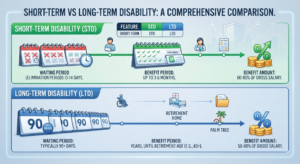
Short-term disability covers the initial period after you become disabled, typically 3-6 months.
How Short-Term Disability Works
Timeline example:
You develop serious back injury on January 1st:
- January 1-7: Waiting period (you’re off work, no benefit yet)
- January 8: First STD benefit begins
- January 8 – June 30: You receive 60% of salary
- July 1: STD period ends, long-term disability begins (if applicable)
Key components:
Benefit period (waiting period):
- 0-14 days typical (how long you wait before benefits start)
- Shorter = better, but costs more
- Some policies have no waiting period
Replacement percentage:
- 50-66% of salary typical
- If earning $5,000/month, receive $3,000/month
- Rarely replaces 100% (discourages shirking)
Maximum benefit:
- $2,000-$5,000/month typical cap
- High earners hit this limit
- Benefits may not fully replace high income
Duration:
- 3-6 months typical
- Some extend to 12 months
- Varies by policy and employer
Short-Term Disability Cost
Employer-provided (most common):
- Free to employee (employer pays)
- Sometimes employee can pay for better coverage
- Cost to employer: $0.50-$1.00 per $100 of payroll
Individual short-term disability:
- $20-$50/month typical
- Varies by age and health
Example cost: 35-year-old buying individual STD
- $2,000/month benefit, 90-day waiting period: $25/month
- $3,000/month benefit, 30-day waiting period: $40/month
- $4,000/month benefit, 14-day waiting period: $55/month
Short-Term Disability Advantages
✅ Immediate income replacement (covers initial disability months)
✅ Affordable ($20-$50/month)
✅ Short waiting period (often available)
✅ Covers temporary conditions (perfect for most disabilities)
✅ Often provided by employer (free coverage)
✅ No long-term commitment (coverage ends after 3-6 months)
Short-Term Disability Disadvantages
❌ Limited duration (only 3-6 months)
❌ Temporary disabilities longer than duration not fully covered
❌ May require proof of disability (medical documentation needed)
❌ Possible integration with other benefits (reduces if you get workers comp)
❌ May not be available to self-employed (employer plans only)
Long-Term Disability Insurance (LTD)
Long-term disability covers extended disabilities, from several months to retirement age.
How Long-Term Disability Works
Timeline example:
You develop cancer diagnosis in January:
- January: Diagnosed, unable to work
- January 1-90 days: STD covers if available, or you use savings
- April 1: LTD begins (after STD ends)
- April – December: Receive 60% salary
- Throughout treatment and recovery: Covered
- Return to work: Benefits stop
- Never return to work: Benefits continue to age 65
Key components:
Elimination period (waiting period):
- 90-365 days typical (how long you wait before benefits start)
- Overlaps with short-term disability
- 90 days common for employer plans
- Longer waiting period = lower premium
Replacement percentage:
- 50-66% of salary typical
- Usually coordinated with Social Security (reduced if you get SSDI)
- High earners may not be fully replaced
Maximum benefit:
- $3,000-$7,000/month typical
- High earners capped at this amount
- Own-occupation plans sometimes higher
Duration:
- “To age 65” typical (from benefit start to retirement)
- “Lifetime” sometimes available
- Some plans have maximum benefit period (5-10 years)
Long-Term Disability Cost
Employer-provided (most common):
- Often free to employees (employer subsidizes)
- Cost to employer: $0.30-$0.75 per $100 of payroll
- Sometimes employee can buy additional coverage
Individual LTD:
- $30-$100/month typical
- Varies by age, health, occupation
- Own-occupation definition costs more
Example cost: 35-year-old buying individual LTD
- $2,000/month benefit, 90-day elimination: $35/month
- $3,000/month benefit, 90-day elimination: $50/month
- $4,000/month benefit, 90-day elimination: $65/month
- $4,000/month benefit, own-occupation definition: $85/month
Long-Term Disability Advantages
✅ Extended coverage (months to retirement age)
✅ Covers serious, prolonged disabilities (where most risk is)
✅ Reasonable cost ($30-$100/month)
✅ Coordinated with STD (both together provide comprehensive protection)
✅ Portable (if individual policy, continue if you change jobs)
✅ Own-occupation option available (better definition of disability)
✅ Often indexed for inflation (benefits increase with cost of living)
Long-Term Disability Disadvantages
❌ Long waiting period (90-365 days before benefits start)
❌ Partial income replacement (50-66%, not 100%)
❌ Integration with other benefits (SSDI reduces benefit)
❌ Offset provisions (workers comp, unemployment reduce benefit)
❌ Cost of living adjustments often limited (benefits don’t keep pace with inflation)
❌ May require proof of ongoing disability (medical exams periodically)
Employer vs Individual Disability Insurance
Where you get disability insurance matters.
Employer-Provided Disability Insurance
How it works:
Your employer provides group disability insurance covering all employees. Simple.
Typical coverage:
Short-term disability:
- 60% income replacement
- 3-6 month duration
- 0-14 day waiting period
- Often free to employees
Long-term disability:
- 60% income replacement
- To age 65
- 90-180 day elimination period
- Often free to employees
Advantages:
✅ Free or subsidized (employer pays most/all cost)
✅ Guaranteed approval (no medical underwriting)
✅ Payroll deduction (automatic, never miss payment)
✅ Group rates (cheaper than individual)
✅ Comprehensive (STD + LTD often bundled)
Disadvantages:
❌ Coverage ends when you leave job (need individual backup)
❌ Tax-deductible benefits taxed as income (if employer paid, benefits taxed)
❌ Employer-controlled definitions (not negotiable)
❌ Possible offset provisions (SSDI, workers comp reduce benefit)
❌ May have integration with Social Security (Medicare offset)
❌ Limited customization (one-size-fits-all)
Important tax issue: If employer pays disability insurance premium, benefits are taxable income. If you pay premium (out-of-pocket or after-tax), benefits are tax-free.
Example:
- Monthly disability benefit: $3,000
- If employer-paid: You owe taxes on $3,000 (roughly $750 taxes owed)
- If employee-paid: You keep full $3,000 (no taxes)
This difference can be significant over months/years of disability.
Individual Disability Insurance
How it works:
You buy policy directly from insurance company, coverage follows you.
Coverage customization:
You control:
- Benefit amount ($1,000-$10,000+/month possible)
- Elimination period (0-365 days)
- Definition of disability (any-occupation vs own-occupation)
- Benefit duration (to age 65, lifetime, 5-year, etc.)
- Cost-of-living adjustments
- Occupational exclusions
Advantages:
✅ Portable (continues if you change jobs)
✅ Tax-free benefits (if you paid premium out-of-pocket)
✅ Ownership (yours, can’t be cancelled by employer)
✅ Customizable (you choose all terms)
✅ Own-occupation definition available (better protection)
✅ No integration with SSDI (you keep full benefit + Social Security)
Disadvantages:
❌ More expensive than employer group coverage
❌ Requires medical underwriting (must pass health exam)
❌ You pay full premium (no employer subsidy)
❌ Coverage gaps if unemployed (need to bridge between jobs)
❌ More complex (many options to choose)
When to buy individual policy:
- Self-employed (no employer coverage)
- Freelancer/independent contractor
- Plan to change jobs frequently (portability matters)
- Employer coverage inadequate
- Want own-occupation definition
- Want better tax treatment
How Much Disability Insurance Do You Need?
Calculate based on your actual expenses and income replacement philosophy.
Method 1: Income Replacement Percentage
Calculation:
Monthly gross income: $5,000
Choose replacement percentage: 60%
Coverage needed: $3,000/month
Reasoning: 60% of gross income provides 75-85% of net income (accounting for taxes not owed during disability).
Typical percentages:
- 50% replacement: Bare minimum, encourages return to work
- 60% replacement: Sweet spot, maintains reasonable lifestyle
- 70% replacement: Comfortable, minimal lifestyle reduction
- 80%+ replacement: Rare, insurance companies resist overinsuring
Action: Choose 60% of gross income as target.
Method 2: Expense-Based Calculation
Calculate actual monthly expenses:
- Rent/mortgage: $1,500
- Food: $400
- Utilities: $200
- Insurance: $300
- Transportation: $200
- Minimum debt payments: $300
- Other necessities: $300
- Total: $3,200/month
Coverage needed: $3,200/month
This ensures you can cover actual living expenses during disability.
Method 3: Income Plus Buffer
Calculate:
Monthly expenses: $3,000
Buffer for unexpected costs: 20%
Total coverage: $3,600/month
This covers living expenses plus small margin for unexpected disability-related costs (medical copays, equipment, etc.).
Recommended Approach
Use Method 1 or 2, whichever is higher:
Example scenario:
- Gross monthly income: $5,000
- 60% of gross: $3,000
- Actual monthly expenses: $2,800
- Coverage needed: $3,000 (choose higher amount)
This ensures you can cover living expenses while having margin of safety.
High Earners and Coverage Caps
Problem: Insurance companies cap benefits.
High earner making $15,000/month:
- 60% of income: $9,000/month
- Insurance cap: $5,000/month maximum
- Gap: $4,000/month uncovered
Solution options:
- Buy maximum available ($5,000/month)
- Buy multiple policies (some insurers allow this)
- Negotiate with employer (they might offer higher cap for employees)
- Accept partial coverage (better than nothing)
- Build larger emergency fund (cover gap with savings)
Recommendation: Buy whatever maximum your insurer allows. Partial coverage better than no coverage.
What Determines Your Disability Insurance Cost
Several factors affect your premium.
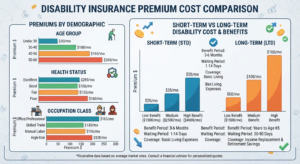
1. Age (Biggest Factor)
Insurance cost roughly doubles every 10 years:
35-year-old buying $3,000/month LTD benefit:
- Cost: $50/month
45-year-old buying same:
- Cost: $90-$110/month
55-year-old buying same:
- Cost: $180-$220/month
Action: Buy disability insurance while young (rates locked for years).
2. Health Status
Pre-existing conditions increase premiums:
Healthy applicant: Standard rates
Controlled high blood pressure: +15-25% premium
Diabetes (controlled): +25-50% premium
Back problems: +50-100% premium
Mental health conditions: +25-100% premium (varies significantly)
Serious conditions: May be declined for coverage
Action: Apply while healthy. Once you have coverage, it’s generally protected even if health changes.
3. Occupation
More dangerous occupations cost more:
Low-risk: Office worker, accountant, manager ($30-50/month for $3,000 benefit)
Medium-risk: Teacher, nurse, retail manager ($50-80/month)
High-risk: Construction, manufacturing, law enforcement ($80-150+/month)
Extremely high-risk: May be declined for coverage
Why: Higher disability claim rate = higher insurance cost.
4. Income Level
Higher income = higher premiums (proportional to benefit amount):
$2,000/month benefit: $25-40/month
$3,000/month benefit: $40-60/month
$4,000/month benefit: $55-80/month
$5,000/month benefit: $70-100/month
Plus insurers apply higher percentage rates to higher incomes (charging 1.5-2% of income vs 0.75% for lower incomes).
5. Definition of Disability
Own-occupation definition costs more:
Any-occupation definition: $50/month (you must be unable to do ANY job you’re qualified for)
Own-occupation definition: $65-75/month (you must be unable to do YOUR specific job)
Why: Own-occupation is better for you (easier to qualify for benefits), so you pay more.
Recommendation: Buy own-occupation definition. The 25-50% cost increase is worth it.
6. Elimination Period (Waiting Period)
Longer waiting period = lower premium:
14-day elimination: $80/month (fastest benefits)
30-day elimination: $70/month
60-day elimination: $60/month
90-day elimination: $50/month
180-day elimination: $40/month
Choice: 90 days is sweet spot for most people (you use emergency fund/STD first 90 days, then LTD kicks in).
7. Benefit Duration
Longer duration = higher premium:
5-year benefit maximum: $40/month
To age 65: $60/month
Lifetime benefit: $75+/month
Recommendation: “To age 65” is standard and appropriate. You’ll likely return to work or reach retirement before benefits end.
8. Cost-of-Living Adjustments (COLA)
With COLA, benefits increase annually:
Without COLA: $50/month premium
With annual 3% COLA: $65/month premium
Value: If disabled for 10 years, COLA ensures $3,000 benefit doesn’t lose purchasing power.
Recommendation: Include COLA if affordable ($10-15 extra/month). Over long disability, inflation matters.
How to Get Disability Insurance
Step 1: Determine If Employer Coverage Is Sufficient
Review your employer plan:
- Short-term disability: What’s the benefit amount and duration?
- Long-term disability: What’s the benefit amount and elimination period?
- Definition: Own-occupation or any-occupation?
- Tax treatment: Will benefits be taxed?
- Portability: Can you keep coverage if you leave?
Is it adequate?
If STD + LTD together replace 60% of income with no waiting period = probably adequate.
If gaps exist (low benefit amount, long elimination period, any-occupation definition) = buy individual policy to supplement.
Step 2: Get Individual Quotes If Needed
Online quote tools:
- PolicyGenius
- SelectQuote
- eHealthinsurance
- Direct insurer websites (Guardian, Principal, Unum, Metlife)
What to provide:
- Age and gender
- Occupation and job duties
- Annual income
- Current health status
- When coverage needed
Get quotes for:
- $2,000/month benefit
- $3,000/month benefit
- $4,000/month benefit
- Choose desired elimination period and definition
Step 3: Compare Quotes
Key metrics to compare:
- Monthly premium (obvious)
- Definition of disability (own-occupation preferred)
- Elimination period (90 days typical)
- Benefit duration (to age 65 standard)
- Cost-of-living adjustments (included?)
- Partial disability rider (covered?)
- Portability (can you take it if you change jobs?)
- Renewability (can they cancel you?)
Don’t just choose cheapest. Evaluate total value.
Step 4: Apply
Application process:
- Online application: 20-30 minutes
- Health questions: Detailed health history
- Medical records: Company may request from your doctor
- Medical exam: For larger benefits, blood/urine test (done at home, 30 minutes)
- Underwriting: 2-4 weeks for approval
- Approval and setup: Coverage begins upon approval
Step 5: Review Employer Coverage
If you have employer plan:
- Review it annually (benefits may change)
- Understand your specific benefits
- Know elimination period (coordinate with individual policy)
- Understand tax treatment (taxable or not?)
- Confirm portability if you might change jobs
Step 6: Keep Policies Current
Annual review:
- Confirm coverage still active
- Verify premium amount (should stay same if locked in)
- Update beneficiary if applicable
- Note coverage details (elimination period, benefit amount, definition)
- Maintain policy documents
Common Disability Insurance Mistakes to Avoid
Mistake 1: Assuming You Won’t Become Disabled
Error: “I’m young and healthy, disability won’t happen to me”
Reality: 37% of 35-year-olds will have 90+ day disability before retirement. You’re statistically likely to need it.
Solution: Buy coverage now while young and premiums are cheap.
Mistake 2: Relying Only on Employer Coverage
Error: Thinking employer STD + LTD is sufficient protection
Reality: Employer coverage ends when you leave job. Need individual backup for portability.
Solution: Buy individual long-term policy as backup, especially if self-employed or changing jobs frequently.
Mistake 3: Choosing Any-Occupation Definition
Error: Picking any-occupation definition to save $10-15/month
Reality: Any-occupation is hard to qualify for. Own-occupation is better protection.
Solution: Buy own-occupation definition. The cost difference is worthwhile.
Mistake 4: Choosing Too Long Elimination Period
Error: Picking 180-365 day elimination to minimize premium
Reality: Can’t survive 6-12 months without income. No emergency fund supports that.
Solution: Choose 90-day elimination period (covers with STD or emergency fund).
Mistake 5: Underestimating Income Replacement Needed
Error: Buying $1,500/month benefit when expenses are $3,000/month
Reality: Insufficient benefit forces you into debt during disability.
Solution: Calculate actual expenses, buy coverage matching 60% of gross income (whichever is higher).
Mistake 6: Not Buying Enough Coverage Due to Cost
Error: “Individual policy is $60/month, that’s too much”
Reality: 1-month disability costs $3,000+ in lost income. $60/month is incredible bargain.
Solution: Buy coverage. Cost is tiny relative to risk.
Mistake 7: Skipping Individual Policy If Employer Coverage Exists
Error: “Employer covers me, don’t need individual”
Reality: Employer coverage disappears when you leave job. Individual policy continues.
Solution: Buy individual policy as backup, especially if you might change jobs.
Mistake 8: Not Understanding Tax Treatment
Error: Assuming all disability benefits are tax-free
Reality: If employer paid premiums, benefits are taxable. If you paid premiums, benefits are tax-free.
Solution: Understand your specific plan’s tax treatment. May want to pay own premium to get tax-free benefits.
Mistake 9: Ignoring Partial Disability Rider
Error: Not adding partial/residual disability rider to policy
Reality: Many disabilities don’t prevent all work (can work part-time). Rider covers this.
Solution: Add partial disability rider (small additional cost, valuable protection).
Mistake 10: Not Reviewing Coverage When Income Increases
Error: Buying $3,000/month benefit at 30, never updating despite income doubling to $100k by age 40
Reality: Coverage becomes insufficient as income increases.
Solution: Review coverage every 5 years. Increase benefits if income increased significantly.
Frequently Asked Questions About Disability Insurance
How long does disability insurance take to process a claim?
Initial processing: 30-60 days to review claim
Approval: If approved, benefits usually start within 30 days
If denied: You have appeal period (usually 30-60 days)
Total timeline: 2-4 months from claim submission to first benefit, assuming approval.
What if I’m self-employed?
Employer disability insurance: Not available (no employer)
Solution: Buy individual long-term disability policy
Availability: Some insurers restrict coverage for self-employed or gig workers. Shop carefully.
Cost: Often higher than employed people (higher claim risk if you’re sole income source)
Recommendation: Self-employed should prioritize disability insurance (no employer backup).
Can I get disability insurance if I have a pre-existing condition?
Yes, but expect higher premiums.
Insurance companies will:
- Ask detailed health history
- Request medical records
- Possibly require medical exam
- Charge 25-200% more depending on condition severity
Some conditions may be declined: Very severe conditions may be uninsurable.
Solution: Apply with multiple insurers. Different companies have different underwriting standards.
What’s the difference between workers’ compensation and disability insurance?
Workers’ Compensation:
- Covers injuries/illness from work only
- Provided by employer (required by law)
- Replaces partial income (60-66%)
- Medical bills covered
- You don’t pay premium
Disability Insurance:
- Covers any illness/injury preventing work
- Personal insurance you buy
- Replaces income percentage (50-66%)
- Medical bills NOT typically covered
- You pay premium
Example:
- Back injury from work: Workers’ comp covers
- Back injury from personal activity: Disability insurance covers
- Both: Both can work together (though integrated, so total may be capped)
If I’m approved for Social Security Disability Insurance (SSDI), how does that affect my private disability insurance?
Integration/offset: Most private policies reduce benefits if you receive SSDI.
Example:
- Private LTD benefit: $3,000/month
- SSDI approval: $1,500/month
- Your actual LTD payment: $1,500/month ($3,000 – $1,500 SSDI)
- Total income: $1,500 + $1,500 = $3,000
Some policies don’t integrate. Verify this during purchase.
Better policy: Own-occupation with no integration clause. Pay more but receive full benefit even if SSDI approved.
Can I get disability insurance if I’m unemployed?
Employed: Yes, straightforward
Recently unemployed: Possibly, if can show recent income history
Long-term unemployed: Difficult. Need proof of income to insure against.
Solution: Buy coverage while employed. Once you have it, coverage continues through employment gaps.
What if I return to work part-time during disability?
Partial/residual disability rider: Covers this scenario.
Example:
- Full benefit: $3,000/month (if completely unable to work)
- Return to part-time work earning $1,500/month
- Residual benefit: $1,500/month (gap between pre-disability income and current)
- Total income: $1,500 (work) + $1,500 (insurance) = $3,000
Most modern policies include this. Verify it’s in your policy.
How do I prove I’m disabled?
Insurance company requires:
- Medical records documenting condition
- Doctor’s statement about work capacity
- Treatment plans and progress notes
- Sometimes independent medical exam (at insurer’s cost)
- Ongoing medical records if disability extends
Don’t exaggerate. Insurance companies verify claims. Fraud is federal crime.
Be honest and thorough: Provide all requested documentation promptly.
Can disability insurance be cancelled?
Employer plans: Can be cancelled by employer, but usually with notice
Individual policies: Generally guaranteed renewable (cannot be cancelled as long as you pay premium)
Exception: Fraud or non-disclosure of facts during application could void policy
Peace of mind: Individual policy is truly yours once issued. Can’t be cancelled (except for non-payment).
Is there a waiting period to receive benefits after disability begins?
Yes, the elimination period.
This is the waiting period before benefits begin.
Common elimination periods:
- 14-30 days: Short-term, covers immediately
- 90 days: Standard long-term, you use emergency fund/savings for first 3 months
- 180+ days: Cheaper premium but long gap
Strategy: Pair STD (covers first 3-6 months) with LTD (kicks in after STD).
Should I buy disability insurance if I have substantial savings?
Even with savings, yes.
Example:
- Monthly expenses: $4,000
- Savings: $100,000
- 100% disability: $48,000/year (savings last ~2 years)
Two-year disability can happen: (37% of disabilities exceed 90 days, some exceed 1 year)
Savings rate after recovery: Once disabled, can’t save. Need disability insurance to avoid depleting emergency fund entirely.
Recommendation: Even with savings, buy coverage. Protects your nest egg.
Disability Insurance and Your Complete Financial Plan
Disability insurance doesn’t exist in isolation.
How It Fits Together
With emergency fund: First-line defense
- Emergency fund: Covers 3-6 months of living expenses
- Disability insurance: Covers extended income loss
- Together: Complete protection against income loss
With life insurance: Both protect dependents
- Life insurance: If you die
- Disability insurance: If you can’t work but survive
- Together: Complete family protection
With health insurance: Covers medical expenses
- Health insurance: Covers doctor bills, medical costs
- Disability insurance: Covers living expenses while recovering
- Together: Complete medical and income protection
With retirement savings: Building long-term wealth
- Disability insurance: Protects income while building wealth
- Retirement accounts: Grow the wealth
- Together: Income protection while building nest egg
With budgeting: Ensures affordability
- Disability insurance: Added expense ($30-100/month)
- Budgeting: Ensures cost fits your budget
- Together: Sustainable financial planning
Learn more about complete insurance protection for full financial security.
Take Action: Your Disability Insurance Action Plan
30-Day Disability Insurance Checklist
Week 1: Assess Current Situation
- Review employer disability insurance plan (if available)
- Note STD benefit amount
- Note STD duration
- Note LTD benefit amount
- Note LTD elimination period
- Note definition (any-occupation or own-occupation)
- Confirm tax treatment of benefits
- Calculate current monthly expenses
- Determine desired coverage amount (60% of gross income or actual expenses, whichever higher)
- Assess if coverage gaps exist
Week 2: Research Individual Policy (If Needed)
- Visit PolicyGenius, SelectQuote, or direct insurer websites
- Get quotes for desired benefit amount
- Request own-occupation definition quotes
- Compare quotes from 3-5 companies
- Note premium differences
- Review policy definitions carefully
Week 3: Choose and Apply
- Select best-value policy
- Complete online application (20-30 minutes)
- Submit health information
- Schedule medical exam if required
- Follow up on application status
Week 4: Finalize and Document
- Receive and review policy documents
- Confirm all terms match what you selected
- Set up automatic premium payment
- Save policy documents in safe place
- Create spreadsheet with all coverage details:
- STD benefit amount and duration
- LTD benefit amount and duration
- LTD elimination period
- Definition of disability
- Premium amount
- Tax treatment
- Contact information for claims
Post-Implementation:
- Annual review during policy anniversary
- Update coverage if income increases significantly
- Verify continuous coverage (never miss premium)
- Document any life changes that might affect coverage
Conclusion: Disability Insurance Protects Your Greatest Asset
Your income is your greatest financial asset.
A 35-year-old with 30 years until retirement earning $50,000/year has a lifetime earnings potential of $1.5 million. Lose that income for a year and you lose $50,000 of that potential—forever.
Yet most people buy life insurance to protect a temporary asset (their family’s lifestyle, if they die) but skip disability insurance protecting their actual greatest asset (their ability to earn income).
The statistical reality: You’re 3-5x more likely to experience a prolonged disability than to die before retirement.
The financial reality: Disability insurance costs $30-100/month—a fraction of what you spend on coffee, streaming services, or eating out.
The peace of mind: Knowing that if you become unable to work due to illness or injury, your income is protected. Your family maintains stability. You recover without financial devastation.
That’s the power of disability insurance.
Key principles to remember:
✅ Buy now while young: Rates locked in for decades
✅ Buy adequate amount: 60% of gross income minimum
✅ Choose own-occupation definition: Worth the cost difference
✅ Use 90-day elimination: Pairs with STD and emergency fund
✅ Pair STD + LTD: Together provide complete protection
✅ Buy individual if self-employed: No employer backup
✅ Buy individual as backup: If you might change jobs
✅ Include COLA rider: Protects against inflation over long disability
✅ Include partial disability: Covers part-time work situations
✅ Review annually: Increase if income increases
Your ability to work is what creates your paycheck. Disability insurance protects your paycheck.
Don’t protect just your life—protect your livelihood.
Ready to complete your financial protection? Explore these related guides:
- Complete Insurance Guide: Protect Your Financial Future – Comprehensive protection overview
- Life Insurance Explained: Term vs Whole Life and How Much You Need – Family income protection
- Health Insurance Guide: Choose the Right Plan and Save Money – Medical cost protection
- Homeowners and Renters Insurance: Essential Coverage Explained – Property protection
- Best Budgeting Apps: Top Tools to Manage Your Money in 2025 – Ensure disability insurance fits your budget
Leave a Reply