
Table of Contents
- Introduction
- What Makes an Online Business Different?
- The Online Business Landscape in 2025
- How to Choose the Right Online Business
- E-Commerce & Product-Based Businesses
- Service-Based Online Businesses
- Content & Media Online Businesses
- Education & Information Businesses
- Technology & Software Businesses
- Subscription & Membership Businesses
- Low-Investment Online Business Ideas
- High-Profit Margin Online Businesses
- How to Validate Your Business Idea
- Essential Tools and Platforms
- Legal & Business Setup
- Marketing Your Online Business
- Scaling from Side Hustle to Full-Time Business
- Common Online Business Mistakes to Avoid
- Success Stories: Real Online Businesses
- Frequently Asked Questions
- Conclusion
Introduction {#introduction}
The barriers to starting a business have never been lower. No storefront needed. No massive inventory. No geographic limitations. Just you, a laptop, an internet connection, and an idea.
In 2024, there are over 26 million online businesses globally, and that number is growing by 12% annually. The online business economy is projected to reach $8.1 trillion by 2026 (eMarketer).
But here’s the reality check the “guru” courses won’t tell you:
- 90% of online businesses fail within the first year
- Most “overnight success” stories took 2-3 years of grinding
- “Passive income” businesses require massive upfront work
- Competition is global and fierce
- Many “profitable” business ideas are actually saturated
However—and this is critical—the 10% that succeed can build life-changing income:
- Location independence (work from anywhere)
- Income potential far exceeding traditional jobs
- True ownership of your income source
- Scalability beyond trading time for money
- Potential exit (selling the business for 3-5x annual profit)
In this comprehensive guide, you’ll discover:
✅ 20+ proven online business models with realistic income potential
✅ Low-investment options you can start with under $500
✅ Step-by-step frameworks to validate ideas before investing
✅ Honest assessments of difficulty, competition, and profitability
✅ Real case studies from actual online business owners
✅ Tools and platforms to launch quickly
✅ Marketing strategies that actually work in 2025
This isn’t a “get rich quick” guide. It’s a realistic roadmap to building a legitimate online business that can generate anywhere from $2,000/month in supplemental income to $50,000+/month as a full-time venture.
Whether you’re looking to escape the 9-to-5, supplement your income, or build wealth through entrepreneurship—there’s an online business model that fits your situation.
Your journey to online business ownership starts now.
What Makes an Online Business Different? {#what-makes-different}
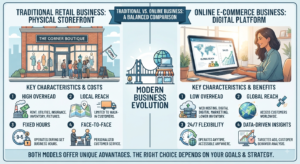 Before diving into specific business ideas, let’s understand what makes online businesses unique.
Defining an Online Business
An online business is any business that operates primarily or entirely through the internet, with transactions, marketing, customer service, and/or product delivery happening online.
Key characteristics:
- Internet-dependent: Primary business activities happen online
- Global reach: Can serve customers anywhere (vs. local-only)
- Lower overhead: No physical storefront or location required
- Digital-first: Leverages technology for operations
- Scalable: Can grow revenue without proportional cost increases
Online Business vs. Traditional Business
| Aspect | Traditional Business | Online Business |
|---|---|---|
| Startup costs | $10,000-$100,000+ | $100-$10,000 |
| Location requirement | Physical location needed | Work from anywhere |
| Customer reach | Local/regional | Global |
| Operating hours | Limited (9-5, etc.) | 24/7 |
| Overhead costs | High (rent, utilities, staff) | Low (hosting, software) |
| Time to launch | 3-12 months | 1 week to 3 months |
| Inventory needed | Often yes | Sometimes no (dropshipping, digital) |
| Scalability | Limited (physical constraints) | High (digital scalability) |
| Marketing reach | Local advertising | Global digital marketing |
| Exit potential | 2-3x annual profit | 3-5x annual profit |
Types of Online Business Models
1. E-Commerce (Selling Physical Products)
- Traditional inventory
- Dropshipping
- Print-on-demand
- Subscription boxes
2. Service-Based
- Freelancing (covered in separate article)
- Consulting
- Agencies
- Done-for-you services
3. Digital Products
- Online courses
- Ebooks/guides
- Software/apps
- Templates and tools
- Stock media
4. Content & Advertising
- Blogs with ads
- YouTube channels
- Podcasts
- Niche websites
5. Affiliate & Lead Generation
- Affiliate marketing
- Lead generation sites
- Comparison/review sites
6. Platforms & Marketplaces
- Online marketplaces
- Community platforms
- SaaS (Software as a Service)
7. Subscription & Membership
- Membership sites
- Subscription boxes
- Online communities
- Premium content
The Online Business Spectrum
Not all online businesses are equally “online”:
100% Online (Pure Digital):
- SaaS business
- Digital course platform
- Affiliate marketing site
- Advantage: Lowest overhead, highest margins, most scalable
- Challenge: Often competitive, requires technical skills
Mostly Online (Physical Component):
- E-commerce (you ship products)
- Print-on-demand
- Advantage: Tangible products easier to understand/sell
- Challenge: Inventory, shipping, returns
Hybrid (Online + Offline):
- Local service business with online booking
- Online store with local pickup
- Advantage: Less competition, serve local + online
- Challenge: Not fully location-independent
Advantages of Online Businesses
1. Low Barrier to Entry
- Start with $100-1,000 (many cases)
- No storefront lease
- No inventory required (some models)
- Minimal equipment (laptop + internet)
2. Location Independence
- Work from home
- Work while traveling
- Hire globally
- Serve customers worldwide
3. Flexibility
- Set your own hours
- Work around life commitments
- Scale up or down as needed
4. Scalability
- Add customers without proportional cost increase
- Digital products: sell unlimited copies
- Automation handles growth
- Can scale to 7-8 figures with small team
5. Lower Operating Costs
- No retail space rent ($2,000-10,000/month saved)
- Lower utilities
- Smaller team (or solo)
- Remote contractors vs. full-time employees
6. Data & Testing
- Track everything (analytics)
- A/B test quickly
- Pivot based on data
- Understand customers deeply
7. Exit Opportunities
- Online businesses sell for 3-5x annual profit
- Multiple marketplaces (Flippa, Empire Flippers, FE International)
- Growing buyer market
Challenges of Online Businesses
1. High Competition
- Global competition (compete with entire world)
- Low barriers = more competitors
- Constant innovation required
2. Technology Dependence
- Platform changes (Google algorithm, Facebook policy)
- Technical issues can halt business
- Requires ongoing tech learning
3. Customer Acquisition
- No foot traffic
- Must actively drive traffic (ads, SEO, social)
- Marketing skills critical
- Can be expensive
4. Isolation
- Work alone initially
- Miss team collaboration
- Must proactively build community
5. Feast or Famine
- Income can fluctuate wildly
- Seasonal variations
- Algorithm changes impact overnight
6. Self-Discipline Required
- No boss enforcing work
- Easy to procrastinate
- Must set own structure
7. Initial Learning Curve
- Website building
- Marketing tactics
- Analytics and tools
- Business operations
Who Thrives in Online Business?
✅ You’re likely to succeed if you:
- Self-motivated (work without supervision)
- Comfortable with technology
- Adaptable (things change constantly)
- Patient (takes 6-18 months usually)
- Willing to learn continuously
- Good at problem-solving
- Financially stable (can handle income fluctuation)
- Persistent (won’t quit after setbacks)
❌ Online business may not suit you if you:
- Need guaranteed paycheck
- Prefer clear instructions/structure
- Avoid technology
- Give up easily
- Can’t handle uncertainty
- Want immediate results
- Need social interaction daily
- Are risk-averse
Income Potential Reality Check
Realistic income progression for successful online business:
Months 1-6:
- Income: $0-500/month typically
- Reality: Building foundation, learning
- Many quit here (seeing no results yet)
Months 7-12:
- Income: $500-2,000/month
- Reality: Starting to gain traction
- Still side hustle level
Year 2:
- Income: $2,000-6,000/month
- Reality: Can supplement or replace salary
- Serious business emerging
Year 3+:
- Income: $5,000-20,000+/month (if successful)
- Reality: Full-time business supporting lifestyle
- Top performers exceed $50,000/month
Important: These are successful businesses. Many never get past month 6.
Online Business Success Rate
The hard truth:
- 90% of online businesses fail within first year
- 95% fail within 5 years
- Only 5% reach profitability above $100,000/year
Why most fail:
- Gave up too early (quit at month 4-6)
- Poor business idea (no market demand)
- Inadequate marketing
- Undercapitalized (ran out of money)
- Didn’t validate before building
- Wrong business model for skills/situation
Why the 10% succeed:
- Validated demand first
- Consistent execution
- Adapted based on feedback
- Adequate funding/runway
- Strong marketing
- Chose right business for their strengths
- Didn’t quit during difficult months
This guide focuses on increasing your odds of being in the successful 10%.
The Online Business Landscape
Understanding current trends helps you choose a business with tailwinds, not headwinds.
Market Size & Growth
Global e-commerce:
- $6.3 trillion in 2024
- Growing 10% annually
- Expected $8.1 trillion by 2026
U.S. online business statistics:
- 26.5 million online businesses
- 12% growth year-over-year
- E-commerce represents 15% of total retail (rising)
Market maturity:
- No longer “early days”
- Established infrastructure (Shopify, Amazon, platforms)
- Easier to start than ever
- More competitive than ever
Trending Business Models (2025)
What’s HOT (growing demand, good opportunities):
1. AI-Enhanced Services 🔥
- AI consulting for small businesses
- AI content creation services
- Custom GPT development
- AI automation implementation
- Why hot: Businesses need help navigating AI, high demand
- Competition: Low (still emerging)
2. Sustainability & Eco Products 🌱
- Eco-friendly product lines
- Sustainable fashion
- Zero-waste products
- Carbon offset services
- Why hot: Consumer demand growing 25%/year
- Competition: Moderate
3. Health & Wellness Digital Products 💪
- Mental health apps/programs
- Fitness coaching online
- Nutrition planning
- Biohacking content
- Why hot: $4.5 trillion wellness industry growing
- Competition: High but fragmented
4. Remote Work Solutions 💼
- Virtual team building services
- Remote work software
- Online collaboration tools
- Virtual office services
- Why hot: Remote work now permanent for many
- Competition: Moderate to high
5. Personalization Services 🎯
- Custom product creation
- Personalized nutrition
- Tailored learning programs
- Customized gift businesses
- Why hot: Consumers want unique, not mass-produced
- Competition: Moderate
6. Short-Form Video Content Creation 📱
- TikTok/Reels editing services
- Short-form video strategy
- Content repurposing agencies
- Why hot: Massive platform investment in short video
- Competition: Low to moderate (skills gap)
7. Elder Care & Senior Services 👴
- Online senior communities
- Tech support for seniors
- Senior-focused products
- Aging-in-place solutions
- Why hot: 10,000 people turn 65 daily in U.S.
- Competition: Low (underserved market)
8. Niche Subscription Boxes 📦
- Highly specialized boxes (not generic)
- Subscription boxes for specific hobbies
- Cultural/international subscriptions
- Why hot: Subscription economy still growing
- Competition: High in broad categories, low in micro-niches
What’s COOLING (declining or saturated):
1. Generic Dropshipping ❄️
- AliExpress → Shopify model
- Why cooling: Saturated, low margins, long shipping
- Alternative: Branded dropshipping or print-on-demand
2. Broad Affiliate Blogs ❄️
- General review sites
- Why cooling: Google favors authority/expertise
- Alternative: Deep niche authority sites
3. Generic Online Courses ❄️
- “How to make money online” courses
- Why cooling: Market exhausted
- Alternative: Highly specific skill courses
4. Basic Print-on-Demand ❄️
- Generic t-shirt designs
- Why cooling: Race to bottom on price
- Alternative: Niche designs for specific communities
5. Cryptocurrency-Based Businesses ❄️
- NFT marketplaces
- Crypto education
- Why cooling: Market maturity, regulation uncertainty
- Alternative: Wait for next cycle or blockchain utility focus
Platform Trends
Growing platforms (where to build):
- TikTok Shop: E-commerce integration, massive reach
- YouTube Shorts: Monetization opportunities expanding
- Substack: Newsletter-based businesses thriving
- Shopify: Continual feature expansion
- Discord: Community-based businesses
Declining platforms:
- Traditional blogging: Harder to monetize via ads
- Facebook organic reach: Near zero for businesses
- Twitter/X: Uncertain future, volatility
Consumer Behavior Shifts
What consumers want in 2025:
1. Authenticity over polish
- Real people, not perfect influencers
- Behind-the-scenes content
- Founder stories
2. Values alignment
- Shop from businesses matching their values
- Sustainability, ethics matter
- Willing to pay premium for aligned values
3. Community over transaction
- Want to belong to brand communities
- Engage beyond purchase
- Membership models growing
4. Convenience uber alles
- Same-day delivery expectations
- One-click purchasing
- Seamless experiences
5. Education + Entertainment (Edutainment)
- Want to learn while being entertained
- TikTok teaching moments
- Short-form educational content
6. Personalization
- Expect tailored experiences
- Custom products
- Personalized recommendations
Economic Factors
Recession-resistant business models:
- Essential services
- Budget-friendly products
- Self-improvement/education (people invest in themselves)
- Small luxuries (lipstick effect)
- Repair/maintenance services
Recession-vulnerable:
- High-ticket luxury items
- Discretionary entertainment
- Travel-related
- Non-essential subscriptions
2025 economic context:
- Inflation moderating but prices remain high
- Consumers more price-sensitive
- Value for money critical
- Trade-down from premium to mid-tier
Smart positioning: Offer premium quality at accessible prices
Technology Enablers
What makes online businesses easier in 2025:
AI Tools:
- Content creation (ChatGPT, Jasper, Claude)
- Design (Midjourney, DALL-E, Canva AI)
- Customer service (AI chatbots)
- Analytics and insights
- Impact: One person can do work of five
No-Code Platforms:
- Shopify (e-commerce)
- Webflow (websites)
- Bubble (web apps)
- Zapier (automation)
- Impact: Build complex businesses without coding
Payment Processing:
- Stripe, PayPal integration
- Buy-now-pay-later (Klarna, Affirm)
- Cryptocurrency options
- Impact: Frictionless global transactions
Marketing Automation:
- Email automation (ConvertKit, Klaviyo)
- Social media scheduling (Buffer, Later)
- Ad automation (Facebook Advantage+)
- Impact: Marketing on autopilot
Logistics Solutions:
- Fulfillment networks (Amazon FBA, ShipBob)
- Print-on-demand (Printful, Printify)
- Dropshipping apps (Oberlo, Spocket)
- Impact: Sell physical products without inventory
Competitive Landscape
How competitive is online business in 2025?
High competition:
- E-commerce (general products)
- Digital courses (broad topics)
- Affiliate marketing
- Content creation
Moderate competition:
- Specialized services
- Niche products
- B2B services
- Local-to-online hybrid
Low competition:
- Emerging technologies (AI services)
- Underserved demographics (seniors)
- Hyper-niche products
- Complex B2B solutions
Strategy: Go narrow and deep, not broad and shallow
How to Choose the Right Online Business {#choose-right}
 With hundreds of possible online businesses, how do you choose?
The Three-Circle Framework
The perfect online business sits at intersection of:
1. PASSION/INTEREST
What you enjoy doing (won’t burn out)
2. SKILLS/STRENGTHS
What you’re good at (can deliver quality)
3. MARKET DEMAND/PROFIT
What people will pay for (sustainable business)
❌ Only passion: Hobby, not business (starving artist)
❌ Only skills: Boring, will quit (joyless expertise)
❌ Only profit: Soulless, difficult to maintain (chasing money)
✅ All three: Sustainable, enjoyable, profitable business
Assessment Questions
Answer these honestly:
Passion/Interest Assessment
What topics do you naturally gravitate toward?
- What do you read about in free time?
- What do you watch on YouTube?
- What could you talk about for hours?
- What problems do you enjoy solving?
List 5 topics/activities you’re passionate about:
Skills/Strengths Assessment
What are you naturally good at?
- What do people ask you for help with?
- What tasks feel easy to you but hard to others?
- What have you been formally trained in?
- What have you done professionally?
Professional skills:
Natural talents:
Learned skills:
Market Demand Assessment
Of your passions, which have market demand?
Test with these questions:
- Are people already paying for solutions? (Proof of market)
- Is the market growing or shrinking? (Trends)
- Are existing solutions inadequate? (Gap you can fill)
- Can customers afford to pay? (Economic viability)
Quick validation:
- Google search your idea + “buy” (see if people search to purchase)
- Check Amazon/Etsy for similar products (do they sell?)
- Look at competitors (are they making money?)
- Survey potential customers (would they pay?)
Your Business Fit Score
For each business idea you’re considering, rate 1-10:
Example: Online Fitness Coaching
Passion: 9/10 (Love fitness and helping people)
Skills: 7/10 (Certified trainer, but new to online delivery)
Market Demand: 9/10 (Huge market, proven willingness to pay)
Total Score: 25/30 (Strong fit)
Your idea: ________________________
Passion: ___/10
Skills: ___/10
Market Demand: ___/10
Total Score: ___/30
Scoring:
- 25-30: Excellent fit, strong potential
- 20-24: Good fit, worth pursuing
- 15-19: Moderate fit, may need to build skills or find better idea
- Below 15: Poor fit, reconsider
Practical Constraints to Consider
Time availability:
- 5-10 hours/week: Service business, freelancing, content creation
- 10-20 hours/week: E-commerce, course creation, small agency
- 20-40 hours/week: Full-scale business, software, larger ventures
Financial investment:
- $0-500: Content, affiliate, freelancing, dropshipping
- $500-5,000: E-commerce with inventory, course production, tools
- $5,000+: Software development, agency, inventory-based business
Risk tolerance:
- Low risk: Service-based, freelancing (get paid before delivering)
- Medium risk: Small product inventory, course creation
- High risk: Large inventory, software development, platform building
Technical ability:
- Low-tech: Coaching, content creation, social media management
- Medium-tech: E-commerce (Shopify), online courses, affiliate sites
- High-tech: Software development, app creation, complex platforms
Timeline to income:
- Fast (1-3 months): Freelancing, service business, consulting
- Medium (3-6 months): E-commerce, course creation, affiliate
- Slow (6-12+ months): Content sites, software, complex businesses
Business Model Decision Tree
Start here: What appeals to you more?
Option A: Selling products (physical or digital)
→ Go to Product-Based section
Option B: Selling services (your time/expertise)
→ Go to Service-Based section
Option C: Building audience/platform
→ Go to Content/Media section
Option D: Creating tools/software
→ Go to Technology section
The “Hell Yes” Test
Before committing to a business idea:
Ask yourself:
- Can I see myself doing this for 2+ years?
- Would I work on this even if growth was slow?
- Do I get excited talking about this topic?
- Would I do this even if I didn’t need money? (passion test)
If any answer is “no” or “maybe”—reconsider.
You need “HELL YES” conviction to push through difficult early months.
Common Selection Mistakes
Mistake #1: Chasing trends blindly
- Seeing “NFTs are hot!” and jumping in
- By the time you notice trend, often too late
- Better: Find timeless needs, use current trends as delivery method
Mistake #2: Choosing solely based on profit potential
- “This makes $100k/year!” (but you hate it)
- Burnout inevitable
- Better: Choose profitable idea you also enjoy
Mistake #3: Picking business beyond skill level
- Want to build SaaS with no coding experience
- Won’t learn fast enough to compete
- Better: Build on existing skills, learn incrementally
Mistake #4: Ignoring market validation
- “I think people would love this!” (with no proof)
- Build for months, launch to crickets
- Better: Validate BEFORE building
Mistake #5: Trying to serve everyone
- “My product is for anyone who needs X”
- Too broad, ineffective marketing
- Better: Specific niche, specific customer
Quick-Start Recommendation by Situation
Situation 1: “I have $500, 10 hours/week, need income in 3 months”
→ Best options: Service-based freelancing, consulting, virtual assistance
Situation 2: “I have $5,000, 20 hours/week, can wait 6-12 months”
→ Best options: E-commerce with inventory, course creation, niche site
Situation 3: “I have $0, 15 hours/week, technical skills”
→ Best options: Freelance development, SaaS tool, app development
Situation 4: “I have $2,000, 30 hours/week, creative skills”
→ Best options: Digital product business, content creation, design agency
Situation 5: “I have $10,000, 40 hours/week, business experience”
→ Best options: Full-scale e-commerce, agency, software business
Your Business Selection Worksheet
Top 3 business ideas I’m considering:
Idea #1: _______________________________
- Passion score: ___/10
- Skills score: ___/10
- Market demand score: ___/10
- Total: ___/30
Idea #2: _______________________________
- Passion score: ___/10
- Skills score: ___/10
- Market demand score: ___/10
- Total: ___/30
Idea #3: _______________________________
- Passion score: ___/10
- Skills score: ___/10
- Market demand score: ___/10
- Total: ___/30
Winner (highest score): _______________________________
Next step: Validate this idea before building (see Validation section)
E-Commerce & Product-Based Businesses {#ecommerce}
 Let’s dive into specific online business models. We’ll start with selling physical products.
1. Print-on-Demand Business ⭐ LOW INVESTMENT
What it is: Create designs, upload to platform, products printed/shipped only when ordered (zero inventory).
How it works:
- Create designs (t-shirts, mugs, posters, phone cases, etc.)
- Upload to POD platform (Printful, Printify, Redbubble)
- Platform prints & ships when customer orders
- You keep profit margin
Investment needed: $0-500
- Designs (DIY or hire designer: $0-300)
- Website (Shopify: $39/month or use free marketplace)
- Marketing ($0-200 to start)
Income potential: $500-5,000/month
- Beginner: $200-800/month
- Established: $2,000-5,000/month
- Top sellers: $10,000+/month
Time to profit: 1-6 months
Difficulty: ⭐⭐ (Easy to start, hard to stand out)
Best platforms:
Integrated POD + Marketplace:
- Redbubble: Zero setup, upload designs, they handle everything (lowest margins)
- TeePublic: Similar to Redbubble
- Society6: Art-focused, higher-end products
POD + Your Store:
- Printful: Integrates with Shopify, Etsy, Amazon
- Printify: Similar to Printful, often cheaper
- SPOD: Shopify’s official POD partner
Product types:
- Apparel (t-shirts, hoodies, leggings)
- Home décor (throw pillows, wall art, blankets)
- Accessories (phone cases, tote bags, stickers)
- Stationery (notebooks, planners)
- Drinkware (mugs, water bottles)
Profit margins:
Example: T-shirt
- Retail price: $25
- Base cost (print + shirt): $12
- Platform fee: $0 (Printful) or 20% (Redbubble = $5)
- Your profit: $13 (Printful) or $8 (Redbubble)
To make $2,000/month:
- Need ~150 sales/month ($13 profit each)
- 5 sales per day
Success strategies:
1. Niche down specifically
- ❌ Generic: “Funny t-shirts”
- ✅ Specific: “T-shirts for cat-loving nurses”
- Easier to market, less competition
2. Leverage trends intelligently
- Use Google Trends, TikTok trends
- Create designs fast for trending topics
- Example: TV show launches, viral memes
3. Build brand, not just products
- Cohesive aesthetic
- Target specific audience
- Tell story
4. Use multiple products per design
- One good design → 20 products
- Increases revenue per design
5. SEO optimize listings
- Use keywords in titles, descriptions
- Especially important on Etsy, Redbubble
Pros:
✅ Zero inventory risk
✅ Low startup cost
✅ No shipping/fulfillment hassles
✅ Easy to start
✅ Scalable
✅ Can run while traveling
Cons:
❌ Lower profit margins than traditional e-commerce
❌ Very competitive
❌ Quality control limited (you don’t handle products)
❌ Shipping times can be long (7-14 days)
❌ Difficult to build brand loyalty
Realistic expectations:
Month 1-2:
- Learning platform, creating designs
- First few sales ($0-100)
Month 3-6:
- 50-100 designs uploaded
- $200-800/month income
Month 7-12:
- 200+ designs, established store
- $1,000-3,000/month
Year 2:
- Multiple stores, outsourcing design
- $3,000-8,000/month (if successful)
When to choose POD:
✅ You’re creative or can hire designers
✅ Want low-risk entry to e-commerce
✅ Don’t have money for inventory
✅ Want passive-ish income
✅ Enjoy design/visual work
❌ Avoid if you want highest profit margins (traditional e-commerce better)
[Internal Link: Fund POD startup with income from “Best Side Hustles for 2025: Make Extra Money on Your Schedule”]
2. Dropshipping Business
What it is: Sell products online without holding inventory; supplier ships directly to customer.
How it works:
- Set up online store (Shopify)
- Add products from suppliers (AliExpress, CJ Dropshipping, Spocket)
- Customer orders from your store
- You forward order to supplier
- Supplier ships to customer
- You keep markup
Investment needed: $500-3,000
- Shopify: $39/month
- Domain: $15/year
- Apps/plugins: $30-100/month
- Product samples: $100-200
- Marketing budget: $300-2,500 (critical)
Income potential: $1,000-10,000/month
- Most beginners: $500-2,000/month
- Established stores: $5,000-15,000/month
- Top performers: $50,000+/month
Time to profit: 3-6 months (marketing dependent)
Difficulty: ⭐⭐⭐⭐ (Easy to start, very hard to succeed)
Dropshipping models:
1. General Store
- Sell variety of products
- Test multiple niches
- Pro: Flexibility to pivot
- Con: Hard to build brand, ineffective marketing
2. Niche Store
- Focus on one product category
- Example: Pet products, fitness equipment
- Pro: Easier to market, build authority
- Con: Limited product range
3. One-Product Store
- Sell single hero product
- Deep focus, perfect for Facebook ads
- Pro: Laser-focused marketing
- Con: All eggs in one basket
Recommendation: Start with niche store
Finding products:
Supplier platforms:
- AliExpress: Largest selection, longest shipping (15-30 days)
- CJ Dropshipping: Faster shipping, better quality control
- Spocket: US/EU suppliers (faster shipping, higher costs)
- Modalyst: Brand-name products
Product selection criteria:
✅ Solves specific problem
✅ Not available in local stores
✅ High perceived value vs. cost
✅ Profit margin 3x cost minimum
✅ Lightweight (lower shipping costs)
✅ Not fragile (fewer returns)
Avoid:
❌ Highly seasonal products (unless intentional)
❌ Branded/trademarked items (legal issues)
❌ Products with huge Amazon presence (can’t compete)
Profit margins:
Example: Fitness resistance bands
- Supplier cost: $8
- Shipping: $3
- Total cost: $11
- Retail price: $39.99
- Payment processing (3%): $1.20
- Gross profit: $27.79
After expenses:
- Marketing cost per sale: $15 (Facebook ads)
- Net profit: $12.79 per sale
To make $5,000/month profit:
- Need ~391 sales/month
- ~13 sales/day
- Marketing spend: ~$5,865/month
- Gross revenue: ~$15,636/month
Math is tight. Marketing efficiency is everything.
Success strategies:
1. Branded dropshipping
- Create brand identity
- Custom packaging (many suppliers offer)
- Build real business, not just arbitrage
2. Focus on marketing
- Dropshipping is 80% marketing, 20% product
- Learn Facebook ads or TikTok ads
- Budget $500-2,000/month for ads minimum
3. Fast shipping is critical
- Use US/EU suppliers when possible
- Or China warehouses with 5-7 day shipping
- 30-day AliExpress shipping = bad reviews
4. Exceptional customer service
- Respond within 24 hours
- Proactive communication
- Handle issues generously
- Build trust despite not controlling fulfillment
5. Test products systematically
- Don’t marry first product
- Test 5-10 products
- Double down on winners
Pros:
✅ Low startup cost (vs. traditional inventory)
✅ No inventory management
✅ Easy to test products
✅ Scalable
✅ Can run from anywhere
Cons:
❌ Very competitive (low barrier = lots of competition)
❌ Thin profit margins
❌ Shipping issues (delays, quality, tracking)
❌ No control over fulfillment
❌ Hard to build sustainable brand
❌ Suppliers can run out of stock
❌ Returns/refunds cut into profits
Realistic expectations:
Month 1-3:
- Store setup, testing products
- Losing money on ads (learning)
- $0-500 revenue, negative profit
Month 4-6:
- Found winning product(s)
- Breaking even or small profit
- $2,000-5,000 revenue, $200-1,000 profit
Month 7-12:
- Optimized ads, scaling winners
- $5,000-15,000 revenue, $1,000-4,000 profit
Note: Most dropshippers fail or quit before month 6. Success requires persistence through learning phase.
When to choose dropshipping:
✅ You have marketing budget ($1,000+ to test)
✅ Willing to learn paid advertising
✅ Comfortable with uncertainty
✅ Patient during testing phase
✅ Want to learn e-commerce with low risk
❌ Avoid if you want passive income (requires active marketing)
❌ Avoid if you can’t afford $1,000+ ad testing budget
❌ Avoid if you need immediate profit
3. Amazon FBA (Fulfillment by Amazon)
What it is: Sell products on Amazon; Amazon stores, packs, and ships your inventory.
How it works:
- Source products (wholesale, private label, or manufacture)
- Send inventory to Amazon warehouse
- Create product listings on Amazon
- Customer orders
- Amazon fulfills and ships
- You keep profit (after Amazon fees)
Investment needed: $3,000-10,000
- Initial inventory: $2,000-7,000
- Amazon seller account: $39.99/month
- Product samples: $100-300
- Photography: $100-500
- UPC codes: $30
- Shipping to Amazon: $200-500
Income potential: $2,000-20,000+/month
- Beginners: $1,000-3,000/month
- Established: $5,000-15,000/month
- Successful brands: $50,000+/month
Time to profit: 3-9 months
Difficulty: ⭐⭐⭐⭐ (Requires capital, complex, competitive)
Amazon FBA models:
1. Private Label
- Find generic product
- Add your brand/packaging
- Sell as branded product
- Most common approach
2. Wholesale
- Buy name-brand products wholesale
- Resell on Amazon
- Lower margins, easier to start
3. Retail Arbitrage
- Buy clearance/sale items retail
- Resell on Amazon
- Time-intensive, not scalable
Recommendation: Private label offers best long-term potential
Finding products to sell:
Criteria for good Amazon product:
✅ Sells 300+ units/month (demand exists)
✅ Priced $15-50 (sweet spot)
✅ Small/lightweight (lower FBA fees)
✅ Few reviews (<500 on top listings = less competition)
✅ 3x profit margin after all fees
✅ Evergreen (not seasonal/trendy)
✅ Not fragile
✅ Not restricted category
Tools for product research:
- Jungle Scout ($29-79/month)
- Helium 10 ($29-99/month)
- AMZScout ($30-50/month)
Process:
- Use tool to find product categories meeting criteria
- Order samples from Alibaba suppliers
- Test quality
- Calculate total costs + fees
- If profitable, order inventory
Costs breakdown example:
Product: Yoga mat
Upfront costs:
- Manufacturing (500 units @ $4 each): $2,000
- Shipping to Amazon (sea freight): $400
- Photography/listing: $200
- Total investment: $2,600
Per-unit economics:
- Manufacturing cost: $4.00
- Shipping to Amazon: $0.80
- Landed cost: $4.80
Sale price: $24.99
Amazon fees (referral + FBA): $9.37
Cost of goods: $4.80
Advertising (PPC): $3.00
Gross profit per unit: $7.82
Profit margin: 31%
To make $5,000/month:
- Need ~640 sales/month
- ~21 sales/day
- Inventory: 640 × $4.80 = $3,072 tied up monthly
Success strategies:
1. Product differentiation
- Don’t sell identical product to competitors
- Add features, improve packaging, bundle items
- Example: Not just yoga mat—yoga mat with alignment markers + carrying strap
2. Listing optimization
- Professional photos (hire photographer)
- Keyword-rich title
- Bullet points highlighting benefits
- A+ content
- Great listings convert 2-3x better
3. Launch strategy critical
- First 30 days determine ranking
- Run aggressive PPC campaigns
- Consider launch service (deals, promotions)
- Get reviews fast (Request a Review button, follow-up emails)
4. Master Amazon PPC
- Sponsored Products ads
- Start broad, optimize to profitable keywords
- Minimum $20/day ad spend
5. Protect your listing
- Register brand (Amazon Brand Registry)
- Prevents hijackers
- Unlocks A+ content
Pros:
✅ Access to massive customer base (300M+ Amazon customers)
✅ Amazon handles fulfillment (storage, packing, shipping, returns)
✅ Fast shipping (Prime badge)
✅ Scalable (Amazon handles growth)
✅ Can build sellable brand (3-4x annual profit exit)
Cons:
❌ High upfront investment (inventory)
❌ Complex fee structure (eats margins)
❌ Intense competition
❌ Amazon policy changes (can kill product overnight)
❌ Account suspension risk (strict rules)
❌ Long-term storage fees (inventory must move)
❌ Amazon owns customer relationship (can’t build email list)
❌ Race to bottom on price
Realistic expectations:
Month 1-3:
- Research, source, order inventory
- Waiting for manufacturing/shipping
- $0 revenue
Month 4-6:
- Launch product
- Heavy ad spend (losing money)
- $3,000-8,000 revenue, breakeven or small loss
Month 7-12:
- Optimized, gaining reviews
- $8,000-15,000 revenue, $2,000-5,000 profit
- Reorder inventory
Year 2:
- Mature product, add SKUs
- $15,000-30,000 revenue, $5,000-10,000 profit
Challenges:
- 50% of Amazon sellers fail in first year
- Requires capital cushion (don’t invest last $5,000)
- Must reinvest profits into inventory for growth
When to choose Amazon FBA:
✅ Have $5,000-10,000 investment capital
✅ Comfortable with inventory risk
✅ Want access to massive marketplace
✅ Willing to learn complex platform
✅ Patient (takes 6-12 months to profit)
❌ Avoid if you have limited capital (too risky)
❌ Avoid if you want quick returns (slow to profit)
❌ Avoid if you can’t handle complexity
4. Subscription Box Business
What it is: Curate products, subscribers receive box monthly/quarterly.
How it works:
- Choose niche (beauty, snacks, books, pets, etc.)
- Source products (wholesale, partnerships)
- Create subscription tiers
- Market to build subscriber base
- Fulfill boxes monthly
- Collect recurring revenue
Investment needed: $2,000-10,000
- Initial inventory: $1,000-5,000
- Packaging/boxes: $200-500
- Website (Cratejoy or Shopify): $30-100/month
- Marketing: $500-3,000
- Shipping materials: $200-500
Income potential: $2,000-20,000/month
- 100 subscribers × $35/box = $3,500/month revenue
- After costs (product, shipping, packaging): ~40% margin = $1,400 profit
- 500 subscribers = $7,000 profit/month
Time to profit: 6-12 months
Difficulty: ⭐⭐⭐⭐ (Logistics complex, competitive)
Successful subscription box niches:
Underserved (good opportunities):
- Hobby-specific: Specific crafts, games, activities
- Dietary-specific: Keto, vegan, allergen-free snacks
- Cultural: International snacks, books from specific countries
- Professional: Tools for specific professions
- Pet-specific: Boxes for reptiles, birds (not just dogs/cats)
- Wellness: Mental health, meditation, self-care
- Sustainable: Eco-friendly household products
Saturated (avoid):
- Generic beauty boxes
- General snack boxes
- Broad “self-care” boxes
Key: Go micro-niche, not broad
Economics example:
Niche: Monthly book box for sci-fi fans
Subscription price: $39.99/month
Costs per box:
- Book (wholesale): $8
- 2-3 themed items: $5
- Box/packaging: $3
- Shipping (USPS): $5
- Payment processing (3%): $1.20
- Total cost: $22.20
- Gross margin: $17.79 (45%)
With 200 subscribers:
- Monthly revenue: $7,998
- Total costs: $4,440
- Gross profit: $3,558
- Operating expenses (marketing, tools, labor): $1,500
- Net profit: ~$2,058/month
Success strategies:
1. Niche down radically
- Not “book box” → “Sci-fi book box for women”
- Not “pet box” → “Box for senior dogs with joint issues”
- Easier to market, build community
2. Build community, not just box
- Facebook group for subscribers
- Exclusive content
- Unboxing experiences
- Member-only perks
3. Leverage curation expertise
- Position as curator/expert
- Share stories behind items
- Educational component
4. Retention is everything
- Subscriber lifetime value critical
- Focus on reducing churn
- Personalization increases retention
- Surprise & delight
5. Partner with brands
- Get products at cost or free (exposure for them)
- Reduces product costs
- Expands what you can include
Pros:
✅ Recurring revenue (predictable)
✅ Build loyal community
✅ Creative & fun
✅ Premium pricing possible
✅ Can become valuable asset (sell business for 3-5x ARR)
Cons:
❌ Logistics intensive (fulfillment every month)
❌ Customer acquisition expensive
❌ High churn (subscribers cancel)
❌ Inventory risk (must order before knowing exact subscriber count)
❌ Shipping costs eat margins
❌ Seasonal fluctuations (December high, January drop)
Realistic expectations:
Month 1-3:
- Build website, source products
- First 10-30 subscribers (friends, family)
- Losing money (acquiring customers)
Month 4-8:
- 50-150 subscribers
- Breakeven or small profit
- Refining box contents based on feedback
Month 9-18:
- 200-500 subscribers
- $2,000-8,000 profit/month
- Optimized operations
Critical metric: Churn rate
- 5-10% monthly churn is typical
- Need constant new subscriber acquisition
- Retention campaigns critical
When to choose subscription box:
✅ You’re passionate about specific niche
✅ Enjoy curation and discovery
✅ Have logistics capability (or partner)
✅ Comfortable with monthly fulfillment grind
✅ Can invest $5,000-10,000
❌ Avoid if you want hands-off business
❌ Avoid if you can’t handle physical fulfillment
❌ Avoid if you’re in saturated niche
5. Handmade Products (Etsy Business)
What it is: Create handmade products, sell on Etsy or own website.
How it works:
- Make products by hand (jewelry, home décor, art, etc.)
- List on Etsy marketplace
- Take orders
- Create product
- Ship to customer
Investment needed: $200-2,000
- Materials/supplies: $100-1,000
- Tools/equipment: $0-500 (if don’t have)
- Etsy fees: $0.20 per listing
- Photography setup: $50-200
- Packaging: $50-300
Income potential: $500-5,000/month
- Part-time: $500-2,000/month
- Full-time: $3,000-8,000/month
- Top sellers: $15,000+/month
Time to profit: 1-4 months
Difficulty: ⭐⭐⭐ (Moderate—creative skill required)
Popular handmade categories:
High demand on Etsy:
- Personalized gifts (custom names, dates)
- Wedding items (invitations, décor, favors)
- Jewelry (especially personalized)
- Home décor (signs, wall art)
- Planners/stationery
- Baby items (clothes, blankets, milestone items)
- Pet accessories
- Digital downloads (printables, templates)
Trending:
- Sustainability (upcycled, eco-friendly materials)
- Minimalist aesthetic
- Boho/cottagecore style
- Personalization
Economics example:
Product: Personalized wood family sign
Costs:
- Wood: $5
- Stain/paint: $2
- Hardware/accessories: $1
- Labor (2 hours @ $15/hr): $30
- Packaging: $2
- Total cost: $40
Selling price: $85
Etsy fees (6.5% + $0.20): $5.73
Payment processing (3% + $0.25): $2.80
Shipping (charged to customer): $0
Profit per item: $36.47
To make $3,000/month:
- Need ~82 sales/month
- ~3 sales/day
- ~6 hours/day production time
Reality: Time-intensive. Hard to scale beyond $5,000/month solo.
Success strategies:
1. Niche specialization
- Not “jewelry” → “Personalized birthstone jewelry for mothers”
- Not “home décor” → “Farmhouse wood signs with family names”
2. Professional photography
- Quality photos = 3x sales
- Natural lighting
- Lifestyle shots (in use)
- Multiple angles
- Invest in light box ($50)
3. SEO optimization critical
- Etsy is search engine
- Keywords in titles, tags, descriptions
- Research what buyers search
- Tools: eRank, Marmalead
4. Fast shipping
- Etsy rewards fast fulfillment
- Offer 1-3 day processing
- Provides tracking
5. Stellar customer service
- Respond within 24 hours
- Go above and beyond
- Reviews are everything
- 5-star reviews boost ranking
6. Expand beyond Etsy
- Build own website (Shopify)
- Direct traffic there (avoid Etsy fees)
- Build email list
- Social media following
Pros:
✅ Creative and fulfilling work
✅ Low startup cost
✅ Access to established marketplace (Etsy traffic)
✅ Can start part-time
✅ Premium pricing possible (handmade commands higher prices)
✅ Build real brand
Cons:
❌ Time-intensive (you make everything)
❌ Hard to scale (limited by your time)
❌ Etsy fees eat into profits (9-12% total)
❌ Competitive marketplace
❌ Algorithm changes affect visibility
❌ Physical product challenges (inventory, shipping)
Realistic expectations:
Month 1:
- Set up shop, list products
- First few sales (5-10)
- $100-500 revenue
Month 2-4:
- Building reviews, improving SEO
- 20-50 sales/month
- $500-2,000 revenue
Month 5-12:
- Established shop, steady sales
- 50-150 sales/month
- $2,000-6,000 revenue
- $1,000-3,000 profit
Scaling challenge:
- Can hire help (production assistants)
- Or transition to manufacturing (lose “handmade” appeal)
- Many stay at $3,000-5,000/month sweet spot
When to choose handmade Etsy:
✅ You’re creative and enjoy crafting
✅ Have skill in specific craft
✅ Want to start small and test
✅ Prefer making things to digital work
✅ Can handle repetition (making same thing often)
❌ Avoid if you want passive income (very active)
❌ Avoid if you want to scale big (limited by time)
❌ Avoid if you hate shipping/logistics
Service-Based Online Businesses {#service-based}
Moving from products to services—selling your expertise and time.
6. Freelancing (Covered in Separate Article)
Quick overview:
- Offer services on project basis
- Writing, design, development, marketing, VA, etc.
- $2,000-10,000/month realistic
- Covered in depth in dedicated article
[Internal Link: See complete guide “How to Start Freelancing: Turn Your Skills Into Income”]
7. Online Coaching/Consulting Business ⭐ HIGH PROFIT
What it is: Provide 1-on-1 or group coaching/consulting in your area of expertise.
How it works:
- Identify your expertise (business, health, life, career, etc.)
- Create coaching package/program
- Market your services
- Deliver coaching sessions (Zoom)
- Help clients achieve specific results
Investment needed: $100-2,000
- Website: $50-500
- Scheduling tool (Calendly): $0-10/month
- Zoom Pro: $15/month
- Marketing: $0-1,000
- Certification (optional): $0-2,000
Income potential: $3,000-20,000+/month
- Beginner coaches: $2,000-5,000/month
- Established coaches: $8,000-15,000/month
- Top coaches: $30,000-100,000+/month
Time to profit: 1-6 months
Difficulty: ⭐⭐⭐ (Moderate—requires expertise + sales skills)
Coaching niches:
Business coaching:
- Sales coaching
- Marketing coaching
- Leadership development
- Startup coaching
- Productivity coaching
Career coaching:
- Resume/interview coaching
- Career transition
- Executive coaching
- LinkedIn optimization
Health/Wellness:
- Nutrition coaching
- Fitness coaching
- Mental health coaching
- Sleep coaching
Life coaching:
- Relationship coaching
- Parenting coaching
- Confidence/mindset coaching
- Financial coaching
Specialized:
- ADHD coaching
- Grief coaching
- Author coaching
The more specific, the easier to market and charge premium.
Pricing models:
1. Hourly sessions
- $100-500/hour (depending on niche/experience)
- Good for starting, but limits income
2. Package deals
- 6 sessions over 3 months: $1,500-5,000
- Commitment ensures results
- Higher perceived value
3. Group coaching
- 10 people × $500 = $5,000
- Leverage your time
- Weekly group calls
4. High-ticket programs
- 6-12 month intensive: $10,000-50,000
- For experienced coaches
- Transformational results
Example: Business coaching for solopreneurs
Package: “Six-Figure Solopreneur” 3-month program
Includes:
- 12 1-on-1 sessions (weekly)
- Email support between sessions
- Templates and resources
- Accountability
Price: $3,000
Clients: 8 per cohort (manageable)
Revenue per cohort: $24,000
Time commitment: ~40 hours (3 months)
Effective hourly rate: $600/hour
Run 4 cohorts/year = $96,000 annual revenue
Success strategies:
1. Prove results
- Case studies critical
- Before/after transformations
- Testimonials with specifics
- “Sarah increased revenue from $50k to $200k in 6 months”
2. Niche down
- Not “life coach” → “Burnout recovery coach for healthcare professionals”
- Easier to become known expert
- Can charge premium
3. Content marketing
- Blog, podcast, YouTube
- Give value for free
- Builds authority
- Attracts ideal clients
4. Free discovery calls
- 30-min complimentary session
- Understand their problem
- Present your solution
- Conversion rates: 20-50%
5. Leverage frameworks
- Create proprietary method/system
- “The 5 Pillars of X”
- Makes you unique
- Easier to explain value
Pros:
✅ High profit margins (80-90%)
✅ No inventory or physical products
✅ Deeply rewarding work
✅ Flexible schedule
✅ Can work from anywhere
✅ Builds personal brand
✅ Scalable (group coaching, courses)
Cons:
❌ Requires expertise/credibility
❌ Must be comfortable selling
❌ Time-for-money (unless you scale to group/courses)
❌ Client results vary (can be frustrating)
❌ Emotional labor (holding space for clients)
❌ Feast or famine if not consistent with marketing
Realistic expectations:
Month 1-3:
- Building credibility, website, content
- First 1-3 clients (often discounted)
- $500-2,000/month
Month 4-8:
- 5-8 clients
- Refining offer based on results
- $3,000-6,000/month
Month 9-18:
- 10-15 clients or group programs
- Established authority
- $8,000-15,000/month
Scaling:
- Add group coaching (leverage time)
- Create digital course (passive income)
- Train other coaches (licensing model)
When to choose coaching/consulting:
✅ You have deep expertise in specific area
✅ You enjoy helping people 1-on-1
✅ You’re comfortable with sales
✅ You can produce measurable results
✅ You have credibility (or can build it)
❌ Avoid if you lack expertise (build it first via freelancing)
❌ Avoid if you hate sales conversations
❌ Avoid if you want passive income (active work)
8. Digital Marketing Agency
What it is: Provide marketing services (SEO, PPC, social media, content) to businesses.
How it works:
- Choose service offering (SEO, Facebook ads, etc.)
- Build own skills or hire contractors
- Find clients (outreach, referrals, content marketing)
- Deliver results
- Retain clients on monthly retainers
Investment needed: $500-5,000
- Website: $100-1,000
- Tools/software: $100-500/month
- Contractor costs: $0-2,000 (can start solo)
- Marketing: $0-2,000
Income potential: $5,000-50,000+/month
- Solo operator: $5,000-15,000/month
- Small team: $15,000-40,000/month
- Established agency: $50,000-200,000+/month
Time to profit: 2-6 months
Difficulty: ⭐⭐⭐⭐ (Requires skills + sales + management)
Agency service options:
Specialized (recommended):
- SEO agency (search engine optimization)
- PPC agency (Google Ads, Facebook Ads management)
- Social media agency (content + management)
- Content marketing agency (blog writing, content strategy)
- Email marketing agency (automation, campaigns)
Full-service (harder to position):
- All of the above
- Harder to become known for anything
- More complex operations
Recommendation: Start specialized, expand later
Agency pricing models:
1. Monthly retainer
- $1,000-10,000/month per client
- Ongoing services
- Predictable revenue
- Most common model
2. Project-based
- Website redesign: $5,000-50,000
- Campaign setup: $2,000-10,000
- One-time work
3. Performance-based
- % of ad spend
- % of revenue generated
- Higher risk, higher reward
4. Hybrid
- Retainer + performance bonuses
- Best of both worlds
Example: Facebook Ads Agency
Service: Manage Facebook ad campaigns for e-commerce brands
Pricing: $2,500/month retainer + 10% of ad spend
Client spending $10,000/month on ads:
- Retainer: $2,500
- Performance: $1,000
- Total: $3,500/month per client
With 5 clients: $17,500/month revenue
Costs:
- Ad tools (Madgicx, etc.): $200/month
- Contractor (ad creative): $1,500/month
- Profit: $15,800/month
Success strategies:
1. Niche down by industry
- Not “We do Facebook ads for anyone”
- “We do Facebook ads for DTC beauty brands”
- Easier to get known
- Case studies more relevant
- Can charge premium
2. Results-focused positioning
- Lead with outcomes, not services
- “We help e-commerce brands scale to $1M/month with Facebook ads”
- Specific, measurable, credible
3. Build case studies early
- Offer first 3 clients discounted rates
- Document everything
- Results = future sales ammunition
4. White-label contractors
- Don’t try to do everything yourself
- Hire specialists (Upwork, Fiverr)
- You manage, they execute
- Allows scaling
5. Systematize everything
- SOPs (standard operating procedures)
- Templates for common tasks
- Onboarding process
- Reporting templates
- Allows delegation and scaling
Pros:
✅ High income potential
✅ Recurring revenue (retainers)
✅ Scalable (hire team)
✅ Sellable business (3-5x annual profit)
✅ Remote-friendly
✅ Helps businesses grow (rewarding)
Cons:
❌ Client management intensive
❌ Results pressure (must deliver ROI)
❌ Competitive market
❌ Constantly evolving (platforms change)
❌ Feast or famine early on
❌ Difficult clients sometimes
❌ Managing team adds complexity
Realistic expectations:
Month 1-4:
- Build skills, create offer
- First 1-2 clients
- $2,000-5,000/month revenue
Month 5-12:
- 3-8 clients
- Refining systems
- $8,000-20,000/month revenue
- $4,000-12,000 profit (after contractors)
Year 2-3:
- 10-20 clients
- Small team or contractors
- $30,000-80,000/month revenue
- $15,000-40,000 profit
Scaling:
- Add services to existing clients
- Build team to handle more clients
- Eventually step back to CEO role
When to choose agency:
✅ You have marketing skills (or will learn)
✅ Comfortable with client management
✅ Want to build scalable business
✅ Enjoy sales and business development
✅ Can deliver measurable results
❌ Avoid if you want solo/lifestyle business (agencies require management)
❌ Avoid if you don’t have marketing skills and aren’t willing to learn
❌ Avoid if you hate sales
9. Virtual Assistant Agency
What it is: Provide virtual assistant services to clients, eventually building team of VAs.
How it works:
- Start as VA yourself (learn the work)
- Get 3-5 clients
- Hire other VAs to take on work
- You manage client relationships
- Scale team as you add clients
Investment needed: $100-1,000
- Website: $50-500
- Scheduling/project management tools: $20-50/month
- Initial marketing: $0-500
Income potential: $3,000-20,000+/month
- Solo VA: $2,000-5,000/month
- With 3 VAs: $8,000-15,000/month
- Established agency: $20,000-50,000+/month
Time to profit: 1-3 months
Difficulty: ⭐⭐⭐ (Moderate—requires organization + client management)
VA services to offer:
General:
- Email management
- Calendar scheduling
- Data entry
- Research
Specialized (higher rates):
- Real estate VA (MLS listings, client management)
- E-commerce VA (product listings, inventory)
- Bookkeeping VA (QuickBooks, financial reports)
- Social media VA (scheduling, engagement)
- Podcast VA (editing, show notes)
Recommendation: Specialize for higher rates and easier marketing
Pricing models:
Hourly:
- You charge client: $30-60/hour
- You pay VA: $10-25/hour
- Margin: $15-35/hour
Package:
- 20 hours/month: $800
- 40 hours/month: $1,400
- Predictable for client and you
Retainer:
- Ongoing monthly fee
- Most stable for agency
Example: Real Estate VA Agency
Service: Provide VAs to real estate agents
Package: 40 hours/month of support for $1,600
You pay VA: $15/hour × 40 = $600
Your gross margin: $1,000
With 8 clients: $8,000/month gross profit
Your time: Mostly client management, quality control
VAs do actual work
Operating costs: $500/month (tools, marketing)
Net profit: $7,500/month
Success strategies:
1. Start as VA yourself
- Learn what clients need
- Build processes
- Get testimonials
- Then hire others
2. Niche by industry
- “VAs for real estate agents”
- “VAs for e-commerce brands”
- Understand industry = better service
3. Build SOP library
- Document everything
- Makes training new VAs easy
- Ensures consistency
- Allows scaling
4. Vet VAs carefully
- Test task before hiring
- Check references
- Start with trial period
- Quality = your reputation
5. Overdeliver early
- Exceed expectations with first clients
- Leads to referrals (main growth source)
- Easier to raise rates
Pros:
✅ Low startup cost
✅ Recurring revenue
✅ Scalable (hire more VAs)
✅ Remote business
✅ Helps overwhelmed business owners
✅ Can start solo, grow to agency
Cons:
❌ Managing people (VAs)
❌ Client management intensive
❌ Quality control challenges
❌ VA turnover (must constantly recruit)
❌ Margins tighter than other businesses
❌ Time zone coordination
Realistic expectations:
Month 1-3:
- Solo VA getting first clients
- 3-5 clients
- $2,000-4,000/month (doing work yourself)
Month 4-8:
- Hire first VA
- 5-10 clients
- $5,000-8,000/month
- Starting to step back from delivery
Month 9-18:
- 3-5 VAs on team
- 15-25 clients
- $12,000-20,000/month
- Mostly managing, less doing
When to choose VA agency:
✅ You’re highly organized
✅ Good at managing people
✅ Enjoy client relationships
✅ Want to build team business
✅ Willing to start by doing the work
❌ Avoid if you don’t want to manage people
❌ Avoid if you want completely passive income
❌ Avoid if you lack organizational skills
Content & Media Online Businesses {#content-media}
 Building businesses around creating content and building audience.
10. YouTube Channel (Ad Revenue + Sponsorships)
What it is: Create video content, monetize through ads, sponsorships, and affiliate links.
How it works:
- Choose niche/topic
- Create consistent valuable videos
- Build subscriber base
- Reach monetization (1,000 subs + 4,000 watch hours)
- Earn from ads + sponsorships + affiliate links
Investment needed: $200-2,000
- Camera: $0 (smartphone) – $1,000 (DSLR)
- Microphone: $50-300
- Lighting: $50-200
- Editing software: $0 (DaVinci Resolve free) – $20/month (Premiere Pro)
- Thumbnail graphics: $0 (Canva free) – $13/month (Canva Pro)
Income potential: $500-10,000+/month
- Small channel (10k subs): $200-1,000/month
- Medium channel (100k subs): $2,000-8,000/month
- Large channel (1M subs): $10,000-50,000+/month
Time to profit: 6-24 months (to reach monetization)
How to Start Freelancing: Turn Your Skills Into Income
YouTube income streams:
1. Ad revenue (AdSense)
- $2-10 per 1,000 views (CPM) depending on niche
- Finance/business: $8-15 CPM
- Gaming/entertainment: $2-5 CPM
- Education: $5-10 CPM
Example:
- 100,000 views/month
- $5 CPM average
- $500/month ad revenue
2. Sponsorships
- Brands pay for dedicated segment in video
- $10-50 per 1,000 views (CPM)
- Example: 50k views, $25 CPM = $1,250 per sponsored video
3. Affiliate links
- Recommend products in description
- Earn commission on sales
- Example: Amazon Associates, course affiliates
4. Your own products/services
- Sell courses, coaching, products to audience
- Often most profitable (once audience established)
Total income = Ads + Sponsorships + Affiliates + Products
High-CPM YouTube niches (2025):
Best for ad revenue:
- Personal finance ($10-20 CPM)
- Investing/stocks ($12-25 CPM)
- Real estate ($10-18 CPM)
- Technology/software ($8-15 CPM)
- Business/entrepreneurship ($8-12 CPM)
Lower CPM but high engagement:
- Lifestyle/vlogging ($2-6 CPM)
- Gaming ($2-5 CPM)
- Comedy/entertainment ($3-6 CPM)
Trending topics (growing fast):
- AI/ChatGPT tutorials
- Side hustle/make money online
- Productivity/self-improvement
- Sustainable living
- Personal development
Success strategies:
1. Niche clarity
- Not “random vlogs”
- “Personal finance tips for millennials”
- Easier to attract and retain subscribers
2. Consistency is king
- Upload schedule (weekly minimum)
- Subscriber expectations
- Algorithm rewards consistency
- Most successful: 2-3 videos/week
3. Thumbnail + title = everything
- 50% of success is clickability
- A/B test thumbnails
- Study successful channels in niche
4. First 30 seconds critical
- Hook viewers immediately
- “In this video you’ll learn…”
- Don’t waste time with long intros
5. Optimize for SEO
- Keyword research (TubeBuddy, VidIQ)
- Title, description, tags
- Helps new channels get discovered
6. Engage with audience
- Respond to comments (first hour crucial)
- Ask questions in videos
- Build community
- Algorithm favors engagement
7. Leverage shorts
- YouTube Shorts getting massive push
- Repurpose long content into shorts
- Drives traffic to main channel
Pros:
✅ Huge income potential (once established)
✅ Multiple revenue streams
✅ Build personal brand
✅ Can scale beyond ad revenue
✅ Creative and fulfilling
✅ Global reach
Cons:
❌ Very slow to monetize (6-24 months typically)
❌ Extremely competitive
❌ Algorithm dependency (changes impact views)
❌ Requires consistent content production
❌ Technical skills (video, audio, editing)
❌ Public-facing (not for everyone)
❌ Burnout risk (constant content treadmill)
Realistic expectations:
Month 1-6:
- Learning, creating first videos
- 0-1,000 subscribers
- $0 revenue (not monetized yet)
- This is where 90% quit
Month 7-12:
- Hit monetization threshold
- 1,000-10,000 subscribers
- $50-500/month revenue
- Growth accelerating
Month 13-24:
- 10,000-50,000 subscribers
- $500-3,000/month revenue
- First sponsorship opportunities
- Starting to feel viable
Year 3+:
- 50,000-500,000 subscribers
- $3,000-15,000/month revenue
- Multiple income streams
- Full-time potential
Key: Most people quit before month 12. Persistence is everything.
When to choose YouTube:
✅ You’re comfortable on camera (or willing to learn)
✅ You can commit to 2+ years before meaningful income
✅ You enjoy video creation
✅ You have interesting knowledge/personality
✅ You’re consistent and disciplined
❌ Avoid if you need income quickly (takes 1-2 years)
❌ Avoid if you hate being on camera (faceless channels harder to grow)
❌ Avoid if you can’t commit to consistent publishing
11. Blogging (SEO + Ads + Affiliates)
What it is: Write content targeting search traffic, monetize with ads and affiliate links.
How it works:
- Choose profitable niche
- Create SEO-optimized content
- Build search traffic (Google)
- Monetize with display ads (Mediavine, AdThrive)
- Add affiliate links to products
- Traffic = income
Investment needed: $100-1,000
- Domain: $12/year
- Hosting: $5-30/month
- WordPress theme: $0-60
- SEO tools: $0-100/month (Ahrefs, Semrush)
- Content creation: $0-500 (if outsourcing)
Income potential: $500-10,000+/month
- New blog (50k monthly views): $200-800/month
- Established (200k monthly views): $2,000-6,000/month
- Authority site (1M+ monthly views): $10,000-40,000+/month
Time to profit: 6-18 months (SEO takes time)
Difficulty: ⭐⭐⭐⭐ (Difficult—requires SEO knowledge, patience, writing)
Blogging income sources:
1. Display ads
- Google AdSense: $5-15 per 1,000 pageviews (RPM)
- Can join immediately, lower rates
- Mediavine: $15-30 RPM
- Requires 50k monthly sessions
- AdThrive: $20-40 RPM
- Requires 100k monthly pageviews
- Highest paying
Example:
- 100,000 monthly pageviews
- Mediavine at $20 RPM
- $2,000/month ad revenue
2. Affiliate marketing
- Promote products, earn commission
- Amazon Associates: 1-10% commission
- Higher-ticket affiliates: 20-50% commission
- Recurring (software): 20-30% monthly
Example:
- Review article for web hosting
- 10,000 monthly visitors
- 2% click + 5% convert = 10 sales
- $50 commission each
- $500/month from one article
3. Sponsored posts
- Brands pay for dedicated article
- $100-2,000 per post (depending on traffic)
4. Your own products
- Sell courses, ebooks, tools
- Highest margin (once audience built)
Total income = Ads + Affiliates + Sponsorships + Products
Profitable blog niches (2025):
High RPM (ad revenue):
- Personal finance ($25-40 RPM)
- Insurance/legal ($30-50 RPM)
- B2B/SaaS ($20-35 RPM)
- Home improvement ($18-30 RPM)
High affiliate potential:
- Web hosting/tech ($100-200 per sale)
- Finance (credit cards, investing)
- Online courses/education
- Health/supplements
Growing niches:
- Sustainable living
- Remote work
- AI tools/productivity
- Side hustles/entrepreneurship
Success strategies:
1. Keyword research is everything
- Find keywords with:
- Search volume (1,000+ searches/month)
- Low competition (DR <30 competitors)
- Buyer intent (people ready to purchase)
- Tools: Ahrefs, Semrush, Ubersuggest
2. Quality over quantity
- Not “publish 100 thin articles”
- “Publish 25 comprehensive, best-in-category articles”
- Google favors depth and quality
3. Build topical authority
- Cover one topic comprehensively
- Not “general lifestyle blog”
- “Coffee brewing methods blog” (specific)
- Easier to rank, establish expertise
4. Update old content
- Refresh articles annually
- Add new information
- Improve SEO
- Often easier than creating new
5. Build backlinks
- Guest posting
- Digital PR
- Create linkable assets (studies, tools, infographics)
- Critical ranking factor
6. Email list
- Capture emails from day 1
- Traffic diversification
- Launch platform for products
- Most valuable asset
Leave a Reply