
Table of Contents
- Introduction
- What is Passive Income? (The Truth vs. The Hype)
- Active vs. Passive Income: Understanding the Difference
- How Much Passive Income Can You Really Make?
- Passive Income Myth-Busting
- 15 Best Passive Income Ideas for 2025
- How to Build Multiple Passive Income Streams
- Passive Income Tax Implications
- Common Mistakes to Avoid
- Getting Started: Your 90-Day Action Plan
- Real Success Stories
- Frequently Asked Questions
- Conclusion
Introduction {#introduction}
Imagine waking up to find you’ve made $100 while you slept. Not because you worked overnight, but because systems you built continue generating income whether you’re working, sleeping, or on vacation.
This isn’t a fantasy—it’s passive income.
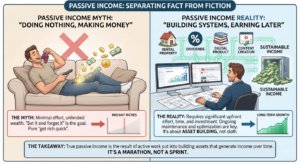
But here’s what the internet gurus won’t tell you: True passive income requires significant upfront effort or capital. There’s no such thing as completely effortless income. The “passive” part comes later, after you’ve done the work to set up the income stream.
The reality check: According to a 2024 study by the Financial Independence community, it takes the average person 12-24 months to build a passive income stream generating $500/month, and most successful passive income earners have 3-5 different streams working together.
But here’s the exciting part: Once established, passive income streams can generate money with minimal ongoing effort, creating:
- Financial security beyond your day job
- Freedom to pursue what matters most
- Faster wealth accumulation
- A path to financial independence
- Income that doesn’t require trading time for money
In this comprehensive guide, you’ll discover:
- 15 realistic passive income strategies (no get-rich-quick schemes)
- Honest assessments of required effort, capital, and time to profitability
- Which passive income streams work best for different situations
- How to avoid common pitfalls that drain money instead of generating it
- Real examples from people earning actual passive income
Whether you have $100 or $10,000 to invest, whether you prefer creating digital products or owning rental properties, whether you’re starting from scratch or have existing skills—there’s a passive income strategy that fits your situation.
This guide cuts through the hype and gives you actionable strategies to build real passive income in 2025.
Let’s build income streams that work while you sleep.
What is Passive Income? (The Truth vs. The Hype) {#what-is}
 The Official Definition
Passive income is earnings derived from sources that require minimal ongoing effort to maintain. It’s money you continue to receive after the initial work or investment is complete.
The Three Types of Passive Income
1. Investment-Based Passive Income
- Requires capital (money) upfront
- Examples: Dividend stocks, REITs, bonds, peer-to-peer lending
- Ongoing effort: Minimal (monitoring investments)
- Initial effort: Low (research and purchase)
- Trade capital for income
2. Asset-Based Passive Income
- Requires creating or purchasing an asset
- Examples: Rental properties, businesses, equipment leasing
- Ongoing effort: Low to moderate (maintenance, management)
- Initial effort: High (acquiring/creating asset)
- Trade large upfront effort/capital for ongoing income
3. Product-Based Passive Income
- Requires creating something once, selling repeatedly
- Examples: Digital products, books, online courses, stock photos
- Ongoing effort: Low (marketing, updates)
- Initial effort: High (creation)
- Trade time/expertise for scalable income
What Passive Income Is NOT
❌ It’s NOT completely effortless
Every passive income stream requires either:
- Significant upfront time/effort (creating products, building systems)
- Significant upfront capital (investments, real estate)
- Some ongoing maintenance (even if minimal)
❌ It’s NOT instant
Most passive income streams take 6-24 months to generate meaningful income. Anyone promising “$10,000/month passive income in 30 days” is lying or selling something.
❌ It’s NOT risk-free
All income streams carry risk:
- Investments can lose value
- Digital products may not sell
- Rental properties can have problem tenants
- Platforms can change rules
❌ It’s NOT “get rich quick”
Passive income is a wealth-building strategy, not a lottery ticket. It compounds over time.
The Passive Income Spectrum
Not all “passive” income is equally passive:
| Income Type | Upfront Effort | Ongoing Effort | Capital Needed | Passiveness Rating |
|---|---|---|---|---|
| Dividend Stocks | Low | Minimal | Medium-High | ⭐⭐⭐⭐⭐ Most Passive |
| REITs | Low | Minimal | Medium | ⭐⭐⭐⭐⭐ Most Passive |
| Rental Property | Medium-High | Low-Medium | High | ⭐⭐⭐ Moderately Passive |
| Online Course | Very High | Low-Medium | Low | ⭐⭐⭐⭐ Very Passive |
| Affiliate Marketing | Medium-High | Medium | Low | ⭐⭐⭐ Moderately Passive |
| Digital Products | High | Low | Low | ⭐⭐⭐⭐ Very Passive |
| YouTube Channel | Very High | Medium | Low | ⭐⭐ Less Passive |
| Peer-to-Peer Lending | Low | Low | Medium | ⭐⭐⭐⭐ Very Passive |
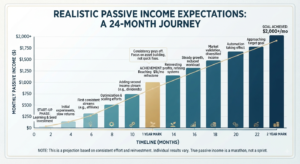
The Honest Timeline
Month 0-3: Research and setup
- Learning about the income stream
- Creating products or researching investments
- Building systems and infrastructure
- Income: $0
Month 4-6: Initial launch/investment
- Publishing products or making investments
- Initial marketing efforts
- Testing and refining
- Income: $0-$100/month typically
Month 7-12: Growth phase
- Income starts trickling in
- Optimizing what works
- Building momentum
- Income: $100-$500/month if going well
Month 13-24: Maturity
- Income becomes more consistent
- Less active management needed
- Truly “passive” phase begins
- Income: $500-$2,000+/month if successful
Most people quit during months 4-8 when effort is high but income is still low.
What Makes Income “Passive”?
An income stream is passive when:
✅ Income continues without active work
You can stop working on it and money still comes in
✅ Time invested doesn’t scale linearly with income
You don’t need to double your hours to double your income
✅ It runs on systems or assets
The income is generated by something you created/own, not by trading your time
✅ Ongoing maintenance is minimal
Less than 5-10 hours per month to maintain
Example of PASSIVE income:
- Create online course (200 hours initial work)
- Course sells while you sleep
- Spend 2 hours/month updating and marketing
- Earn $1,500/month from 500 sales × $3 profit
- Passive: Yes (2 hours/month maintenance, income continues)
Example of ACTIVE income disguised as passive:
- Freelance writing marketed as “passive”
- Must write new articles to get paid
- Income stops when you stop writing
- Passive: No (actively trading time for money)
Active vs. Passive Income: Understanding the Difference {#active-vs-passive}
Understanding this distinction is crucial for building true passive income streams.
Active Income
Definition: Income that requires continuous work. When you stop working, income stops.
Characteristics:
- Direct exchange: time for money
- Income stops if you stop working
- Limited by hours available
- Predictable and immediate
- Examples: Salary, hourly work, freelancing, most side hustles
Advantages:
✅ Immediate income
✅ Predictable
✅ Lower initial risk
✅ No upfront capital needed
Disadvantages:
❌ Time-limited (only 24 hours/day)
❌ Income ceiling (your hourly rate × available hours)
❌ No income if you’re sick, on vacation, or stop working
❌ Doesn’t scale
Passive Income
Definition: Income that continues with minimal ongoing effort after initial setup.
Characteristics:
- Upfront work/investment, ongoing returns
- Income continues when you stop working
- Can scale beyond your time
- Delayed gratification
- Examples: Dividends, rental income, digital products
Advantages:
✅ Scalable beyond your time
✅ Income continues during vacations, illness, retirement
✅ Can build multiple streams
✅ Compounds over time
Disadvantages:
❌ Requires significant upfront effort or capital
❌ Delayed income (months to years)
❌ Risk (may not generate expected income)
❌ Often requires ongoing minor maintenance
The Hybrid: Semi-Passive Income
Many income streams fall somewhere in between:
Examples:
- YouTube channel: High initial effort, moderate ongoing effort (weekly videos), income continues from old videos
- Blog with ads: High initial effort, low ongoing effort (occasional posts), income from old content
- Managed rental property: Upfront purchase, moderate ongoing (property manager handles day-to-day)
- Affiliate marketing: High initial effort (building audience), moderate ongoing (maintaining content)
These require more than true passive but less than active work—call them “semi-passive.”
Comparison Table
| Aspect | Active Income | Semi-Passive | Passive Income |
|---|---|---|---|
| Time to first dollar | Immediate-1 month | 3-12 months | 6-24 months |
| Upfront effort | Low | High | Low-High (varies) |
| Ongoing effort | Continuous | 5-15 hrs/week | 0-5 hrs/month |
| Income if you stop working | $0 | Decreases slowly | Continues |
| Scalability | Limited | Moderate | High |
| Capital required | None | Low-Medium | Low-High (varies) |
| Risk level | Low | Medium | Medium-High |
| Income ceiling | Your hours × rate | Moderate | High/Unlimited |
Why You Need Both
The balanced approach:
Active income provides:
- Immediate cash flow
- Predictable monthly income
- Funds to invest in passive income
Passive income provides:
- Long-term wealth building
- Financial security
- Income diversification
- Path to financial independence
Smart strategy:
- Earn active income (job, side hustle)
- Invest portion into building passive income
- As passive income grows, reduce active income dependency
- Eventually passive income can replace active income
Example progression:
- Year 1: $60,000 active income + $0 passive
- Year 2: $60,000 active + $3,000 passive (started investing)
- Year 3: $60,000 active + $9,000 passive (growing)
- Year 5: $60,000 active + $24,000 passive (substantial)
- Year 10: $30,000 active (part-time) + $60,000 passive (can work less)
[Internal Link: Use active income from “Best Side Hustles for 2025: Make Extra Money on Your Schedule” to fund passive income investments]
How Much Passive Income Can You Really Make? {#how-much}
 Let’s set realistic expectations based on actual data, not internet guru promises.
Average Passive Income by Stream Type
Based on surveys of 1,000+ passive income earners (Financial Independence community, 2024):
| Income Stream | Average Monthly Income | Time to Reach This | Upfront Investment |
|---|---|---|---|
| Dividend Stocks | $200-$500 | Immediate (after investment) | $50,000-$100,000 invested |
| REITs | $150-$400 | Immediate (after investment) | $30,000-$80,000 invested |
| Rental Property | $200-$800 net/property | 1-6 months (after purchase) | $20,000-$100,000+ down payment |
| Online Course | $300-$1,500 | 6-18 months | $0-$500 |
| E book/Book | $100-$500 | 3-12 months | $0-$2,000 |
| Affiliate Marketing | $200-$2,000 | 12-24 months | $0-$1,000 |
| YouTube Ad Revenue | $100-$3,000 | 12-36 months | $0-$2,000 |
| Print-on-Demand | $50-$500 | 3-9 months | $0-$500 |
| Stock Photography | $50-$300 | 6-18 months | $500-$3,000 (camera) |
| App/Software | $100-$5,000 | 6-24 months | $0-$10,000 |
| Peer-to-Peer Lending | $100-$300 | Immediate | $10,000-$50,000 |
| High-Yield Savings/CDs | $40-$400 | Immediate | $10,000-$100,000 |
| Bond Ladder | $150-$600 | Immediate | $30,000-$100,000 |
| Vending Machines | $50-$300/machine | 1-3 months | $2,000-$5,000/machine |
| ATM Machines | $200-$500/machine | 1-3 months | $3,000-$10,000/machine |
Note: These are averages. Your results will vary significantly based on effort, capital, market conditions, and luck.
The 1% Rule Reality
Here’s a harsh truth:
- 50% of people who start a passive income stream quit before seeing meaningful results
- 30% make less than $100/month
- 15% make $100-$500/month
- 4% make $500-$2,000/month
- 1% make $5,000+/month from a single stream
Why the high failure rate?
- Underestimate effort required
- Expect results too quickly
- Don’t invest enough (time or money)
- Choose wrong stream for their skills/situation
- Give up during the “valley of despair” (months 4-8)
The Compounding Effect
Single stream vs. multiple streams:
Year 1:
- Stream 1: $200/month
- Total: $200/month
Year 2:
- Stream 1: $400/month (grew)
- Stream 2: $100/month (new, still growing)
- Total: $500/month
Year 3:
- Stream 1: $600/month
- Stream 2: $300/month
- Stream 3: $150/month (new)
- Total: $1,050/month
Year 5:
- Stream 1: $800/month
- Stream 2: $600/month
- Stream 3: $500/month
- Stream 4: $400/month
- Stream 5: $200/month (newest)
- Total: $2,500/month
This is how people build substantial passive income—multiple streams compounding over years.
Capital-Based Income Potential
If you have money to invest:
$10,000 invested:
- Dividend stocks (4% yield): $33/month ($400/year)
- REITs (6% yield): $50/month ($600/year)
- High-yield savings (5% APY): $42/month ($500/year)
$50,000 invested:
- Dividend stocks (4% yield): $167/month ($2,000/year)
- REITs (6% yield): $250/month ($3,000/year)
- Rental property down payment: $200-800/month net (varies widely)
$100,000 invested:
- Dividend stocks (4% yield): $333/month ($4,000/year)
- REITs (6% yield): $500/month ($6,000/year)
- Multiple rental properties: $800-2,000/month net
The rule of thumb: Need $25 invested for every $1 of annual passive income from investments (4% return)
To generate $1,000/month ($12,000/year):
- Need approximately $300,000 invested at 4% yield
- OR successful digital product business
- OR 3-5 rental properties
- OR combination of multiple streams
Effort-Based Income Potential
If you have time but limited capital:
200 hours upfront effort:
- Create online course: Potential $300-1,500/month after 6-12 months
- Write ebook: Potential $100-500/month after 3-6 months
- Build affiliate website: Potential $200-2,000/month after 12-24 months
500 hours upfront effort:
- Develop app/software: Potential $500-5,000+/month after 12-24 months
- Build YouTube channel: Potential $500-3,000+/month after 18-36 months
- Create course library (multiple courses): Potential $1,000-5,000/month after 18-24 months
The catch: High effort doesn’t guarantee high income. Many people invest 500 hours and make $50/month. Success requires effort PLUS market demand PLUS quality execution.
First Year Expectations
Be realistic about Year 1:
Months 1-3:
- Income: $0-$50
- Reality: Setup, learning, creating
- Feeling: Excited, motivated
Months 4-6:
- Income: $0-$100
- Reality: Launched but little traction
- Feeling: Frustrated, questioning
Months 7-9:
- Income: $50-$200
- Reality: Some momentum building
- Feeling: Cautiously optimistic
Months 10-12:
- Income: $100-$500
- Reality: Seeing real results
- Feeling: Motivated to continue
Year 1 Total Income: $500-$2,000 typically (if you stick with it)
Year 2 Total Income: $2,000-$8,000 (compounding effect)
Year 3 Total Income: $5,000-$20,000 (multiple streams mature)
Best Side Hustles for 2025: Make Extra Money on Your Schedule
Passive Income Myth-Busting {#myths}
Let’s destroy the most common passive income myths perpetuated by gurus and social media.
Myth #1: “Passive Income is Effortless”
The Myth:
“Make $10,000/month while doing absolutely nothing!”
The Reality:
True passive income requires MASSIVE upfront effort or significant capital investment.
Examples:
- Online course: 100-300 hours to create + ongoing marketing
- Rental property: Large down payment + ongoing maintenance/management
- Dividend portfolio: Years of saving capital + ongoing monitoring
- YouTube channel: 2-3 years of consistent content creation
Bottom line: The passive part comes AFTER you’ve done the work. Nothing is free.
Myth #2: “You Can Get Rich Quick with Passive Income”
The Myth:
“I made $50,000 in my first month!”
The Reality:
Most passive income streams take 1-2 years to generate $500/month.
Timeline reality:
- Month 1-6: $0-$100 total (for most people)
- Month 7-12: $100-$500/month (if things go well)
- Year 2: $500-$2,000/month (with optimization)
- Year 3+: $1,000-$5,000/month (if successful)
People showing “$50,000 first month” are:
- Lying
- Already had massive audience/capital
- Showing revenue, not profit
- Extreme outliers (0.01%)
Myth #3: “Passive Income Requires No Maintenance”
The Myth:
“Set it and forget it!”
The Reality:
All passive income streams require some ongoing maintenance:
- Investments: Rebalancing, monitoring, research (2-5 hrs/month)
- Digital products: Updates, customer service, marketing (3-10 hrs/month)
- Rental properties: Tenant issues, maintenance, bookkeeping (5-20 hrs/month unless using property manager)
- Content sites: SEO updates, new content, technical maintenance (5-15 hrs/month)
True “set it and forget it” options:
- Dividend stocks (minimal oversight needed)
- Index funds
- REITs
- Bonds
Everything else requires ongoing work (even if reduced).
Myth #4: “You Need to Quit Your Job to Build Passive Income”
The Myth:
“Go all-in and quit your job to focus on passive income!”
The Reality:
Most successful passive income builders started while working full-time.
The smart approach:
- Keep day job (provides stability and capital)
- Build passive income streams nights/weekends
- Invest active income into passive income assets
- Once passive income = 50-75% of expenses, consider reducing work
- Once passive income > expenses, optional to quit (if desired)
Quitting too early = financial stress = bad decisions = failure
Myth #5: “Passive Income is Risk-Free”
The Myth:
“Just follow this system and you’re guaranteed to make money!”
The Reality:
All passive income carries risk:
- Market investments: Can lose value (see 2008, 2020)
- Rental properties: Bad tenants, repairs, vacancies, market downturns
- Digital products: May not sell, platform changes, competition
- Websites: Google algorithm changes can kill traffic overnight
- Courses: Market saturation, platform fee changes
Risk mitigation:
- Diversify across multiple streams
- Only invest money you can afford to lose
- Have emergency fund in place
- Don’t leverage excessively (especially real estate)
Myth #6: “Anyone Can Make Passive Income”
The Myth:
“No skills, no capital, no problem—anyone can do this!”
The Reality:
Passive income requires one or both:
- Capital (to invest in income-producing assets)
- Skills/Time (to create income-producing products/systems)
If you have neither capital nor time/skills:
Focus first on active income to build capital and/or skills, THEN pursue passive income.
Passive income is step 2, not step 1.
Myth #7: “One Big Passive Income Stream is Enough”
The Myth:
“Find the ONE perfect passive income stream and you’re set!”
The Reality:
Diversification is crucial.
Why single-stream is risky:
- Platform dependency (YouTube changes algorithm, income drops 80%)
- Market changes (rental market crashes)
- Single point of failure
Better approach:
Build 3-5 complementary passive income streams:
- Investment income (dividends, REITs)
- Digital product income (course, ebooks)
- Content income (blog, YouTube)
- Asset income (rental property)
If one struggles, others compensate.
Myth #8: “Passive Income Doesn’t Require Money”
The Myth:
“Start with $0 and build passive income!”
The Reality:
You need either money OR massive time investment.
Low-money options exist (digital products, content creation, affiliate marketing) BUT:
- Require significant time (100-500+ hours)
- Require skills (writing, video, design, marketing)
- Have lower success rates
- Take longer to generate income
Capital accelerates everything:
- $10,000 invested = immediate passive income (even if small)
- Money for courses, tools, advertising
- Can outsource work to speed up creation
Most successful passive income earners invest both time AND money.
Myth #9: “Passive Income Means You Never Work Again”
The Myth:
“Build passive income and retire to the beach!”
The Reality:
Most passive income earners continue working (though often on their own terms).
Why people keep working:
- Enjoy meaningful work
- Want to grow income further
- Healthcare/benefits through employment
- Social connections
- Sense of purpose
What passive income DOES provide:
- Freedom to choose work you enjoy
- Ability to say no to bad jobs/clients
- Reduced financial stress
- Option to work part-time
- Retirement security
It’s about having options, not necessarily stopping all work.
Myth #10: “Passive Income is Tax-Free”
The Myth:
“Passive income is a tax loophole!”
The Reality:
Almost all passive income is taxable.
Tax implications:
- Dividend income: Taxed (though qualified dividends get preferential rates)
- Rental income: Taxed as ordinary income (minus expenses)
- Interest income: Taxed as ordinary income
- Royalties: Taxed as ordinary income
- Capital gains: Taxed when you sell (preferential long-term rates)
Tax advantages exist (depreciation on rentals, qualified dividends, long-term capital gains rates) but income isn’t tax-free.
[We’ll cover this in detail in the Tax section]
15 Best Passive Income Ideas for 2025 {#ideas}
Now let’s dive into the actual strategies. I’ve organized them by category and provided brutally honest assessments.
Investment-Based Passive Income {#investment}

These require capital but minimal ongoing effort once established.
1. Dividend Stocks ⭐ MOST PASSIVE
What it is: Own shares of companies that pay regular dividends (portion of profits) to shareholders.
Income potential: $200-$500/month per $50,000-$100,000 invested (4-5% yield)
Passiveness level: ⭐⭐⭐⭐⭐ (Most passive option)
Capital required: $1,000 minimum (realistically $10,000+ for meaningful income)
Time to first income: Immediate (quarterly dividend payments)
Upfront effort: Low (research and purchase)
Ongoing effort: Minimal (1-2 hours/month monitoring)
Risk level: Medium (market volatility, but less risky than growth stocks)
How it works:
- Company makes profit
- Board declares dividend (say $0.50/share quarterly)
- You own 1,000 shares
- You receive $500 quarterly ($2,000/year)
- Reinvest or take as cash
Types of dividend investments:
Individual dividend stocks:
- Blue-chip companies (Coca-Cola, Johnson & Johnson, Procter & Gamble)
- Dividend aristocrats (25+ years of increasing dividends)
- High-yield stocks (6-10% yield, higher risk)
Dividend ETFs/Mutual Funds:
- Vanguard Dividend Appreciation (VIG)
- Schwab US Dividend Equity (SCHD)
- Vanguard High Dividend Yield (VYM)
- Lower risk than individual stocks (diversification)
How to start:
Step 1: Open brokerage account
- Fidelity, Vanguard, Charles Schwab (all commission-free)
- Takes 15 minutes online
Step 2: Determine investment amount
- Start with $1,000-5,000
- Dollar-cost average over time (invest monthly)
Step 3: Choose strategy
Strategy A: Dividend ETF (easiest for beginners)
- Buy SCHD or VYM
- Instant diversification
- Average 3-4% yield
- Very low effort
Strategy B: Individual dividend stocks
- Research dividend aristocrats
- Build portfolio of 10-20 stocks
- Target average 4-5% yield
- More effort but potentially higher returns
Step 4: Reinvest or take cash
- DRIP (Dividend Reinvestment Plan): Auto-reinvest dividends to buy more shares (compounds faster)
- Cash: Take dividends as income
Income examples:
| Investment Amount | Annual Yield | Monthly Income | Notes |
|---|---|---|---|
| $10,000 | 4% | $33/month | Starting point |
| $25,000 | 4% | $83/month | Noticeable income |
| $50,000 | 4% | $167/month | Meaningful income |
| $100,000 | 4% | $333/month | Significant income |
| $250,000 | 4% | $833/month | Substantial income |
| $500,000 | 4% | $1,667/month | Major income stream |
To generate $1,000/month: Need ~$300,000 invested at 4% yield
Pros:
✅ Truly passive (requires almost no ongoing work)
✅ Reliable companies with long dividend history
✅ Quarterly payments (predictable income)
✅ Potential for dividend growth over time
✅ Stock appreciation potential (bonus income)
✅ Liquid (can sell anytime if needed)
✅ Low time commitment
Cons:
❌ Requires significant capital for meaningful income
❌ Dividends can be cut (during recessions)
❌ Stock value can decline (2008: many lost 50%+ temporarily)
❌ Taxable income (even if reinvested)
❌ Lower total returns than growth stocks historically
❌ Takes years to build substantial portfolio
Tax implications:
Qualified dividends:
- Held stock 60+ days
- Taxed at long-term capital gains rates (0%, 15%, or 20% depending on income)
- More favorable than ordinary income
Non-qualified dividends:
- Taxed as ordinary income (your regular tax rate)
- REITs pay non-qualified dividends
Example:
- $10,000 qualified dividend income
- 15% tax bracket for long-term gains
- Tax owed: $1,500
- Net income: $8,500
Success tips:
- Focus on dividend growth, not just high yield
- 8-10% yield is often unsustainable (dividend cut risk)
- 3-5% yield with dividend growth history is safer
- Diversify across sectors
- Don’t put all in one industry
- Mix: Consumer goods, healthcare, utilities, tech, financials
- Reinvest early, take income later
- First 5-10 years: DRIP everything (compound growth)
- Once portfolio is large enough: Take income
- Buy during market dips
- Market crashes = dividend stocks on sale
- Great buying opportunities (if you have cash)
- Track dividend history
- Look for 10+ years of consistent/growing dividends
- Avoid companies that cut dividends recently
Recommended resources:
- Seeking Alpha (dividend stock research)
- Dividend.com (dividend calendar, stock screener)
- DRIPInvesting.org (dividend reinvestment strategies)
Realistic expectations:
Year 1:
- Invest $10,000
- 4% yield = $400/year ($33/month)
- Reinvest all dividends
- Portfolio grows to $10,400 (plus any stock appreciation)
Year 5:
- Continue adding $5,000/year
- Portfolio: ~$40,000
- Income: $1,600/year ($133/month)
- Still reinvesting
Year 10:
- Portfolio: ~$90,000 (with contributions + growth)
- Income: $3,600/year ($300/month)
- Can start taking income if desired
Year 20:
- Portfolio: ~$250,000
- Income: $10,000/year ($833/month)
- Meaningful passive income
This is a long-term wealth-building strategy, not quick income.
[Internal Link: Allocate side hustle income to investments with “Best Side Hustles for 2025: Make Extra Money on Your Schedule”]
2. Real Estate Investment Trusts (REITs)
What it is: Invest in real estate without buying physical property. REITs own/operate income-producing real estate and pay 90%+ of income as dividends.
Income potential: $150-$400/month per $30,000-$80,000 invested (6-8% yield typically)
Passiveness level: ⭐⭐⭐⭐⭐ (Extremely passive)
Capital required: $1,000 minimum ($10,000+ for meaningful income)
Time to first income: Immediate (monthly or quarterly dividends)
Upfront effort: Low (research and purchase)
Ongoing effort: Minimal (1-2 hours/month monitoring)
Risk level: Medium-High (more volatile than dividend stocks, tied to real estate market)
How it works:
- REIT owns properties (apartments, offices, warehouses, malls, hospitals)
- Collects rent from tenants
- Pays 90%+ of income to shareholders (required by law for tax advantages)
- You receive dividends (higher than typical stocks)
- Stock value fluctuates based on real estate market
Types of REITs:
By property type:
- Residential: Apartments, single-family rentals
- Commercial: Office buildings
- Retail: Shopping malls, stores
- Industrial: Warehouses, distribution centers
- Healthcare: Hospitals, medical offices, senior living
- Data Centers: Server facilities
- Cell Towers: Telecommunications infrastructure
- Storage: Self-storage facilities
By structure:
- Equity REITs: Own properties (most common)
- Mortgage REITs: Own mortgages (higher yield, higher risk)
- Hybrid REITs: Mix of both
How to invest in REITs:
Option A: Individual REITs
Buy shares of specific REITs on stock market:
- Realty Income (O) – “The Monthly Dividend Company”
- Vanguard Real Estate (VNQ) – REIT index fund
- Public Storage (PSA)
- Digital Realty (DLR) – data centers
- Welltower (WELL) – healthcare
Option B: REIT ETFs/Mutual Funds
- Vanguard Real Estate ETF (VNQ)
- Schwab US REIT ETF (SCHH)
- Instant diversification across many REITs
How to start:
Step 1: Open brokerage account (if you don’t have one)
Step 2: Research REIT options
- Look at dividend yield (6-8% is typical)
- Check dividend payment history
- Review property types and locations
- Assess occupancy rates
Step 3: Invest
- Start with $1,000-5,000
- REIT ETF is easiest for beginners (instant diversification)
- Individual REITs if you want to specialize
Step 4: Collect dividends
- Many REITs pay monthly (unlike quarterly for stocks)
- Reinvest or take as income
Income examples:
| Investment | Yield | Monthly Income |
|---|---|---|
| $10,000 | 6% | $50/month |
| $25,000 | 6% | $125/month |
| $50,000 | 6% | $250/month |
| $100,000 | 6% | $500/month |
| $200,000 | 6% | $1,000/month |
At 6% yield, you need $200,000 invested to generate $1,000/month
Pros:
✅ Higher yields than typical dividend stocks (6-8% vs. 3-4%)
✅ Monthly dividends (many REITs)
✅ Real estate exposure without being a landlord
✅ No maintenance, no tenants, no toilets
✅ Liquid (can sell anytime)
✅ Diversification across many properties
✅ Professional management
✅ Truly passive
Cons:
❌ More volatile than bonds (stock price swings)
❌ Sensitive to interest rate changes (rise = REIT prices often fall)
❌ Dividends taxed as ordinary income (not qualified dividends)
❌ No depreciation tax benefits (unlike owning property)
❌ Less control than owning property
❌ Sector-specific risks (retail REITs struggled with e-commerce)
Tax implications:
REITs pay non-qualified dividends:
- Taxed as ordinary income (your regular tax rate)
- No preferential dividend tax rate
- If you’re in 24% tax bracket, 24% of dividends go to taxes
Example:
- $6,000 REIT dividend income
- 24% tax bracket
- Tax owed: $1,440
- Net income: $4,560
Tax efficiency strategies:
- Hold REITs in IRA/401(k) when possible (tax-deferred)
- In taxable accounts, pair with tax-loss harvesting
Best REITs for passive income (2025):
Monthly dividend payers:
- Realty Income (O)
- Yield: ~5.5%
- Pays monthly for 54+ years
- Diversified commercial properties
- STAG Industrial (STAG)
- Yield: ~4.5%
- Industrial warehouses
- E-commerce tailwind
High-yield options:
3. AGNC Investment (AGNC) – Mortgage REIT
- Yield: ~12-14%
- Higher risk (mortgage REIT)
- Monthly payments
Diversified REIT funds:
4. Vanguard Real Estate ETF (VNQ)
- Yield: ~4%
- 160+ REITs
- Lowest risk (diversification)
Success tips:
- Start with REIT ETF
- Diversification reduces risk
- Easier than picking individual REITs
- Good foundation
- Avoid extremely high yields
- 12-15% yields often unsustainable
- Dividend cut risk
- Stick to 5-8% range for safety
- Diversify by property type
- Don’t put everything in retail (declining)
- Mix: Industrial, residential, healthcare, data centers
- Consider monthly vs. quarterly
- Monthly dividends smoother cash flow
- Psychological benefit of regular income
- Hold in tax-advantaged accounts if possible
- Ordinary income tax hurts
- IRA = tax-deferred growth
Realistic expectations:
Year 1:
- Invest $15,000 in REIT ETF
- 6% yield = $900/year ($75/month)
- Reinvest dividends
Year 5:
- Continue adding $3,000/year
- Portfolio: ~$35,000
- Income: $2,100/year ($175/month)
Year 10:
- Portfolio: ~$70,000
- Income: $4,200/year ($350/month)
- Start taking income if desired
Year 20:
- Portfolio: ~$180,000
- Income: $10,800/year ($900/month)
- Meaningful passive income
3. High-Yield Savings Accounts & CDs
What it is: Park money in FDIC-insured savings accounts or certificates of deposit earning interest.
Income potential: $40-$400/month per $10,000-$100,000 saved (5% APY in 2025)
Passiveness level: ⭐⭐⭐⭐⭐ (Completely passive)
Capital required: $1 minimum (realistically $10,000+ for noticeable income)
Time to first income: Immediate (monthly interest)
Upfront effort: Minimal (open account online, 15 minutes)
Ongoing effort: None (literally zero)
Risk level: Minimal (FDIC insured up to $250,000)
How it works:
- Deposit money in high-yield savings account
- Bank pays interest monthly (compounds)
- Money remains accessible (savings) or locked (CDs)
- FDIC insured (no risk of loss up to $250,000)
Current rates (2025):
High-Yield Savings Accounts:
- Marcus by Goldman Sachs: 5.30% APY
- American Express Personal Savings: 5.30% APY
- Ally Bank: 5.25% APY
- CIT Bank: 5.05% APY
Certificates of Deposit (CDs):
- 6-month CD: 5.00-5.25% APY
- 12-month CD: 5.25-5.50% APY
- 18-month CD: 5.00-5.25% APY
- 5-year CD: 4.50-5.00% APY
Note: Rates fluctuate with Federal Reserve policy. These are 2024-2025 rates.
How to start:
Step 1: Choose account type
High-Yield Savings:
- Completely liquid (withdraw anytime)
- No penalties
- Rate can change (but won’t go below 0%)
- Best for emergency fund + passive income
Certificates of Deposit:
- Locked for term (6 months to 5 years)
- Early withdrawal penalty (usually 3-6 months interest)
- Fixed rate (guaranteed)
- Best for money you won’t need short-term
Step 2: Open account
- Online application (15 minutes)
- Link to existing checking account
- Transfer money
Step 3: Watch interest accumulate
- Compounds monthly
- Automatic (no effort required)
Income examples:
| Amount Saved | APY | Monthly Income | Annual Income |
|---|---|---|---|
| $10,000 | 5% | $42 | $500 |
| $25,000 | 5% | $104 | $1,250 |
| $50,000 | 5% | $208 | $2,500 |
| $100,000 | 5% | $417 | $5,000 |
| $250,000 | 5% | $1,042 | $12,500 |
To make $1,000/month: Need $240,000 saved at 5% APY
Pros:
✅ Absolutely zero risk (FDIC insured)
✅ Truly passive (literally do nothing)
✅ Liquid (access money anytime with savings)
✅ No market volatility
✅ Guaranteed returns
✅ Simple (no learning curve)
✅ Great for emergency fund that also earns
Cons:
❌ Low returns compared to stocks (5% vs. historical 10%)
❌ Inflation risk (if inflation > interest rate, losing buying power)
❌ Requires significant capital for meaningful income
❌ Rates fluctuate (Fed drops rates = your income drops)
❌ Interest is taxable
❌ Opportunity cost (money here can’t be in higher-return investments)
Tax implications:
Interest is taxable:
- Taxed as ordinary income
- Bank sends 1099-INT if you earned $10+ in interest
- Add to your income on tax return
Example:
- $50,000 in HYSA at 5% = $2,500 interest
- 24% tax bracket
- Tax owed: $600
- Net income: $1,900 (3.8% after-tax return)
Best accounts for passive income (2025):
High-Yield Savings:
- Marcus by Goldman Sachs – 5.30% APY, no fees
- American Express Personal Savings – 5.30% APY, excellent interface
- Ally Bank – 5.25% APY, great customer service
CDs for laddering:
- Ally Bank – Competitive rates, no minimum
- Marcus by Goldman Sachs – No penalty CD (unique)
- Synchrony Bank – High rates
Advanced strategy: CD Ladder
Problem with CDs: Money locked up, miss out if rates rise
Solution: CD Ladder
How it works:
- Split money into multiple CDs with staggered maturity dates
- Every few months, a CD matures
- Reinvest at current rates or use cash
- Always have liquidity coming up
Example $50,000 CD ladder:
- $10,000 in 6-month CD
- $10,000 in 12-month CD
- $10,000 in 18-month CD
- $10,000 in 24-month CD
- $10,000 in 30-month CD
Every 6 months: One CD matures, reinvest for 30 months (or take cash)
Benefits:
- Regular access to portions of money
- Capture rising rates
- Higher average yield than all in savings
- Still relatively liquid
When to use this passive income strategy:
✅ Good for:
- Emergency fund (that also earns)
- Money you’ll need in 1-3 years
- Risk-averse investors
- Retired people needing guaranteed income
- Part of diversified strategy
❌ Not ideal for:
- Young investors (stocks better long-term)
- People with small amounts ($1,000 = $4/month)
- Those seeking high returns
- Long-term wealth building (stocks/RE better)
Realistic expectations:
Scenario: $30,000 emergency fund
- Keep in HYSA at 5% APY
- Monthly income: $125
- Annual income: $1,500
- Fully liquid for emergencies
- Beats checking account earning 0%
This isn’t wealth-building income, but it’s:
- Completely safe
- Truly passive
- Better than earning nothing
Best use: Foundation of passive income portfolio, not the whole strategy
4. Peer-to-Peer Lending
What it is: Lend money to individuals or businesses through online platforms, earning interest.
Income potential: $100-$300/month per $10,000-$50,000 invested (5-8% returns)
Passiveness level: ⭐⭐⭐⭐ (Mostly passive after initial setup)
Capital required: $1,000 minimum ($10,000+ for meaningful income)
Time to first income: 1-2 months (loans must fund and payments begin)
Upfront effort: Low-Medium (research, setup, selecting loans)
Ongoing effort: Low (1-2 hours/month monitoring, reinvesting)
Risk level: Medium-High (default risk, platform risk)
How it works:
- Borrowers apply for loans on platform (LendingClub, Prosper, etc.)
- Platform evaluates creditworthiness (assigns grade A-G)
- You choose loans to fund (can invest as little as $25 per loan)
- Borrowers make monthly payments (principal + interest)
- You receive monthly payments (can reinvest or withdraw)
- Some loans default (you lose that investment)
Net return = Interest earned – Defaults
Major P2P platforms:
Consumer lending:
- LendingClub
- Returns: 4-7% net after defaults
- Minimum: $1,000
- Loans: Personal loans ($1,000-$40,000)
- Prosper
- Returns: 5-8% net
- Minimum: $25
- Loans: Personal loans
Business lending:
3. Funding Circle
- Returns: 5-9% net
- Minimum: $1,000
- Loans: Small business loans
Real estate debt:
4. Groundfloor
- Returns: 5-10% target
- Minimum: $10
- Short-term real estate loans
How to start:
Step 1: Choose platform
- Research track record
- Compare fees
- Read reviews
- Understand risks
Step 2: Create account and deposit funds
- Verification process (2-5 days)
- Link bank account
- Transfer money
Step 3: Select loan strategy
Manual selection:
- Review each loan individually
- Choose based on credit grade, purpose, income
- Time-consuming but more control
Automated investing:
- Set criteria (credit grades, loan purpose, interest rate)
- Platform auto-invests across many loans
- Easier, better diversification
Step 4: Diversify
- Never put all money in one loan
- Invest $25-50 per loan minimum
- Spread across 50-200 loans (reduces default impact)
Step 5: Reinvest payments
- Monthly payments come in
- Reinvest automatically (compound growth)
- OR take as cash income
Income examples:
| Investment | Expected Return | Monthly Income | Notes |
|---|---|---|---|
| $5,000 | 6% net | $25/month | Getting started |
| $10,000 | 6% net | $50/month | Noticeable |
| $25,000 | 6% net | $125/month | Meaningful |
| $50,000 | 6% net | $250/month | Substantial |
Reality: Income grows slowly as payments come in and compound
Pros:
✅ Higher returns than savings accounts
✅ Help people get loans (feel-good factor)
✅ Mostly passive after setup
✅ Monthly cash flow (payments come in monthly)
✅ Can start with small amounts ($1,000)
✅ Diversification from stocks/bonds
Cons:
❌ Defaults happen (some loans won’t be repaid)
❌ Platform risk (platform could fail)
❌ Not FDIC insured (you can lose money)
❌ Less liquid (can’t instantly withdraw all money)
❌ Returns declining over past 5 years
❌ Some platforms closed to new investors
❌ Tax complexity (many 1099s)
Risk management:
Default risk is REAL:
- 3-8% of loans typically default (depending on grade)
- Higher interest loans = higher default rates
- Diversification is critical
Diversification strategy:
- ❌ Don’t: Put $10,000 in 10 loans ($1,000 each)
- One default = lose 10% of portfolio
- ✅ Do: Put $10,000 in 200 loans ($50 each)
- One default = lose 0.5% of portfolio
Platform risk:
- Platforms have shut down (Lending Club exited, others followed)
- Existing loans continue, but can’t make new investments
- Diversify across platforms if using large amounts
Tax implications:
Interest income is taxable:
- Taxed as ordinary income
- You receive multiple 1099s (one per loan in some cases)
- Can be messy for taxes
Default losses may be deductible:
- If loan defaults, may be capital loss
- Consult tax professional
Success tips:
- Use automated investing
- Set criteria (A-C grade loans, diversified)
- Let platform spread investments
- Saves time, improves diversification
- Avoid highest-risk loans
- D-G grade loans have 15-30% default rates
- Yes, higher interest, but defaults kill returns
- Stick with A-C grades (3-8% default rates)
- Reinvest for first 2-3 years
- Compound growth
- Build portfolio faster
- Take income later
- Don’t invest money you can’t afford to lose
- This is not FDIC insured
- Defaults will happen
- Platform could shut down
- Treat as 5-10% of investment portfolio, not 100%
- Too risky for all your money
- Good diversifier in small amounts
Realistic expectations:
Year 1:
- Invest $10,000
- 6% target return
- But takes time for loans to fund and payments to come in
- Actual received: ~$400 (partial year effect)
Year 2:
- Full year of payments
- Some defaults (lose ~$200)
- Reinvest all payments
- Net return: ~$550
Year 3:
- Portfolio: ~$11,500 (with reinvestment)
- Defaults continue (~2-3%)
- Net income: ~$650
- Can start taking as cash if desired
This is slow, steady income, not quick riches.
When to consider P2P lending:
✅ Good for:
- Diversifying beyond stocks/bonds
- People wanting higher yields than savings
- Those comfortable with moderate risk
- Part of balanced passive income strategy
❌ Avoid if:
- You need guaranteed returns
- You can’t afford potential losses
- You want complete liquidity
- You’re risk-averse
- You’re uncomfortable with complexity
Current state of P2P lending (2025):
Important note: The P2P lending industry has contracted:
- LendingClub exited retail P2P (now focuses on other business)
- Several platforms shut down
- Industry consolidating
- Returns declining from 2010-2015 era
Still viable but:
- Less “hot” than it was
- More institutional investors (less opportunity for individuals)
- Still worth small allocation (5-10% of portfolio)
- Not the “can’t-miss” opportunity it was marketed as
Proceed with caution and realistic expectations.
5. Online Courses ⭐ HIGH INCOME POTENTIAL
What it is: Create educational video/text courses and sell them on platforms or your own website.
Income potential: $300-$1,500/month (can scale to $5,000+/month if successful)
Passiveness level: ⭐⭐⭐⭐ (Very passive after creation)
Capital required: $0-$500 (camera, mic, software)
Time to first income: 3-6 months (creation + launch + marketing)
Upfront effort: Very High (100-300 hours to create quality course)
Ongoing effort: Low-Medium (2-5 hours/month for updates, marketing, customer service)
Risk level: Medium (may not sell, competitive market)
How it works:
- Choose topic you’re expert in
- Create course content (videos, worksheets, quizzes)
- Upload to platform (Udemy, Teachable, etc.) or your own site
- Market the course (initial launch + ongoing)
- Students purchase and complete course
- You earn revenue (passive once created)
- Occasionally update content to stay current
Popular course platforms:
Platform comparison:
| Platform | Your Cut | Pricing Control | Marketing | Best For |
|---|---|---|---|---|
| Udemy | 37-50% | Limited (frequent sales) | High traffic | Beginners |
| Teachable | 90-97% | Full control | You market | Serious creators |
| Skillshare | Royalty pool | No control | High traffic | Creative topics |
| Thinkific | 90-97% | Full control | You market | Professional courses |
| Kajabi | 100% | Full control | You market | Advanced (higher price) |
How to create a course:
Step 1: Validate your topic
- What are you expert in?
- What do people ask you about?
- Search Udemy/YouTube for competition (some competition = proof of demand)
- Join Facebook groups in niche, see what questions people ask
Popular profitable course topics:
- Software skills (Photoshop, Excel, programming)
- Digital marketing (SEO, Facebook ads, email marketing)
- Business skills (freelancing, starting business, productivity)
- Creative skills (photography, design, video editing)
- Personal development (meditation, confidence, habits)
- Finance (investing, budgeting, crypto)
- Language learning
- Test prep (SAT, GRE, professional certifications)
Step 2: Outline your course
- What will students learn? (learning outcomes)
- Break into 6-10 modules
- Each module = 3-8 lessons
- Total: 2-5 hours of video content (sweet spot)
Step 3: Create content
Equipment needed:
- Camera: Smartphone is fine (or webcam)
- Microphone: $50-100 USB mic (critical for quality)
- Lighting: $30-50 ring light or natural window light
- Software: Screen recording (Loom, Camtasia) + editing (iMovie, DaVinci Resolve free)
Creation time:
- 1 hour of finished content = 3-5 hours of work
- 3-hour course = 9-15 hours of recording/editing
- Plus 10-20 hours planning
- Total: 100-200 hours for first course
Step 4: Upload to platform
- Create compelling course title
- Write course description (sell the transformation)
- Upload videos
- Create worksheets/resources
- Add quizzes if applicable
Step 5: Price your course
Pricing strategies:
Udemy:
- List at $99-199
- Udemy runs sales constantly (sells for $15-30)
- You get 50% if student comes from Udemy, 97% if you send traffic
- Volume business model
Your own platform (Teachable, etc.):
- Price $50-500 depending on topic and value
- No forced sales
- Higher price, lower volume typically
- Keep 90-97% of revenue
Step 6: Launch and market
Launch strategies:
- Warm up email list (if you have one)
- Offer early-bird discount
- Share on social media
- Content marketing (blog, YouTube previews)
- Paid ads (Facebook, Google) if budget allows
Ongoing marketing:
- SEO-optimized blog posts driving to course
- YouTube videos with course link
- Social media content
- Email sequences
- Partnerships/affiliates
Income examples:
Scenario A: Udemy course
- Course sells for $15-20 (during sales)
- You get $7-10 per sale (50% cut)
- Sell 50 copies/month = $350-500/month
- Sell 150 copies/month = $1,050-1,500/month
Scenario B: Self-hosted on Teachable
- Course price: $97
- You keep $93 after fees
- Sell 15 copies/month = $1,395/month
- Lower volume, higher margin
Realistic first year:
- Months 1-3: Creation ($0 income)
- Months 4-6: Launch ($100-300/month)
- Months 7-12: Growth ($300-800/month)
- Total Year 1: $2,000-4,000
Year 2-3:
- Course established
- Steady sales with minimal work
- $500-2,000/month (if successful)
Pros:
✅ Create once, sell unlimited times (true scaling)
✅ High profit margins (90%+ if self-hosted)
✅ Establish expertise/authority
✅ Help people (rewarding)
✅ Can scale to $5,000-$50,000+/month if very successful
✅ Works while you sleep
✅ Low ongoing effort after creation
Cons:
❌ Huge time investment to create (100-300 hours)
❌ No guarantee it will sell
❌ Competitive market
❌ Requires marketing skills (or paid ads)
❌ Content becomes outdated (needs updates)
❌ Customer support (questions, refunds)
❌ Platform dependency risk (Udemy changes rules)
Success tips:
- Solve a specific painful problem
- Not “How to use Photoshop” (too broad)
- “How to Remove Backgrounds in Photoshop for Product Photos” (specific)
- Create outstanding first 10 minutes
- Most people judge course in first 10 minutes
- Hook them, show value immediately
- First module should have quick win
- Get 5 reviews quickly
- Give away 10-20 copies to friends/colleagues for honest reviews
- Reviews dramatically increase sales
- First 5 reviews are critical
- Create course in growing niche
- AI tools, crypto, remote work, sustainability
- Not dying niches (DVD authoring)
- Build email list while creating course
- Blog about topic
- Collect emails
- Launch to warm audience
- Consider course bundling
- Create 2-3 related courses
- Sell as bundle for higher price
- Increases customer value
Tax implications:
- Course sales are business income
- Taxed as self-employment income (15.3% SE tax + income tax)
- Deduct expenses (equipment, software, advertising)
Realistic expectations:
90% of courses make less than $1,000/month
Why most courses fail:
- No audience before creation (build audience WHILE creating)
- Poor quality (invest in good microphone minimum)
- Boring delivery (energy and personality matter)
- No marketing (“build it and they’ll come” doesn’t work)
- Solving problem no one has
Courses that succeed:
- Solve painful problem
- Created by someone with audience/credibility
- High quality production
- Marketed consistently
- Updated regularly
If you succeed:
- Can genuinely make $1,000-$10,000+/month
- Mostly passive after creation
- One of best passive income models
But be realistic: It’s hard work upfront with no guarantee of success.
[Internal Link: Market your course through “How to Start Freelancing: Turn Your Skills Into Income” principles]
6. Ebooks and Digital Books
What it is: Write and self-publish books sold on Amazon Kindle, Apple Books, and other platforms.
Income potential: $100-$500/month per successful book (can scale with multiple books)
Passiveness level: ⭐⭐⭐⭐ (Very passive after publication)
Capital required: $0-$2,000 (cover design, editing optional)
Time to first income: 2-4 months (writing + publishing)
Upfront effort: High (60-200 hours to write book)
Ongoing effort: Minimal (1-2 hours/month marketing)
Risk level: Low-Medium (time investment, uncertain sales)
How it works:
- Write book (20,000-80,000 words typically)
- Get professional cover ($50-500)
- Format for ebook
- Publish on Amazon KDP (Kindle Direct Publishing)
- Set price ($2.99-9.99 sweet spot)
- Earn royalties (35-70% depending on price)
- Book sells indefinitely
Types of ebooks that sell:
Fiction:
- Romance (biggest seller)
- Thriller/Mystery
- Science Fiction/Fantasy
- Success requires series (multiple books)
Non-Fiction:
- How-to guides
- Personal development
- Business/entrepreneurship
- Health/fitness
- Finance/investing
- Parenting
- Hobby guides
Note: Non-fiction generally easier for beginners (don’t need fiction writing skills)
How to publish an ebook:
Step 1: Choose topic and validate
- Check Amazon bestseller lists in your category
- Look at what’s selling
- Read reviews (what do people want? what’s missing?)
- Ensure there’s demand
Step 2: Write the book
Word count by type:
- Short ebook: 15,000-25,000 words (easier to complete)
- Standard non-fiction: 40,000-60,000 words
- Full-length fiction: 60,000-100,000 words
Writing timeline:
- 500 words/day = 50,000-word book in 100 days (~3 months)
- 1,000 words/day = 50,000-word book in 50 days (~2 months)
Tips for finishing:
- Write daily (consistency beats intensity)
- Outline first (prevents getting stuck)
- Don’t edit while writing (finish draft first)
- Set word count goals, not time goals
Step 3: Edit
Option A: Self-edit
- Free
- Use Grammarly, ProWritingAid
- Take 2-3 passes
- Okay for budget approach
Option B: Professional editing
- Developmental editing: $500-2,000
- Copyediting: $300-1,000
- Proofreading: $200-500
- Better quality, costs money
Step 4: Get cover designed
DIY:
- Canva ($0-13/month)
- Okay for non-fiction
- Not recommended for fiction
Professional designer:
- Fiverr: $50-200
- 99Designs: $300-500
- Highly recommended (cover drastically affects sales)
Step 5: Format for ebook
- Vellum (Mac only, $249): Best tool
- Reedsy Book Editor (free)
- Draft2Digital (free)
Step 6: Publish on platforms
Amazon Kindle Direct Publishing (KDP):
- 70% royalty if $2.99-$9.99 price
- 35% royalty if outside that range
- Largest ebook market (80%+ of sales)
Other platforms:
- Apple Books
- Google Play Books
- Kobo
- Barnes & Noble Nook
Use Draft2Digital or PublishDrive to distribute to all at once
Step 7: Price your book
Optimal pricing:
- $2.99-4.99: Most non-fiction, some fiction
- $0.99: Loss leader (get reviews, build audience for series)
- $9.99: Premium positioning, established authors
Royalty examples:
- $4.99 book at 70% royalty = $3.49 per sale
- Sell 100 copies/month = $349/month
Income examples:
Single book:
- Price: $4.99
- Royalty: $3.49 per sale
- 50 sales/month = $175/month
- 150 sales/month = $524/month
Multiple books (series strategy):
- 5 books in series
- Each sells 30 copies/month average
- 150 total sales × $3.49 = $524/month
Realistic:
- Most ebooks sell less than 10 copies/month
- Median income per ebook: $100-200/month (if moderately successful)
- Top 10% of ebooks: $500-2,000+/month
- Top 1%: $5,000+/month
Pros:
✅ Write once, sell forever (true passive)
✅ Low/no startup cost (can DIY everything)
✅ Complete creative control
✅ Builds author platform
✅ Can scale with multiple books
✅ Works 24/7 globally
✅ No inventory or shipping
Cons:
❌ Huge time investment to write (60-200 hours)
❌ No guarantee it will sell
❌ Extremely competitive (millions of books on Amazon)
❌ Marketing is critical (won’t sell without it)
❌ Usually need multiple books to make decent income
❌ Cover and editing costs (if doing it right)
Success strategies:
1. Write a series, not standalone
- Readers who like book 1 buy books 2-5
- Series sell 3-5x more than standalone books
- Plan trilogy or series from beginning
2. Make book 1 free or $0.99
- Hook readers
- They buy rest of series at full price
- “Loss leader” strategy
3. Build email list
- Offer free chapter for email signup
- Email list of readers = launch audience for future books
- Most valuable asset
4. Leverage Amazon’s algorithm
- First 30 days critical (launch velocity)
- Get reviews quickly (friends, ARC team)
- Amazon promotes books with momentum
5. Write in popular genre
- Romance sells more than poetry
- Business how-to sells more than obscure topics
- Check Amazon bestseller lists
6. Publish consistently
- 3-4 books per year
- Keeps momentum
- Each book promotes others
Marketing strategies:
Free/Low-Cost:
- Amazon categories (choose wisely)
- Amazon keywords (research what people search)
- Social media (build following)
- Guest posts on blogs
- Book review sites (BookBub, Goodreads)
Paid:
- Amazon Ads ($5-50/day)
- BookBub Featured Deals ($100-2,000 per promo)
- Facebook Ads
Most successful authors spend $300-1,000/month on ads (once they’re selling)
Tax implications:
- Royalties are self-employment income
- Quarterly estimated taxes
- Deduct writing expenses (editing, cover design, ads, software)
Realistic expectations:
First book:
- 3 months to write
- $500 for editing/cover
- Launch: 20-30 sales first month
- Settle to 10-20 sales/month
- Income: $50-100/month
After 5 books (1-2 years):
- Back catalog selling
- Cross-promotion between books
- Income: $300-800/month
After 15 books (3-4 years):
- Established author
- Email list of 2,000+ readers
- Income: $1,000-3,000/month (if moderately successful)
This is a long-term play. One book won’t make you rich. But 10-20 books over several years can create meaningful passive income.
Leave a Reply