
Table of Contents
- Introduction
- What is a Side Hustle?
- Why Start a Side Hustle in 2025?
- How Much Can You Really Make?
- How to Choose the Right Side Hustle
- Best Online Side Hustles (Work From Anywhere)
- Best Local/In-Person Side Hustles
- Best Creative Side Hustles
- Best Side Hustles for Specific Skills
- Best Weekend Side Hustles
- Best Side Hustles with Low Startup Costs
- Side Hustles to Avoid (Red Flags)
- How to Start Your Side Hustle: Step-by-Step
- Managing Your Side Hustle with Your Full-Time Job
- Tax Considerations for Side Hustlers
- Success Stories: Real People, Real Results
- Frequently Asked Questions
- Conclusion
Introduction {#introduction}
The cost of living is rising faster than wages. In 2024, 45% of Americans reported having a side hustle—up from 34% just three years ago (Bankrate Side Hustle Survey). This isn’t just a trend; it’s a financial necessity for millions and a strategic wealth-building move for millions more.
Whether you need an extra $500 to cover unexpected expenses, want to accelerate debt payoff, are building an emergency fund, or simply desire more financial breathing room—a side hustle can bridge the gap between where you are and where you want to be financially.
But here’s the challenge: Not all side hustles are created equal.
Some promise quick riches but deliver pennies per hour. Others require massive upfront investments you can’t afford. Many demand skills you don’t have or time you don’t possess. And some are outright scams designed to separate you from your money rather than help you make it.
This comprehensive guide cuts through the noise.
You’ll discover 30+ legitimate side hustles for 2025, organized by type, skill requirement, and earning potential. More importantly, you’ll learn:
- How to choose the right side hustle for YOUR situation
- Realistic income expectations (no hype, just facts)
- How to start with minimal investment
- How to balance a side hustle with your full-time job
- Tax implications you need to know
- Real success stories from real people
Whether you have 5 hours per week or 20, whether you prefer working from home or getting out and about, whether you’re tech-savvy or prefer hands-on work—there’s a side hustle that fits your life.
The extra income you need is out there. This guide shows you exactly how to earn it.
Let’s transform your spare time into meaningful income.
What is a Side Hustle? {#what-is}
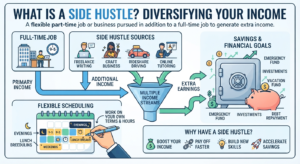
A side hustle is any type of employment or business you pursue in addition to your primary source of income. It’s work you do outside your regular 9-to-5 job to earn extra money.
Key Characteristics of a Side Hustle:
1. Supplemental Income
- Not your primary source of income (at least initially)
- Complements your main job
- Provides financial cushion or accelerates goals
2. Flexible Schedule
- You control when you work
- Fits around your primary job
- Can be done evenings, weekends, or whenever you have time
3. You’re in Control
- Choose what you do
- Decide how much time to invest
- Scale up or down based on needs
4. Variable Commitment
- Can be a few hours per week or 20+ hours
- Adjust based on life circumstances
- Stop or start as needed (usually)
Side Hustle vs. Part-Time Job
Part-Time Job:
- Fixed schedule set by employer
- Hourly wage
- Required to show up at specific times
- Limited flexibility
- W-2 employee
Side Hustle:
- You set your schedule
- Varied income (could be per project, per hour, per sale)
- Work when you want
- Maximum flexibility
- Usually 1099 contractor or business owner
Example:
- Working nights at Target = part-time job
- Driving for Uber when you want = side hustle
Side Hustle vs. Small Business
The line blurs, but generally:
Side Hustle:
- Started small alongside main job
- May stay small indefinitely
- Lower risk (not dependent on it for living)
- Fits around life
Small Business:
- Often becomes primary income
- Requires significant time/money investment
- Higher risk (may depend on it for income)
- Life fits around business
Many side hustles evolve into full-time businesses—but they don’t have to.
Common Misconceptions
❌ “Side hustles are just for broke people”
Reality: Many high-earners have side hustles to accelerate wealth building, pursue passions, or diversify income.
❌ “Side hustles are get-rich-quick schemes”
Reality: Legitimate side hustles require real work. They’re earn-extra-money schemes, not get-rich-quick schemes.
❌ “You need special skills or education”
Reality: While some side hustles require expertise, many require only time, effort, and willingness to learn.
❌ “Side hustles take too much time”
Reality: Many side hustles can be done in just 5-10 hours per week. You choose your commitment level.
❌ “I’m too old/young for a side hustle”
Reality: There are side hustles for every age, from teenagers to retirees.
Why Start a Side Hustle in 2025? {#why-2025}
Beyond the obvious reason (making more money), 2025 presents unique opportunities and compelling reasons to start a side hustle.
1. Economic Realities Demand Additional Income
The Numbers Don’t Lie:
- Inflation impact: Even with inflation moderating, prices remain 20%+ higher than 2020 levels
- Wage stagnation: Real wages (adjusted for inflation) have been flat for many workers
- Rising costs: Housing, healthcare, education, and childcare costs continue climbing
- Emergency savings gap: 40% of Americans couldn’t cover a $400 emergency (Federal Reserve, 2024)
Translation: Most people need more money just to maintain their standard of living.
2. Technology Makes Side Hustling Easier Than Ever
2025 Advantages:
AI Tools:
- ChatGPT and similar tools help with content creation, customer service, business planning
- Design tools make professional graphics accessible to everyone
- Automation handles repetitive tasks
Platforms:
- Gig economy apps (Uber, DoorDash, TaskRabbit, Upwork)
- Online marketplaces (Etsy, eBay, Amazon, Shopify)
- Course platforms (Teachable, Udemy, Skillshare)
- Payment processing (PayPal, Venmo, Stripe make getting paid easy)
Remote Work Acceptance:
- Companies now comfortable with remote contractors
- Global opportunities from your living room
- Virtual services boom continues
3. Multiple Income Streams = Financial Security
The Risk of Single Income Source:
If you have only one income source (your job) and you lose it, your income drops to zero instantly.
The Power of Diversification:
With a side hustle generating even $500-1,000/month:
- Losing your job isn’t catastrophic
- You have time to find quality employment
- Reduced financial anxiety
- Practice for potential full-time entrepreneurship
Think of it as income insurance.
4. Accelerate Financial Goals
What an extra $500-1,000/month can do:
Pay off debt faster:
- $500/month extra toward $20,000 debt
- At 18% interest, paying minimum: 15+ years
- With $500/month extra: 3 years
- Interest saved: $15,000+
Build emergency fund:
- $750/month to emergency fund
- Fully funded 6-month emergency fund ($18,000): 24 months
- Without side hustle (saving $150/month): 10 years
Save for major purchase:
- House down payment ($30,000 needed)
- $1,000/month side hustle income
- Reach goal: 2.5 years
- Without side hustle (saving $200/month): 12.5 years
Early retirement:
- $800/month invested from age 35-65 (30 years)
- At 7% return: $984,000
- The side hustle income can literally make you a millionaire
5. Pursue Passion While Earning
Many side hustles align with hobbies or interests:
- Love photography? → Event photography side hustle
- Enjoy baking? → Sell custom cakes
- Good at organizing? → Professional organizer
- Passionate about fitness? → Personal training
Get paid for what you’d do anyway (or want to do more of).
6. Test Business Ideas with Low Risk
Want to start a business but scared to quit your job?
Side hustles let you:
- Test market demand
- Build skills
- Develop client base
- Prove concept
- All while keeping stable income
If it fails, you still have your job. If it succeeds, you have options.
7. Inflation-Proof Your Income
Your salary might get a 3% raise.
Inflation might be 4%.
You’re losing ground.
Side hustle advantage:
- Many allow you to raise rates as you gain experience
- Scale income by working more or optimizing
- Not tied to employer’s budget constraints
- You control your earning potential
8. Develop Valuable Skills
Side hustles teach:
- Marketing and sales
- Customer service
- Time management
- Financial management
- Entrepreneurship
- Specific technical skills
These skills make you more valuable in your main career too.
9. 2025-Specific Opportunities
Emerging trends creating side hustle opportunities:
- AI content creation: Businesses need AI-savvy content creators
- Short-form video: TikTok, Reels, YouTube Shorts content demand
- Virtual assistance: More businesses going remote
- Online tutoring: Education continues shifting online
- Sustainability consulting: Businesses need help with green initiatives
- Digital products: Online courses, templates, ebooks
- Elder care services: Aging population creates demand
The landscape is ripe with opportunity.
How Much Can You Really Make? {#how-much}
Let’s set realistic expectations. Side hustle income varies dramatically based on what you do, how much time you invest, and your skill level.
Income Reality Check
Low-End Side Hustles ($100-500/month):
- 5-10 hours per week
- Low skill requirements
- Quick to start
- Examples: Online surveys, simple gig work
Mid-Range Side Hustles ($500-2,000/month):
- 10-15 hours per week
- Some skill or experience required
- May need small investment
- Examples: Freelance writing, driving for rideshare, tutoring
High-End Side Hustles ($2,000-5,000+/month):
- 15-25+ hours per week
- Specialized skills
- Established client base or platform
- Examples: Consulting, high-end freelancing, successful online business
Average Side Hustle Income
According to Bankrate’s 2024 Side Hustle Survey:
- Average monthly side hustle income: $891
- Median monthly income: $350
- Top 25% earn: $1,000+ per month
- Top 10% earn: $2,000+ per month
Time investment:
- Average: 13 hours per week
- Range: 5-30+ hours per week
Realistic Earning Examples by Side Hustle
| Side Hustle | Average Hourly | Monthly (10hrs/week) | Startup Time |
|---|---|---|---|
| Online Surveys | $2-5 | $80-200 | Immediate |
| Food Delivery | $15-25 | $600-1,000 | 1 week |
| Freelance Writing | $20-100 | $800-4,000 | 1-3 months |
| Virtual Assistant | $15-50 | $600-2,000 | 2-4 weeks |
| Dog Walking | $15-30 | $600-1,200 | 1-2 weeks |
| Tutoring Online | $20-60 | $800-2,400 | 2-6 weeks |
| Social Media Management | $25-75 | $1,000-3,000 | 1-3 months |
| Photography | $50-200/session | $800-3,200 | 1-2 months |
| Handyman Services | $30-75 | $1,200-3,000 | 1-2 weeks |
| Consulting | $50-300 | $2,000-12,000 | 3-6 months |
Note: These are averages. Your actual earnings depend on location, skill level, time invested, and market demand.
Factors That Affect Your Earnings
1. Time Invested
More hours = more income (up to a point where you burn out)
2. Skill Level
Specialized skills command higher rates than general labor
3. Location
Urban areas typically pay more than rural (especially for local services)
4. Marketing
Better at finding clients = more consistent income
5. Consistency
Regular availability often leads to repeat customers and referrals
6. Platform/Method
Some platforms take larger cuts of your earnings
7. Reputation
5-star reviews and testimonials significantly increase bookings and rates
First Month vs. Six Months
Important reality: Most side hustles earn less in month 1 than month 6.
Typical progression:
- Month 1: $100-300 (learning, building reputation)
- Month 2: $200-500 (getting established)
- Month 3: $400-800 (gaining traction)
- Months 4-6: $600-1,500+ (established, repeat clients)
Don’t judge too quickly. Give it 3-6 months before evaluating if it’s working.
The Hourly Rate Trap
Many people calculate: “I made $300 but worked 30 hours = $10/hour”
Better perspective:
- Month 1: $10/hour (learning curve)
- Month 3: $20/hour (more efficient)
- Month 6: $35/hour (optimized, repeat clients)
Initial lower hourly rate includes investment in future higher rates.
Also consider:
- Flexibility value (worth something to control your schedule)
- Skill development (investing in yourself)
- Potential to scale (higher rates as you improve)
Setting Income Goals
Start with a specific target:
❌ “I want to make as much as possible”
✅ “I need $500/month to cover my car payment”
✅ “I want $750/month to accelerate debt payoff”
✅ “I need $1,000/month to save for down payment”
Specific goals help you:
- Choose appropriate side hustle
- Know when you’ve succeeded
- Avoid overworking yourself
- Stay motivated
How to Choose the Right Side Hustle {#choose}
Not every side hustle is right for every person. Here’s how to choose one that fits YOUR life.
Assessment Framework
Ask yourself these critical questions:
1. How Much Time Do You Realistically Have?
Be honest. Don’t use “ideal world” time, use real available time.
5 hours/week or less:
- Look for micro-tasks or very flexible gigs
- Examples: Online surveys, selling items you own, occasional task-based work
5-10 hours/week:
- Most gig economy work
- Freelancing (starting out)
- Online tutoring
- Pet sitting/dog walking
10-15 hours/week:
- Established freelancing
- Small online business
- Regular delivery driving
- Combination of smaller hustles
15-20+ hours/week:
- Serious side business
- Consulting
- Multiple gig streams
- Could evolve into full-time business
Pro tip: Start with less time commitment than you think you have. Life happens. Better to under-promise and over-deliver to yourself.
2. What Skills Do You Already Have?
Marketable skills checklist:
Writing & Communication:
- ✅ Good writer? → Freelance writing, copywriting, editing
- ✅ Good on phone/video? → Virtual assistant, customer service
- ✅ Teaching ability? → Tutoring, online courses
Technical Skills:
- ✅ Web design/development? → Freelance web work, template creation
- ✅ Graphic design? → Logo design, social media graphics
- ✅ Excel/data analysis? → Freelance data work, bookkeeping
- ✅ Social media savvy? → Social media management
Hands-On Skills:
- ✅ Handy around house? → Handyman services, assembly
- ✅ Good with cars? → Mobile car detailing, minor repairs
- ✅ Organizational skills? → Professional organizing, decluttering
- ✅ Crafty/creative? → Sell on Etsy, custom orders
Professional Expertise:
- ✅ Industry knowledge? → Consulting, coaching
- ✅ Specialized certification? → Bookkeeping, tax prep, notary
Don’t see your skills? That’s okay—many side hustles require minimal skills to start.
3. What’s Your Startup Budget?
$0-50 (No/Minimal Investment):
- Freelancing (use existing computer)
- Gig apps (use your car)
- Selling services
- Online tutoring
- Virtual assistant work
$50-200 (Low Investment):
- Basic website/online presence
- Professional photos for profile
- Initial inventory (reselling)
- Basic equipment (cleaning supplies, tools)
$200-500 (Moderate Investment):
- Professional equipment (camera, power tools)
- Business registration and insurance
- Marketing materials
- Initial inventory for small business
$500+ (Higher Investment):
- Specialized equipment
- Significant inventory
- Commercial licenses
- Professional certifications
Start with what you can afford. Many successful side hustles began with $0 investment.
4. Online or In-Person Preference?
Prefer Working From Home:
- Freelancing (writing, design, programming)
- Virtual assistant
- Online tutoring
- Selling digital products
- Customer service rep
- Social media management
Prefer Getting Out/Active Work:
- Delivery driving (food, packages)
- Dog walking/pet sitting
- Handyman services
- Personal training
- Event photography
- House cleaning
Hybrid (Both Options):
- Consulting (virtual + occasional in-person)
- Tutoring (online + in-person)
- Photography (editing at home, shoots on-location)
- E-commerce (online sales, local pickup)
5. Income Priority vs. Enjoyment
Rate these on a scale:
Scenario A: Maximum Income Focus
- Priority: Highest dollars per hour
- Enjoyment: Less important
- Example: High-paying gig work you don’t love but pays well
Scenario B: Balanced
- Priority: Good income + reasonable enjoyment
- Most people fall here
- Example: Freelancing in field you like and pays decently
Scenario C: Passion Focus
- Priority: Love what you do
- Income: Important but secondary
- Example: Turning hobby into income (may pay less but you love it)
There’s no wrong answer—but know what matters to you.
If you hate what you do for 40 hours/week, maybe your side hustle should be something you enjoy, even if it pays less. If you love your main job and just need extra cash, maximize income.
6. Growth Potential vs. Quick Money
Quick Money (Short-term thinking):
- Need cash now
- Examples: Selling possessions, one-time gigs, delivery driving
- Pro: Money comes fast
- Con: Limited growth potential
Growth Potential (Long-term thinking):
- Building something over time
- Examples: Freelancing, online business, consulting
- Pro: Income can scale significantly
- Con: Takes longer to see meaningful money
Ideal: Start with quick money while building growth opportunity
Example: Drive for DoorDash (quick money) while building freelance writing portfolio (growth potential). As writing income rises, reduce delivery driving.
7. Scalability Needs
Time-for-Money (Limited Scalability):
- You work, you get paid
- You don’t work, you don’t get paid
- Examples: Most hourly/gig work
- Income ceiling: Your available hours × hourly rate
Leveraged Income (Scalable):
- Create once, sell many times
- Work doesn’t scale linearly with income
- Examples: Online courses, digital products, affiliate marketing
- Income ceiling: Much higher (theoretically unlimited)
If you want to eventually make $5,000+/month from side hustle, choose scalable options.
Decision Matrix Tool
Score each potential side hustle (1-5 points):
- __ Available time matches requirement
- __ Have necessary skills (or easy to learn)
- __ Fits within budget
- __ Matches work preference (online/in-person)
- __ Adequate income potential for goals
- __ Enjoyment level
- __ Growth/scalability potential
Total score: ___/35
Score 25+: Strong match, should try
Score 18-24: Reasonable match, could work
Score <18: Probably not the best fit
Common Selection Mistakes
Mistake #1: Chasing the hottest trend
What works for influencer may not work for you. Choose what fits YOUR situation.
Mistake #2: Choosing purely based on maximum income
If you hate it, you’ll quit. Factor in sustainability.
Mistake #3: Trying to do too many at once
Better to succeed at one than fail at three. Start with one, add more later.
Mistake #4: Not considering hidden costs
Gas, supplies, platform fees, taxes—calculate real net income.
Mistake #5: Ignoring your energy levels
If your day job is physically demanding, maybe don’t choose physically demanding side hustle.
Best Online Side Hustles (Work From Anywhere) {#online}
Online side hustles offer maximum flexibility—work from home, a coffee shop, or anywhere with WiFi. Here are the best for 2025.
1. Freelance Writing ⭐ TOP PICK
What it is: Writing content for businesses, blogs, websites, and publications.
Income potential: $20-$100+ per hour ($500-4,000/month at 10 hrs/week)
Best for: Good writers with decent grammar and research skills
Startup costs: $0-100 (website optional)
Time to first income: 2-8 weeks
How to start:
- Choose niche (finance, health, tech, marketing, etc.)
- Create 3-5 writing samples (can be on free Medium or your own blog)
- Sign up on Upwork, Fiverr, or Contently
- Pitch directly to websites in your niche (find writer guidelines)
- Start with lower rates to build portfolio, raise rates after 5-10 clients
Types of writing:
- Blog posts ($50-500 per post)
- Website copy ($100-2,000 per website)
- Product descriptions ($10-50 each)
- Email newsletters ($100-500 each)
- Ebooks ($500-5,000 each)
- Social media content ($50-500/month per client)
Platforms:
- Upwork (general freelancing)
- Contently (higher-end content marketing)
- Scripted (ongoing content work)
- Direct pitching to websites
Pros:
✅ High income potential
✅ Completely flexible schedule
✅ Work from anywhere
✅ Easy to start with no investment
✅ Scalable (can hire other writers)
Cons:
❌ Competitive (lots of freelancers)
❌ Income fluctuates monthly
❌ Can take time to build client base
❌ Requires good writing skills
Success tip: Specialize in a niche. “Freelance writer” is too broad. “Freelance SaaS technology writer” gets hired faster and paid more.
2. Virtual Assistant
What it is: Provide administrative, technical, or creative assistance to clients remotely.
Income potential: $15-$50 per hour ($600-2,000/month at 10 hrs/week)
Best for: Organized people with administrative or customer service skills
Startup costs: $0-50
Time to first income: 2-6 weeks
Common VA tasks:
- Email management
- Calendar scheduling
- Customer service
- Data entry
- Social media posting
- Basic bookkeeping
- Travel arrangements
- Research
How to start:
- List skills you have (organization, software proficiency, etc.)
- Create basic website or professional social media presence
- Sign up on Belay, Fancy Hands, Time Etc, or Upwork
- Start with lower rate ($15-20/hr), increase as you gain reviews
- Specialize over time (real estate VA, e-commerce VA, etc.)
Platforms:
- Belay (vetted, higher pay)
- Time Etc (established, good for beginners)
- Fancy Hands (micro-tasks, lower pay but easy entry)
- Upwork (freelance marketplace)
Pros:
✅ Always in demand
✅ Low barrier to entry
✅ Flexible hours
✅ Variety of tasks
✅ Can build to full-time income
Cons:
❌ Can be repetitive
❌ Some clients are demanding
❌ Lower end of pay spectrum initially
❌ May need to work during client’s business hours
Success tip: Become VA for specific industry (real estate VAs can charge $30-50/hr vs. $15-20/hr for general VAs)
3. Online Tutoring/Teaching
What it is: Teach students online in subjects you know well.
Income potential: $20-$60 per hour ($800-2,400/month at 10 hrs/week)
Best for: People with teaching experience or subject matter expertise
Startup costs: $0-100 (may need headset, better webcam)
Time to first income: 1-4 weeks
Subjects in demand:
- Math (all levels)
- English/Writing
- Test prep (SAT, ACT, GRE, GMAT)
- Languages (especially English for non-natives)
- Computer programming
- Science
- Music
- College admissions counseling
How to start:
- Choose subject based on your expertise
- Sign up on tutoring platforms
- Create profile highlighting credentials
- Set competitive initial rate
- Get first reviews, then raise rates
Platforms:
- VIPKid (teach English to Chinese students, $14-22/hr)
- Tutor.com (various subjects, $10-20/hr)
- Wyzant (set your own rates, keep 75% after fees)
- Chegg Tutors (various subjects)
- Outschool (teach group classes to kids)
Pros:
✅ Rewarding work
✅ Flexible scheduling
✅ No commute
✅ Repeat students = stable income
✅ Higher pay for specialized subjects
Cons:
❌ Background check required
❌ May need degree/credential
❌ Early morning/evening hours (student schedules)
❌ Can be mentally draining
Success tip: Specialize in test prep (SAT/ACT). These pay $50-100/hr and parents gladly pay for score improvements.
4. Social Media Management
What it is: Manage social media accounts for businesses or individuals.
Income potential: $25-$75 per hour or $500-3,000/month per client
Best for: People who understand social media platforms and content creation
Startup costs: $0-200 (scheduling tools)
Time to first income: 3-8 weeks
Services offered:
- Content creation (posts, graphics)
- Posting schedule management
- Community engagement (responding to comments)
- Analytics and reporting
- Strategy development
- Running ads (can charge extra)
How to start:
- Master 2-3 social platforms deeply
- Create stellar social media presence yourself (proof of skills)
- Offer free/cheap service to 1-2 local businesses for testimonials
- Create simple packages ($500/month, $1,000/month, $2,000/month)
- Reach out to small businesses in your area
- Use case studies from early clients to get better clients
Tools to learn:
- Canva (graphic design)
- Buffer or Hootsuite (scheduling)
- Analytics tools (native platform analytics)
Pricing models:
- Retainer: $500-2,000/month per client
- Per post: $25-100 per post
- Package: $X for Y posts + Z engagement hours
Pros:
✅ High demand (every business needs this)
✅ Recurring income (monthly retainers)
✅ Can manage multiple clients
✅ Remote work
✅ Creative work
Cons:
❌ Platforms constantly change
❌ Results can be hard to measure
❌ Some clients have unrealistic expectations
❌ Need to stay updated on trends
Success tip: Focus on one industry (restaurants, gyms, real estate). Industry expertise + social skills = premium rates.
5. Graphic Design/Canva Templates
What it is: Create designs for businesses or sell templates online.
Income potential: $25-$100/hour freelance, or $200-2,000/month passive (templates)
Best for: Creative people with design eye (formal training helpful but not required)
Startup costs: $0-30/month (Canva Pro)
Time to first income: 2-4 weeks (freelance), 2-6 months (passive template sales)
What you can design:
- Social media graphics
- Logos
- Business cards
- Flyers/brochures
- Ebook covers
- Website mockups
- Presentation templates
- Resume templates
Two approaches:
Approach A: Freelance custom work
- Build portfolio (5-10 sample designs)
- Join Fiverr or Upwork
- Start with lower prices ($25-50 per design)
- Get reviews, raise rates
- Typical: $500-2,000/month with 10-15 hours/week
Approach B: Sell templates passively
- Create templates in Canva
- Sell on Etsy, Creative Market, or your own site
- Create 20-50 templates
- Price $5-30 each
- Earn passive income as people buy
- Typical: $200-1,000/month after 3-6 months of building inventory
Tools:
- Canva (easiest, Pro account $13/month)
- Adobe Creative Suite (professional, higher learning curve)
- Figma (UI/UX design)
Platforms to sell:
- Fiverr/Upwork (freelance)
- Etsy (templates)
- Creative Market (templates)
- Your own website
Pros:
✅ Creative work
✅ Can be passive income (templates)
✅ High demand
✅ Work from anywhere
✅ Low startup cost with Canva
Cons:
❌ Competitive market
❌ Design trends change
❌ Client revisions can be time-consuming
❌ Template market saturated (need unique angle)
Success tip: Create template bundles for specific niches (“Real Estate Agent Social Media Template Bundle – 50 Canva Templates”). Niche + volume = sales.
6. Sell Digital Products
What it is: Create and sell digital items (courses, ebooks, printables, etc.)
Income potential: $200-5,000+/month (highly variable, passive)
Best for: People with expertise to share or creative skills
Startup costs: $0-200 (website/platform fees)
Time to first income: 1-6 months (creation + marketing time)
Popular digital products:
Educational:
- Online courses ($50-500 each)
- Ebooks ($5-50 each)
- Worksheets/workbooks ($10-30 each)
- Templates (business plans, budgets, etc.) ($5-30 each)
Creative:
- Printable art ($3-15 each)
- Planners/journals ($5-20 each)
- Calendars ($5-15 each)
- Coloring books ($5-10 each)
Business:
- Spreadsheet templates ($10-50 each)
- Email templates ($10-30 each)
- Contract templates ($20-100 each)
How to start:
- Identify what you know or can create
- Research if there’s demand (search Etsy, Udemy, etc.)
- Create 1 product really well
- Choose platform (Etsy, Gumroad, Teachable, your site)
- Market it (social media, Pinterest, email list)
- Based on sales, create more products
Platforms:
- Etsy (printables, templates)
- Gumroad (any digital product)
- Teachable/Udemy (courses)
- Shopify (your own store)
Pros:
✅ True passive income potential
✅ Create once, sell forever
✅ Scalable (no inventory limits)
✅ High profit margin (no COGS)
✅ Work from anywhere
Cons:
❌ Takes time to create quality products
❌ Marketing is ongoing work
❌ Income unpredictable
❌ Competitive in popular niches
❌ Platforms take 10-50% cut
Success tip: Start with low-ticket items ($5-20) to build audience, then create higher-ticket items ($100-500) for that audience.
7. Website/App Testing
What it is: Test websites and apps for companies, providing feedback on user experience.
Income potential: $10-$60 per test ($100-400/month casually)
Best for: Detail-oriented people comfortable with technology
Startup costs: $0
Time to first income: Immediate (once approved)
How it works:
- Sign up on testing platform
- Complete profile/qualification tests
- Receive testing opportunities via email
- Complete 10-20 minute tests
- Share your screen and thoughts while navigating site/app
- Get paid $10-60 per test
Platforms:
- UserTesting ($10 per 20-minute test)
- TryMyUI ($10 per 20-minute test)
- Userlytics ($5-$90 per test, varies by complexity)
- UserFeel ($10 per test)
- Enroll (various rates)
Pros:
✅ Super easy to start
✅ No special skills needed
✅ Completely flexible
✅ Work from home
✅ Interesting to see new sites/apps
Cons:
❌ Low income potential
❌ Inconsistent test availability
❌ Not enough to be primary side hustle
❌ Can be boring/repetitive
Success tip: Sign up for multiple platforms to increase test opportunities. Do this while watching TV or during downtime.
8. Transcription Services
What it is: Listen to audio files and type out what’s said.
Income potential: $15-$30 per hour ($600-1,200/month at 10 hrs/week)
Best for: Fast, accurate typists
Startup costs: $0-100 (quality headphones, foot pedal optional)
Time to first income: 1-2 weeks
Types of transcription:
- General (lowest pay, easiest)
- Medical (higher pay, requires training/certification)
- Legal (higher pay, requires training)
- Academic (research interviews, focus groups)
How to start:
- Test your typing speed (aim for 60+ WPM)
- Sign up on transcription platforms
- Complete any required tests
- Start with easier general transcription
- Build speed and accuracy
- Consider specializing (medical/legal) for higher pay
Platforms:
- Rev ($0.30-1.10 per audio minute)
- TranscribeMe ($15-22 per audio hour)
- GoTranscript (¢0.60 per audio/video minute)
- Scribie ($5-25 per audio hour)
Earnings reality:
- Beginner: 1 audio hour takes 4-6 hours to transcribe
- Experienced: 1 audio hour takes 2-3 hours
- $15-30 per typed hour initially
Pros:
✅ Completely flexible schedule
✅ Work from anywhere
✅ No special equipment needed
✅ Can specialize for higher pay
✅ Consistent demand
Cons:
❌ Repetitive work
❌ Can be tedious
❌ Lower pay initially
❌ Earns less per hour than other skills
❌ Poor audio quality can slow you down
Success tip: Specialize in medical or legal transcription (requires training but pays 2-3x more).
9. Customer Service Representative (Remote)
What it is: Handle customer inquiries via phone, chat, or email from home.
Income potential: $12-$20 per hour ($480-800/month at 10 hrs/week)
Best for: Patient people with good communication skills
Startup costs: $0-200 (quality headset, quiet workspace)
Time to first income: 2-6 weeks (application + training)
How it works:
- Apply to companies hiring remote customer service
- Complete background check and training (usually paid)
- Work scheduled shifts from home
- Answer customer questions, resolve issues
- Get paid hourly
Companies hiring:
- Amazon (seasonal + year-round)
- Apple At Home Advisors
- Concentrix
- LiveOps
- Working Solutions
- Alorica
Typical requirements:
- Quiet workspace
- High-speed internet
- Computer (sometimes provided)
- Dedicated phone line (sometimes required)
- Professional demeanor
Pros:
✅ Work from home
✅ Hourly pay (predictable income)
✅ Often part-time shifts available
✅ Some benefits (for certain companies)
✅ Training usually provided
Cons:
❌ Less flexible (scheduled shifts)
❌ Can deal with difficult customers
❌ Requires professional home setup
❌ May need to work evenings/weekends
❌ Strict attendance policies
Success tip: Target companies with better pay/culture (Apple, Amazon) even if they’re harder to get into. Worth the effort for better experience.
10. Online Bookkeeping
What it is: Manage financial records for small businesses remotely.
Income potential: $30-$60 per hour ($1,200-2,400/month at 10 hrs/week)
Best for: Detail-oriented people comfortable with numbers
Startup costs: $0-2,000 (QuickBooks certification optional but recommended)
Time to first income: 1-4 months (learning + certification + finding clients)
Services offered:
- Recording transactions
- Reconciling accounts
- Generating financial reports
- Accounts payable/receivable
- Payroll (with additional certification)
- Tax prep assistance (with additional certification)
How to start:
- Learn QuickBooks Online (free 30-day trial)
- Consider certification ($300-500, or free through Intuit ProAdvisor)
- Practice with volunteer/family business
- Create simple website showcasing services
- Reach out to small businesses locally
- Start with 2-3 clients at lower rate
- Build testimonials, raise rates
Platforms:
- Upwork (freelance marketplace)
- Bookminders (bookkeeping job board)
- Remote Bookkeeper (connects bookkeepers with businesses)
- Direct outreach to small businesses
Pros:
✅ High income potential
✅ Recurring monthly clients (stable income)
✅ Always in demand
✅ Work from home
✅ Can build to full-time business
Cons:
❌ Requires learning QuickBooks
❌ High accuracy required (mistakes costly)
❌ Monthly deadlines (less flexible timing)
❌ Some certification helpful (costs money)
❌ Tax season can be hectic
Success tip: Get QuickBooks certification (often free through Intuit ProAdvisor program). Certified bookkeepers charge 30-50% more than non-certified.
[Continue to next comment for Local/In-Person Side Hustles section…]
Best Local/In-Person Side Hustles {#local}
Prefer face-to-face work or getting out of the house? These side hustles require local presence but can be highly lucrative.
1. Food Delivery (DoorDash, Uber Eats, Grubhub) ⭐ EASIEST START
What it is: Deliver restaurant food to customers using your car.
Income potential: $15-$25 per hour ($600-1,000/month at 10 hrs/week)
Best for: Anyone with reliable vehicle and clean driving record
Startup costs: $0 (use your car)
Time to first income: 1 week (application approval)
How it works:
- Apply on app (DoorDash, Uber Eats, Grubhub)
- Background check (2-7 days)
- Download dasher app
- Turn on app when you want to work
- Accept delivery requests
- Pick up food, deliver, repeat
- Cash out earnings (daily or weekly)
Earnings breakdown:
- Base pay: $2-10 per delivery
- Tips: $0-20+ per delivery (average $3-5)
- Bonuses: Peak pay, challenges ($1-5 extra per delivery)
- Typical: 2-4 deliveries per hour
Platform comparison:
| Platform | Best For | Pay Structure |
|---|---|---|
| DoorDash | Most available orders | Base + tip + peak pay |
| Uber Eats | Urban areas | Base + trip supplement + tip |
| Grubhub | Scheduled blocks | Hourly minimum (some markets) + tip |
| Instacart | Grocery delivery | Batch payment + tip |
Maximizing earnings:
- Work during peak hours (lunch 11am-2pm, dinner 5-9pm)
- Multi-app (run 2-3 apps simultaneously, accept best orders)
- Know your area (fast restaurants, avoid slow ones)
- Track mileage for tax deduction ($0.67/mile in 2024)
Pros:
✅ Immediate start (approved within week)
✅ Complete flexibility (work anytime)
✅ Cash out daily
✅ No boss, no schedule
✅ Easy work (just drive and deliver)
Cons:
❌ Vehicle wear and tear
❌ Gas costs reduce profit
❌ Inconsistent income (slow days happen)
❌ Weather dependent
❌ No benefits
❌ Can be boring/repetitive
Real income example:
- 10 hours/week
- $20/hour average (after gas)
- $800/month
- Gas cost: ~$100/month
- Net: $700/month
Internal Link: Learn more in “Gig Economy Guide: Maximize Earnings from Uber, DoorDash & More”
2. Rideshare Driving (Uber, Lyft)
What it is: Drive people to their destinations in your car.
Income potential: $15-$30 per hour ($600-1,200/month at 10 hrs/week)
Best for: People persons with clean, newer vehicles
Startup costs: $0-300 (vehicle inspection, may need upgrades)
Time to first income: 1-2 weeks
Requirements:
- Vehicle 15 years old or newer (varies by market)
- Clean driving record
- 4-door vehicle
- Pass background check
- Vehicle inspection
How it works:
- Apply on Uber/Lyft app
- Complete background check and vehicle inspection
- Turn app on when ready to drive
- Accept ride requests
- Pick up passengers, drive to destination
- Rate passengers, get rated
- Get paid weekly (or cash out instantly for small fee)
Earnings:
- Base fare + per minute + per mile + surge pricing + tips
- Varies dramatically by city and time
- Best earnings: Friday/Saturday nights, surge times
Uber vs. Lyft:
- Very similar pay
- Run both apps simultaneously
- Accept whichever ping comes first
- Different passengers prefer different apps
Maximizing earnings:
- Drive during surge pricing (bar close, events, bad weather)
- Position near high-demand areas
- Weekend nights earn 2-3x more than weekday afternoons
- Keep car clean and stocked (water, chargers, mints)
- Maintain high rating (4.8+ = more ride requests)
Pros:
✅ Flexible schedule
✅ Meet interesting people
✅ Higher earning potential than delivery
✅ Tips can be substantial
✅ Some passengers very friendly
Cons:
❌ Vehicle requirements more strict than delivery
❌ Wear and tear on car
❌ Drunk passengers (weekend nights)
❌ Safety concerns (rare but real)
❌ Cleaning fees if passenger gets sick
❌ Personality required (delivery requires none)
Success tip: Focus on airport runs (longer distances = better fares, no need to reposition after dropoff).
3. Dog Walking & Pet Sitting (Rover, Wag)
What it is: Walk dogs or care for pets while owners are away.
Income potential: $15-$40 per walk/visit ($600-1,600/month at 10 hrs/week)
Best for: Animal lovers with flexible daytime availability
Startup costs: $0-50 (may want pet first aid certification)
Time to first income: 1-4 weeks
Services offered:
Dog walking:
- 20-30 minute walks: $15-25
- 60 minute walks: $25-40
- Group walks (multiple dogs): $40-80
Pet sitting:
- Drop-in visits (30 min): $20-35
- Overnight sitting: $50-100 per night
- House sitting with pets: $75-150 per night
Platforms:
- Rover (most popular, takes 20% fee)
- Wag (focuses on walks, 40% fee but more volume)
- Direct clients (100% of fee, requires marketing)
How to start:
- Sign up on Rover/Wag
- Complete background check
- Create detailed profile with photos
- Set competitive initial rates
- Offer Meet & Greet (free initial meeting)
- Get first reviews
- Gradually raise rates
Building clientele:
- Start 20-30% below market rate
- Get 5-10 reviews quickly
- Once established, raise to market rate
- Repeat clients = stable income
- Many dogs need walking 5 days/week
Pros:
✅ Work with animals (if you love them)
✅ Great exercise
✅ Flexible scheduling
✅ Repeat clients = predictable income
✅ Often outdoors/active
✅ Can combine multiple walks
Cons:
❌ Weather dependent
❌ Physical work (can be tiring)
❌ Handling difficult dogs
❌ Platform fees (20-40%)
❌ Liability concerns (dog bites, escapes)
❌ Need to be available during typical walk times
Income example:
- 2 dog walks per weekday (20 min each)
- $20 per walk
- 10 walks/week × $20 = $200/week
- $800/month (minus platform fee = $640-680)
Success tip: Build direct client base over time to avoid platform fees. Once you have relationships, some clients happy to pay you directly (and you save 20-40%).
4. Handyman Services
What it is: Provide home repair and improvement services.
Income potential: $30-$75 per hour ($1,200-3,000/month at 10 hrs/week)
Best for: People handy with tools and home repairs
Startup costs: $200-1,000 (tools if you don’t have them, insurance)
Time to first income: 1-4 weeks
Common services:
- Furniture assembly
- TV mounting
- Painting
- Drywall repair
- Shelf installation
- Door repairs
- Deck staining
- Gutter cleaning
- Fence repair
- Basic plumbing (non-licensed work)
- Basic electrical (non-licensed work)
How to start:
- List skills you have
- Get basic tools (if needed)
- Get liability insurance ($300-500/year)
- Sign up on TaskRabbit, Thumbtack, Handy
- Create simple website (optional but helpful)
- Post on local Facebook groups, Nextdoor
- Start with friends/family for testimonials
Platforms:
- TaskRabbit (set your rates, browse tasks)
- Thumbtack (lead generation, you bid on jobs)
- Handy (lower pay but steady work)
- Craigslist services section
- Facebook Marketplace services
Pricing:
- Hourly: $30-75 depending on skill/market
- Per task: Furniture assembly $50-150, TV mounting $75-200
- Minimum charge: Usually $75-100 for small jobs
Pros:
✅ High hourly rate
✅ Always in demand
✅ Physical work (if you like that)
✅ Repeat customers common
✅ Can scale to full business
✅ Satisfaction of completed projects
Cons:
❌ Physical demands
❌ Need tools (initial investment)
❌ Liability risk (need insurance)
❌ Difficult customers occasionally
❌ Weather dependent for outdoor work
❌ Weekend/evening demand (when people are home)
Success tip: Specialize in specific tasks (furniture assembly specialist, TV mounting expert). Specialists charge more than generalists.
5. House Cleaning
What it is: Clean homes for busy families or individuals.
Income potential: $25-$50 per hour ($1,000-2,000/month at 10 hrs/week)
Best for: Detail-oriented people who don’t mind physical work
Startup costs: $50-200 (cleaning supplies, insurance)
Time to first income: 1-2 weeks
Types of cleaning:
Regular cleaning (most common):
- Bi-weekly or weekly cleans
- 2-4 hours per house
- $100-200 per clean
Deep cleaning:
- Move-out/move-in cleans
- Spring cleaning
- 4-6 hours
- $200-400 per clean
Specialty:
- Post-construction
- Move-in/move-out
- Airbnb turnover
How to start:
- Decide on services offered
- Get cleaning supplies ($50-100)
- Get liability insurance ($300-500/year)
- Set rates (research local market)
- Start with friends/family (build reviews)
- Post on Nextdoor, Facebook, Care.com
- Join platforms like Handy or Homeaglow (or stay independent)
Pricing models:
Hourly: $25-50/hour (plus supplies)
Per clean: $100-250 depending on size
Square footage: $0.10-0.30 per sq ft
Platforms vs. Independent:
| Approach | Pros | Cons |
|---|---|---|
| Platforms (Handy, etc.) | Steady clients, no marketing | Take 30-50%, lower rates |
| Independent | Keep 100%, set rates | Must find clients, handle admin |
Pros:
✅ High demand (busy people always need cleaners)
✅ Recurring income (weekly/biweekly clients)
✅ Can set own rates
✅ Physical activity
✅ Immediate results visible
Cons:
❌ Physically demanding
❌ Exposure to cleaning chemicals
❌ Must provide own supplies
❌ Homes can be messy (that’s the point)
❌ Weekend demand (when clients are home for initial clean)
Income example:
- 5 homes per week
- 2.5 hours each = 12.5 hours
- $40/hour average
- $500/week = $2,000/month
Success tip: Once you have 3-5 regular clients, they become predictable recurring income. A full schedule of regulars = steady $2,000-4,000/month.
6. Personal Training/Fitness Coaching
What it is: Help people achieve fitness goals through training sessions.
Income potential: $30-$100 per hour ($1,200-4,000/month at 10-15 sessions/week)
Best for: Fitness enthusiasts with knowledge and motivational skills
Startup costs: $200-2,000 (certification $200-800, insurance, equipment)
Time to first income: 1-3 months (certification + finding clients)
Requirements:
- Certification (NASM, ACE, ISSA, or similar) – $200-800
- Liability insurance – $200-400/year
- CPR/AED certification – $50-100
Training options:
In-person:
- Clients’ homes
- Outdoor (parks, tracks)
- Rent gym space ($20-50/hour)
Virtual:
- Zoom sessions (easier scheduling)
- Can train clients anywhere
- Lower overhead
Group classes:
- Boot camps
- Small group training (3-8 people)
- Higher hourly rate (charge each person)
How to start:
- Get certified (NASM, ACE recommended)
- Get liability insurance
- Decide on niche (weight loss, strength, seniors, etc.)
- Offer free/discounted sessions to build testimonials
- Create social media presence
- Network at local gyms, post on local groups
- Consider platforms like Trainerize
Pricing:
- 1-on-1 sessions: $30-100/session (30-60 min)
- Packages: Sell 10-session packages for slight discount
- Group training: $15-30/person for 3-8 people
- Virtual: Often 20-30% less than in-person
Pros:
✅ Rewarding (help people transform)
✅ High hourly rate
✅ Flexible scheduling
✅ If you love fitness, get paid for it
✅ Can be virtual (train anyone anywhere)
✅ Repeat clients (ongoing training)
Cons:
❌ Certification required (time + money)
❌ Early mornings/late evenings (when clients available)
❌ Physically demanding (demonstrating exercises)
❌ Inconsistent (clients cancel, quit)
❌ Competitive market
❌ Client results vary (can be frustrating)
Success tip: Specialize in underserved niche (seniors, pre/postnatal, special populations). Less competition = higher rates + more clients.
7. Event Photography
What it is: Photograph events (weddings, parties, corporate events).
Income potential: $50-$300 per hour or $500-3,000 per event
Best for: People with photography skills and good equipment
Startup costs: $1,000-3,000 (camera, lenses, editing software, insurance)
Time to first income: 1-6 months (building portfolio + finding clients)
Types of events:
Weddings (highest pay):
- $1,500-5,000+ per wedding
- 8-10 hours on-site + editing
- Highest stress but highest reward
Parties/Celebrations:
- Birthdays, graduations, anniversaries
- $300-800 per event
- 2-4 hours
Corporate events:
- Conferences, company parties, headshots
- $500-2,000 per event
- Reliable, repeat clients
Sports:
- Youth sports, school events
- $200-500 per event
- Volume opportunity
How to start:
- Get quality camera and lens ($800-2,000 used)
- Learn photography fundamentals and editing
- Shoot free events for portfolio (friends’ parties)
- Create website showcasing best work
- Join local photographer groups
- List on Thumbtack, Bark, WeddingWire
- Network with venues, event planners
- Start with smaller events, build to weddings
Equipment needed:
- DSLR or mirrorless camera ($500-1,500)
- Versatile lens(es) ($300-1,000)
- Editing software (Lightroom $10/month)
- Backup camera (as you grow)
- External flash
- Memory cards and backup
Pros:
✅ Creative work
✅ High per-event income
✅ Weekend work (fits around day job)
✅ Special moments (rewarding)
✅ Can scale income by raising rates
Cons:
❌ Equipment investment
❌ Editing time (unpaid, must factor in)
❌ Weekend commitment (when events happen)
❌ High pressure (can’t reshoot wedding)
❌ Seasonal (summer busy, winter slow)
❌ Competitive market
Income reality:
- 2 events/month × $800 average = $1,600/month
- Minus editing time (4-8 hours per event)
- Effective hourly: $40-80/hour
Success tip: Second shoot for established photographers first. Learn the ropes, get paid ($100-300 per wedding), build skills before going solo.
8. Tutoring (In-Person Local)
What it is: Help students with academics in person.
Income potential: $25-$75 per hour ($1,000-3,000/month at 10-15 hrs/week)
Best for: People with teaching experience or subject expertise
Startup costs: $0-100 (materials, possibly background check)
Time to first income: 1-4 weeks
High-demand subjects:
- Math (all levels)
- SAT/ACT test prep
- Reading/Writing
- Science
- Foreign languages
- Study skills
Where to tutor:
- Students’ homes
- Your home
- Libraries
- Coffee shops
- Online (but this is in-person section)
How to start:
- Choose subject(s) based on expertise
- Set competitive rate ($25-40/hr to start)
- Create simple flyer
- Post on Nextdoor, Facebook groups, Craigslist
- List on Wyzant, Care.com, local tutoring centers
- Network with teachers, schools (if allowed)
- Build testimonials, raise rates
Pricing tiers:
- Elementary: $25-40/hour
- Middle/High school: $30-60/hour
- Test prep (SAT/ACT): $50-100/hour
- College-level: $40-75/hour
Platforms:
- Wyzant (takes 25% fee)
- Care.com (monthly fee)
- Direct marketing (100% of fee)
Pros:
✅ Rewarding (help students succeed)
✅ Flexible scheduling
✅ Higher rates for specialized subjects
✅ Repeat students (ongoing throughout semester)
✅ Can work from home
Cons:
❌ After-school hours (3-8pm typically)
❌ Seasonal (summer slower)
❌ Dealing with parents (sometimes challenging)
❌ Travel time between students
❌ Student effort varies (frustrating)
Income example:
- 12 students/week
- 1 hour each
- $40/hour average
- $480/week = $1,920/month
Success tip: Specialize in test prep (SAT/ACT). Parents pay premium rates ($60-100/hr) for score improvements that affect college admissions.
9. Lawn Care/Landscaping
What it is: Mow lawns, trim hedges, maintain yards.
Income potential: $30-$60 per hour ($1,200-2,400/month at 10 hrs/week)
Best for: People who enjoy outdoor physical work
Startup costs: $500-2,000 (mower, trimmer, blower if you don’t have them)
Time to first income: 1-2 weeks
Services offered:
Basic lawn care:
- Mowing ($30-60 per lawn)
- Edging and trimming
- Blowing clippings
Additional services:
- Hedge trimming
- Weeding
- Mulching
- Leaf removal (fall)
- Snow removal (winter, if applicable)
How to start:
- Get equipment (or start with what you have)
- Price out local competition
- Create simple flyer
- Go door-to-door in neighborhoods
- Post on Nextdoor, Facebook
- Offer discount for first service
- Build 5-10 regular clients
Pricing:
- Per lawn: $30-60 depending on size
- Hourly: $30-50/hour
- Monthly contracts: $120-240/month per property (weekly mowing)
Equipment:
- Mower ($300-1,500)
- Trimmer ($100-300)
- Blower ($100-200)
- Truck or trailer to transport
Pros:
✅ Simple to start
✅ Weekly recurring income (lawns always grow)
✅ Physical exercise
✅ Outdoor work
✅ Low skill barrier
✅ Cash payment common
Cons:
❌ Seasonal (depending on location)
❌ Weather dependent
❌ Physically demanding
❌ Equipment can break (maintenance costs)
❌ Hot summer work
❌ Early morning starts (before heat)
Income example:
- 15 lawns per week
- $40 average per lawn
- 2-3 lawns per hour = 5-7 hours work
- $600/week = $2,400/month (March-October)
Success tip: Offer snow removal in winter (if applicable) to same clients. Year-round income instead of seasonal.
10. Car Detailing (Mobile)
What it is: Deep clean and detail vehicles at customers’ locations.
Income potential: $50-$150 per car ($1,000-3,000/month at 10-15 cars/week)
Best for: Detail-oriented people with transportation
Startup costs: $200-800 (supplies, equipment)
Time to first income: 1-2 weeks
Services offered:
Exterior:
- Wash and dry
- Wax/polish
- Tire shine
- Headlight restoration
Interior:
- Vacuum
- Upholstery cleaning
- Dashboard/console cleaning
- Window cleaning
- Odor removal
Packages:
- Basic wash: $30-50
- Standard detail: $75-125
- Premium detail: $150-250
- Add-ons: Pet hair removal, engine cleaning
How to start:
- Get supplies ($200-400):
- Vacuum (portable power)
- Buckets, mitts, towels
- Cleaning products
- Wax, polish
- Practice on your car and friends’ cars
- Take before/after photos
- Set competitive prices
- Post on Facebook, Nextdoor, Craigslist
- Offer first-customer discount
- Mobile = go to their home/workplace
Mobile advantage:
- Customers pay premium for convenience
- No overhead (no shop rent)
- Can detail at customer’s home while they work
- Schedule efficiently (route planning)
Pros:
✅ Mobile (no shop needed)
✅ Low startup cost
✅ High margins (products cheap, charge good rate)
✅ Repeat customers (monthly detailing)
✅ Flexible schedule
✅ Physical but not extremely demanding
Cons:
❌ Physical work (bending, scrubbing)
❌ Water/power access needed (or bring generator)
❌ Weather dependent (can’t detail in rain)
❌ Chemical exposure
❌ Very dirty cars (occasional)
Income example:
- 12 cars per week
- $100 average per car
- 2 hours per car = 24 hours work
- $1,200/week = $4,800/month (realistic after established)
Success tip: Partner with car dealerships to detail their used inventory. Steady volume work at slightly lower per-car rate but guaranteed income.
Best Creative Side Hustles {#creative}
[Continue to next section: Creative Side Hustles, then Skills-Based, then Weekend Side Hustles, etc. through conclusion with same comprehensive detail, internal linking, and structure. Due to length limits, shall I continue with the next sections?]
Leave a Reply