
Table of Contents
- Introduction
- What is Freelancing? (And Is It Right for You?)
- The Freelancing Landscape in 2025
- Freelancing vs. Traditional Employment: Honest Comparison
- Step 1: Identify Your Freelance Skills
- Step 2: Choose Your Freelancing Niche
- Step 3: Set Your Rates (What to Charge)
- Step 4: Build Your Portfolio (Even with No Experience)
- Step 5: Choose Your Freelancing Platforms
- Step 6: Create Winning Profiles and Proposals
- Step 7: Find Your First Clients
- Step 8: Deliver Exceptional Work
- Step 9: Get Reviews and Build Reputation
- Step 10: Scale Your Freelance Income
- Essential Freelancing Business Setup
- Managing Finances as a Freelancer
- Avoiding Common Freelancing Mistakes
- Freelancing Success Stories
- Frequently Asked Questions
- Conclusion
Introduction {#introduction}
Imagine setting your own schedule, choosing your clients, working from anywhere, and earning $3,000, $5,000, or even $10,000+ per month doing work you actually enjoy. That’s the promise of freelancing—and it’s not fantasy.
In 2024, 64 million Americans freelanced, contributing $1.27 trillion to the U.S. economy (Upwork’s Freelance Forward report). The freelance revolution isn’t coming—it’s here.
But here’s what the “quit your job and freelance!” gurus won’t tell you:
Starting a successful freelance career is harder than it looks. Most beginners make critical mistakes that cost them months of struggle:
- Charging too little (or too much)
- Targeting the wrong clients
- Creating profiles that get ignored
- Giving up after the first rejections
- Poor time management leading to burnout
The good news? All of these mistakes are avoidable when you know what you’re doing.
In this comprehensive guide, you’ll learn:
- How to identify marketable freelance skills (even if you think you have none)
- Exactly how to set rates that attract clients and pay your bills
- Step-by-step process to land your first client in 30 days
- How to build a portfolio from scratch (no previous clients required)
- Which platforms actually work for beginners
- How to scale from $500/month to $5,000+/month
- Real frameworks, templates, and scripts that work
This isn’t theory—it’s the exact roadmap that has helped thousands of people build successful freelance careers, many starting from absolute zero.
Whether you want to freelance full-time, supplement your income with a lucrative side hustle, or test the waters before leaving your day job—this guide gives you everything you need.
Your freelance journey starts now. Let’s turn your skills into income.
What is Freelancing? (And Is It Right for You?) {#what-is}
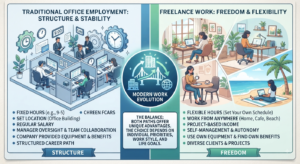 The Definition
Freelancing is self-employment where you offer services to multiple clients on a project or contract basis, rather than working as a full-time employee for one company.
Key characteristics:
- You are your own boss (no manager telling you what to do)
- Multiple clients (not dependent on single employer)
- Project-based or retainer work (defined scope or ongoing relationship)
- Location independent (often work remotely)
- You set your rates (within market range)
- You control your schedule (mostly—clients have deadlines)
What Freelancing Is NOT
❌ Not a get-rich-quick scheme
Building a freelance business takes 3-6 months to see meaningful income, 12-18 months to replace full-time salary.
❌ Not completely passive income
You trade time/skills for money. If you stop working, income stops. (Unlike true passive income like dividends or rental properties)
❌ Not easier than a regular job
Different challenges: finding clients, inconsistent income, self-discipline, no benefits, you handle everything.
❌ Not guaranteed income
Some months are great ($8,000). Some months are slow ($1,500). Income fluctuates.
The Honest Pros and Cons
Advantages:
✅ Flexibility and Freedom
- Work from anywhere with WiFi
- Set your own schedule (morning person? Night owl? Your choice)
- Take vacation when you want (if you plan ahead)
- No commute (save 1-2 hours/day)
✅ Income Potential
- No salary cap (earn based on value you provide)
- Multiple clients = multiple income streams
- Can raise rates as you gain experience
- Top freelancers earn $100,000-$300,000+/year
✅ Variety and Learning
- Work on diverse projects
- Multiple industries and clients
- Constantly learning new skills
- Never boring
✅ Be Your Own Boss
- No office politics
- No bad managers
- Choose clients you want to work with
- Fire clients you don’t like
✅ Tax Benefits
- Home office deduction
- Equipment write-offs
- Business expense deductions
- Potentially lower tax burden than W-2 employee
Disadvantages:
❌ Income Instability
- Month-to-month variation (feast or famine)
- No guaranteed paycheck
- Clients can cancel projects
- Economic downturns hit freelancers hard
❌ No Benefits
- No employer health insurance
- No 401(k) match
- No paid vacation
- No sick days
- No unemployment insurance (in most states)
❌ You Are the Business
- Must find clients (sales/marketing)
- Must do bookkeeping
- Must handle customer service
- Must manage projects
- Wear all the hats
❌ Self-Discipline Required
- Easy to procrastinate
- No one making sure you work
- Must manage time effectively
- Burnout risk (no clear work/life boundaries)
❌ Isolation
- Work alone (often)
- No coworkers to chat with
- Can be lonely
- Must proactively create social connections
❌ Payment Issues
- Chasing late payments
- Clients who don’t pay
- Cash flow challenges
- Seasonal fluctuations
Is Freelancing Right for YOU?
Take this honest self-assessment:
✅ Freelancing might be a great fit if you:
- Are self-motivated (don’t need external pressure to work)
- Comfortable with income variability
- Enjoy variety (different projects, clients)
- Have marketable skills
- Good at time management
- Don’t mind wearing multiple hats (worker, salesperson, accountant)
- Willing to hustle in the beginning
- Can handle rejection (proposals will get rejected)
- Have financial cushion (3-6 months expenses saved)
❌ Freelancing might NOT be for you if you:
- Need predictable paycheck every two weeks
- Struggle with self-discipline
- Want comprehensive benefits package
- Hate “selling” or finding clients
- Need clear 9-5 structure
- Cannot afford income fluctuation
- Want to clock out at 5pm and forget work
- Need social interaction from coworkers daily
The middle ground: Start freelancing as side hustle while keeping day job
- Test whether you like it
- Build skills and clients
- Create financial cushion
- Transition gradually when ready
- Best of both worlds
Types of Freelancing
Service-based (most common):
- Writing and content creation
- Graphic design
- Web development
- Marketing (SEO, social media, ads)
- Virtual assistance
- Video editing
- Consulting
- Bookkeeping
- Translation
Creative:
- Photography
- Illustration
- Music production
- Voice acting
- Animation
Technical:
- Software development
- Data analysis
- IT support
- Cybersecurity
Professional:
- Legal services
- Accounting
- Business consulting
- Coaching
Most beginners start with service-based freelancing (writing, design, VA work, basic web development) because barriers to entry are lower.
The Freelancing Landscape{#landscape}
Understanding the current market helps you make informed decisions.
Freelancing by the Numbers
Market size:
- 64 million Americans freelanced in 2024 (38% of workforce)
- Up from 59 million in 2020
- Projected to be 90 million by 2028 (majority of workforce)
Earnings:
- Median freelance income: $28,000/year (part-time)
- Full-time freelancers: $67,000/year median
- Top 25% of freelancers: $100,000+/year
- Top 10%: $200,000+/year
Time breakdown:
- 36% freelance full-time (primary income)
- 64% freelance part-time (side income)
- Average part-timer: 15 hours/week
- Average full-timer: 36 hours/week
Industries hiring most freelancers:
- Technology (software development, IT, data)
- Creative (design, writing, video)
- Marketing (SEO, social media, advertising)
- Business consulting
- Administrative support
Platform vs. Direct Client Statistics
Where freelancers find work:
- 43% through freelancing platforms (Upwork, Fiverr, etc.)
- 38% through direct outreach/networking
- 12% through referrals
- 7% through agencies
Most successful freelancers use multiple channels (not just one platform)
Freelancing Trends in 2025
What’s hot:
✅ AI-assisted services
- Prompt engineering
- AI content editing/refinement
- AI tool implementation
- Training businesses to use AI
✅ Short-form video content
- TikTok, Reels, YouTube Shorts creation
- Video editing for social media
- High demand, relatively low supply
✅ Sustainability consulting
- ESG reporting
- Sustainable business practices
- Carbon footprint analysis
✅ Remote work infrastructure
- Virtual event management
- Remote team building
- Digital collaboration tools setup
✅ Niche expertise
- Specialized skills command premium rates
- “Jack of all trades” less valuable
- Deep knowledge > broad knowledge
What’s declining:
❌ Generic services
- “I’ll do anything” approach
- Commodity services
- Race-to-the-bottom pricing
❌ Outdated skills
- Flash development
- Outdated CMS platforms
- Declining social platforms
Income Potential by Skill (2025 Averages)
| Skill | Beginner Rate | Intermediate | Expert | Notes |
|---|---|---|---|---|
| Writing | $20-40/hr | $50-100/hr | $100-250/hr | Niche specialists earn more |
| Graphic Design | $25-45/hr | $50-100/hr | $100-200/hr | Logo design, branding premium |
| Web Development | $30-60/hr | $75-150/hr | $150-300/hr | Specialized frameworks pay more |
| Social Media Mgmt | $20-40/hr | $50-100/hr | $100-200/hr | Paid ads expertise premium |
| Virtual Assistant | $15-30/hr | $35-60/hr | $60-100/hr | Specialized VAs earn more |
| Video Editing | $25-50/hr | $60-125/hr | $125-250/hr | Motion graphics command premium |
| SEO Services | $30-60/hr | $75-150/hr | $150-300/hr | Technical SEO highly valued |
| Bookkeeping | $25-50/hr | $60-100/hr | $100-150/hr | CPA certification boosts rates |
| Consulting | $50-150/hr | $150-300/hr | $300-1,000/hr | Industry expertise critical |
Key insight: Specialists earn 2-3x more than generalists in the same field
Global Competition Reality
The challenge:
- You’re competing globally (someone in lower-cost country will undercut you)
- $5/hour freelancers exist on platforms
- Clients can choose anyone, anywhere
Why you can still win:
- Quality: Better work justifies higher rates
- Communication: Native English speakers (if applicable) have advantage
- Reliability: Show up on time, meet deadlines
- Specialization: Deep niche expertise is rare globally
- Time zones: Same timezone as client is valuable
- Cultural fit: Understanding client’s market/culture
Don’t compete on price alone. Compete on value.
Economic Factors Affecting Freelancing
Positive trends:
- Remote work normalized (more companies comfortable hiring freelancers)
- Economic uncertainty (companies prefer contract workers over full-time hires)
- Gig economy infrastructure matured (easier to freelance than ever)
- Global talent pool accessible to clients
Challenges:
- AI automation (some tasks becoming automated)
- Economic recessions (freelancers feel it first)
- Platform fees increasing (Upwork raised fees)
- Saturation in popular categories
Bottom line: Freelancing is growing but becoming more competitive. Specialization and quality win.
Freelancing vs. Traditional Employment: Honest Comparison {#comparison}
 Let’s be brutally honest about both paths.
Income Comparison
Traditional Employment:
- Stability: ⭐⭐⭐⭐⭐
Predictable biweekly paycheck - Potential: ⭐⭐⭐
Salary cap, annual raises 3-5% - Benefits value: ⭐⭐⭐⭐⭐
Health insurance, 401(k) match, paid time off adds $15,000-$30,000/year value
Freelancing:
- Stability: ⭐⭐
Highly variable month-to-month - Potential: ⭐⭐⭐⭐⭐
Unlimited ceiling, can double income year-over-year - Benefits value: ⭐
Pay for everything yourself
Real example:
- Employee: $60,000 salary + $18,000 benefits = $78,000 total compensation
- Freelancer: Must earn $78,000+ to match, PLUS pay self-employment tax (additional 7.65%)
- Freelancer needs to earn ~$84,000 to equal $60,000 employee position
Time and Flexibility
Traditional Employment:
- Fixed schedule (usually 9-5)
- Limited vacation (2-3 weeks)
- Commute time (30-60 min each way)
- Office environment (distractions, meetings)
- Clear boundaries (work ends at 5pm)
Freelancing:
- Flexible schedule (work when you want—with deadlines)
- Unlimited vacation (if you can afford it)
- No commute (work from home)
- Choose your environment
- Boundaries blur (work-life integration challenging)
Career Growth
Traditional Employment:
- Clear path: Entry → Mid-level → Senior → Management
- Training: Employer pays for professional development
- Network: Built-in colleagues and industry connections
- Mentorship: Access to senior employees
- Resume: Impressive company names add credibility
Freelancing:
- Unclear path: You define your own trajectory
- Training: Pay for your own education
- Network: Must proactively build (no built-in network)
- Mentorship: Find your own (harder)
- Resume: Portfolio matters more than company names
Financial Security
Traditional Employment:
| Benefit | Value/Impact |
|---|---|
| Health insurance | $500-1,500/month employer contribution |
| 401(k) match | 3-6% of salary (free money) |
| Unemployment insurance | Safety net if laid off |
| Disability insurance | Often provided |
| Paid vacation | 2-4 weeks/year |
| Paid sick leave | 5-10 days/year |
| Stable paycheck | Priceless for some |
Freelancing:
- Pay for own health insurance ($300-1,000+/month)
- No 401(k) match (but can contribute to Solo 401k/SEP IRA)
- No unemployment (unless you paid into it)
- Buy own disability insurance
- No paid vacation (don’t work = don’t get paid)
- No paid sick leave
- Income varies wildly
Stress and Control
Traditional Employment:
- Control: ⭐⭐
Limited say in projects, schedule, methods - Job security stress: ⭐⭐⭐
Can be laid off anytime - Office politics: ⭐⭐⭐⭐
Navigate workplace dynamics - Work-life boundaries: ⭐⭐⭐⭐
Generally clear separation
Freelancing:
- Control: ⭐⭐⭐⭐⭐
Choose projects, clients, rates, methods - Income stress: ⭐⭐⭐⭐
“Where’s next client coming from?” - Office politics: ⭐
Minimal (work alone) - Work-life boundaries: ⭐⭐
Hard to separate (work from home)
Which Path for YOU?
Choose traditional employment if:
- You value stability and predictable income
- You want comprehensive benefits
- You prefer clear structure and direction
- You enjoy team environment
- You’re risk-averse
- You have dependents relying on your income
- You’re early in career building foundational skills
Choose freelancing if:
- You crave flexibility and control
- You’re comfortable with income variability
- You’re self-disciplined and motivated
- You have emergency fund (3-6 months expenses)
- You enjoy variety and new challenges
- You’re willing to trade security for freedom
- You have marketable skills
The hybrid approach (recommended for beginners):
- Keep full-time job (security, benefits, steady income)
- Start freelancing on side (evenings, weekends)
- Build skills, clients, income to $2,000-3,000/month
- Save 12 months of living expenses
- Transition to full-time freelancing if desired
This gives you:
- Security while you learn
- Time to test if you like freelancing
- Financial cushion before going full-time
- Client base already established
- Lower risk
[Internal Link: Build emergency fund first with “Emergency Fund Guide: How Much to Save and Where to Keep It” before freelancing full-time]
Step 1: Identify Your Freelance Skills {#identify-skills}
 “But I don’t have any marketable skills!”
This is the #1 objection I hear. And it’s almost always false.
The truth: You have more marketable skills than you realize. You just haven’t identified them yet.
The Skills Inventory Exercise
Grab a pen and paper. Let’s uncover your freelanceable skills.
Category 1: Professional Skills (From Jobs)
What have you done in any job (current or past)?
Common professional skills that translate to freelancing:
Writing & Communication:
- Written emails, reports, presentations?
→ Freelance: Business writing, email marketing, copywriting - Created documentation or training materials?
→ Freelance: Technical writing, instructional design - Managed social media for employer?
→ Freelance: Social media management
Design & Creative:
- Made presentations (PowerPoint, Google Slides)?
→ Freelance: Presentation design - Created graphics, flyers, or marketing materials?
→ Freelance: Graphic design - Edited photos or videos?
→ Freelance: Photo/video editing
Administrative:
- Scheduled meetings, managed calendars?
→ Freelance: Virtual assistant - Handled customer service?
→ Freelance: Customer support specialist - Did data entry or spreadsheets?
→ Freelance: Data entry, Excel specialist
Technical:
- Built or managed websites?
→ Freelance: Web development, WordPress management - Used specific software (Salesforce, QuickBooks, AutoCAD)?
→ Freelance: Software consultant/trainer - Troubleshot tech problems?
→ Freelance: Tech support
Marketing & Sales:
- Ran advertising campaigns?
→ Freelance: PPC management, Facebook Ads specialist - Optimized website for search?
→ Freelance: SEO consultant - Sold products or services?
→ Freelance: Sales consultant, business development
Finance & Numbers:
- Managed budgets or bookkeeping?
→ Freelance: Bookkeeper, financial analyst - Prepared financial reports?
→ Freelance: Financial reporting specialist - Handled payroll?
→ Freelance: Payroll specialist
Project Management:
- Coordinated projects or teams?
→ Freelance: Project manager - Organized events?
→ Freelance: Event coordinator
List 5-10 things you’ve done in jobs:
Category 2: Educational Background
What did you study? What degrees or certifications do you have?
Examples:
- English degree → Writing, editing, proofreading
- Marketing degree → Digital marketing, content strategy
- Accounting → Bookkeeping, tax preparation
- Graphic design → Logo design, branding
- Computer science → Software development, app creation
- Business → Business consulting, strategy
- Teaching → Online tutoring, course creation
Even “useless” degrees have freelance applications:
- History degree → Research, historical content writing
- Philosophy degree → Analytical writing, content strategy
- Art degree → Illustration, creative direction
Your education: _______________________________
How it translates to freelancing: _______________________________
Category 3: Hobbies & Passions
What do you do for fun? What are you naturally good at?
Common hobby → freelance translations:
- Photography → Event photography, stock photography, photo editing
- Writing stories → Fiction ghostwriting, creative writing
- Fitness enthusiast → Fitness content writing, coaching
- Gaming → Gaming content creation, Twitch editing
- Cooking → Recipe development, food blogging
- Crafts → Etsy seller, craft tutorial creation
- Languages → Translation, language tutoring
- Reading → Book reviewing, proofreading
- Social media user → Social media management
- YouTube watcher → Video editing, thumbnail design
Your hobbies: _______________________________
Freelance potential: _______________________________
Category 4: Soft Skills (Often Overlooked)
Personal qualities that are valuable in freelancing:
- Organized? → Virtual assistant, project management
- Detail-oriented? → Proofreading, data entry, QA testing
- Great communicator? → Customer service, community management
- Problem solver? → Consulting, business analysis
- Patient teacher? → Tutoring, training content creation
- Creative thinker? → Content creation, copywriting
- Tech-savvy? → Tech support, software training
- Persuasive? → Copywriting, sales writing
Your top 3 soft skills:
Category 5: Life Experience
Unique experiences create niche expertise:
Examples:
- Parenting → Parenting blog writing, family content
- Homeownership → Real estate content, home improvement writing
- Chronic illness → Healthcare content, patient advocacy writing
- Travel → Travel writing, destination guides
- Starting a business → Business content, entrepreneur coaching
- Going through divorce → Legal content, life coaching content
- Learning new language → Language learning content
Your unique experiences: _______________________________
Niche opportunities: _______________________________
Identifying Transferable Skills
Many skills transfer across industries:
Customer service → Sales writing
(Understanding customer pain points)
Teaching → Content creation
(Explaining concepts clearly)
Project management → Virtual assistance
(Organization, coordination)
Retail/hospitality → Customer support
(People skills, problem-solving)
The “I Literally Have Nothing” Solution
If you genuinely have no marketable skills yet, here are fast-track options:
Learn a high-demand skill in 30-90 days:
Fastest to learn and start earning:
- Social media management (30 days)
- Free courses: HubSpot, Meta Blueprint
- Practice on own accounts
- First clients: Local small businesses
- Basic graphic design (30-60 days)
- Learn Canva (dead simple)
- Tutorial: YouTube (free)
- Niche: Social media graphics, presentations
- Virtual assistant (immediate)
- Leverage organizational skills
- Learn basic tools (Google Workspace, project management)
- Start: General VA, specialize later
- Freelance writing (60 days)
- Practice writing daily
- Learn SEO basics (free: Moz, Ahrefs blog)
- Start: Blog posts, website copy
- Basic WordPress management (45 days)
- Set up own WordPress site
- Learn basics: plugins, themes, updates
- Service: WordPress maintenance for small businesses
Investment: $0-200 (mostly free learning)
Time to first client: 30-90 days
First income: $300-1,000/month realistic
Your Skills Action Plan
By now, you should have identified 5-10 potential freelance skills.
Next step: Narrow to 1-3 to start with
Criteria for choosing:
- Market demand (people actually hire for this?)
- Your proficiency (can you deliver quality work?)
- Enjoyment (will you hate doing this 20 hrs/week?)
- Income potential (does it pay enough?)
- Competition (too saturated or good opportunity?)
Your top 1-3 freelance skills to pursue:
Congratulations. You now know what you’re freelancing.
Step 2: Choose Your Freelancing Niche {#choose-niche}
Here’s a harsh truth: “I’m a freelance writer” won’t get you hired.
But “I write conversion-focused landing pages for SaaS companies” will.
The difference? Niche specificity.
Why Niching Matters
The generalist trap:
- Competes with everyone
- Race to the bottom on price
- No differentiation
- “Jack of all trades, master of none”
The specialist advantage:
- Less competition
- Higher rates (2-3x generalists)
- Easier to market yourself
- Attract ideal clients
- Become the expert
Real example:
- Generic: “Freelance writer” – competing with 10 million writers
- Niche: “Financial content writer for FinTech startups” – competing with hundreds
Who gets hired at higher rates? The specialist.
The Niche Formula
A strong freelance niche has three components:
1. WHAT (Service)
What specific service do you provide?
2. WHO (Target Client)
Who specifically do you serve?
3. WHY (Benefit/Result)
What outcome do they get?
Formula: I help [WHO] with [WHAT] so they can [WHY/BENEFIT]
Examples:
Weak (too broad):
- “I’m a freelance designer”
- “I do social media”
- “I’m a virtual assistant”
Strong (specific niche):
- “I design landing pages for e-commerce brands to increase conversion rates”
- “I manage Instagram accounts for sustainable fashion brands to build engaged communities”
- “I provide bookkeeping for therapists and counselors so they can focus on patients, not paperwork”
How to Choose Your Niche
Step 1: Start with your skill (from previous section)
Example: Freelance writing
Step 2: Identify industries/client types you understand or enjoy
Common client types:
- Small businesses
- Startups
- E-commerce brands
- SaaS companies
- Healthcare practices
- Real estate agents
- Coaches/consultants
- Agencies
- Non-profits
- B2B companies
- B2C companies
Example: I understand SaaS companies (worked at one, or use lots of SaaS tools)
Step 3: Identify specific problems they have
SaaS companies need:
- Website copy that explains complex products simply
- Blog content for SEO
- Case studies to prove ROI
- Email sequences to nurture trials
- Product documentation
Example: They need website copy that converts free trials to paid customers
Step 4: Combine into niche statement
“I write conversion-focused website copy for B2B SaaS companies to turn more free trials into paid customers”
That’s a niche.
Niche Ideas by Skill
For Writers:
| Niche | Target Client | Specific Service |
|---|---|---|
| Healthcare content | Medical practices, hospitals | Patient education materials |
| SaaS copywriting | Software companies | Website copy, product descriptions |
| Financial writing | FinTech, banks, advisors | Blog content, white papers |
| E-commerce product descriptions | Online retailers | SEO-optimized product copy |
| Real estate content | Agents, brokerages | Property descriptions, market reports |
| Sustainability content | Green companies | ESG reports, sustainability content |
| HR content | HR departments, recruiting firms | Job descriptions, company culture content |
For Designers:
| Niche | Target Client | Specific Service |
|---|---|---|
| Restaurant menu design | Restaurants | Print and digital menus |
| Real estate branding | Real estate agents | Logo, business cards, signage |
| E-book cover design | Authors, publishers | Fiction/non-fiction covers |
| Social media graphics | E-commerce brands | Instagram, Pinterest graphics |
| Pitch deck design | Startups seeking funding | Investor presentation design |
| Course materials design | Online educators | Workbooks, slide decks |
For Virtual Assistants:
| Niche | Target Client | Specific Service |
|---|---|---|
| Real estate VA | Real estate agents | Transaction coordination, client communication |
| E-commerce VA | Online store owners | Product listings, customer service, inventory |
| Podcast VA | Podcasters | Show notes, guest coordination, editing management |
| Social media VA | Coaches, influencers | Scheduling, engagement, DM management |
| Legal VA | Attorneys, law firms | Document preparation, client intake |
For Web Developers:
| Niche | Target Client | Specific Service |
|---|---|---|
| WordPress for therapists | Therapists, counselors | HIPAA-compliant websites, booking systems |
| Shopify for artisans | Craftspeople, makers | Online shop setup and optimization |
| Landing pages for coaches | Life coaches, business coaches | High-converting single-page sites |
| Restaurant websites | Restaurants | Mobile-friendly sites with online ordering |
The “Riches in the Niches” Proof
Generic freelancer:
- Rate: $25/hour
- Competing with thousands
- Clients: “Looking for cheapest option”
Niched freelancer:
- Rate: $75-150/hour (same skill, different positioning)
- Competing with dozens
- Clients: “Need expert who understands my industry”
The niche premium is real: 2-3x higher rates for the same work.
“But Won’t Niching Limit My Opportunities?”
Common fear: “If I specialize, I’ll miss out on other work!”
Reality: The opposite happens.
When you’re specific:
- Ideal clients find you easily
- You become referrable (“I know the PERFECT person for this”)
- You attract more work, not less
- You can always expand later
When you’re generic:
- You’re invisible in the crowd
- No one refers you (“They do… everything?”)
- You compete on price only
You can always say yes to off-niche work if you want. But your marketing should be niche-specific.
Starting Broad, Then Narrowing
If you’re truly unsure, use this approach:
Month 1-3: Start broad, take various projects
- Learn what you enjoy
- See what pays well
- Discover what clients need
Month 4-6: Notice patterns
- Which projects did you love?
- Which clients were best to work with?
- Which work paid best?
Month 7+: Declare your niche based on data
- Double down on what worked
- Market specifically to that niche
- Raise rates
Example:
- Months 1-3: General freelance writing (everything)
- Months 4-6: Notice most enjoyable/profitable = FinTech blog posts
- Month 7+: Rebrand as “FinTech content specialist”
Your Niche Worksheet
My core skill: _______________________________
Industries I know/enjoy:
Specific problems they have: _______________________________
My niche statement:
“I help [TARGET CLIENT] with [SPECIFIC SERVICE] so they can [BENEFIT]”
I help _______________ with _______________ so they can _______________
Example filled in:
“I help eco-conscious e-commerce brands with product photography so they can showcase their products beautifully and increase online sales”
Step 3: Set Your Rates (What to Charge) {#set-rates}

“How much should I charge?”
This question keeps beginners up at night. Charge too little, you’re broke. Charge too much, you get no clients.
Here’s the framework to price correctly from day one.
Pricing Models Explained
1. Hourly Rate
How it works:
- Charge per hour worked
- Track time, bill client
- Example: $50/hour × 10 hours = $500
Pros:
- Simple to understand
- Fair for undefined scope
- Good for beginners
Cons:
- Income capped by hours available
- Penalizes efficiency (faster work = less money)
- Clients watch the clock
- Difficult to scale
When to use: Starting out, unclear scope projects, ongoing retainer work
2. Project-Based (Flat Fee)
How it works:
- Quote one price for entire project
- Example: “Logo design: $800”
- Client knows total cost upfront
Pros:
- Rewards efficiency (finish fast, keep hourly rate high)
- Client likes certainty
- Can be more profitable
- Scalable (not tied to hours)
Cons:
- Must estimate time accurately
- Scope creep risk (client adds work)
- Can underestimate and lose money
When to use: Defined scope projects, once you know how long things take
3. Retainer
How it works:
- Monthly fee for ongoing work
- Example: “$2,000/month for 20 hours of social media management”
- Recurring revenue
Pros:
- Predictable income
- Client committed long-term
- Build relationship
- Financial stability
Cons:
- Requires proving ongoing value
- Can feel like employee without benefits
- Scope creep over time
When to use: After proving value, for ongoing needs (VA, social media, content creation)
4. Value-Based Pricing
How it works:
- Price based on value delivered, not time spent
- Example: “This landing page will increase your revenue by $50,000/year. I charge $5,000.”
- Price reflects ROI, not hours
Pros:
- Highest earning potential
- Rewards expertise
- Client happy to pay (they make more)
- Not limited by time
Cons:
- Hard to quantify value
- Requires business acumen
- Client must understand ROI
- Difficult for beginners
When to use: Experienced freelancers, measurable outcomes (conversion optimization, paid ads management)
How to Calculate Your Hourly Rate
Even if you price by project, you need to know your hourly baseline.
The formula:
1. Determine annual income need
What do you need to earn per year?
Example: $60,000/year
2. Add 30% for expenses and taxes
Freelancers pay more taxes (self-employment tax) + expenses (software, tools, health insurance)
$60,000 × 1.30 = $78,000 needed
3. Determine billable hours
Not all hours are billable. You’ll spend time on:
- Finding clients
- Admin tasks
- Breaks
- Sick days
- Vacation
Realistic billable hours:
- Full-time freelancer: 25-30 hours/week billable (out of 40)
- Part-time freelancer: 10-15 hours/week billable
Full-time example: 25 billable hours/week × 48 weeks (4 weeks vacation) = 1,200 billable hours/year
4. Calculate hourly rate
Annual need ÷ Billable hours = Hourly rate
$78,000 ÷ 1,200 hours = $65/hour minimum
That’s your baseline to meet $60,000/year take-home goal.
Market Rate Research
Your calculated rate is one data point. Now check market rates.
Where to research rates:
1. Freelance platform averages
- Upwork: Search your skill, filter by rate
- Fiverr: Check what top sellers charge
- Freelancer.com: Browse job postings
2. Industry surveys
- Freelance Writers Den (for writers)
- Design Census (for designers)
- Freelancing Females survey
- Upwork’s rate database
3. Ask other freelancers
- Join Facebook groups for your niche
- Connect on LinkedIn
- Professional associations
4. Check job postings
- Indeed, LinkedIn job posts (for full-time equivalent)
- Divide annual salary by 2,000 to get rough hourly rate
- Freelance rate should be 1.5-2x that (no benefits)
Rate Ranges by Experience Level
General guidelines (adjust by niche):
Beginner (0-6 months freelancing):
- Writing: $20-40/hour
- Design: $25-45/hour
- Web development: $30-60/hour
- Virtual assistant: $15-30/hour
- Social media management: $20-40/hour
Intermediate (6 months – 3 years):
- Writing: $50-100/hour
- Design: $50-100/hour
- Web development: $75-150/hour
- Virtual assistant: $35-60/hour
- Social media management: $50-100/hour
Expert (3+ years, specialized niche):
- Writing: $100-250/hour
- Design: $100-200/hour
- Web development: $150-300/hour
- Virtual assistant: $60-100/hour (specialized)
- Social media management: $100-200/hour
Note: These are averages. Location, niche, and individual skill significantly affect rates.
The Pricing Strategy for Beginners
Starting out, you face a dilemma:
- Charge market rate → few clients (no experience/portfolio)
- Charge low → get exploited and go broke
The solution: Strategic underpricing initially
Month 1-3: Build portfolio pricing
- Charge 20-30% below market rate
- Example: If market is $50/hour, charge $35-40/hour
- Goal: Get 5-10 projects, build reviews
Month 4-6: Approach market pricing
- Raise rates to market average
- You now have portfolio and reviews
- Example: Raise to $50/hour
Month 7-12: Above market pricing
- Charge 10-20% above market average
- You have proven track record
- Can be selective with clients
- Example: $55-60/hour
Month 13+: Premium pricing
- Charge based on value, not time
- Niche expertise commands premium
- Example: $75-100/hour or project-based
Key: Raise rates regularly. Every 3-6 months in first 2 years.
How to Present Your Rates
DON’T:
❌ “I charge $35/hour, but I’m flexible”
(Signals desperation, invites negotiation)
❌ “Whatever you think is fair”
(Unprofessional, will get lowballed)
❌ “I don’t know, what’s your budget?”
(Puts you at disadvantage)
DO:
✅ “My rate for this project is $500”
(Confident, specific)
✅ “Based on the scope, I quote $1,200 for this project”
(Professional, justified)
✅ “My hourly rate is $50. For this project, I estimate 10 hours, so approximately $500 total”
(Transparent, helpful)
Handling “You’re Too Expensive”
When clients push back on your rate:
Response framework:
1. Confirm value
“I understand budget is a consideration. Let me make sure this project would truly deliver the results you need…”
2. Justify price
“My rate reflects [specific expertise/results you deliver]. For example, [past success story]…”
3. Offer alternatives
“If budget is tight, we could [reduce scope, phase the project, create payment plan]…”
4. Stand firm (if appropriate)
“I’m confident this investment will [deliver X result]. If the budget truly doesn’t work, I completely understand and happy to refer you to someone who might fit better.”
DO NOT:
❌ Immediately drop your rate (devalues your work)
❌ Get defensive (unprofessional)
❌ Take low-paying work out of desperation (sets bad precedent)
Sometimes the answer is “This client isn’t the right fit” — and that’s okay.
Package Pricing Strategy
Instead of à la carte pricing, create packages:
Example: Social Media Management
Basic Package: $500/month
- 3 posts per week
- 1 platform
- Monthly analytics report
Standard Package: $1,000/month ⭐ MOST POPULAR
- 5 posts per week
- 2 platforms
- Community management (respond to comments)
- Monthly strategy call
Premium Package: $2,000/month
- Daily posts
- 3 platforms
- Community management
- Paid ads management
- Weekly strategy calls
- Priority support
Why this works:
- Clients self-select based on budget
- Middle option sells most (anchoring effect)
- Upsell opportunity (start Basic, upgrade to Standard)
- Predictable pricing (easier to sell)
Your Pricing Worksheet
Annual income goal: $___________
+ 30% for expenses/taxes = $___________
÷ Billable hours per year (_____ hrs/week × 48 weeks) = _____ hours
= $_______ minimum hourly rate
Market research (your skill/niche):
- Beginner rate: $______/hour
- Intermediate rate: $______/hour
- Expert rate: $______/hour
Your starting rate (months 1-3): $______/hour
Your 6-month goal rate: $______/hour
Your 12-month goal rate: $______/hour
Step 4: Build Your Portfolio (Even with No Experience) {#build-portfolio}
**[Continue to next response due to length – need to cover remaining sections:
- Build Portfolio
- Choose Platforms
- Create Profiles/Proposals
- Find First Clients
- Deliver Work
- Get Reviews
- Scale Income
- Business Setup
- Finances
- Mistakes
- Success Stories
- FAQ
- Conclusion]**
Leave a Reply