Blog

  • Homeowners and Renters Insurance: Essential Coverage Explained

    Homeowners and Renters Insurance: Essential Coverage Explained

    Your home is likely the most valuable asset you own. Yet many people protect it with inadequate or nonexistent insurance.

    Consider these scenarios:

    Scenario 1: House fire
    Your $400,000 home burns down. Replacement cost: $450,000 (inflation, upgraded materials). Your insurance coverage: $250,000. Your personal responsibility: $200,000 (paid from personal assets or bankruptcy).

    Scenario 2: Apartment theft
    Burglary while you’re at work. $15,000 in electronics, furniture, and clothing stolen. Your coverage: $0 (no renters insurance). Your personal responsibility: $15,000 (paid from savings or credit cards).

    Scenario 3: Liability lawsuit
    Guest slips on icy steps and breaks leg. Medical bills: $50,000. Lawsuit damages: $100,000. Your liability insurance limit: $50,000. Your personal responsibility: $50,000 out-of-pocket.

    These aren’t hypothetical. They happen constantly—and without proper insurance, they’re financially catastrophic.

    Yet homeowners and renters insurance is surprisingly affordable:

    • Homeowners: $800-$1,500/year
    • Renters: $150-$200/year

    In this comprehensive guide, you’ll understand what homeowners and renters insurance actually covers, how to calculate adequate coverage, how to find the best rates, and exactly what to do if disaster strikes.

    Whether you own or rent, proper property insurance is essential protection.

    Let’s ensure your home and possessions are protected.


    Understanding Property Insurance: The Basics

    Before diving into specifics, let’s understand what property insurance does.

    The Purpose of Property Insurance

    Property insurance protects you from financial loss due to:

    • Damage to property: Fire, weather, theft, vandalism
    • Liability: If someone is injured on your property

    It’s not flood or earthquake insurance (separate policies). It’s not paying for normal maintenance. It’s specifically protecting against unexpected property damage and liability.

    Who Needs Property Insurance

    Homeowners with mortgage: Required by lender (non-negotiable)

    Homeowners without mortgage: Not required by law, but essential protection

    Renters: Not required by law, but essential protection (landlord’s insurance doesn’t cover your stuff)

    Landlords with rental properties: Required by mortgage lender and essential

    How Property Insurance Works

    When damage occurs:

    1. You experience loss (fire, theft, weather damage)
    2. You contact insurance company to file claim
    3. Insurance company assigns adjuster
    4. Adjuster investigates and assesses damage
    5. Insurance company pays claim (minus deductible)
    6. You use proceeds to repair/replace

    Important: Insurance pays for actual damage/loss, not profit.

    Example:

    • Your TV purchased for $1,000 five years ago
    • Current value: $300 (depreciation)
    • Insurance pays: $300 (actual cash value)
    • Insurance does NOT pay: Original $1,000 cost

    Homeowners Insurance: Complete Coverage Guide

    Homeowners insurance protects your home and belongings, plus provides liability coverage.

    What Homeowners Insurance Covers

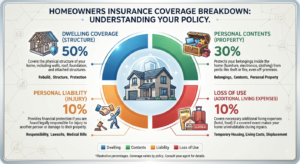
    Homeowners insurance has multiple coverage components:

    Coverage A: Dwelling (Structure)

    What it covers:

    • Home structure (walls, roof, foundation)
    • Attached structures (garage, deck, shed)
    • Permanent fixtures (built-in appliances, fixtures)
    • Cost to rebuild your home

    What it doesn’t cover:

    • Land (insurance covers structure, not the ground)
    • Yard/landscaping (sometimes partial coverage)
    • Personal property (covered under separate coverage)
    • Detached structures over certain value

    How much to buy:

    Critical: Buy enough to FULLY rebuild your home.

    Calculation:

    Rebuilding cost per square foot: $150-$250 (varies by location and quality)
    Home size: 2,000 square feet
    Rebuild cost: 2,000 × $150-$250 = $300,000-$500,000

    Common mistake: Insuring for original purchase price instead of rebuild cost.

    Example:

    • Bought house for $300,000 in 2005
    • Today’s rebuild cost: $500,000
    • Insuring for $300,000: Underinsured by $200,000

    Action: Get formal replacement cost estimate from insurance company or appraiser.

    Coverage options:

    Actual Cash Value (ACV):

    • What it pays: Replacement cost minus depreciation
    • Example: $50,000 roof damage, roof is 15 years old (50% life remaining)
    • Pays: $25,000 (50% of replacement cost)
    • Cost: Cheaper premium
    • Problem: Gap between what insurance pays and actual repair cost

    Replacement Cost (RC):

    • What it pays: Full replacement cost, no depreciation deduction
    • Example: $50,000 roof damage, roof is 15 years old
    • Pays: Full $50,000 (no depreciation deduction)
    • Cost: Higher premium ($100-200/year more)
    • Recommended: Almost always worth the cost

    Guaranteed/Extended Replacement Cost:

    • What it pays: Up to 120-150% of dwelling limit
    • Example: Dwelling limit $400,000, pays up to $480,000-$600,000
    • Cost: Slightly higher premium
    • Best for: Inflation protection

    Recommendation: Buy replacement cost coverage, not actual cash value.

    Coverage B: Other Structures

    What it covers:

    • Detached garage
    • Shed
    • Pool house
    • Guest house
    • Fence (sometimes)

    Coverage amount:

    • Usually 10-20% of dwelling coverage
    • Example: $400,000 dwelling = $40,000-$80,000 other structures

    When it matters:

    • Valuable detached structures
    • Expensive pool houses or guest houses
    • Consider increasing limit if structures valuable

    Coverage C: Personal Property (Contents)

    What it covers:

    • Furniture
    • Electronics (TV, computer, stereo)
    • Clothing
    • Appliances
    • Jewelry
    • Art
    • Sports equipment

    How much it covers:

    • Usually 50-75% of dwelling coverage
    • Example: $400,000 dwelling = $200,000-$300,000 contents

    Valuation options:

    Actual Cash Value:

    • Pays based on current market value (with depreciation)
    • Example: 5-year-old couch bought for $2,000, now worth $500, insurance pays $500
    • Cheaper premium

    Replacement Cost:

    • Pays what it costs to buy new item
    • Example: Same couch costs $2,000 new, insurance pays $2,000 (if limit allows)
    • Higher premium ($100-200/year more)
    • Recommended: Better coverage

    Important limits:
    Some items have sub-limits (maximum payout):

    • Jewelry: Often $1,500-$5,000 limit
    • Electronics: Sometimes $2,500-$5,000
    • Art/collectibles: Often limited
    • Cash: Usually $200-$500

    Solution for high-value items: Schedule them separately (floater policy).

    Calculate how much you need:

    • Walk through home, list all possessions
    • Estimate replacement cost for each category
    • Total the amounts
    • Buy dwelling × 50-75% at minimum
    • Consider higher limit if you have valuable items

    Example:

    • Furniture: $10,000
    • Electronics: $8,000
    • Clothing: $4,000
    • Kitchen items: $3,000
    • Bedroom items: $4,000
    • Living room items: $5,000
    • Miscellaneous: $6,000
    • Total: $40,000

    If dwelling is $400,000, should have $200,000+ contents coverage.

    Coverage D: Loss of Use (Additional Living Expenses)

    What it covers:

    • Temporary housing if home becomes uninhabitable
    • Meals and food
    • Transportation
    • Other living expenses during repairs

    How it works:

    Home damaged by fire, uninhabitable for 3 months:

    • Monthly living expenses increased by: $2,000 (temporary housing adds to normal expenses)
    • 3 months × $2,000 = $6,000
    • Insurance covers: Full $6,000

    Coverage amount:

    • Usually 20-30% of dwelling coverage
    • Example: $400,000 dwelling = $80,000-$120,000 loss of use

    Recommendation: Accept whatever limit insurance offers (rarely a limiting factor).

    Coverage E: Liability Protection

    What it covers:

    • If someone injured on your property
    • Legal defense (your attorney paid by insurance)
    • Medical bills for injured person
    • Damages if sued

    How it works:

    Guest slips on icy steps, breaks leg:

    • Medical bills: $50,000
    • Ongoing care: $20,000
    • Pain and suffering damages: $30,000
    • Total claim: $100,000

    If liability limit is $300,000:

    • Insurance pays: Full $100,000
    • Your responsibility: $0

    If liability limit is $50,000:

    • Insurance pays: $50,000
    • Your responsibility: $50,000

    Coverage amounts:

    • Typical offered: $100,000-$300,000
    • Recommended: $300,000-$500,000
    • High-risk properties (pool, trampoline): $500,000+

    When to increase:

    • You have pool or trampoline
    • You have pets (liability risk)
    • Frequent guests
    • High net worth (more attractive lawsuit target)

    Cost: Increasing from $100,000 to $300,000 usually costs only $10-20/year.

    Recommendation: Buy at least $300,000 (cheap upgrade with significant protection increase).

    Coverage F: Medical Payments

    What it covers:

    • Medical bills for anyone injured on your property (regardless of fault)
    • Automatic coverage, no lawsuit needed

    How it works:

    Neighbor slips on your driveway (no negligence on your part), breaks arm:

    • Medical bills: $5,000
    • No lawsuit needed
    • Medical payments covers: Full $5,000

    Coverage amounts:

    • Usually $1,000-$5,000
    • Default is often sufficient for most situations

    When to increase:

    • Frequent guests
    • High injury risk environment (pool, sports activities)
    • Rarely necessary to increase

    What Homeowners Insurance Doesn’t Cover

    Water damage from floods: Excluded (requires separate flood insurance)

    Earthquake damage: Excluded (requires separate earthquake insurance)

    Routine maintenance: Not insurance claim (normal wear and tear)

    Intentional damage: Not covered (if you intentionally cause damage)

    Neglect: Not covered (damage from lack of maintenance)

    Business use: Not covered (operating business from home usually excluded)

    Certain weather: Some policies exclude wind/hail damage (especially in high-risk areas)

    Important: Know what’s NOT covered in your policy.

    Homeowners Insurance Costs

    Typical annual premiums:

    • Basic homeowners: $800-$1,200/year
    • Average home value $350,000: $1,000-$1,500/year
    • High-risk area: $1,500-$3,000+/year

    What affects cost:

    1. Home value: Higher value = higher premium
    2. Age of home: Older = higher cost (roof age critical)
    3. Location: High-crime areas cost more
    4. Weather risk: Areas with hurricanes, tornadoes cost more
    5. Deductible: Higher deductible = lower premium
    6. Construction type: Wood frame more expensive than brick
    7. Distance to fire station: Rural homes cost more
    8. Claims history: Previous claims increase rates
    9. Credit score: Better credit = lower rates
    10. Safety features: Alarm systems, fire extinguishers reduce cost

    Deductible options and cost impact:

    $500 deductible: Base premium
    $1,000 deductible: 10-15% savings ($100-150/year)
    $2,500 deductible: 25-30% savings ($250-350/year)
    $5,000 deductible: 40-50% savings ($400-600/year)

    Sweet spot: $1,000 deductible (balances reasonable savings with manageable out-of-pocket).

    Example cost breakdown (mid-sized home, good credit, no claims):

    • Dwelling: $400,000 = $900/year
    • Contents: $200,000 = $100/year
    • Liability: $300,000 = $50/year
    • Loss of use: $100,000 = $30/year
    • Medical payments: $5,000 = $20/year
    • Total: ~$1,100/year ($92/month)

    Homeowners Insurance Discounts

    Bundle discount: Home + auto = 10-25% savings

    New construction: 5-10% discount

    Updated roof: 5-10% discount (newer roof = less weather risk)

    Updated electrical/plumbing: 5-10% discount

    Alarm system: 5-10% discount

    Fire extinguisher: 2-5% discount

    Security system: 5-15% discount

    Good credit: 5-15% discount

    No claims: Maintained 3+ years = 5-10% discount

    Loyalty discount: Customer 3+ years = 5-10% discount

    Paid-in-full: Annual payment vs monthly = 2-5% discount

    Multiple discounts: Can stack significantly (often 20-40% total)

    Action: After enrolling, contact insurance to ensure all discounts applied.


    Renters Insurance: Protection for Apartment Dwellers

    Renters insurance protects your possessions and provides liability coverage. Critical for renters, yet most don’t have it.

    What Renters Insurance Covers

    Coverage A: Personal Property (Contents)

    What it covers:

    • All your possessions in rental unit
    • Furniture
    • Electronics
    • Clothing
    • Kitchen items
    • Bedroom items
    • Everything you own in apartment

    What it doesn’t cover:

    • Landlord’s property (walls, appliances, fixtures)
    • Vehicles (covered under auto insurance)
    • High-value items (unless scheduled separately)

    Coverage amount:

    • Typical: $20,000-$50,000
    • Calculate what you own (see homeowners section)
    • Most people need $25,000-$40,000

    Valuation:

    • Actual cash value (depreciated value): Cheaper
    • Replacement cost (new item cost): Better, slightly more expensive

    Recommendation: Replacement cost is worth small premium increase.

    Sub-limits (maximums for specific items):

    • Jewelry: Often $2,500 limit
    • Electronics: Often $2,500 limit
    • Valuable items: May be limited

    Solution: Schedule valuable items separately for full coverage.

    Coverage B: Liability Protection

    What it covers:

    • If someone injured in your apartment
    • Legal defense
    • Damages if sued

    How it works:

    Friend visits, slips on your wet floor, breaks arm:

    • Medical bills: $15,000
    • Damages: $25,000
    • Total: $40,000

    If liability limit is $300,000:

    • Insurance pays: Full $40,000
    • Your responsibility: $0

    If liability limit is $50,000:

    • Insurance pays: $50,000
    • Your responsibility: $0 (stays within limit)

    Coverage amounts:

    • Typical offered: $100,000-$300,000
    • Recommended: $300,000 (same as homeowners)
    • Cost difference minimal ($10-15/year between $100k and $300k)

    When to increase:

    • Frequent visitors
    • High injury risk activities
    • Generally, $300,000 is standard and sufficient

    Coverage C: Medical Payments

    What it covers:

    • Medical bills for anyone injured in your apartment
    • No lawsuit needed
    • Covers regardless of your fault

    Coverage amount:

    • Usually $1,000-$5,000
    • $1,000 typically sufficient

    Rarely necessary to increase.

    Coverage D: Loss of Use (Additional Living Expenses)

    What it covers:

    • Temporary housing if apartment becomes uninhabitable
    • Meals
    • Other living expenses

    How it works:

    Apartment damaged by fire, uninhabitable for 1 month:

    • Temporary housing: $1,500/month additional cost
    • Insurance covers: Full $1,500
    • 1 month = $1,500 total covered

    Coverage amount:

    • Usually adequate at default amounts
    • Rarely limiting factor

    What Renters Insurance Doesn’t Cover

    Landlord’s responsibility: Insurance only covers your stuff, not building damage

    Flood damage: Requires separate flood insurance

    Roommate damage: Damage caused by roommate intentionally usually not covered

    Maintenance issues: Normal wear and tear not covered

    Business use: Operating business from apartment usually excluded

    Renters Insurance Costs

    Typical annual cost: $150-$300/year ($12-25/month)

    Extremely affordable considering coverage provided.

    What affects cost:

    1. Coverage amount: Higher coverage = higher cost
    2. Location: High-crime areas cost more
    3. Building safety: Buildings with better security, fire suppression = lower cost
    4. Claims history: Previous claims increase rates
    5. Credit score: Better credit = lower rates
    6. Deductible: Higher deductible = lower cost

    Deductible impact:

    $250 deductible: Base premium ($200/year example)
    $500 deductible: 10% savings ($180/year)
    $1,000 deductible: 20% savings ($160/year)

    Sweet spot: $500 deductible (balances savings with manageable out-of-pocket).

    Why renters insurance is cheap:

    Insurance companies pay less frequent claims (theft, fire rare in apartments). Risk lower than homeowners = cheaper insurance.

    Example cost breakdown:

    • Personal property ($30,000): $100/year
    • Liability ($300,000): $40/year
    • Medical payments ($1,000): $10/year
    • Loss of use ($10,000): $10/year
    • Total: ~$160/year ($13/month)

    Renters Insurance Discounts

    Bundle discount: Renters + auto = 10-20% savings

    Good credit: 5-10% discount

    No claims: 3+ years = 5-10% discount

    Loyalty discount: Customer 3+ years = 5-10% discount

    Paid-in-full: Annual payment vs monthly = 2-5% discount

    Safety features: Fire extinguisher, alarm system = 5-10% discount

    Multi-policy: Multiple policies with same insurer = 10-25% discount

    Discounts stack: Can achieve 20-40% total discount.

    Why Renters Don’t Buy It (And Why They Should)

    Common reasons renters skip coverage:

    1. “It’s expensive” (Actually $13/month—less than one coffee)
    2. “My landlord’s insurance covers my stuff” (No, landlord’s covers building only)
    3. “I don’t have much stuff” (Even basic possessions worth $15,000+)
    4. “I’m never home” (Theft/fire can happen anytime)
    5. “It won’t happen to me” (Burglary affects 1 in 36 households annually)

    Reality check:

    Average apartment contents value: $25,000
    Cost to replace without insurance: $25,000
    Cost of renters insurance: $160/year
    Payoff from single theft or fire: Enormous

    The math is irrefutable: Renters insurance is the best financial bargain available.


    Comparing Homeowners and Renters Insurance

    Key Similarities

    Feature Homeowners Renters
    Personal property coverage Yes Yes
    Liability protection Yes Yes
    Medical payments Yes Yes
    Additional living expenses Yes Yes
    Deductible options Yes Yes
    Discount opportunities Yes Yes
    Can add riders Yes Yes

    Key Differences

    Feature Homeowners Renters
    Dwelling/structure Yes (covers home) No (landlord’s responsibility)
    Contents $200,000-$500,000 typical $20,000-$50,000 typical
    Annual cost $800-$1,500 $150-$300
    Required by lender Yes (if mortgage) Usually no
    Deductible typical $500-$1,000 $250-$500
    Coverage scope Home + belongings Belongings only

    How to Get Homeowners or Renters Insurance

    Step 1: Determine Coverage Needed

    For homeowners:

    • Get replacement cost estimate for home
    • Walk through home, estimate contents value
    • Determine liability limit needed ($300,000 minimum recommended)
    • Note special features (pool, trampoline, valuable items)

    For renters:

    • Walk through apartment, list contents
    • Estimate total value (usually $25,000-$40,000)
    • Choose liability limit ($300,000 recommended)
    • Note high-value items needing separate schedule

    Step 2: Get Quotes from Multiple Companies

    Online quote tools:

    • InsWeb
    • The Zebra
    • Insurify
    • Direct company websites (State Farm, Progressive, Allstate, Geico, etc.)

    In-person quotes:

    • Local independent insurance agents
    • Company-specific agents

    Get quotes from 5-7 companies (rates vary 20-40%).

    Step 3: Compare Quotes

    Key metrics to compare:

    • Premium amount (annual and monthly)
    • Deductible options available
    • Coverage amounts (dwelling, liability, contents)
    • Discounts available
    • Replacement cost vs actual cash value
    • Additional riders/endorsements

    Use comparison spreadsheet:

    Company Premium Deductible Dwelling Contents Liability Discounts
    Company A $950 $1,000 $400k $200k $300k 25%
    Company B $1,050 $500 $400k $200k $300k 20%
    Company C $900 $1,000 $400k $200k $300k 30%

    Step 4: Review Coverage Details

    Before purchasing, verify:

    • Deductible amount (check you understand what you’ll pay)
    • Coverage limits adequate
    • Replacement cost (not actual cash value) for dwelling and contents
    • Liability limit at least $300,000
    • Special coverage for high-value items if needed
    • Discounts properly applied
    • Company reputation (good customer service rating)

    Step 5: Purchase and Set Up

    Finalize purchase:

    • Choose company with best value (not necessarily cheapest)
    • Complete application
    • Arrange payment (monthly or annual)
    • Set up automatic payments

    After purchase:

    • Download policy documents
    • Save in safe place (physical and digital)
    • Create inventory with photos/video
    • Document all coverage details
    • Update beneficiaries if applicable
    • Note renewal date (annual review reminder)

    Step 6: Annual Review

    Every year during renewal:

    • Review coverage limits (adequate?)
    • Check if new discounts available
    • Verify all discounts still applied
    • Compare quotes from competitors
    • Switch if better deal found (1-3 hour investment for $100-200 savings)

    What to Do When Disaster Strikes: Filing Claims

    Understanding the claims process helps you get paid faster and more completely.

    Step 1: Document the Damage (Before Repairs)

    Critical: Do NOT repair damage before insurance adjuster sees it.

    What to do:

    • Take photos/video of all damage
    • Document everything visible
    • Note any damaged items (furniture, electronics, clothing)
    • Don’t move items (may need to verify condition)
    • List any items lost to theft/fire

    Example:

    • Fire damage: Photograph walls, ceilings, damaged furniture
    • Theft: Photograph broken lock, areas where items were
    • Water damage: Photograph affected areas, stains, damage progression

    Step 2: Contact Insurance Company

    Call your agent or company claim line:

    • Report claim with date and time damage occurred
    • Describe what happened
    • Request claim number
    • Ask about claims process timeline
    • Get claim adjuster contact information

    Important: Report promptly. Most policies have time limits (usually 30-60 days).

    Step 3: Meet with Claims Adjuster

    Adjuster will:

    • Inspect property and damage
    • Document findings with photos
    • Ask detailed questions about what happened
    • Request documentation (receipts, warranties, etc.)
    • Assess repair/replacement costs
    • Determine coverage and deductible

    What to prepare:

    • Original receipts (if you have them, though not always required)
    • Warranty information
    • List of damaged items with descriptions
    • Photos you took documenting damage
    • Any documentation of pre-loss condition (home inspection, appraisal, etc.)

    What to say:

    • Be honest and thorough
    • Describe exactly what happened
    • Provide all requested information
    • Ask questions if you don’t understand something
    • Don’t agree to settlement immediately if uncomfortable

    Step 4: Provide Documentation

    Adjuster requests:

    • Original receipts for items (if available)
    • Bank/credit card statements showing purchases
    • Warranties
    • Serial numbers
    • Photos of items before damage
    • Repair estimates

    If you don’t have receipts:

    • You can still be covered (insurance knows most people don’t keep receipts)
    • Provide descriptions of items and approximate purchase price/time
    • Insurance can research typical prices
    • Estimated depreciation applied

    Step 5: Settlement

    Insurance company offers settlement:

    • Initial offer includes:
      • Payment for covered loss
      • Minus deductible
      • Minus depreciation (if ACV policy; not if replacement cost)

    Options:

    • Accept settlement and sign release
    • Negotiate if amount seems too low
    • Request itemized breakdown if unclear
    • Request appraisal if significant disagreement about value

    Typical timeline: 30-60 days from claim filing to settlement.

    Step 6: Repairs and Replacement

    Use settlement funds for:

    • Home repairs
    • Item replacement
    • Temporary housing (if covered)

    Important: Insurance doesn’t require you to use specific contractors. Choose your own. Get multiple repair quotes if needed.


    Common Homeowners and Renters Insurance Mistakes to Avoid

    Mistake 1: Underinsuring Home Value

    Error: Insuring $250,000 home for $300,000 thinking it’s adequate

    Reality: Rebuild cost often exceeds purchase price. Old $300k house might cost $450k to rebuild today.

    Solution: Get formal replacement cost estimate. Update coverage regularly (home values change).

    Mistake 2: Choosing Actual Cash Value Instead of Replacement Cost

    Error: Saving $100-150/year by choosing ACV

    Reality: When damage occurs, depreciation reduces payout significantly.

    Example:

    • 10-year-old roof costs $12,000 to replace
    • ACV policy pays: $6,000 (50% depreciated)
    • You pay: $6,000 out-of-pocket
    • Replacement cost policy pays: Full $12,000

    Solution: Buy replacement cost. Small premium increase provides huge protection.

    Mistake 3: Not Documenting Possessions

    Error: Relying on memory to list what you own if there’s a loss

    Reality: When disaster occurs, you’re stressed and forget items. Insurance can’t cover items you didn’t mention.

    Solution: Create home inventory NOW:

    • Walk through every room
    • List furniture, electronics, appliances
    • Take photos/video
    • Store list somewhere safe (cloud storage, email to yourself)
    • Update annually

    Value of inventory: Claims settle 10-20% faster and 15-25% higher with documentation.

    Mistake 4: Buying Minimum Liability Coverage

    Error: Accepting $50,000-$100,000 liability limit

    Reality: One serious injury lawsuit easily exceeds $100,000.

    Example:

    • Permanent injury: $500,000+ damages
    • Your limit: $100,000
    • Your responsibility: $400,000 out-of-pocket

    Solution: Buy $300,000+ liability (costs only $10-20/year more than $100k).

    Mistake 5: Skipping Renters Insurance

    Error: Assuming you don’t have valuable possessions needing insurance

    Reality: Average apartment has $20,000-$30,000 in possessions. Theft/fire can happen anytime.

    Solution: Buy renters insurance ($160/year is cheapest insurance bargain available).

    Mistake 6: Not Comparing Quotes Annually

    Error: Keeping same policy year after year

    Reality: Rates change. Better deals available. Competitor often cheaper.

    Solution: Every 2-3 years, get 3-5 quotes. Switch if better deal found.

    Typical savings: $200-400/year switching to cheaper competitor.

    Mistake 7: Not Using Available Discounts

    Error: Not claiming all eligible discounts

    Reality: Discounts can save 20-40% total.

    Common missed discounts:

    • Bundle discount (not bundling home + auto)
    • Safety features (alarm system, fire extinguisher)
    • Updated roof
    • Good credit
    • Paid-in-full (annual vs monthly)

    Solution: After purchasing, call agent and ask: “What discounts am I missing?”

    Mistake 8: High-Value Items Without Special Coverage

    Error: Assuming jewelry, art, electronics fully covered

    Reality: Policy sub-limits (maximum payouts) often too low.

    Example:

    • You own $10,000 diamond ring
    • Jewelry sub-limit: $2,500
    • Insurance pays: Only $2,500
    • You lose: $7,500

    Solution: Schedule valuable items separately on floater policy (small additional cost).

    Mistake 9: Unclear Coverage Gaps

    Error: Not knowing what ISN’T covered

    Common exclusions:

    • Flood damage (need separate flood insurance)
    • Earthquake damage (need separate earthquake insurance)
    • Maintenance/neglect (damage from poor upkeep)
    • Intentional damage

    Solution: Read your policy. Understand exclusions. Buy separate policies for excluded risks if relevant.

    Mistake 10: Not Updating Coverage When Home Improvements Increase Value

    Error: Buying $500k coverage when home now worth $600k

    Reality: Coverage becomes inadequate as home value increases.

    Solution: Update coverage annually. After major improvements, reassess and increase limits.



    Special Coverage: Floods and Earthquakes

    Standard homeowners insurance doesn’t cover floods or earthquakes. If you’re in high-risk areas, separate policies essential.

    Flood Insurance

    Why separate policy required:

    Floods are excluded from standard homeowners insurance because:

    • Extremely expensive to insure
    • Risk concentrated in specific areas
    • Standard insurers can’t profitably offer it

    Who needs flood insurance:

    • Located in flood zone (check FEMA flood map: msc.fema.gov)
    • History of flooding in area
    • Property near river, stream, or low elevation
    • Required if mortgage lender in designated flood zone

    How much coverage:

    • Dwelling: Up to $250,000
    • Contents: Up to $100,000

    Cost:

    • Low-risk area: $300-500/year
    • Moderate-risk area: $500-1,000/year
    • High-risk area: $1,000-3,000+/year

    How to buy:

    Contact insurance agent for National Flood Insurance Program (NFIP) policy or private flood insurance options.

    Earthquake Insurance

    Why separate policy required:

    Earthquakes excluded from standard homeowners insurance because:

    • Rare but extremely expensive when they occur
    • Concentration of risk in specific areas
    • Standard insurers can’t profitably offer it

    Who needs earthquake insurance:

    • California, Oregon, Washington, Alaska, Hawaii (highest risk)
    • Any area with seismic activity
    • Older home in seismic area (higher damage risk)

    How much coverage:

    • Dwelling: Up to full home value
    • Contents: 15-25% of dwelling coverage typical

    Cost:

    • Low-risk area: $200-400/year
    • Moderate-risk area: $400-800/year
    • High-risk area: $800-2,000+/year

    Deductible:

    • Often 10-20% of coverage amount (higher than standard)
    • Example: $400,000 coverage = $40,000-$80,000 deductible

    How to buy:

    Contact insurance agent. Earthquake insurance available through private carriers or California Earthquake Authority (if California resident).


    Frequently Asked Questions About Property Insurance

    If I have a mortgage, can I drop homeowners insurance?

    Legally: Yes, no law requires it
    Practically: No, lender requires it as mortgage condition
    Reality: If you drop it, lender will buy force-placed insurance (much more expensive, less comprehensive)

    Bottom line: You’ll have it whether you choose to or not. Buy it directly for better rates and coverage.

    What if I’m a renter and my landlord requires me to have renters insurance?

    Some landlords require renters insurance as part of lease.

    It’s actually good news: Forces you to have important protection.

    Cost: Only $150-300/year, reasonable requirement.

    Where to buy: Same places as renters shopping independently (insurers, agents, online).

    Can I get a discount if I bundle homeowners and auto insurance?

    Yes, significant discount:

    • Typical bundle discount: 10-25%
    • Savings example: $1,100 homeowners + $1,200 auto = $2,300
    • With 20% bundle discount: $1,840
    • Savings: $460/year

    It’s worth bundling even if one insurer is slightly more expensive on individual policy (discount often outweighs higher base rate).

    How often should I review my homeowners/renters insurance?

    Minimum: Annually (policy renewal)

    Better: Every time you:

    • Make significant home improvement
    • Buy valuable items (jewelry, electronics, art)
    • Move (new property, new area)
    • Change life situation (marriage, children, business)
    • Experience claim (adjust coverage based on experience)

    Shop for better rates: Every 2-3 years, get quotes from competitors.

    If I experience a claim, will my rates increase?

    Usually yes, depending on:

    At-fault claims (you caused damage):

    • Likely to increase rates 10-25%
    • Increase lasts 3-5 years
    • Rate increase varies by insurer

    Not-at-fault claims (weather, theft):

    • Less likely to increase rates
    • If increased, smaller amount (5-10%)
    • Some insurers don’t increase for weather

    No claims: After 3-5 years, you become eligible for loyalty discount.

    What documents should I keep safe?

    Essential to save:

    • Original homeowners/renters policy
    • Coverage details (limits, deductible, policy numbers)
    • Recent appraisal or home inspection
    • Home improvement receipts
    • Expensive item receipts
    • Photos of home and contents
    • List of valuable items
    • Insurance claim documents (if any)

    Storage:

    • Fireproof safe at home
    • Cloud storage (digital backup)
    • Safety deposit box at bank

    Can I insure my home for more than it’s worth?

    No, insurance companies prevent “overinsurance”:

    Insurance is designed to restore you to pre-loss condition, not profit from loss.

    Why: Prevents fraudulent claims and incentive to cause damage.

    The limit: Insurance won’t pay more than replacement/actual cash value.

    If I improve my home, do I need to notify my insurance company?

    Yes, significant improvements should be reported:

    Improvements that increase home value:

    • New roof
    • New electrical/plumbing
    • Room addition
    • Major kitchen/bathroom remodeling
    • Swimming pool addition
    • Security system addition

    Why: These improvements often REDUCE risk (new roof means less weather damage risk), which should LOWER your rates.

    Reality: Many people improve homes and never tell insurance company—missing opportunities for rate reductions.

    What’s the difference between actual cash value and replacement cost?

    Actual Cash Value (ACV):

    • What it pays: Current market value minus depreciation
    • Example: 10-year-old couch bought for $2,000, worth $500 today, insurance pays $500
    • Cost: Cheaper premium ($200/year example)
    • Problem: Gap between what insurance pays and what new item costs

    Replacement Cost (RC):

    • What it pays: Full cost to replace with new item
    • Example: Same couch costs $2,000 new, insurance pays $2,000
    • Cost: Higher premium ($300/year example)
    • Benefit: No gap, covers full replacement cost

    Recommendation: Replacement cost is worth the $100/year premium difference.

    What happens if I’m underinsured and need major repairs?

    Example scenario:

    Home insured for $300,000, actual rebuild cost $400,000.
    House catches fire, needs $300,000 in repairs (total is fully destroyed).

    What happens:

    • Insurance pays: $300,000 (your policy limit)
    • Actual cost: $300,000
    • Gap: $0 (lucky in this example, but catastrophic if damage exceeded rebuild cost)

    Coinsurance clause (sometimes applies):

    Many policies have clause requiring you to insure for 80-90% of replacement cost.

    If you insure for LESS:

    • Insurance company may apply “coinsurance penalty”
    • You pay larger portion of loss

    Example with coinsurance:

    • Home rebuild cost: $400,000
    • You insure for: $300,000 (75% of value)
    • Damage amount: $80,000
    • Coinsurance penalty applies
    • You pay more than just deductible

    Avoid this: Insure for full replacement cost to avoid penalties.

    Is there liability coverage if my dog bites someone?

    Yes, homeowners/renters liability covers:

    Dog bite injury claims:

    • Medical bills
    • Damages for permanent scarring
    • Pain and suffering

    How it works:

    Your dog bites guest, causing injuries:

    • Claim filed against your homeowners insurance
    • Insurance covers (up to liability limit)
    • You’re protected

    Some exclusions:

    • Certain breeds may be excluded (check your policy)
    • Prior bite history might affect coverage
    • Intentional harm not covered

    Note: High-risk breeds (pit bulls, etc.) may have exclusions or require special endorsement (additional cost).


    Take Action: Your Property Insurance Action Plan

    30-Day Property Insurance Checklist

    Week 1: Assess Current Situation

    Homeowners:

    •  Review current policy documents
    •  Note dwelling coverage amount
    •  Note contents coverage amount
    •  Note liability limit
    •  Note deductible
    •  Note policy expiration date
    •  Get home replacement cost estimate (call insurer or get appraisal)
    •  Compare estimated rebuild cost to current dwelling coverage

    Renters:

    •  Determine if you have renters insurance (check apartment documents)
    •  If yes, review policy and note coverage amounts
    •  If no, plan to purchase

    Week 2: Get Quotes

    •  Visit 5-7 insurance websites (InsWeb, The Zebra, direct insurers)
    •  Enter home/apartment information
    •  Get quotes for your desired coverage
    •  Create comparison spreadsheet
    •  Note which company has best value (not just cheapest)
    •  Check company ratings (JD Power, AM Best)

    Week 3: Make Decision

    •  Choose insurance company with best value
    •  Verify coverage amounts meet your needs
    •  Confirm replacement cost (not ACV) for dwelling/contents
    •  Verify liability limit at least $300,000
    •  Complete application
    •  Schedule policy start date

    Week 4: Finalize and Prepare

    •  Complete insurance application
    •  Set up automatic payment (monthly or annual)
    •  Download policy documents
    •  Save documents (cloud storage + physical backup)
    •  Create home inventory (walk through, list contents, take photos/video)
    •  Note policy number, deductible, claim process
    •  Set calendar reminder for annual review

    Ongoing Maintenance

    Quarterly:

    •  Review any home improvements made
    •  Note valuable items purchased
    •  Update inventory list

    Annually:

    •  Review coverage limits (still adequate?)
    •  Get 2-3 quote comparisons
    •  Verify all discounts applied to your policy
    •  Switch if better deal found

    When life changes:

    •  Major home improvement: Update coverage
    •  Expensive item purchase: Consider scheduling
    •  Change jobs: Verify coverage still adequate
    •  Marriage/children: May affect liability needs

    Conclusion: Property Insurance Protects Your Most Valuable Assets

    Your home and possessions represent years of financial sacrifice and hard work. Losing them to preventable catastrophe is devastating.

    Yet proper property insurance is remarkably affordable:

    • Homeowners: $800-1,500/year ($67-125/month)
    • Renters: $150-300/year ($12-25/month)

    These small investments protect against financial devastation worth hundreds of thousands of dollars.

    The core principles:

    ✅ Buy adequate dwelling coverage: Full replacement cost, updated annually
    ✅ Buy adequate contents coverage: 50-75% of dwelling coverage minimum
    ✅ Buy sufficient liability: Minimum $300,000 (cheap upgrade)
    ✅ Choose replacement cost: Worth small premium increase
    ✅ Document possessions: Photos/video of everything you own
    ✅ Schedule valuable items: Special coverage for high-value goods
    ✅ Bundle home + auto: 10-25% savings
    ✅ Use available discounts: Safety features, good credit, loyalty
    ✅ Shop every 2-3 years: Better deals available regularly
    ✅ Update when home improves: New roof, renovations should reduce rates

    Your home isn’t just walls and furniture—it’s your sanctuary, your nest egg, your security. Protect it properly.

    Ready to complete your financial protection? Explore these related guides:

  • Disability Insurance: Protect Your Income From Unexpected Events

    Disability Insurance: Protect Your Income From Unexpected Events

    You’re more likely to become disabled than to die before retirement.

    That’s not meant to scare you—it’s meant to wake you up.

    According to the Council for Disability Awareness, a 35-year-old worker has a 37% chance of experiencing a disability lasting 90+ days before retirement. Compare that to a 10% lifetime probability of dying before age 65.

    Yet most people have life insurance but skip disability insurance entirely. They protect their family against the unlikely event of death but leave themselves completely exposed to the far more likely event of disability.

    The financial consequence is devastating: lose your income for 90 days and most people’s savings evaporate. Lose it for a year and financial ruin becomes likely.

    Disability insurance solves this problem. It replaces your income if you become unable to work due to illness or injury, allowing you to pay bills and maintain your lifestyle while recovering.

    The irony? Disability insurance is shockingly affordable—often $30-$100/month for comprehensive protection. Yet 25% of working-age Americans have no disability coverage.

    In this comprehensive guide, you’ll understand disability insurance completely: what it covers, types available, how much you need, what determines your cost, and exactly which type is best for your situation.

    By the end, you’ll understand why disability insurance might be the single most important insurance you own.

    Let’s protect your most valuable asset: your income.


    Why Disability Insurance Matters: The Harsh Reality

    Before discussing disability insurance details, let’s understand why it’s essential.

    The Probability Problem

    You’re much more likely to become disabled than to die:

    Probability of 90+ day disability before retirement age:

    • Age 25: 53%
    • Age 35: 37%
    • Age 45: 26%
    • Age 55: 15%

    Probability of death before retirement age (65):

    • Age 25: 12%
    • Age 35: 10%
    • Age 45: 8%
    • Age 55: 5%

    The insight: Disability is 2-5x more likely than death during working years.

    Yet insurance ownership is reversed: most people have life insurance but skip disability.

    The Financial Impact

    Scenario: 35-year-old accountant with $60,000 salary

    Without disability insurance, 6-month disability:

    • Monthly expenses: $4,000
    • Income during disability: $0
    • Total needed over 6 months: $24,000
    • Savings accumulated: $10,000
    • Monthly loss: $14,000
    • Total deficit over 6 months: $84,000

    This person must:

    • Drain emergency fund ($10,000 gone)
    • Rack up $74,000 in debt
    • Sell assets
    • Declare bankruptcy
    • Potentially lose home/car

    With disability insurance replacing $3,000/month:

    • Monthly expenses: $4,000
    • Insurance benefit: $3,000
    • Monthly shortfall: $1,000
    • 6-month total shortfall: $6,000
    • Financial outcome: Manageable, no debt

    Difference: Bankruptcy vs. manageable hardship. All for $50/month in disability insurance.

    Common Disabilities

    People think “disability” means permanent paralysis. Reality is different:

    Most common causes of disability claims:

    1. Back injuries: 26% of claims
    2. Cancer: 9% of claims
    3. Arthritis/joint disorders: 8% of claims
    4. Pregnancy complications: 5% of claims
    5. Heart disease: 5% of claims
    6. Mental health issues: 5% of claims
    7. Slip and fall injuries: 4% of claims
    8. Fractures: 4% of claims
    9. Herniated disc: 3% of claims
    10. Other: 26% of claims

    Key insight: Most disabilities aren’t permanent injuries. They’re temporary conditions causing temporary income loss. But even temporary becomes catastrophic without income replacement.

    Average Disability Length

    Council for Disability Awareness data:

    • 37% of disabilities last 90+ days
    • Average disability duration: 34.6 weeks (8 months)
    • Long-term disabilities (beyond 1 year): 15% of claims
    • Permanent disabilities: ~8% of claims

    This means:

    • Most disabilities are recoverable (you’ll return to work)
    • But they cause 2-8 months of income loss
    • Income loss is catastrophic without insurance

    Understanding Disability Insurance: What It Actually Covers

    Disability insurance replaces income if you become unable to work. Simple concept, but important details exist.

    What “Disability” Actually Means

    Medical definition: You have a condition preventing you from working.

    Insurance definition (varies by policy): You cannot perform the duties of your own occupation (own-occupation definition) OR you cannot perform any occupation you’re qualified for (any-occupation definition).

    Example:

    Surgeon develops hand arthritis, can’t perform surgery:

    • Own-occupation definition: Qualifies for disability (can’t do surgeon work)
    • Any-occupation definition: Might not qualify (could work as a medical consultant)

    Key insight: Own-occupation definition is much better. Pay more for it.

    What Disability Insurance Covers

    Short-term disability typically covers:

    ✅ Illness preventing work (flu, pneumonia, appendicitis)
    ✅ Injury preventing work (broken leg, surgery recovery)
    ✅ Pregnancy/childbirth complications
    ✅ Mental health conditions (depression, anxiety)
    ✅ Chronic disease flare-ups
    ✅ Medical procedure recovery
    ✅ Cancer treatment side effects

    Long-term disability covers the same conditions, but for extended periods.

    What Disability Insurance Doesn’t Cover

    ❌ Pre-existing conditions (typically 12-month waiting period)
    ❌ Conditions from illegal activity (no coverage if injured while committing crime)
    ❌ Injuries from alcohol/drug intoxication (varies by policy)
    ❌ Self-inflicted injuries (suicide, self-harm)
    ❌ War-related injuries (excluded in most policies)
    ❌ Cosmetic surgery complications (unless medically necessary)

    Most exclusions are reasonable. The important thing: legitimate illnesses/injuries are covered.


    Two Types of Disability Insurance

    Two distinct types exist: short-term and long-term. Many people use both.

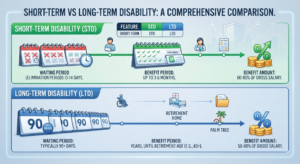
    Short-Term Disability Insurance (STD)

    Short-term disability covers the initial period after you become disabled, typically 3-6 months.

    How Short-Term Disability Works

    Timeline example:

    You develop serious back injury on January 1st:

    • January 1-7: Waiting period (you’re off work, no benefit yet)
    • January 8: First STD benefit begins
    • January 8 – June 30: You receive 60% of salary
    • July 1: STD period ends, long-term disability begins (if applicable)

    Key components:

    Benefit period (waiting period):

    • 0-14 days typical (how long you wait before benefits start)
    • Shorter = better, but costs more
    • Some policies have no waiting period

    Replacement percentage:

    • 50-66% of salary typical
    • If earning $5,000/month, receive $3,000/month
    • Rarely replaces 100% (discourages shirking)

    Maximum benefit:

    • $2,000-$5,000/month typical cap
    • High earners hit this limit
    • Benefits may not fully replace high income

    Duration:

    • 3-6 months typical
    • Some extend to 12 months
    • Varies by policy and employer

    Short-Term Disability Cost

    Employer-provided (most common):

    • Free to employee (employer pays)
    • Sometimes employee can pay for better coverage
    • Cost to employer: $0.50-$1.00 per $100 of payroll

    Individual short-term disability:

    • $20-$50/month typical
    • Varies by age and health

    Example cost: 35-year-old buying individual STD

    • $2,000/month benefit, 90-day waiting period: $25/month
    • $3,000/month benefit, 30-day waiting period: $40/month
    • $4,000/month benefit, 14-day waiting period: $55/month

    Short-Term Disability Advantages

    ✅ Immediate income replacement (covers initial disability months)
    ✅ Affordable ($20-$50/month)
    ✅ Short waiting period (often available)
    ✅ Covers temporary conditions (perfect for most disabilities)
    ✅ Often provided by employer (free coverage)
    ✅ No long-term commitment (coverage ends after 3-6 months)

    Short-Term Disability Disadvantages

    ❌ Limited duration (only 3-6 months)
    ❌ Temporary disabilities longer than duration not fully covered
    ❌ May require proof of disability (medical documentation needed)
    ❌ Possible integration with other benefits (reduces if you get workers comp)
    ❌ May not be available to self-employed (employer plans only)


    Long-Term Disability Insurance (LTD)

    Long-term disability covers extended disabilities, from several months to retirement age.

    How Long-Term Disability Works

    Timeline example:

    You develop cancer diagnosis in January:

    • January: Diagnosed, unable to work
    • January 1-90 days: STD covers if available, or you use savings
    • April 1: LTD begins (after STD ends)
    • April – December: Receive 60% salary
    • Throughout treatment and recovery: Covered
    • Return to work: Benefits stop
    • Never return to work: Benefits continue to age 65

    Key components:

    Elimination period (waiting period):

    • 90-365 days typical (how long you wait before benefits start)
    • Overlaps with short-term disability
    • 90 days common for employer plans
    • Longer waiting period = lower premium

    Replacement percentage:

    • 50-66% of salary typical
    • Usually coordinated with Social Security (reduced if you get SSDI)
    • High earners may not be fully replaced

    Maximum benefit:

    • $3,000-$7,000/month typical
    • High earners capped at this amount
    • Own-occupation plans sometimes higher

    Duration:

    • “To age 65” typical (from benefit start to retirement)
    • “Lifetime” sometimes available
    • Some plans have maximum benefit period (5-10 years)

    Long-Term Disability Cost

    Employer-provided (most common):

    • Often free to employees (employer subsidizes)
    • Cost to employer: $0.30-$0.75 per $100 of payroll
    • Sometimes employee can buy additional coverage

    Individual LTD:

    • $30-$100/month typical
    • Varies by age, health, occupation
    • Own-occupation definition costs more

    Example cost: 35-year-old buying individual LTD

    • $2,000/month benefit, 90-day elimination: $35/month
    • $3,000/month benefit, 90-day elimination: $50/month
    • $4,000/month benefit, 90-day elimination: $65/month
    • $4,000/month benefit, own-occupation definition: $85/month

    Long-Term Disability Advantages

    ✅ Extended coverage (months to retirement age)
    ✅ Covers serious, prolonged disabilities (where most risk is)
    ✅ Reasonable cost ($30-$100/month)
    ✅ Coordinated with STD (both together provide comprehensive protection)
    ✅ Portable (if individual policy, continue if you change jobs)
    ✅ Own-occupation option available (better definition of disability)
    ✅ Often indexed for inflation (benefits increase with cost of living)

    Long-Term Disability Disadvantages

    ❌ Long waiting period (90-365 days before benefits start)
    ❌ Partial income replacement (50-66%, not 100%)
    ❌ Integration with other benefits (SSDI reduces benefit)
    ❌ Offset provisions (workers comp, unemployment reduce benefit)
    ❌ Cost of living adjustments often limited (benefits don’t keep pace with inflation)
    ❌ May require proof of ongoing disability (medical exams periodically)


    Employer vs Individual Disability Insurance

    Where you get disability insurance matters.

    Employer-Provided Disability Insurance

    How it works:

    Your employer provides group disability insurance covering all employees. Simple.

    Typical coverage:

    Short-term disability:

    • 60% income replacement
    • 3-6 month duration
    • 0-14 day waiting period
    • Often free to employees

    Long-term disability:

    • 60% income replacement
    • To age 65
    • 90-180 day elimination period
    • Often free to employees

    Advantages:

    ✅ Free or subsidized (employer pays most/all cost)
    ✅ Guaranteed approval (no medical underwriting)
    ✅ Payroll deduction (automatic, never miss payment)
    ✅ Group rates (cheaper than individual)
    ✅ Comprehensive (STD + LTD often bundled)

    Disadvantages:

    ❌ Coverage ends when you leave job (need individual backup)
    ❌ Tax-deductible benefits taxed as income (if employer paid, benefits taxed)
    ❌ Employer-controlled definitions (not negotiable)
    ❌ Possible offset provisions (SSDI, workers comp reduce benefit)
    ❌ May have integration with Social Security (Medicare offset)
    ❌ Limited customization (one-size-fits-all)

    Important tax issue: If employer pays disability insurance premium, benefits are taxable income. If you pay premium (out-of-pocket or after-tax), benefits are tax-free.

    Example:

    • Monthly disability benefit: $3,000
    • If employer-paid: You owe taxes on $3,000 (roughly $750 taxes owed)
    • If employee-paid: You keep full $3,000 (no taxes)

    This difference can be significant over months/years of disability.

    Individual Disability Insurance

    How it works:

    You buy policy directly from insurance company, coverage follows you.

    Coverage customization:

    You control:

    • Benefit amount ($1,000-$10,000+/month possible)
    • Elimination period (0-365 days)
    • Definition of disability (any-occupation vs own-occupation)
    • Benefit duration (to age 65, lifetime, 5-year, etc.)
    • Cost-of-living adjustments
    • Occupational exclusions

    Advantages:

    ✅ Portable (continues if you change jobs)
    ✅ Tax-free benefits (if you paid premium out-of-pocket)
    ✅ Ownership (yours, can’t be cancelled by employer)
    ✅ Customizable (you choose all terms)
    ✅ Own-occupation definition available (better protection)
    ✅ No integration with SSDI (you keep full benefit + Social Security)

    Disadvantages:

    ❌ More expensive than employer group coverage
    ❌ Requires medical underwriting (must pass health exam)
    ❌ You pay full premium (no employer subsidy)
    ❌ Coverage gaps if unemployed (need to bridge between jobs)
    ❌ More complex (many options to choose)

    When to buy individual policy:

    • Self-employed (no employer coverage)
    • Freelancer/independent contractor
    • Plan to change jobs frequently (portability matters)
    • Employer coverage inadequate
    • Want own-occupation definition
    • Want better tax treatment

    How Much Disability Insurance Do You Need?

    Calculate based on your actual expenses and income replacement philosophy.

    Method 1: Income Replacement Percentage

    Calculation:

    Monthly gross income: $5,000
    Choose replacement percentage: 60%
    Coverage needed: $3,000/month

    Reasoning: 60% of gross income provides 75-85% of net income (accounting for taxes not owed during disability).

    Typical percentages:

    • 50% replacement: Bare minimum, encourages return to work
    • 60% replacement: Sweet spot, maintains reasonable lifestyle
    • 70% replacement: Comfortable, minimal lifestyle reduction
    • 80%+ replacement: Rare, insurance companies resist overinsuring

    Action: Choose 60% of gross income as target.

    Method 2: Expense-Based Calculation

    Calculate actual monthly expenses:

    • Rent/mortgage: $1,500
    • Food: $400
    • Utilities: $200
    • Insurance: $300
    • Transportation: $200
    • Minimum debt payments: $300
    • Other necessities: $300
    • Total: $3,200/month

    Coverage needed: $3,200/month

    This ensures you can cover actual living expenses during disability.

    Method 3: Income Plus Buffer

    Calculate:

    Monthly expenses: $3,000
    Buffer for unexpected costs: 20%
    Total coverage: $3,600/month

    This covers living expenses plus small margin for unexpected disability-related costs (medical copays, equipment, etc.).

    Recommended Approach

    Use Method 1 or 2, whichever is higher:

    Example scenario:

    • Gross monthly income: $5,000
    • 60% of gross: $3,000
    • Actual monthly expenses: $2,800
    • Coverage needed: $3,000 (choose higher amount)

    This ensures you can cover living expenses while having margin of safety.

    High Earners and Coverage Caps

    Problem: Insurance companies cap benefits.

    High earner making $15,000/month:

    • 60% of income: $9,000/month
    • Insurance cap: $5,000/month maximum
    • Gap: $4,000/month uncovered

    Solution options:

    1. Buy maximum available ($5,000/month)
    2. Buy multiple policies (some insurers allow this)
    3. Negotiate with employer (they might offer higher cap for employees)
    4. Accept partial coverage (better than nothing)
    5. Build larger emergency fund (cover gap with savings)

    Recommendation: Buy whatever maximum your insurer allows. Partial coverage better than no coverage.


    What Determines Your Disability Insurance Cost

    Several factors affect your premium.

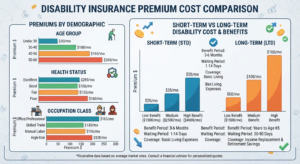
    1. Age (Biggest Factor)

    Insurance cost roughly doubles every 10 years:

    35-year-old buying $3,000/month LTD benefit:

    • Cost: $50/month

    45-year-old buying same:

    • Cost: $90-$110/month

    55-year-old buying same:

    • Cost: $180-$220/month

    Action: Buy disability insurance while young (rates locked for years).

    2. Health Status

    Pre-existing conditions increase premiums:

    Healthy applicant: Standard rates

    Controlled high blood pressure: +15-25% premium

    Diabetes (controlled): +25-50% premium

    Back problems: +50-100% premium

    Mental health conditions: +25-100% premium (varies significantly)

    Serious conditions: May be declined for coverage

    Action: Apply while healthy. Once you have coverage, it’s generally protected even if health changes.

    3. Occupation

    More dangerous occupations cost more:

    Low-risk: Office worker, accountant, manager ($30-50/month for $3,000 benefit)

    Medium-risk: Teacher, nurse, retail manager ($50-80/month)

    High-risk: Construction, manufacturing, law enforcement ($80-150+/month)

    Extremely high-risk: May be declined for coverage

    Why: Higher disability claim rate = higher insurance cost.

    4. Income Level

    Higher income = higher premiums (proportional to benefit amount):

    $2,000/month benefit: $25-40/month
    $3,000/month benefit: $40-60/month
    $4,000/month benefit: $55-80/month
    $5,000/month benefit: $70-100/month

    Plus insurers apply higher percentage rates to higher incomes (charging 1.5-2% of income vs 0.75% for lower incomes).

    5. Definition of Disability

    Own-occupation definition costs more:

    Any-occupation definition: $50/month (you must be unable to do ANY job you’re qualified for)

    Own-occupation definition: $65-75/month (you must be unable to do YOUR specific job)

    Why: Own-occupation is better for you (easier to qualify for benefits), so you pay more.

    Recommendation: Buy own-occupation definition. The 25-50% cost increase is worth it.

    6. Elimination Period (Waiting Period)

    Longer waiting period = lower premium:

    14-day elimination: $80/month (fastest benefits)
    30-day elimination: $70/month
    60-day elimination: $60/month
    90-day elimination: $50/month
    180-day elimination: $40/month

    Choice: 90 days is sweet spot for most people (you use emergency fund/STD first 90 days, then LTD kicks in).

    7. Benefit Duration

    Longer duration = higher premium:

    5-year benefit maximum: $40/month
    To age 65: $60/month
    Lifetime benefit: $75+/month

    Recommendation: “To age 65” is standard and appropriate. You’ll likely return to work or reach retirement before benefits end.

    8. Cost-of-Living Adjustments (COLA)

    With COLA, benefits increase annually:

    Without COLA: $50/month premium
    With annual 3% COLA: $65/month premium

    Value: If disabled for 10 years, COLA ensures $3,000 benefit doesn’t lose purchasing power.

    Recommendation: Include COLA if affordable ($10-15 extra/month). Over long disability, inflation matters.


    How to Get Disability Insurance

    Step 1: Determine If Employer Coverage Is Sufficient

    Review your employer plan:

    • Short-term disability: What’s the benefit amount and duration?
    • Long-term disability: What’s the benefit amount and elimination period?
    • Definition: Own-occupation or any-occupation?
    • Tax treatment: Will benefits be taxed?
    • Portability: Can you keep coverage if you leave?

    Is it adequate?

    If STD + LTD together replace 60% of income with no waiting period = probably adequate.

    If gaps exist (low benefit amount, long elimination period, any-occupation definition) = buy individual policy to supplement.

    Step 2: Get Individual Quotes If Needed

    Online quote tools:

    • PolicyGenius
    • SelectQuote
    • eHealthinsurance
    • Direct insurer websites (Guardian, Principal, Unum, Metlife)

    What to provide:

    • Age and gender
    • Occupation and job duties
    • Annual income
    • Current health status
    • When coverage needed

    Get quotes for:

    • $2,000/month benefit
    • $3,000/month benefit
    • $4,000/month benefit
    • Choose desired elimination period and definition

    Step 3: Compare Quotes

    Key metrics to compare:

    • Monthly premium (obvious)
    • Definition of disability (own-occupation preferred)
    • Elimination period (90 days typical)
    • Benefit duration (to age 65 standard)
    • Cost-of-living adjustments (included?)
    • Partial disability rider (covered?)
    • Portability (can you take it if you change jobs?)
    • Renewability (can they cancel you?)

    Don’t just choose cheapest. Evaluate total value.

    Step 4: Apply

    Application process:

    1. Online application: 20-30 minutes
    2. Health questions: Detailed health history
    3. Medical records: Company may request from your doctor
    4. Medical exam: For larger benefits, blood/urine test (done at home, 30 minutes)
    5. Underwriting: 2-4 weeks for approval
    6. Approval and setup: Coverage begins upon approval

    Step 5: Review Employer Coverage

    If you have employer plan:

    • Review it annually (benefits may change)
    • Understand your specific benefits
    • Know elimination period (coordinate with individual policy)
    • Understand tax treatment (taxable or not?)
    • Confirm portability if you might change jobs

    Step 6: Keep Policies Current

    Annual review:

    • Confirm coverage still active
    • Verify premium amount (should stay same if locked in)
    • Update beneficiary if applicable
    • Note coverage details (elimination period, benefit amount, definition)
    • Maintain policy documents

    Common Disability Insurance Mistakes to Avoid

    Mistake 1: Assuming You Won’t Become Disabled

    Error: “I’m young and healthy, disability won’t happen to me”

    Reality: 37% of 35-year-olds will have 90+ day disability before retirement. You’re statistically likely to need it.

    Solution: Buy coverage now while young and premiums are cheap.

    Mistake 2: Relying Only on Employer Coverage

    Error: Thinking employer STD + LTD is sufficient protection

    Reality: Employer coverage ends when you leave job. Need individual backup for portability.

    Solution: Buy individual long-term policy as backup, especially if self-employed or changing jobs frequently.

    Mistake 3: Choosing Any-Occupation Definition

    Error: Picking any-occupation definition to save $10-15/month

    Reality: Any-occupation is hard to qualify for. Own-occupation is better protection.

    Solution: Buy own-occupation definition. The cost difference is worthwhile.

    Mistake 4: Choosing Too Long Elimination Period

    Error: Picking 180-365 day elimination to minimize premium

    Reality: Can’t survive 6-12 months without income. No emergency fund supports that.

    Solution: Choose 90-day elimination period (covers with STD or emergency fund).

    Mistake 5: Underestimating Income Replacement Needed

    Error: Buying $1,500/month benefit when expenses are $3,000/month

    Reality: Insufficient benefit forces you into debt during disability.

    Solution: Calculate actual expenses, buy coverage matching 60% of gross income (whichever is higher).

    Mistake 6: Not Buying Enough Coverage Due to Cost

    Error: “Individual policy is $60/month, that’s too much”

    Reality: 1-month disability costs $3,000+ in lost income. $60/month is incredible bargain.

    Solution: Buy coverage. Cost is tiny relative to risk.

    Mistake 7: Skipping Individual Policy If Employer Coverage Exists

    Error: “Employer covers me, don’t need individual”

    Reality: Employer coverage disappears when you leave job. Individual policy continues.

    Solution: Buy individual policy as backup, especially if you might change jobs.

    Mistake 8: Not Understanding Tax Treatment

    Error: Assuming all disability benefits are tax-free

    Reality: If employer paid premiums, benefits are taxable. If you paid premiums, benefits are tax-free.

    Solution: Understand your specific plan’s tax treatment. May want to pay own premium to get tax-free benefits.

    Mistake 9: Ignoring Partial Disability Rider

    Error: Not adding partial/residual disability rider to policy

    Reality: Many disabilities don’t prevent all work (can work part-time). Rider covers this.

    Solution: Add partial disability rider (small additional cost, valuable protection).

    Mistake 10: Not Reviewing Coverage When Income Increases

    Error: Buying $3,000/month benefit at 30, never updating despite income doubling to $100k by age 40

    Reality: Coverage becomes insufficient as income increases.

    Solution: Review coverage every 5 years. Increase benefits if income increased significantly.


    Frequently Asked Questions About Disability Insurance

    How long does disability insurance take to process a claim?

    Initial processing: 30-60 days to review claim
    Approval: If approved, benefits usually start within 30 days
    If denied: You have appeal period (usually 30-60 days)

    Total timeline: 2-4 months from claim submission to first benefit, assuming approval.

    What if I’m self-employed?

    Employer disability insurance: Not available (no employer)

    Solution: Buy individual long-term disability policy

    Availability: Some insurers restrict coverage for self-employed or gig workers. Shop carefully.

    Cost: Often higher than employed people (higher claim risk if you’re sole income source)

    Recommendation: Self-employed should prioritize disability insurance (no employer backup).

    Can I get disability insurance if I have a pre-existing condition?

    Yes, but expect higher premiums.

    Insurance companies will:

    • Ask detailed health history
    • Request medical records
    • Possibly require medical exam
    • Charge 25-200% more depending on condition severity

    Some conditions may be declined: Very severe conditions may be uninsurable.

    Solution: Apply with multiple insurers. Different companies have different underwriting standards.

    What’s the difference between workers’ compensation and disability insurance?

    Workers’ Compensation:

    • Covers injuries/illness from work only
    • Provided by employer (required by law)
    • Replaces partial income (60-66%)
    • Medical bills covered
    • You don’t pay premium

    Disability Insurance:

    • Covers any illness/injury preventing work
    • Personal insurance you buy
    • Replaces income percentage (50-66%)
    • Medical bills NOT typically covered
    • You pay premium

    Example:

    • Back injury from work: Workers’ comp covers
    • Back injury from personal activity: Disability insurance covers
    • Both: Both can work together (though integrated, so total may be capped)

    If I’m approved for Social Security Disability Insurance (SSDI), how does that affect my private disability insurance?

    Integration/offset: Most private policies reduce benefits if you receive SSDI.

    Example:

    • Private LTD benefit: $3,000/month
    • SSDI approval: $1,500/month
    • Your actual LTD payment: $1,500/month ($3,000 – $1,500 SSDI)
    • Total income: $1,500 + $1,500 = $3,000

    Some policies don’t integrate. Verify this during purchase.

    Better policy: Own-occupation with no integration clause. Pay more but receive full benefit even if SSDI approved.

    Can I get disability insurance if I’m unemployed?

    Employed: Yes, straightforward

    Recently unemployed: Possibly, if can show recent income history

    Long-term unemployed: Difficult. Need proof of income to insure against.

    Solution: Buy coverage while employed. Once you have it, coverage continues through employment gaps.

    What if I return to work part-time during disability?

    Partial/residual disability rider: Covers this scenario.

    Example:

    • Full benefit: $3,000/month (if completely unable to work)
    • Return to part-time work earning $1,500/month
    • Residual benefit: $1,500/month (gap between pre-disability income and current)
    • Total income: $1,500 (work) + $1,500 (insurance) = $3,000

    Most modern policies include this. Verify it’s in your policy.

    How do I prove I’m disabled?

    Insurance company requires:

    • Medical records documenting condition
    • Doctor’s statement about work capacity
    • Treatment plans and progress notes
    • Sometimes independent medical exam (at insurer’s cost)
    • Ongoing medical records if disability extends

    Don’t exaggerate. Insurance companies verify claims. Fraud is federal crime.

    Be honest and thorough: Provide all requested documentation promptly.

    Can disability insurance be cancelled?

    Employer plans: Can be cancelled by employer, but usually with notice

    Individual policies: Generally guaranteed renewable (cannot be cancelled as long as you pay premium)

    Exception: Fraud or non-disclosure of facts during application could void policy

    Peace of mind: Individual policy is truly yours once issued. Can’t be cancelled (except for non-payment).

    Is there a waiting period to receive benefits after disability begins?

    Yes, the elimination period.

    This is the waiting period before benefits begin.

    Common elimination periods:

    • 14-30 days: Short-term, covers immediately
    • 90 days: Standard long-term, you use emergency fund/savings for first 3 months
    • 180+ days: Cheaper premium but long gap

    Strategy: Pair STD (covers first 3-6 months) with LTD (kicks in after STD).

    Should I buy disability insurance if I have substantial savings?

    Even with savings, yes.

    Example:

    • Monthly expenses: $4,000
    • Savings: $100,000
    • 100% disability: $48,000/year (savings last ~2 years)

    Two-year disability can happen: (37% of disabilities exceed 90 days, some exceed 1 year)

    Savings rate after recovery: Once disabled, can’t save. Need disability insurance to avoid depleting emergency fund entirely.

    Recommendation: Even with savings, buy coverage. Protects your nest egg.


    Disability Insurance and Your Complete Financial Plan

    Disability insurance doesn’t exist in isolation.

    How It Fits Together

    With emergency fund: First-line defense

    • Emergency fund: Covers 3-6 months of living expenses
    • Disability insurance: Covers extended income loss
    • Together: Complete protection against income loss

    With life insurance: Both protect dependents

    • Life insurance: If you die
    • Disability insurance: If you can’t work but survive
    • Together: Complete family protection

    With health insurance: Covers medical expenses

    • Health insurance: Covers doctor bills, medical costs
    • Disability insurance: Covers living expenses while recovering
    • Together: Complete medical and income protection

    With retirement savings: Building long-term wealth

    • Disability insurance: Protects income while building wealth
    • Retirement accounts: Grow the wealth
    • Together: Income protection while building nest egg

    With budgeting: Ensures affordability

    • Disability insurance: Added expense ($30-100/month)
    • Budgeting: Ensures cost fits your budget
    • Together: Sustainable financial planning

    Learn more about complete insurance protection for full financial security.


    Take Action: Your Disability Insurance Action Plan

    30-Day Disability Insurance Checklist

    Week 1: Assess Current Situation

    •  Review employer disability insurance plan (if available)
      •  Note STD benefit amount
      •  Note STD duration
      •  Note LTD benefit amount
      •  Note LTD elimination period
      •  Note definition (any-occupation or own-occupation)
      •  Confirm tax treatment of benefits
    •  Calculate current monthly expenses
    •  Determine desired coverage amount (60% of gross income or actual expenses, whichever higher)
    •  Assess if coverage gaps exist

    Week 2: Research Individual Policy (If Needed)

    •  Visit PolicyGenius, SelectQuote, or direct insurer websites
    •  Get quotes for desired benefit amount
    •  Request own-occupation definition quotes
    •  Compare quotes from 3-5 companies
    •  Note premium differences
    •  Review policy definitions carefully

    Week 3: Choose and Apply

    •  Select best-value policy
    •  Complete online application (20-30 minutes)
    •  Submit health information
    •  Schedule medical exam if required
    •  Follow up on application status

    Week 4: Finalize and Document

    •  Receive and review policy documents
    •  Confirm all terms match what you selected
    •  Set up automatic premium payment
    •  Save policy documents in safe place
    •  Create spreadsheet with all coverage details:
      •  STD benefit amount and duration
      •  LTD benefit amount and duration
      •  LTD elimination period
      •  Definition of disability
      •  Premium amount
      •  Tax treatment
      •  Contact information for claims

    Post-Implementation:

    •  Annual review during policy anniversary
    •  Update coverage if income increases significantly
    •  Verify continuous coverage (never miss premium)
    •  Document any life changes that might affect coverage

    Conclusion: Disability Insurance Protects Your Greatest Asset

    Your income is your greatest financial asset.

    A 35-year-old with 30 years until retirement earning $50,000/year has a lifetime earnings potential of $1.5 million. Lose that income for a year and you lose $50,000 of that potential—forever.

    Yet most people buy life insurance to protect a temporary asset (their family’s lifestyle, if they die) but skip disability insurance protecting their actual greatest asset (their ability to earn income).

    The statistical reality: You’re 3-5x more likely to experience a prolonged disability than to die before retirement.

    The financial reality: Disability insurance costs $30-100/month—a fraction of what you spend on coffee, streaming services, or eating out.
    The peace of mind: Knowing that if you become unable to work due to illness or injury, your income is protected. Your family maintains stability. You recover without financial devastation.

    That’s the power of disability insurance.

    Key principles to remember:

    ✅ Buy now while young: Rates locked in for decades
    ✅ Buy adequate amount: 60% of gross income minimum
    ✅ Choose own-occupation definition: Worth the cost difference
    ✅ Use 90-day elimination: Pairs with STD and emergency fund
    ✅ Pair STD + LTD: Together provide complete protection
    ✅ Buy individual if self-employed: No employer backup
    ✅ Buy individual as backup: If you might change jobs
    ✅ Include COLA rider: Protects against inflation over long disability
    ✅ Include partial disability: Covers part-time work situations
    ✅ Review annually: Increase if income increases

    Your ability to work is what creates your paycheck. Disability insurance protects your paycheck.

    Don’t protect just your life—protect your livelihood.

    Ready to complete your financial protection? Explore these related guides:

  • Health Insurance Guide: Choose the Right Plan and Save Money

    Health Insurance Guide: Choose the Right Plan and Save Money

    Health insurance is confusing. Not accidentally confusing—intentionally confusing. Complex language, obscure metrics, dozens of plan options—it’s designed so you’ll just pick something and stop asking questions.

    But health insurance decisions directly impact your financial security and health outcomes. Choosing the wrong plan could cost you thousands in unnecessary premiums or leave you bankrupt from unexpected medical bills.

    Yet most people understand their health insurance plan poorly:

    • 68% of Americans don’t understand the difference between a deductible and co-insurance
    • 72% don’t know what their annual out-of-pocket maximum is
    • 56% incorrectly believe their copay covers everything related to that visit
    • 45% would struggle to pay a $1,000 unexpected medical bill

    These gaps in understanding don’t just create confusion—they create financial disaster.

    This comprehensive guide cuts through the jargon and complexity. You’ll learn what health insurance actually covers, understand every metric that matters (deductibles, copays, coinsurance, out-of-pocket maximums), discover how to compare plans intelligently, and implement strategies to save thousands annually on both premiums and medical costs.

    Whether you’re choosing from employer options, shopping the ACA marketplace, or understanding Medicare, you’ll know exactly which plan offers the best value for your situation.

    Let’s make health insurance simple and ensure you get the protection you need at a cost you can afford.


    Health Insurance Fundamentals: Understanding the Basics

    Before choosing a plan, you need to understand what health insurance actually does and how it works.

    The Purpose of Health Insurance

    Health insurance is designed to protect you from catastrophic medical expenses by:

    1. Sharing costs: You and the insurer split medical expenses
    2. Limiting exposure: Your maximum out-of-pocket cost is capped
    3. Negotiating rates: Insurers negotiate lower rates with providers
    4. Preventing bankruptcy: Protects you from $500,000 medical bills

    The fundamental exchange:

    You pay monthly premiums and share costs on medical expenses. In return, insurance limits your maximum financial exposure to manageable levels.

    The Healthcare System’s Hidden Secret

    Most people don’t realize: Your health insurance doesn’t pay doctors directly. You do.

    Here’s how it actually works:

    1. You see doctor
    2. Doctor bills insurance company for $300
    3. Insurance company pays 80%, you pay 20%
    4. You receive bill for your 20% ($60)
    5. You pay the doctor

    This is why understanding YOUR responsibility (copays, coinsurance, deductibles) is crucial—you’re actually paying most of it.

    The Insurance Negotiation

    Insurance companies have one superpower: negotiating rates down.

    Without insurance:

    • Doctor’s charge: $1,000
    • You pay: $1,000

    With insurance:

    • Doctor’s usual charge: $1,000
    • Negotiated rate (insurance discount): $300
    • Insurance pays: $240 (80%)
    • You pay: $60 (20%)
    • Savings: $700 (70% discount)

    Just having insurance (even before using it) saves you massive amounts through negotiated rates.


    Health Insurance Metrics: The Six Numbers That Matter

    Health insurance plans vary by six key metrics. Understanding each is crucial for comparing plans.

    1. Monthly Premium

    Definition: The amount you pay each month for insurance coverage, regardless of whether you use it.

    Examples:

    • Individual plan: $150-400/month
    • Family plan: $400-1,500/month
    • Employer plan: You pay 0-30%, employer pays 70-100% (deducted from paycheck)

    Important: Premium is separate from costs when you actually use medical services.

    Key insight: Cheaper premium doesn’t mean cheaper overall plan. A plan with $100/month premium but high deductible might cost more total than $200/month plan with low deductible.

    2. Deductible

    Definition: Amount you must pay out-of-pocket before insurance starts paying anything.

    How it works:

    You have $1,500 deductible:

    • Year starts: $0 spent
    • January visit ($300): You pay full $300 (insurance pays $0)
    • February visit ($200): You pay full $200 (insurance pays $0)
    • March visit ($400): You pay full $400, but now $900 spent toward deductible
    • April visit ($800): You’ve paid $1,500 total, deductible met! Insurance now pays percentage

    Key insight: Higher deductible = lower premium, but you pay more upfront before insurance helps.

    Deductible types:

    Plan Type Typical Deductible
    Bronze ACA $5,000-$7,000
    Silver ACA $2,000-$3,500
    Gold ACA $500-$1,500
    Platinum ACA $0-$500
    PPO Employer $500-$2,500
    HMO Employer $0-$1,500
    HSA-compatible $1,500-$7,000

    3. Copay (Co-payment)

    Definition: Fixed amount you pay for specific services (doctor visit, prescription drug).

    Examples:

    • Doctor visit copay: $25, $40, or $50
    • Specialist visit copay: $50, $75, or $100
    • Urgent care copay: $75-$100
    • Emergency room copay: $250-$500
    • Generic drug copay: $10-$15
    • Brand-name drug copay: $25-$50

    How copays work:

    You have plan with $40 copay for doctor visits:

    • See doctor: You pay $40 at visit
    • Doctor’s bill: $150
    • Insurance pays: $110
    • You pay: $40 (copay)
    • Insurance discount: $0 (you still responsible for balance beyond copay… actually no, insurance negotiates that)

    Important distinction:

    • Copays are typically INSTEAD OF coinsurance
    • You don’t pay deductible AND copay (confusing, but usually one or other)
    • Copays count toward out-of-pocket maximum

    4. Coinsurance

    Definition: Percentage of medical costs you pay after deductible is met.

    How it works:

    You have plan with $1,500 deductible and 20% coinsurance:

    1. January: Doctor visit ($300)
      • You pay: $300 (full amount, toward deductible)
      • Insurance pays: $0
      • Deductible remaining: $1,200
    2. February-March: More visits total $1,400
      • You pay: $1,400 (toward deductible)
      • Insurance pays: $0
      • Deductible met: $0 remaining
    3. April: Doctor visit ($500)
      • Deductible met, so coinsurance applies
      • You pay: $100 (20% coinsurance)
      • Insurance pays: $400 (80%)

    Key insight: Coinsurance applies AFTER deductible, and represents your percentage share of costs.

    Common coinsurance percentages:

    • 10% coinsurance: You pay 10%, insurance pays 90%
    • 20% coinsurance: You pay 20%, insurance pays 80%
    • 30% coinsurance: You pay 30%, insurance pays 70%

    5. Out-of-Pocket Maximum (OOP Max)

    Definition: Maximum amount you’ll pay in a year (deductible + copays + coinsurance). After this, insurance pays 100%.

    How it works:

    You have plan with:

    • $1,500 deductible
    • $40 copay for doctor visits
    • 20% coinsurance
    • $5,000 out-of-pocket maximum

    Year scenario:

    • January-March: Pay $1,500 (deductible) + $200 (copays)
    • April-October: Pay $2,100 (copays and coinsurance toward OOP)
    • Total paid so far: $3,800
    • November: Major surgery ($50,000)
      • Your coinsurance would be: 20% of $50,000 = $10,000
      • But you’ve already paid $3,800 toward OOP max
      • You only pay: $5,000 – $3,800 = $1,200 additional
      • Insurance pays: $48,800
    • Year total out-of-pocket: $5,000 (OOP maximum)
    • Insurance paid: $51,000+

    Key insight: Out-of-pocket maximum is your financial safety net. Once hit, insurance covers everything at 100%.

    OOP Maximum ranges:

    Plan Type Individual OOP Max Family OOP Max
    Bronze ACA $7,000-$8,550 $14,000-$17,100
    Silver ACA $6,000-$7,000 $12,000-$14,000
    Gold ACA $3,000-$4,000 $6,000-$8,000
    Platinum ACA $1,000-$2,000 $2,000-$4,000
    Employer PPO $2,500-$5,000 $5,000-$10,000
    Employer HMO $1,500-$4,000 $3,000-$8,000

    6. Network Status

    Definition: Whether your doctor/hospital is “in-network” (has contract with insurance) or “out-of-network” (no contract).

    Cost difference:

    In-network visit ($300 usual charge):

    • Negotiated rate: $150
    • Insurance pays: $120 (80%)
    • You pay: $30

    Out-of-network visit ($300 usual charge):

    • No negotiation, full charge: $300
    • Insurance pays: $60 (20%)
    • You pay: $240

    That’s 8x more expensive out-of-network!

    Key insight: Always verify providers are in-network before scheduling. Out-of-network care is financially devastating.


    Health Insurance Plan Types

    Several types of health insurance exist, each with different cost structures and flexibility.

    1. Health Maintenance Organization (HMO)

    How it works:

    You choose a primary care physician (PCP) who coordinates all your care. Referrals required for specialists. Must use in-network providers.

    Cost structure:

    • Premium: Low
    • Deductible: Low ($0-$1,500) or none
    • Copays: Fixed ($25-$50 per visit)
    • Coinsurance: Minimal
    • Out-of-pocket max: Moderate ($1,500-$4,000)

    Example:

    • Monthly premium: $150
    • Doctor visit copay: $30
    • Specialist copay: $60 (with referral)
    • Emergency room copay: $150
    • Out-of-pocket max: $3,000

    Advantages:
    ✅ Lowest premiums
    ✅ Low/predictable copays
    ✅ Often no deductible
    ✅ Care coordination (PCP manages all care)
    ✅ Preventive care often free

    Disadvantages:
    ❌ Must use in-network providers (out-of-network only in emergencies)
    ❌ Need referrals for specialists
    ❌ Less flexibility in choosing doctors
    ❌ Doesn’t cover out-of-area routine care

    Best for: Healthy people wanting low premiums, willing to follow plan rules for specialist access.

    2. Preferred Provider Organization (PPO)

    How it works:

    Choose any provider in or out of network. In-network costs less, out-of-network costs more. No referrals required.

    Cost structure:

    • Premium: Higher than HMO
    • Deductible: Higher ($500-$2,500)
    • Copays: Fixed ($30-$50 for in-network)
    • Coinsurance: Higher out-of-network (20-40%)
    • Out-of-pocket max: Higher ($2,500-$5,000)

    Example:

    • Monthly premium: $300
    • In-network doctor copay: $40
    • Out-of-network doctor: 30% coinsurance
    • Specialist copay (no referral): $60
    • Emergency room copay: $250
    • Out-of-pocket max: $4,000

    Advantages:
    ✅ Flexibility to see any provider
    ✅ No referrals needed
    ✅ Higher out-of-network benefits than HMO
    ✅ Access out-of-area providers
    ✅ More choice in doctors

    Disadvantages:
    ❌ Higher premiums than HMO
    ❌ Higher deductibles
    ❌ Out-of-network care expensive
    ❌ More complex cost sharing
    ❌ Less coordinated care (no PCP)

    Best for: People who want flexibility and are willing to pay more for it, those with specialists out-of-network.

    3. Point of Service (POS)

    How it works:

    Hybrid of HMO and PPO. Choose PCP, get referrals, but can see out-of-network providers at higher cost.

    Cost structure:

    • Premium: Between HMO and PPO
    • Deductible: Low-moderate
    • Copays: In-network low, out-of-network higher
    • Coinsurance: Out-of-network applies
    • Out-of-pocket max: Moderate

    Advantages:
    ✅ Lower premiums than PPO
    ✅ More flexibility than HMO
    ✅ Out-of-network access if needed

    Disadvantages:
    ❌ Still need referrals
    ❌ Still have PCP requirement
    ❌ Out-of-network costs high
    ❌ Not as flexible as PPO

    Best for: People wanting HMO cost with some PPO flexibility.

    4. Exclusive Provider Organization (EPO)

    How it works:

    In-network providers are required. No out-of-network coverage except emergencies. No referrals needed.

    Cost structure:

    • Premium: Low-moderate
    • Deductible: Moderate
    • Copays: In-network fixed
    • Out-of-network: Not covered (except emergencies)
    • Out-of-pocket max: Moderate

    Advantages:
    ✅ Lower premiums than PPO
    ✅ No referrals required
    ✅ Flexible specialist access (in-network)

    Disadvantages:
    ❌ No out-of-network coverage
    ❌ Rigid network requirement
    ❌ Travel outside service area problematic

    Best for: People willing to commit to network, wanting lower cost than PPO.

    5. High Deductible Health Plan (HDHP)

    How it works:

    Low premiums, high deductibles, and eligibility for Health Savings Account (HSA). You pay more upfront, but HSA savings can be used for medical expenses.

    Cost structure:

    • Premium: Lowest
    • Deductible: High ($1,500-$7,000)
    • Copays: None (coinsurance until deductible met)
    • Coinsurance: After deductible
    • Out-of-pocket max: High ($2,800-$7,000 individual)

    Example:

    • Monthly premium: $100
    • Annual deductible: $3,000
    • Coinsurance: 20% after deductible
    • Out-of-pocket max: $6,500
    • Eligible for HSA: Yes

    Advantages:
    ✅ Lowest premiums
    ✅ HSA savings account (triple tax advantage)
    ✅ Greater control over healthcare spending
    ✅ Accumulate HSA funds year to year

    Disadvantages:
    ❌ High out-of-pocket costs
    ❌ Not ideal if frequent medical care needed
    ❌ Requires discipline to use HSA properly

    Best for: Healthy people wanting to save on premiums, those comfortable with high deductible, people planning to use HSA strategically.

    Important: Learn about Health Savings Accounts below.

    6. Catastrophic Health Plan

    How it works:

    Very low premiums, very high deductible. Only cover preventive care before deductible. Designed for young, healthy people.

    Cost structure:

    • Premium: Extremely low ($20-$50/month)
    • Deductible: Very high ($7,000+)
    • Preventive care: Free (before deductible)
    • Coinsurance: After deductible
    • Out-of-pocket max: High ($8,550)

    Advantages:
    ✅ Extremely low premiums
    ✅ Preventive care free
    ✅ Protects against catastrophic medical costs
    ✅ For young, healthy people

    Disadvantages:
    ❌ Expensive if need regular care
    ❌ High out-of-pocket costs
    ❌ Not available to everyone (usually under 30)

    Best for: Young, healthy people without chronic conditions, wanting cheap protection against catastrophic illness.


    How to Compare Health Insurance Plans

    Comparing plans requires looking at all six metrics together, not just premium.

    The Complete Comparison Framework

    Step 1: Calculate annual premium costs

    Individual plan options:

    • Plan A: $150/month = $1,800/year
    • Plan B: $250/month = $3,000/year
    • Plan C: $200/month = $2,400/year

    Step 2: List all key metrics

    Metric Plan A Plan B Plan C
    Annual Premium $1,800 $3,000 $2,400
    Deductible $3,000 $500 $1,500
    Doctor copay $40 $25 $30
    Specialist copay $60 $50 $60
    ER copay $150 $250 $100
    Out-of-pocket max $6,000 $4,000 $4,500
    Prescription copay $15/$40/$65 $10/$30/$50 $12/$35/$60

    Step 3: Calculate worst-case scenario

    If you had major medical event:

    • Plan A: $1,800 premium + $6,000 OOP max = $7,800 maximum exposure
    • Plan B: $3,000 premium + $4,000 OOP max = $7,000 maximum exposure
    • Plan C: $2,400 premium + $4,500 OOP max = $6,900 maximum exposure

    Step 4: Consider actual healthcare needs

    Healthy person without chronic conditions:

    • Preventive care: Maybe $200-500/year actual costs
    • Plan A estimate: $1,800 + $200 (preventive copays) = $2,000
    • Plan B estimate: $3,000 + $100 (preventive copays) = $3,100
    • Plan C estimate: $2,400 + $150 (preventive copays) = $2,550

    Plan A wins for healthy people.

    Person with chronic condition (monthly doctor visits, prescriptions):

    • 12 doctor visits × $40 copay = $480
    • Monthly prescription $50 × 12 = $600
    • Additional tests/visits = $300
    • Total medical costs before insurance: ~$2,000

    Plan B analysis (with $500 deductible):

    • Premium: $3,000
    • Deductible: $500
    • Doctor visits: 12 × $25 = $300 (after deductible met)
    • Prescription: 12 × $30 = $360
    • Additional: $300
    • Total: $3,000 + $500 + $300 + $360 + $300 = $4,460

    Plan A analysis (no deductible):

    • Premium: $1,800
    • Doctor visits: 12 × $40 = $480
    • Prescription: 12 × $15 = $180 (generic) or $40 × 12 = $480 (brand)
    • Additional: $300 (copay for tests)
    • Total: $1,800 + $480 + $480 + $300 = $3,060

    Plan A wins even with chronic condition due to lower premium.

    Step 5: Check provider networks

    • Is your doctor in-network for each plan?
    • Are your specialists covered?
    • If out-of-area, does plan cover?

    One out-of-network visit can cost thousands. This is critical.

    Using Online Plan Comparison Tools

    Healthcare.gov (if using ACA Marketplace):

    1. Enter zip code
    2. Enter age
    3. Enter income (for subsidies)
    4. See all available plans
    5. Click “Compare” for side-by-side view
    6. Review costs and coverage

    Employer portal (if choosing from employer plans):

    1. Log into benefits portal
    2. Click “Compare Plans”
    3. Use comparison tool
    4. Usually shows costs and coverage clearly

    Other tools:

    • eHealthinsurance.com
    • Insurify.com
    • Kaiser.org (if available in your area)
    • UnitedHealthcare.com
    • Aetna.com
    • Cigna.com

    Health Savings Accounts (HSAs): The Secret Weapon

    HSAs are one of the most powerful financial tools available but poorly understood.

    What Is an HSA?

    An HSA is a savings account specifically for medical expenses, available only if you have a High Deductible Health Plan (HDHP).

    Key features:

    • Tax-deductible contributions: Reduce your taxable income
    • Tax-free growth: Money invested grows without taxes
    • Tax-free withdrawals: For qualified medical expenses, no taxes owed
    • Portable: Belongs to you, not your employer
    • Accumulates year-to-year: Unused funds carry forward (unlike FSA)
    • Investment options: Can invest in stocks, bonds, mutual funds

    HSA Triple Tax Advantage

    No other account offers this:

    1. Tax-deductible contributions

    • You contribute $3,850 (individual limit)
    • Reduces your taxable income by $3,850
    • Saves ~$1,155 in federal taxes (at 30% rate)

    2. Tax-free growth

    • $3,850 invested at 8% returns
    • After 20 years: $17,963
    • All growth tax-free (compared to brokerage account where you’d owe capital gains taxes)

    3. Tax-free withdrawals (for medical expenses)

    • Withdraw $500 for doctor visit
    • Zero taxes owed
    • In regular brokerage account, you’d owe income tax + capital gains tax

    Total advantage: Triple tax benefit that no other account offers

    HSA Contribution Limits (2024)

    Coverage Type Limit
    Individual $3,850/year
    Family $7,750/year
    Catch-up (age 55+) +$1,000/year

    Is the limit enough?

    Average person spends $3,000-$5,000/year on medical expenses (insurance + out-of-pocket). Contributing the maximum covers most expenses while saving on taxes.

    HSA vs FSA: Which Is Better?

    Both are savings accounts for medical expenses, but with key differences:

    Feature HSA FSA
    Contribution limit $3,850 individual, $7,750 family $3,300 individual
    Tax-free growth Yes No
    Portable Yes (yours forever) No (employer plan)
    Carry-over unused Yes (accumulates) No (use-it-or-lose-it)
    Investment options Yes Usually not
    Withdrawals Anytime for medical Limited withdrawal windows

    HSAs are superior in almost every way. FSAs are only better if your employer is extremely generous with contributions.

    HSA Strategy: The Ultimate Tax Loophole

    Advanced HSA users optimize the account strategically:

    Year 1 Strategy:

    • Contribute maximum: $3,850
    • Don’t withdraw for medical expenses
    • Pay medical expenses out-of-pocket instead
    • Let HSA grow and invest

    Over 20 years:

    • Contributions: $3,850 × 20 = $77,000
    • Growth at 8%: Plus $84,963
    • Total in HSA: $161,963

    At retirement:

    • You’ve saved $23,250 in taxes (30% of contributions)
    • Your account has grown tax-free
    • You can withdraw for medical expenses tax-free
    • Best of all: After age 65, you can withdraw for ANY reason (though non-medical withdrawals taxed as income—still, you got the tax deduction upfront)

    The key: HSA is essentially a second retirement account if you can afford to pay medical expenses out-of-pocket.

    Who Should Open an HSA?

    Good candidates:
    ✅ Healthy person choosing HDHP
    ✅ Can afford high deductible without stress
    ✅ Can afford to pay medical expenses out-of-pocket
    ✅ Plans to invest HSA funds (don’t just leave in savings)
    ✅ Has multiple years until needing funds

    Poor candidates:
    ❌ Person with chronic conditions needing frequent care
    ❌ Can’t afford high deductible
    ❌ Need constant access to funds
    ❌ Won’t invest HSA funds


    Choosing Your Health Insurance: Step-by-Step

    Step 1: Determine Available Options

    If employed:

    • Check employer’s benefits portal
    • Note all available plans
    • Gather plan documents

    If self-employed/unemployed:

    • Visit Healthcare.gov (open enrollment Nov 1 – Dec 15)
    • Enter income and household information
    • View all available plans in your zip code

    If 65+:

    • Enroll in Medicare (apply at age 65)
    • Choose Original Medicare or Medicare Advantage
    • Consider supplemental coverage

    If under 26:

    • Check if parents’ employer plan still covers you
    • Often cheaper than individual plan

    Step 2: Assess Your Healthcare Needs

    Honest assessment:

    • How often do I see doctor? (0 = very healthy, 4+ = chronic conditions)
    • Do I take medications? (expensive prescription habits?)
    • Do I have specialists? (if yes, are they in-network?)
    • Upcoming medical procedures? (know costs in advance)
    • Am I comfortable with high deductible? (can afford $3,000+ out-of-pocket?)

    Based on answers:

    Very healthy, no medications, no doctor visits:

    • Catastrophic or HDHP (cheapest option)
    • Focus on lowest premium
    • Out-of-pocket max acceptable

    Occasional doctor visits, few medications:

    • HDHP with HSA (leverage tax advantages)
    • Or Silver/Gold ACA plan
    • Balance premium and deductible

    Chronic condition, multiple medications, frequent visits:

    • Gold or Platinum plan (lower deductible)
    • PPO for provider flexibility
    • Don’t choose HDHP (high deductible counterproductive)

    High medical needs:

    • Platinum plan (lowest deductible, highest premium)
    • PPO for out-of-network flexibility
    • HSA irrelevant (medical costs will exceed HSA contribution limit anyway)

    Step 3: Check Provider Networks

    Critical step: Verify doctors are in-network

    1. Get your doctor’s name and tax ID
    2. Visit insurance company’s provider search tool
    3. Search for your doctor
    4. Confirm they accept the plan
    5. Repeat for all specialists

    One out-of-network visit can cost $500-$2,000 extra. This step matters.

    Step 4: List Your Top 3 Plans

    Using comparison framework above:

    1. Write down all key metrics
    2. Calculate worst-case scenario (OOP max)
    3. Estimate actual costs based on your healthcare needs
    4. Note which providers are in-network
    5. Rank by total estimated cost

    Step 5: Choose and Enroll

    Employer plan:

    • Enroll through benefits portal
    • Coverage starts on specified date
    • Download plan documents for reference

    ACA Marketplace:

    • Create account at Healthcare.gov
    • Enter household information
    • Shop plans
    • Apply for subsidies (if eligible)
    • Enroll before deadline
    • Coverage starts Jan 1 (if enrolled by Dec 15)

    Medicare:

    • Visit Medicare.gov
    • Create account
    • Compare plans
    • Enroll during Annual Enrollment Period (Oct 15 – Dec 7)

    Health Insurance Costs: What You Actually Pay

    Understanding all the costs helps you predict total annual expenses.

    Employer-Sponsored Insurance Costs

    Your costs (typical):

    • Premium: You pay 15-30%, employer pays 70-85%
    • Deductible: $500-$2,000 (varies by employer)
    • Copay: $25-$50 per visit
    • Coinsurance: 10-20% after deductible
    • Out-of-pocket max: $2,500-$6,000

    Example annual costs (employer plan):

    • Your premium: $2,000/year (if you pay 20% of $10,000 employer plan)
    • Preventive care: $0 (usually free)
    • 2 doctor visits at $40 copay: $80
    • 1 urgent care at $100 copay: $100
    • 1 specialist referral at $75 copay: $75
    • Total: $2,255/year

    ACA Marketplace Costs

    Your costs depend on income:

    Example: $45,000 income, individual, no employer coverage

    • Unsubsidized premium: $250/month = $3,000/year
    • With tax credit subsidy (80% subsidy): $50/month = $600/year
    • Deductible: $1,500
    • Copay: $30-$50
    • Coinsurance: 20%
    • Out-of-pocket max: $3,000

    Cost if healthy (few medical visits):

    • Subsidized premium: $600
    • Deductible: $0 (if no visits)
    • Preventive care: $0
    • Total: $600/year

    Cost if multiple medical needs:

    • Subsidized premium: $600
    • Deductible met: $1,500
    • Doctor visits after deductible: 5 visits × $30 = $150
    • Additional coinsurance: $300
    • Total: $2,550/year

    Medicare Costs (Age 65+)

    Your costs (typical):

    • Part A premium: $0 (if paid Medicare taxes 10+ years)
    • Part B premium: $164/month = $1,968/year
    • Part D (prescription): $20-$50/month = $240-$600/year
    • Supplemental insurance: $100-$200/month = $1,200-$2,400/year
    • Deductible: $1,660 (Part A), $240 (Part B)
    • Coinsurance: 20% after deductible

    Total annual cost (basic Medicare):

    • Premiums: ~$2,600
    • Out-of-pocket max: ~$7,500
    • Realistic annual cost if using services: $3,500-$5,000

    Strategies to Save Money on Health Insurance

    Strategy 1: Choose Appropriate Plan for Your Health Status

    Mismatch between plan choice and health needs costs the most money.

    Example:

    Healthy person choosing expensive Platinum plan:

    • Pays $500/month premium = $6,000/year
    • Uses minimal medical services
    • Could have chosen HDHP for $150/month = $1,800/year
    • Wasted: $4,200/year

    Person with chronic condition choosing HDHP:

    • Pays $150/month premium = $1,800/year
    • Has $3,500 deductible
    • Needs frequent doctor visits and expensive medication
    • Annual out-of-pocket: $4,500+
    • Total: $6,300/year
    • Could have chosen Gold plan for $350/month = $4,200/year, with $1,500 OOP max
    • Cost if major medical event: $4,200 + $1,500 = $5,700
    • Savings: $600+/year

    Action: Match plan to actual healthcare needs, not aspirational health.

    Strategy 2: Use HSA Strategically

    If you have HDHP with HSA:

    • Contribute maximum ($3,850/year)
    • Pay medical expenses out-of-pocket if possible
    • Let HSA grow and invest
    • Accumulate receipts for future tax-free withdrawals

    Annual tax savings: ~$1,155 (at 30% marginal tax rate)

    Over 10 years: $11,550 in tax savings before even considering investment growth.

    Strategy 3: Use Preventive Care (It’s Free)

    All plans cover preventive care at no cost:

    ✅ Annual physical exam
    ✅ Health screenings (mammogram, colonoscopy, etc.)
    ✅ Vaccinations
    ✅ Contraceptive services
    ✅ Genetic counseling for hereditary cancers
    ✅ Depression screening
    ✅ Blood pressure screening

    Use these benefits. They’re literally free and prevent expensive problems later.

    Strategy 4: Use Generic Medications

    Brand-name vs generic:

    • Brand-name prescription copay: $40-$60
    • Generic prescription copay: $10-$15
    • Cost difference: $30-$45 per prescription

    Person taking 3 medications monthly:

    • Brand-name cost: 3 × $50 × 12 = $1,800/year
    • Generic cost: 3 × $12 × 12 = $432/year
    • Savings: $1,368/year

    Ask your doctor: Is a generic available? 99% of the time, yes, and equally effective.

    Strategy 5: Ask for Negotiated Rates

    Hospitals have massive price variations:

    • MRI scan: $300-$3,000 depending on facility
    • Knee surgery: $15,000-$50,000
    • Childbirth: $8,000-$30,000

    Before major procedure:

    1. Get price quote from facility
    2. Call insurance company for negotiated rate
    3. Compare to other hospitals
    4. Choose facility with lowest cost

    Potential savings: 30-70% on major procedures.

    Strategy 6: Shop Plans During Open Enrollment

    Plans change every year:

    • Premiums increase
    • Deductibles change
    • New plans offered
    • Existing plans discontinued

    Every year, your current plan might not be best option anymore.

    Action: Every November, review new plan options and switch if better deal exists.

    Typical annual opportunity: Save $500-$2,000 by switching to better plan.

    Strategy 7: Use Employer FSA or HSA Match

    Many employers match HSA contributions:

    If employer offers 50% match on HSA contributions:

    • You contribute: $3,850
    • Employer contributes: $1,925
    • Total: $5,775
    • That’s free money.

    Use it.

    Strategy 8: Appeal Denied Claims

    Insurance companies deny claims hoping you’ll give up.

    • 15-30% of initial claims are denied
    • 50%+ of appealed denials are overturned

    If claim denied:

    1. Don’t panic
    2. Call insurance company
    3. Ask why it was denied
    4. Request appeal
    5. Provide additional documentation
    6. Resubmit

    Potential recovery: $1,000-$10,000+ in previously denied claims.

    Strategy 9: Check For Billing Errors

    Medical billing errors are common:

    • 49% of medical bills contain errors
    • Average error: $1,000-$5,000

    If you receive large medical bill:

    1. Request itemized bill from provider
    2. Cross-reference with insurance explanation
    3. Check for duplicate charges
    4. Verify services were actually provided
    5. Dispute errors

    Potential savings: 10-30% of bill through error correction.

    Strategy 10: Use Telemedicine for Minor Issues

    Telemedicine visit costs vs office visit:

    • Telemedicine: $40-$75
    • Office visit copay: $40-$60
    • But avoids deductible if high-deductible plan

    For minor issues (cold, rash, etc.):

    • Telemedicine often covered (no copay)
    • Faster than office visit
    • Available nights/weekends

    Annual savings: $200-$400 from telemedicine use.


    Special Enrollment Periods: When You Can Change Plans

    Normally, you can only change health insurance during annual open enrollment. But life events allow changes anytime:

    Qualifying Life Events

    You can change plans immediately if you experience:

    ✅ Marriage: Change within 60 days
    ✅ Divorce: Change within 60 days
    ✅ Birth of child: Add child within 30 days
    ✅ Adoption: Change within 60 days
    ✅ Loss of coverage: Change within 60 days (from job loss, plan termination)
    ✅ Employer plan changes: Change if coverage became less affordable
    ✅ Gain Medicaid/Medicare eligibility: Change within 60 days
    ✅ Relocation to new zip code: Change if no plans in new area

    Important: Document the event (marriage certificate, divorce decree, birth certificate, job termination letter) and submit within timeframe.

    Missed deadline? You must wait until next annual open enrollment.


    Common Health Insurance Mistakes to Avoid

    Mistake 1: Choosing Based on Premium Alone

    Error: “Plan X costs $50/month, Plan Y costs $150/month, so Plan X is better”

    Reality: Plan Y might have $500 deductible while Plan X has $3,000. If you use medical services, Plan Y is cheaper overall.

    Solution: Compare total cost (premium + deductible + expected copays/coinsurance), not just premium.

    Mistake 2: Assuming Copay Covers Everything

    Error: “I have a $40 copay for doctor visits, so that’s all I owe”

    Reality: Copay is just the office visit. Bloodwork, imaging, labs still have separate charges that may not be covered by copay.

    Solution: Ask doctor upfront: “What’s the total cost for this visit and all recommended tests?”

    Mistake 3: Not Checking Provider Networks

    Error: Choosing plan without verifying your doctor is in-network

    Result: Seeing “in-network” doctor for $40 copay, then receiving $500 bill because doctor was out-of-network

    Solution: Verify network status before selecting plan.

    Mistake 4: Forgetting Annual Preventive Care

    Error: “I’m healthy, don’t need annual physical”

    Reality: Annual preventive care is free and catches expensive problems early.

    Solution: Schedule annual physical, mammogram, colonoscopy, etc.

    Mistake 5: Not Understanding Out-of-Pocket Maximum

    Error: “I have a $50 deductible, so I’ll never spend more than that”

    Reality: Out-of-pocket maximum is deductible + copays + coinsurance. Could be $5,000.

    Solution: Know your actual out-of-pocket maximum (your real financial worst-case).

    Mistake 6: Paying Out-of-Network When Better Option Exists

    Error: Seeing doctor you really like, but they’re out-of-network

    Result: Paying 30-40% more for same service

    Solution: If possible, use in-network providers. If must use out-of-network, understand the extra cost.

    Mistake 7: Ignoring HSA Opportunity

    Error: Having HDHP with HSA eligibility but not opening HSA

    Result: Missing out on triple tax advantage and free money.

    Solution: If HDHP eligible, open and max out HSA.

    Mistake 8: Not Shopping Plans Annually

    Error: Keep same plan year after year

    Reality: Best plan changes every year as options change and your needs change

    Solution: Every November, review new options and switch if better deal exists.

    Mistake 9: Not Appealing Denied Claims

    Error: Receive denial, accept it

    Reality: 50%+ of appealed denials are overturned

    Solution: Always appeal denied claims.

    Mistake 10: Skipping Open Enrollment

    Error: “I don’t think I need to do anything, my coverage continues”

    Reality: If you don’t re-enroll, you might lose coverage or be automatically assigned to different plan

    Solution: Re-enroll during open enrollment every year, even if keeping same plan.


    Frequently Asked Questions About Health Insurance

    What’s the difference between in-network and out-of-network?

    In-network: Provider has contract with insurance company, negotiated rates apply. You pay copay or coinsurance (after deductible) based on plan.

    Out-of-network: Provider has no contract. You pay significantly more (often 30-40% more). Insurance often covers less.

    Example:

    • In-network doctor visit negotiated rate: $150
    • You pay: $40 copay, insurance pays: $110
    • Out-of-network doctor charges: $250
    • Insurance pays: $60 (20% of $300 usual charge)
    • You pay: $190 (8x more than in-network)

    Can I change plans mid-year if I’m unhappy?

    Only if you have a qualifying life event (marriage, job loss, birth, relocation). Otherwise, you must wait for annual open enrollment.

    Exception: If your employer makes plan changes that significantly affect coverage or cost, you may get special enrollment window.

    What if I can’t afford health insurance premiums?

    ACA subsidy: If income below 400% of poverty line, you qualify for tax credits reducing premiums 50-90%.

    Medicaid: If income very low (varies by state), Medicaid covers you for free or minimal cost.

    Catastrophic plan: Cheapest option ($20-50/month), covers preventive care and protects against catastrophic illness.

    Don’t go without coverage. One medical emergency costs $20,000-$200,000.

    Is telemedicine covered by my insurance?

    Usually yes: Most plans cover telemedicine visits, often with same copay as office visit (sometimes free).

    Check your plan or call insurance company to verify coverage and what the copay is.

    Can I buy health insurance outside of open enrollment without qualifying event?

    No. Outside of open enrollment (Nov 1 – Dec 15), you cannot buy ACA marketplace plans unless you have qualifying life event.

    Exception: Employer plans and direct insurance enrollment sometimes available anytime.

    What’s the penalty for not having health insurance?

    As of 2024, there’s no federal tax penalty for lacking health insurance. However:

    Reality: Medical emergency without insurance could bankrupt you. Don’t skip coverage to avoid small penalty.

    Should I defer medical care to save money?

    Never. Deferring preventive care or urgent medical needs to save money is false economy:

    • Untreated condition worsens
    • Eventually you need expensive emergency care
    • Prevention is always cheaper than treatment

    Get needed care. Insurance exists to protect you.

    How does health insurance work with HSA?

    HSA is separate account:

    • Contributes to HSA during open enrollment
    • Funds accumulate in HSA
    • Use HSA funds to pay for qualified medical expenses
    • HSA funds can be invested

    If you have HDHP with HSA: Use HSA to pay deductible, then insurance takes over.

    Can I use my health insurance in another state?

    Yes, you can use your insurance nationwide:

    • In-network providers apply nationwide
    • Must use your plan’s network in that state
    • Out-of-network coverage same rules apply (more expensive)

    If moving permanently: You can change plans during special enrollment period.


    Health Insurance and Your Complete Financial Plan

    Health insurance isn’t isolated—it integrates with your overall financial security.

    How Health Insurance Fits In

    With life insurance: Protects your family

    • Life insurance: Death benefit to family
    • Health insurance: Protects you while living
    • Together: Complete protection

    With disability insurance: Protects your income

    • Health insurance: Covers medical costs
    • Disability insurance: Replaces income if can’t work
    • Together: Income and health protected

    With emergency fund: Safety net for medical costs

    • Emergency fund: Covers unexpected expenses
    • Health insurance: Covers medical costs
    • Together: Financial resilience

    With HSA: Tax-advantaged medical savings

    • HSA: Saves for medical expenses
    • Other retirement accounts: Build wealth
    • Together: Diversified savings approach

    Learn more about complete insurance protection for full financial security.


    Take Action: Your Health Insurance Action Plan

    Open Enrollment Checklist (Annual, Nov 1 – Dec 15)

    2 Weeks Before Open Enrollment Closes:

    •  Gather current plan documents
    •  List any healthcare needs/changes since last year
    •  Get plan comparison from employer or Healthcare.gov
    •  Review all available options
    •  Write down all plan metrics (premium, deductible, OOP max, copays)

    1 Week Before Deadline:

    •  Verify your doctors are in-network for each plan
    •  Calculate total estimated cost for each plan
    •  Select top choice plan
    •  Share plan comparison with spouse (if applicable)
    •  Get coverage with your selection

    During Open Enrollment:

    •  Enroll in chosen plan through portal or Healthcare.gov
    •  Verify confirmation of enrollment
    •  Download new plan documents
    •  Update beneficiary designations if needed
    •  Set calendar reminder for when coverage starts

    After Enrollment:

    •  Verify coverage effective date
    •  Download ID cards (digital and physical)
    •  Update healthcare providers with new plan info
    •  Explore whether HSA/FSA available
    •  Set annual review reminder for next November

    Mid-Year Health Insurance Check

    Every 6 months:

    •  Verify any life changes (job, marriage, children)
    •  Check if eligible for special enrollment (if changes occurred)
    •  Review medical spending year-to-date
    •  Verify deductible progress (if high-deductible plan)
    •  Ensure current plan still meeting needs

    Conclusion: Health Insurance Protects Your Financial Future

    Health insurance doesn’t prevent you from getting sick—but it prevents bankruptcy when you do.

    One serious illness could cost $50,000-$500,000. Health insurance limits your exposure to manageable amounts.

    The key understanding:

    Health insurance isn’t about choosing the plan with the lowest premium. It’s about choosing the plan that balances:

    • ✅ Affordable monthly premium
    • ✅ Manageable deductible
    • ✅ Predictable copays
    • ✅ Reasonable out-of-pocket maximum
    • ✅ In-network providers you actually use

    A $100/month plan is worthless if you can’t afford the $5,000 deductible when you need care.

    A $300/month plan is wasteful if you’re healthy and rarely see doctors.

    The best plan is the one matching your actual health situation and financial capacity.

    Remember these core principles:

    ✅ Know your six metrics: Premium, deductible, copay, coinsurance, OOP max, network
    ✅ Compare total cost, not just premium: Add premium + realistic medical costs
    ✅ Verify providers are in-network: Before committing to plan
    ✅ Use preventive care: It’s free, prevents expensive problems
    ✅ Choose generic medications: Almost as effective, cheaper
    ✅ Max out HSA if eligible: Triple tax advantage is unbeatable
    ✅ Shop annually: Best plan changes every year
    ✅ Appeal denied claims: Half get overturned
    ✅ Negotiate major procedures: 30-70% savings possible

    Your health insurance decision directly impacts your financial security. Make it thoughtfully.

    Ready to complete your financial protection? Explore these related guides:

  • Life Insurance Explained: Term vs Whole Life and How Much You Need

    Life Insurance Explained: Term vs Whole Life and How Much You Need

    Life insurance is one of the most misunderstood financial products. People either avoid it entirely (dangerous) or buy the wrong type (expensive).

    The confusion starts with a simple question: “Should I buy term or whole life insurance?”

    The answer determines whether you’ll spend $50/month or $300/month for the same death benefit—a difference of $300,000 over a lifetime.

    Most people buying whole life insurance don’t need it. Most people who actually need life insurance aren’t buying enough. And the sales tactics used to sell whole life insurance (often by well-meaning agents) create unnecessary expense.

    Here’s the truth: For 95% of people, term life insurance is the objectively better choice. Period.

    But understanding why—and knowing the rare situations where whole life makes sense—is crucial for making the right decision.

    In this comprehensive guide, you’ll discover the complete comparison between term and whole life insurance, understand the math behind each option, calculate exactly how much coverage you need, learn what determines your premiums, and know exactly which type is best for your situation.

    By the end, you’ll understand life insurance better than 99% of people and make a confident, informed decision.

    Let’s dive in and remove the confusion.


    The Fundamental Question: What Is Life Insurance?

    Before comparing types, let’s understand what life insurance actually does.

    Life Insurance’s Core Purpose

    Life insurance pays a lump-sum benefit to your beneficiaries (people you designate) when you die. That’s it. Simple.

    The purpose: Replace your income if you die, so dependents maintain their standard of living.

    Who needs it:

    • You have children
    • You have a spouse depending on your income
    • You have significant debts (mortgage, student loans)
    • Others financially depend on you

    Who doesn’t need much:

    • Single with no dependents
    • Wealthy with substantial assets
    • Retired with sufficient passive income
    • Children without dependents

    The Insurance Math

    Life insurance solves a basic financial problem:

    Without insurance:

    • You die
    • Your income stops immediately
    • Your family loses $3,000-$10,000/month income
    • They scramble to survive financially

    With insurance:

    • You die
    • Insurance pays $500,000 lump sum
    • Family invests it at 4% returns
    • Family receives $20,000/year income indefinitely
    • Financial security maintained

    Cost comparison:

    • Monthly life insurance premium: $50
    • Annual cost: $600
    • 30-year cost: $18,000
    • Death benefit: $500,000
    • Net value if you die: $482,000 (after subtracting premiums paid)

    The leverage is incredible. You pay $18,000 over your lifetime to protect $500,000 of family income.


    Term Life Insurance: The Simple, Affordable Option

    Term life insurance is straightforward: You pay monthly premiums for a specific “term” (time period). If you die during that term, your beneficiaries get the death benefit. If you survive the term, the coverage expires.

    How Term Life Works

    Simple example:

    You’re age 30 and buy a 20-year term life policy with $500,000 death benefit.

    • Years 1-20: You pay $40/month, have $500,000 coverage
    • Year 20 (age 50): Term expires, coverage ends
    • Scenario A (you die at age 45): Family receives $500,000 death benefit
    • Scenario B (you die at age 55): Family receives $0 (coverage expired)

    This is why the term length matters: You need enough coverage during the years your family depends on your income.

    Term Lengths Available

    Most insurance companies offer:

    • 10-year term: Coverage for 10 years
    • 15-year term: Coverage for 15 years
    • 20-year term: Coverage for 20 years (most popular)
    • 30-year term: Coverage for 30 years
    • Term to age 65: Coverage until age 65 (essentially 30-40 year term depending on current age)

    Costs increase dramatically with term length:

    30-year-old buying $500,000 coverage:

    • 10-year term: $20-25/month
    • 20-year term: $30-45/month
    • 30-year term: $50-75/month

    Longer terms cost more because insurer’s risk extends further.

    Term Life Costs: What Determines Your Premium

    Your life insurance premium depends on:

    1. Age (biggest factor)

    Costs roughly double every 10 years:

    • Age 25: $15/month for $500,000 coverage
    • Age 35: $25-30/month for same coverage
    • Age 45: $50-60/month for same coverage
    • Age 55: $100-150/month for same coverage

    Action: Buy while young (premiums locked for entire term)

    2. Health Status

    Excellent health: Standard rates

    Good health: Standard rates (vast majority qualifies)

    Health issues: Premium increases of 25-200% depending on severity

    • High blood pressure (controlled): +25-50%
    • Diabetes (controlled): +50-100%
    • Heart disease: +100-300%
    • Cancer history: +200-500%
    • Smoking: +100-200%

    Action: Quit smoking (saves hundreds annually)

    3. Smoking Status

    Smokers pay 2-4x more than non-smokers.

    $500,000 20-year term for 35-year-old:

    • Non-smoker: $35/month
    • Smoker: $75-140/month

    Annual difference: $480-$1,260

    Action: If considering life insurance as motivation to quit smoking—do it now (savings alone pay for program)

    4. Coverage Amount

    Higher death benefits cost more (proportionally):

    • $250,000 coverage: $20/month
    • $500,000 coverage: $30/month
    • $1,000,000 coverage: $55/month
    • $2,000,000 coverage: $100/month

    Note: Cost per $1,000 of coverage actually decreases with larger amounts (economy of scale).

    Action: Buy adequate coverage (savings per dollar of coverage is better with larger policies)

    5. Gender (women pay less)

    Women live longer, statistically, so insurance costs 20-40% less:

    35-year-old buying $500,000 20-year term:

    • Men: $40-45/month
    • Women: $25-30/month

    Action: Unfortunately not controllable, but explains rate differences

    6. Medical Exam vs No Medical Exam

    Medical exam required ($1,000+ coverage):

    • Blood test
    • Urine test
    • Health history
    • Blood pressure check
    • Takes 2-4 weeks to underwrite

    No medical exam (smaller amounts):

    • Quick approval (sometimes hours)
    • Higher cost per dollar of coverage (25-50% more expensive)
    • Limited to $100,000-$250,000 typically

    Recommendation: Get medical exam if buying substantial coverage (savings on lower rates outweigh exam hassle)

    Term Life Cost Examples

    Healthy 30-year-old non-smoker:

    • $500,000 20-year term: $30-40/month
    • $1,000,000 20-year term: $50-65/month
    • $1,500,000 20-year term: $70-90/month

    Healthy 40-year-old non-smoker:

    • $500,000 20-year term: $45-60/month
    • $1,000,000 20-year term: $80-110/month
    • $1,500,000 20-year term: $110-150/month

    Healthy 50-year-old non-smoker:

    • $500,000 20-year term: $100-130/month
    • $1,000,000 20-year term: $180-230/month
    • $1,500,000 20-year term: $250-320/month

    Notice the dramatic cost increases after 40. This is why buying young matters.

    Term Life Advantages

    ✅ Extremely affordable: $30-50/month for substantial coverage

    ✅ Simple: Easy to understand—pay premium, get death benefit if you die during term

    ✅ Flexible: Buy as much or little as you need

    ✅ No complexity: No investment components, cash value, loans—just insurance

    ✅ Perfect coverage timing: 20-year term while kids are young; coverage expires when they’re independent

    ✅ Can be converted: Some policies convertible to whole life later (without re-qualifying medically)

    ✅ Guaranteed rates: Premiums locked for entire term (won’t increase)

    ✅ Best value: Most coverage per dollar spent

    ✅ Renewable: Many policies allow renewal at end of term (at higher rates)

    Term Life Disadvantages

    ❌ Coverage expires: After term ends, coverage is gone (you’re too expensive to replace at new age)

    ❌ Doesn’t build cash value: Premium payments don’t accumulate equity

    ❌ Renewing is expensive: Renewing at end of term costs much more (age increased)

    ❌ Less sophisticated: No investment component or policy loans

    ❌ Not for lifetime protection: Can’t use term to cover funeral costs if living to 90


    Whole Life Insurance: The Permanent, Complex Option

    Whole life insurance is fundamentally different from term. Instead of temporary coverage, it covers your entire life and includes an investment component.

    How Whole Life Works

    Basic structure:

    You pay substantially higher premiums than term. The insurance company:

    1. Takes what’s needed for death benefit protection
    2. Invests the remaining premium in a cash value account
    3. Pays you interest on the cash value (typically 4-6% annually)
    4. You can borrow against the cash value
    5. The coverage lasts your entire life (whenever you die, beneficiaries get death benefit)

    Simple example:

    You’re age 35 and buy whole life policy with $500,000 death benefit.

    • Year 1: You pay $250/month ($3,000/year)
      • $40/month covers actual insurance cost
      • $210/month accumulates in cash value account
      • Cash value account: $2,520 (plus interest)
    • Year 10: Cash value account: $35,000+ (depending on returns)
      • You can borrow $35,000 from your policy
      • Death benefit still $500,000
    • Age 80 (still living): Cash value account: $200,000+
      • You can withdraw or borrow funds
      • Death benefit still $500,000 available for beneficiaries
    • Whenever you die: Beneficiaries get $500,000 death benefit (regardless of age)

    Whole Life Costs: What Determines Premium

    Whole life premiums depend on:

    1. Age (significant factor)

    Whole life is much more expensive at younger ages because you have longer to live (more years of premiums to build cash value):

    • Age 25: $150/month
    • Age 35: $220/month
    • Age 45: $350/month
    • Age 55: $550/month

    For $500,000 coverage, 20-year term compares to whole life as:

    • Age 35: 20-year term $40/month vs whole life $220/month (5.5x more)
    • Age 45: 20-year term $60/month vs whole life $350/month (5.8x more)

    2. Coverage Amount

    Like term insurance, larger death benefits cost more monthly.

    3. Health Status

    Same as term—better health = lower rates

    4. Smoking Status

    Smokers pay significantly more (100%+ premium increase)

    5. Type of Whole Life

    Standard whole life: Fixed premium, fixed death benefit, guaranteed cash value

    Universal life: Flexible premium, flexible death benefit, varies with investment performance

    Variable universal life: Your premiums invested in market-linked accounts, higher risk/reward

    Indexed universal life: Premiums invested in stock market index, moderate risk

    Each has different cost structures.

    Whole Life Advantages

    ✅ Lifetime coverage: Protection for entire life (whenever you die)

    ✅ Builds cash value: Can borrow against accumulated funds

    ✅ Fixed premium: Payments never increase (don’t worry about renewing at old age)

    ✅ Forced savings: Some view it as “enforced savings plan”

    ✅ Loan availability: Can borrow against cash value at relatively low rates

    ✅ Estate planning tool: Can help cover estate taxes for wealthy individuals

    ✅ Guaranteed returns: Cash value guaranteed to grow (unlike stocks)

    ✅ Tax benefits: Death benefits tax-free to beneficiaries, cash value grows tax-deferred

    Whole Life Disadvantages

    ❌ Extremely expensive: $200-400+/month vs. $40-60/month for term

    ❌ Complex: Hard to understand mechanics of cash value, investment, and insurance components

    ❌ Poor returns: Cash value typically earns 4-6% when you could earn 8-10% with index funds

    ❌ Expensive early: First 5-10 years, almost entire premium goes to commissions and fees, minimal cash value

    ❌ Complicated loans: Borrowing against policy reduces death benefit unless repaid

    ❌ Surrender charges: Canceling policy early results in losing significant portion of contributions

    ❌ Inflexible: Once premium set, hard to change coverage amount without new medical underwriting

    ❌ Overkill for most situations: Most people don’t need lifetime coverage (children grow up, mortgage gets paid)

    ❌ Poor investment option: Borrowing at 5% to get 4% return doesn’t make financial sense


    Term vs Whole Life: The Direct Comparison

    Cost Comparison Over 30 Years

    Scenario: 35-year-old buying $500,000 coverage

    20-year term life:

    • Monthly premium: $40
    • Annual cost: $480
    • Total over 20 years: $9,600
    • Coverage expires at age 55
    • Total cost for protection: $9,600

    Whole life (same death benefit):

    • Monthly premium: $220
    • Annual cost: $2,640
    • Total over 20 years: $52,800
    • Total over 30 years: $79,200
    • Coverage continues for entire life
    • Cash value after 20 years: $75,000-$90,000

    The math:

    If you die before age 55 (during 20-year term):

    • Term: Family gets $500,000 death benefit (net gain: $490,400)
    • Whole life: Family gets $500,000 death benefit (net gain: $447,200)
    • Advantage: Term (same benefit, less paid in premiums)

    If you live past age 55 (term expires):

    • Term: No coverage (need to buy expensive renewal or do without)
    • Whole life: Still have $500,000 coverage plus $75,000-$90,000 in cash value
    • Advantage: Whole life

    If you live to age 90:

    • Term: Total premiums paid: $9,600 for 20 years of protection
    • Whole life: Total premiums paid: $198,000 over 55 years of protection, plus $150,000-$200,000 in cash value
    • Advantage: Depends on when you die

    Return on Investment Comparison

    If you view life insurance as investment:

    Term life: Pure insurance, no investment component

    Whole life: Blends insurance with forced investment

    Compare to alternatives:

    Pay $40/month for term (20-year), invest difference ($220-$40=$180/month) in index funds:

    • 20-year term cost: $9,600
    • Invested difference at 8% return: $64,000+
    • Total assets: $64,000
    • Insurance coverage: $500,000 death benefit
    • Total protection: Same as whole life, but more flexibility

    Compare to alternatives:

    Pay $220/month for whole life:

    • 20-year whole life cost: $52,800
    • Cash value after 20 years: $75,000-$90,000
    • Insurance coverage: $500,000 death benefit
    • Total protection: Same as term + investment, but invested in insurance company’s portfolio (likely lower returns)

    The verdict: Mathematically, term + index funds investing the difference outperforms whole life for most people.

    Life Stage Comparison: When You’d Actually Need Coverage

    Ages 0-25: Probably don’t need life insurance yet

    • No dependents
    • No mortgage
    • No major debts
    • Future income earning potential

    Ages 25-35 (Starting families):

    • ✅ PERFECT for term life insurance
    • Young (cheap rates)
    • Have kids (need protection)
    • Career building (long earning years ahead)
    • 30-year term makes sense (coverage to age 65)

    Ages 35-50 (Family years):

    • ✅ STILL need term life insurance
    • Kids still dependent
    • Mortgage substantial
    • Working years remaining

    Ages 50-65 (Pre-retirement):

    • ✅ Term life still relevant (kids still dependent, mortgage years remaining)
    • Consider reducing coverage as kids become independent
    • 20-year term covers to retirement

    Ages 65+ (Retirement):

    • ❓ Life insurance becomes optional
    • Kids independent
    • Mortgage paid off
    • Nest egg accumulated
    • Only need coverage if:
      • Still have young dependents (rare)
      • Estate taxes exceed $12+ million (not most people)
      • Want to leave inheritance (choose term, not whole)

    Calculating Your Life Insurance Needs

    This is the most important calculation you’ll do. Get it right.

    Method 1: Income Replacement

    How it works: Calculate years of income family needs replaced.

    Calculation:

    • Annual expenses needed: $50,000
    • Years until retirement: 25 years
    • Total needed: $1,250,000
    • Add buffer (20%): $1,500,000

    Use this if: You want family to maintain current lifestyle indefinitely.

    Method 2: Debt Plus Expenses

    How it works: Cover all debts plus years of living expenses.

    Calculation:

    • Mortgage balance: $300,000
    • Other debts (car, student loans): $50,000
    • Years of expenses (25 × $50,000): $1,250,000
    • Total needed: $1,600,000
    • Round to: $1,500,000-$1,750,000

    Use this if: You want family to have home paid off and years of living expenses covered.

    Method 3: Income Multiple

    How it works: Simple rule of thumb (10-12x annual income).

    Calculation:

    • Annual income: $75,000
    • Multiple: 10x
    • Coverage needed: $750,000

    Use this if: You want simple, quick calculation.

    Note: This method is less precise but good for quick estimates.

    Method 4: Detailed Analysis

    How it works: Calculate exact expenses and timeline.

    Calculation:

    1. Annual household expenses: $60,000
    2. Years of expenses needed:
      • Child 1 (currently 8): $52,000 (10 years)
      • Child 2 (currently 6): $60,000 (12 years)
      • Spouse (until retirement): $60,000 (30 years)
      • Total: $52,000 + $60,000 + $60,000 = $172,000 years
    3. Adjust for inflation (3%): $172,000 × 1.3 = $223,600
    4. Account for investment returns on benefit (4% earnings on remaining balance): Reduce by 15% = $190,000
    5. Add funeral/misc: $15,000
    6. Coverage needed: ~$200,000-$250,000

    Use this if: You want precise, detailed calculation.

    Recommended Approach

    Use Method 2 for most people:

    Calculation:

    1. Calculate total debts (mortgage, car loans, student loans, credit cards)
    2. Add 20 years × annual expenses
    3. Add $50,000 for final expenses and buffer
    4. This is your coverage target

    Example:

    • Mortgage: $250,000
    • Car loan: $15,000
    • Student loans: $30,000
    • 20 years expenses at $50,000/year: $1,000,000
    • Final expenses: $50,000
    • Total: $1,345,000 → Round to $1,500,000

    Is more coverage better?

    Generally yes, as long as cost is reasonable. Extra $200,000 coverage often costs only $5-10/month extra. The margin of safety is worth minimal cost.

    Is less coverage acceptable?

    Only if you’re certain about timeline. If unsure, buy more. Underinsuring is bigger risk than slight overinsuring.


    Who Should Buy Term Life Insurance

    Term life is right for you if:

    ✅ You have dependents (children, spouse)
    ✅ You have a mortgage or other debts
    ✅ You’re building your career and earning potential
    ✅ You want maximum protection for minimal cost
    ✅ You’re under age 50
    ✅ You want coverage until retirement
    ✅ You’d rather invest money than buy whole life
    ✅ You want simple, straightforward insurance
    ✅ Your dependents will eventually become independent

    Ideal term life candidate:

    • Age: 30-50
    • Family status: Married with children
    • Financial situation: Mortgage, student loans, growing assets
    • Goal: Protect family if something happens
    • Philosophy: Simple, practical protection

    Action: Buy 20-30 year term NOW while young and healthy.


    Who Should Buy Whole Life Insurance

    Whole life is appropriate for:

    ✅ Net worth over $2 million (considering estate taxes)
    ✅ Wealthy individual wanting lifetime coverage
    ✅ Complex estate planning situation
    ✅ Business owner needing corporate-owned life insurance
    ✅ Person who absolutely will not self-discipline to invest difference
    ✅ Want coverage guaranteed to age 120+
    ✅ Have maxed out other retirement saving options

    Ideal whole life candidate:

    • Age: 45-60 (already have substantial wealth)
    • Net worth: $3 million+
    • Financial situation: Mortgage paid, kids independent
    • Goal: Estate planning and lifetime coverage
    • Philosophy: Willing to pay premium for guaranteed lifetime coverage

    Reality check: If this isn’t you, whole life probably isn’t appropriate.


    Getting Life Insurance: The Process

    Step 1: Determine Coverage Amount

    Use one of the calculation methods above to determine how much coverage you need.

    Typical amounts:

    • Young family ($50k income): $500,000-$750,000
    • Mid-career professional ($75k income): $750,000-$1,200,000
    • High earner ($100k+ income): $1,000,000-$2,000,000

    Step 2: Choose Term Length

    General guidance:

    • Age 25-35: 30-year term (covers to age 55-65)
    • Age 35-45: 20-year term (covers to age 55-65)
    • Age 45-55: 10-20 year term (covers to age 55-75)

    Think about: When will dependents become independent? That’s your minimum term length.

    Step 3: Get Quotes from Multiple Companies

    Never buy from first company that quotes you. Get 5-7 quotes:

    Online quote tools:

    • PolicyGenius
    • Term4Sale
    • InsWeb
    • Quotes.com
    • Direct company websites (Heres Life, Term Life, etc.)

    Comparison notes:

    • Use identical coverage amounts
    • Use identical term lengths
    • Compare apples-to-apples (same death benefit)
    • Note all companies quoting

    Typical quote range:

    30-year-old, $500,000 20-year term:

    • Cheapest: $30-35/month
    • Mid-range: $35-45/month
    • Expensive: $45-60/month

    Price variance is 50%+ between companies, so shopping matters.

    Step 4: Apply

    Choose cheapest quote and apply. Process:

    1. Online application: 15 minutes
    2. Health questions: Standard medical history
    3. Medical records: Company may request from your doctor (optional, speeds underwriting)
    4. Medical exam (if required): Blood/urine test, takes 30 minutes, done at home
    5. Underwriting: 2-4 weeks for approval
    6. Issued: You’re approved, coverage starts upon first premium payment

    Step 5: Set Up Payment

    • Monthly automatic payment from bank account (easiest)
    • Annual payment (saves 5-10% vs monthly)
    • Quarterly payment option

    Recommendation: Set up automatic monthly payment so you never miss a premium.

    Step 6: Name Your Beneficiaries

    Beneficiary: Person who receives death benefit when you die

    Primary beneficiary: First person to receive benefit (spouse, adult child, etc.)

    Contingent beneficiary: Receives benefit if primary beneficiary predeceases you

    Example:

    • Primary: Your spouse
    • Contingent: Your adult children (equally divided if both primary and spouse deceased)

    Important: Update beneficiaries if life changes (marriage, divorce, new children, etc.)

    Step 7: Annual Review

    Every year during anniversary month:

    • ✅ Verify beneficiaries still correct
    • ✅ Confirm coverage amount still adequate
    • ✅ Check if any life changes affect coverage needs
    • ✅ Consider increasing if income increased significantly

    Common Life Insurance Mistakes to Avoid

    Mistake 1: Buying Whole Life When You Need Term

    Error: Agent convinces you whole life is “better” long-term investment

    Reality:

    • Whole life costs 5-6x more than term
    • Returns are lower than index funds
    • Most people don’t need lifetime coverage
    • Cost savings with term far exceed whole life “benefits”

    Solution: Buy term unless you’re wealthy and have estate planning reasons for whole life

    Mistake 2: Underestimating Coverage Needs

    Error: Buying $250,000 coverage when you need $1,000,000

    Result: Family has insufficient funds to maintain lifestyle; forced to sell home or reduce expenses

    Solution: Calculate actual needs using Method 2 (debt + 20 years expenses); buy adequate coverage

    Mistake 3: Waiting to Buy Until Older

    Error: Age 40 thinking “I’ll buy at 50 since I’m healthier now”

    Reality:

    • Insurance is 2-3x more expensive at 50 than at 40
    • Health changes happen (diabetes, heart issues develop)
    • The longer you wait, the more expensive it becomes

    Solution: Buy now while young and healthy; rates are locked for entire term

    Mistake 4: Not Updating Beneficiaries

    Error: Life insurance policy with ex-spouse listed as beneficiary

    Result: Ex-spouse receives death benefit instead of current family

    Solution: Update beneficiaries immediately upon life changes (marriage, divorce, new children)

    Mistake 5: Buying No Life Insurance

    Error: Thinking “insurance isn’t necessary” or “I’m healthy so won’t need it”

    Reality:

    • Death doesn’t discriminate by health
    • Family left without income faces financial devastation
    • Minimal cost protects against catastrophic outcome

    Solution: If anyone depends on your income, buy life insurance (yes, you might not think so, but statistically people with dependents face scenarios where life insurance would be critical)

    Mistake 6: Letting Policy Lapse

    Error: Missing premium payment, coverage lapses

    Result: Death during lapse period = no benefit

    Solution: Set up automatic payment from bank account; impossible to miss payment

    Mistake 7: Comparing Different Coverage Amounts

    Error: Comparing quote of $500,000 coverage to quote for $750,000 coverage

    Result: Higher priced quote seems worse, but might be cheaper per dollar of coverage

    Solution: Always compare identical coverage amounts from different companies

    Mistake 8: Trusting Agent’s Recommendation Blindly

    Error: Agent recommends whole life; you buy without shopping

    Reality: Agents earn 50-90% commission on whole life vs 40-50% on term

    Solution: Get independent quotes from multiple companies; make decision yourself

    Mistake 9: Buying Individual Policies When Group is Available

    Error: Not enrolling in employer group life insurance

    Reality: Employer coverage usually heavily subsidized (you pay $10-20/month, employer pays bulk)

    Solution: Enroll in any employer group coverage available; supplement with individual term if needed

    Mistake 10: Not Re-evaluating Needs Over Time

    Error: Buy $500,000 coverage at age 30; never adjust as income increases

    Result: Coverage becomes inadequate as financial obligations increase

    Solution: Review and adjust coverage every 5 years or after major life changes


    Frequently Asked Questions About Life Insurance

    Should I buy life insurance if I’m young and single?

    Generally no, unless you have significant debts (student loans) or dependents (rare at young age). Once you have a spouse depending on your income or children to support, buy term life immediately.

    Can my employer’s group life insurance replace individual term life?

    Employer coverage is usually too little ($50,000-$250,000 typically), though better than nothing. If you have significant dependents, buy individual term insurance supplementing employer coverage to reach appropriate total amount.

    What happens when my 20-year term expires?

    Coverage ends. You have three options:

    1. Buy a new policy (expensive if older or developed health issues)
    2. Renew existing policy with same company (much more expensive)
    3. Go without coverage (if you have built substantial assets)

    This is why buying young matters—you lock in cheap rates while healthy.

    Can I convert term life to whole life later?

    Many policies include conversion option (check your policy). This lets you convert to whole life without new medical exam—though whole life is still expensive, at least you don’t need health exam.

    Reality: Rarely makes financial sense to convert to whole life, but option exists.

    Can I borrow against term life insurance?

    No. Term insurance has no cash value, so nothing to borrow against. This is advantage of term (pure insurance) vs whole life (blended insurance + investment).

    Should I buy return-of-premium term insurance?

    Return-of-premium (ROP) term returns your premiums at end of term if you survive.

    Example:

    • Regular 30-year term: $50/month = $18,000 total cost
    • ROP 30-year term: $95/month = $34,200 total cost

    Costs nearly 2x as much for benefit that only matters if you survive the entire term.

    Better approach: Buy regular term, invest the premium difference in index funds. You’ll accumulate more than ROP refund.

    When ROP makes sense: You’re risk-averse and want guaranteed recovery of premiums. Otherwise, regular term is better value.

    Can I get life insurance with pre-existing health conditions?

    Yes, but rates are higher. Examples:

    • Controlled hypertension: +25-50% premium
    • Diabetes (controlled): +50-100% premium
    • Heart disease: +100-300% premium
    • Cancer history: +200-500% premium

    You’ll still qualify; just pay more. Still worth buying for family protection.

    Should I take the medical exam or choose no-exam coverage?

    With exam:

    • More thorough underwriting
    • Lower premiums
    • Coverage takes 2-4 weeks
    • Required for larger amounts

    Without exam:

    • Faster approval (sometimes same day)
    • Higher premiums (25-50% more expensive)
    • Limited to $100,000-$250,000
    • Better for small coverage amounts

    Recommendation: Get medical exam for coverage over $300,000 (savings on lower rates worth the exam hassle).

    Can I get life insurance without job/income?

    Yes. Parents, spouses, or other caregivers without income can get coverage if someone else has insurable interest (someone dependent on you).

    Examples:

    • Stay-at-home parent
    • Unemployed spouse
    • Retired person
    • Caregiver for disabled family member

    Life insurance makes sense for anyone whose death would create financial hardship for others.

    What if I’m rated “uninsurable” by one company?

    Try other companies. Underwriting standards vary significantly between insurers. One company’s decline doesn’t mean all companies will decline.

    What to do:

    • Get declined? Try 3-4 other companies
    • Work with broker who represents multiple insurers
    • Be honest about health history
    • Expect higher premiums but don’t give up

    Should I buy life insurance at age 70+?

    Depends. At 70+:

    • Term insurance becomes very expensive (or unavailable)
    • Whole life still available but very expensive
    • Only makes sense if you have young dependents (rare)
    • Consider instead:
      • One-time large gift from investments to dependent
      • Reducing estate taxes with whole life (for wealthy)
      • Forgoing insurance if dependents self-sufficient

    Most 70+ individuals skip new insurance and rely on accumulated assets.


    Life Insurance and Your Complete Financial Picture

    Life insurance doesn’t exist in isolation. It’s one piece of comprehensive financial protection.

    How Life Insurance Fits In

    With emergency fund: Insurance covers catastrophic loss (death)

    • Emergency fund covers small problems (car repair, medical copay)
    • Together: Complete financial safety net

    With disability insurance: Both protect income

    • Life insurance: Protects dependents if you die
    • Disability insurance: Protects you if can’t work
    • Together: Complete income protection

    With retirement savings: Build long-term wealth

    • Life insurance: Protects family while building wealth
    • Retirement accounts: Grow the wealth
    • Together: Financial security across all scenarios

    With will/beneficiary designations: Control asset distribution

    • Life insurance: Death benefit goes to beneficiaries
    • Will: Everything else distributed per your wishes
    • Together: Complete estate plan

    With budgeting: Manage costs effectively

    • Life insurance: One of core financial protections
    • Budgeting: Ensures you can afford premiums
    • Together: Integrated financial plan

    Learn more about complete insurance protection for full picture.


    Take Action: Your Life Insurance Plan

    30-Day Life Insurance Action Plan

    Week 1: Assess Your Need

    •  Determine if anyone depends on your income
    •  Calculate total coverage needed (use Method 2)
    •  Decide between term and whole life (99% choose term)
    •  Choose term length (20-30 years most common)
    •  Document these decisions

    Week 2: Get Quotes

    •  Visit 5-7 quote websites
    •  Enter identical coverage amounts
    •  Enter identical term lengths
    •  Compare prices (spread sheets helps)
    •  Note top 3 cheapest companies

    Week 3: Apply

    •  Choose cheapest qualified company
    •  Complete online application (15 minutes)
    •  Schedule medical exam if required
    •  Provide requested health information
    •  Follow up on application status

    Week 4: Finalize

    •  Receive and review policy
    •  Confirm coverage amount and term length
    •  Update beneficiary designations
    •  Set up automatic monthly payment
    •  Schedule annual review reminder

    Post-implementation:

    •  Review annually (policy anniversary)
    •  Update if life changes (marriage, children, income)
    •  Increase coverage if income increases significantly
    •  Continue building financial security with other protections

    Conclusion: Protect Your Family’s Future

    Life insurance is unsexy. It won’t make you rich. It won’t help you accumulate wealth. But it will protect your family from the most catastrophic financial scenario imaginable: your death.

    The math is irrefutable:

    • $40/month for term insurance
    • $480/year
    • $9,600 over 20 years
    • Protects $500,000 of family income

    That’s one of the best financial bargains available.

    The choice is clear:

    For 95% of people, term life insurance is the objectively correct choice. It provides:

    • ✅ Maximum coverage
    • ✅ Minimum cost
    • ✅ Simple structure
    • ✅ Flexibility
    • ✅ Perfect timing with life stage

    Whole life is rarely appropriate except for wealthy individuals with estate planning needs.

    The biggest mistake: Waiting. Every year you delay:

    • Rates increase
    • Health may change
    • Dependents remain unprotected

    Buy now while young and healthy. Lock in cheap rates for 20-30 years. Know your family is protected.

    The single most important financial decision for people with dependents is buying adequate term life insurance. Everything else—investing, budgeting, saving—assumes you’re alive to execute the plan.

    Make this decision today. Your family’s financial security depends on it.

    Ready to complete your financial protection? Explore these related guides:

  • Complete Insurance Guide: Protect Your Financial Future

    Complete Insurance Guide: Protect Your Financial Future

    Insurance is boring. Nobody dreams of buying term life insurance or comparing disability policies. Yet skipping insurance might be the most expensive financial mistake you ever make.

    Consider this: One serious car accident could wipe out your entire net worth. A major health issue could force you into bankruptcy even if you have savings. A house fire could destroy everything you own. An unexpected death could leave your family in financial crisis.

    According to the CDC, 45% of Americans would struggle to cover a $1,000 medical emergency. Over 25% of working-age adults lack disability insurance despite it being crucial protection. And approximately 40% of families lack adequate life insurance.

    These gaps don’t just create financial hardship—they create catastrophic financial ruin.

    Insurance isn’t exciting, but it’s essential. It’s the financial equivalent of a seatbelt: you hope you never need it, but when you do, it’s literally life-changing.

    The problem? Insurance is confusing. Dozens of types exist. Coverage amounts are unclear. Policies are dense with jargon. Most people buy whatever their agent recommends without understanding what they’re actually purchasing.

    This comprehensive guide cuts through the complexity. You’ll understand insurance fundamentals, which types you actually need, how much coverage is appropriate, and how to get the best rates. We’ll skip the sales pitch and focus on actual protection.

    By the end, you’ll know exactly what insurance to buy and why—no confusion, no overwhelm, just clarity.

    Let’s protect your financial future.


    Why Insurance Matters: The Math of Financial Ruin

    Before diving into specific types, let’s understand why insurance matters at all.

    The Problem: Uninsured Risk

    Imagine these scenarios:

    Scenario 1: Car Accident

    • You cause serious injury to another person
    • Medical bills: $250,000
    • Permanent disability: Ongoing costs
    • Legal judgment against you: $500,000
    • Your liability insurance limit: $100,000
    • Your responsibility: $650,000 out-of-pocket

    Without adequate insurance, you’re financially destroyed.

    Scenario 2: House Fire

    • Your home’s replacement cost: $400,000
    • Your savings: $50,000
    • Insurance coverage: $0 (let it lapse)
    • Your out-of-pocket cost: $400,000
    • Your actual resources: $50,000
    • Your problem: Homeless and broke

    Scenario 3: Unexpected Death

    • Your salary: $60,000/year
    • Your dependents’ needs for 20 years: $1,200,000
    • Your life insurance: $0
    • Your family’s reality: Financial devastation

    These aren’t hypotheticals. They happen constantly.

    How Insurance Solves This

    Insurance transfers catastrophic financial risk to an insurance company in exchange for regular premium payments.

    The Basic Math:

    Without Insurance:

    • You pay: $0 (until disaster)
    • Disaster happens: You pay $500,000 + devastation

    With Insurance:

    • You pay: $50-$100/month ($600-$1,200/year)
    • Disaster happens: Insurance pays, you pay deductible ($500-$2,500)

    Net savings in catastrophic scenario: $498,000-$499,500

    That’s the power of insurance. It trades small, predictable payments for protection against catastrophic, unpredictable losses.


    The Seven Essential Types of Insurance

    Most people need 4-7 types of insurance. Let’s examine each:

    1. Health Insurance (Essential)

    Health insurance covers medical expenses from doctor visits to hospitalization.

    Why You Need It:

    • Average emergency room visit: $1,200-$2,500
    • Average hospital stay: $15,000-$35,000
    • Cancer treatment: $150,000-$500,000+
    • Without coverage: You pay everything out-of-pocket

    Types of Health Insurance:

    Employer-Sponsored (most common in US):

    • Employer pays 50-80% of premium
    • You pay rest through payroll deduction
    • Covers you immediately upon enrollment
    • Portable (you can take it with you under COBRA)

    Individual Plans (ACA Marketplace):

    • You pay entire premium
    • Subsidies available based on income
    • Penalty-free if income changes
    • Can switch plans during open enrollment

    Medicare (age 65+):

    • Government insurance for seniors
    • Options: Original Medicare or Medicare Advantage
    • Subsidized by taxes (you’ve been funding it your entire career)

    Medicaid (low income):

    • Government insurance, varies by state
    • Free or extremely low-cost
    • Income and asset limits apply

    Key Metrics to Understand:

    Term Meaning
    Premium Monthly/yearly cost you pay
    Deductible Amount you pay before insurance kicks in
    Co-pay Fixed amount per visit ($20, $40, $60, etc.)
    Co-insurance Percentage of cost you pay after deductible
    Out-of-pocket max Maximum you pay in a year before insurance covers 100%
    Network Doctors/hospitals covered by your plan

    Example Plan:

    • Premium: $400/month
    • Deductible: $1,500
    • Co-pay: $30 for doctor visit
    • Coinsurance: 20% after deductible
    • Out-of-pocket max: $5,500

    This means:

    • First $1,500 of medical costs: You pay everything
    • Next $20,000 of costs: You pay 20%, insurance pays 80%
    • Beyond $5,500 out-of-pocket: Insurance pays 100%

    What It Covers:
    ✅ Preventive care (exams, screenings, vaccinations)
    ✅ Doctor visits
    ✅ Hospital stays
    ✅ Prescription drugs
    ✅ Mental health services
    ✅ Emergency care

    What It Doesn’t Cover:
    ❌ Cosmetic procedures (unless medically necessary)
    ❌ Experimental treatments
    ❌ International care (usually)
    ❌ Dental (usually)
    ❌ Vision (usually)

    How to Choose:

    Low health care usage (healthy, young):

    • Choose plan with high deductible, low premium
    • Saves money monthly
    • High deductible = lower insurance costs
    High health care usage (chronic conditions, frequent visits):

    • Choose plan with low deductible, higher premium
    • Saves money on actual care
    • Worth higher monthly cost

    2. Life Insurance (Essential if you have dependents)

    Life insurance pays a death benefit to your beneficiaries when you die, replacing lost income.

    Who Needs It:

    • You have children
    • You have a spouse depending on your income
    • You have substantial debts (mortgage, student loans)
    • Others depend on your income

    Who Doesn’t Need Much:

    • Single with no dependents
    • Wealthy with substantial assets
    • Children with no dependents
    • Retired with sufficient assets

    Two Main Types:

    Term Life Insurance (temporary coverage):

    • Coverage for specific term (10, 20, 30 years)
    • Pays death benefit only if you die during term
    • Expires after term (no payout)
    • Extremely affordable ($15-40/month for substantial coverage)
    • Best for: Most people
    • Example: 30-year-old buys 20-year term for $50/month, $500,000 benefit
      • Dies during term: Family gets $500,000
      • Dies after term expires: Family gets $0
      • Reaches age 50 (term expires): Coverage ends, no payout

    Whole Life Insurance (permanent coverage):

    • Covers your entire life
    • Pays death benefit whenever you die
    • Builds cash value you can borrow against
    • Extremely expensive ($200-400+/month for same $500,000 benefit)
    • Includes investment component
    • Best for: High net worth individuals with specific estate planning needs

    Comparison:

    Factor Term Whole
    Cost $50/month $250/month
    Coverage duration 10-30 years Lifetime
    Best for Most people Wealthy individuals, estate planning
    Death benefit Guaranteed if you die during term Guaranteed whenever you die
    Cash value No Yes

    How Much Life Insurance Do You Need?

    General Rule: 10-12x your annual income

    Examples:

    • $50,000 income: $500,000-$600,000 coverage
    • $75,000 income: $750,000-$900,000 coverage
    • $100,000 income: $1,000,000-$1,200,000 coverage

    Alternative Calculation: Calculate what your dependents need:

    • Years until retirement: 30 years
    • Annual expenses needed: $50,000
    • Total needed: $1,500,000 coverage

    Cost Example:

    Healthy 30-year-old buying 20-year term:

    • $500,000 benefit: $20-30/month
    • $1,000,000 benefit: $35-50/month
    • $1,500,000 benefit: $50-70/month

    Incredibly cheap for life-changing protection.

    Key Points:

    ✅ Get quotes from multiple companies (rates vary significantly)
    ✅ Term life is usually best choice for most people
    ✅ Get coverage while young (rates increase with age)
    ✅ No medical exam often available for smaller amounts
    ✅ Annual review recommended (as life changes, needs change)

    Read more: Our dedicated life insurance guide covers term vs whole life in detail.


    3. Disability Insurance (Essential if you work)

    Disability insurance replaces your income if you become unable to work due to illness or injury.

    Why It Matters:

    Council of Disability Awareness reports:

    • 37% of disability claims last 90+ days
    • Average disability lasts 34.6 weeks
    • Most people can’t afford lost income for more than 1-2 months
    • Disability (not death) is biggest threat to financial security for working adults

    What It Covers:

    • Illness or injury preventing work
    • Surgery recovery
    • Accident-related disability
    • Cancer treatment
    • Major depression or anxiety
    • Back injuries

    Two Types:

    Short-Term Disability (3-6 months):

    • Replaces 50-66% of income
    • Waiting period: 0-14 days (how long before benefits start)
    • Monthly benefit: $2,000-$5,000 example
    • Duration: 3-6 months typically

    Long-Term Disability (until retirement):

    • Replaces 50-66% of income
    • Waiting period: 90 days to 12 months (you wait this long before benefits start)
    • Monthly benefit: $2,000-$5,000 example
    • Duration: Until age 65 (or lifetime, depending on policy)

    Coverage Needs:

    Calculate your monthly expenses:

    • Rent/mortgage: $1,500
    • Food: $400
    • Utilities: $200
    • Insurance: $300
    • Transportation: $300
    • Other: $300
    • Total monthly: $3,000

    You’d want $3,000/month coverage (though many policies max at $5,000-$6,000).

    Cost:

    • Short-term: $15-30/month
    • Long-term: $30-60/month
    • Together: $50-80/month for complete protection

    Employer Coverage:

    Many employers offer free or subsidized disability insurance:

    • Check if available during enrollment
    • Usually covers 50-60% of salary
    • Often has waiting period of 90 days
    • Highly valuable benefit (don’t ignore it)

    Individual Policy (if employer doesn’t offer):

    • Own-occupation definition: Pays if can’t do your specific job
    • Any-occupation definition: Pays if can’t do any job
    • Own-occupation is better but more expensive
    • Shop for best rates (varies significantly by insurer)

    Key Points:

    ✅ Most important insurance for working adults
    ✅ 25% of working-age adults will experience disability lasting 90+ days
    ✅ Often available through employer (check your benefits)
    ✅ Own-occupation policies are worth the extra cost
    ✅ Don’t wait—apply while young and healthy (premiums increase with age)


    4. Auto Insurance (Required by law)

    Auto insurance protects you from liability if you cause an accident and covers damage to your vehicle.

    What’s Required (varies by state):

    Most states require:

    • Liability coverage (bodily injury and property damage)
    • Minimum limits: 25/50/25 (minimum $25,000 per person, $50,000 per accident bodily injury, $25,000 property damage)
    • Note: Minimums are dangerously low—one serious accident exceeds these limits

    Coverage Types:

    Liability (REQUIRED):

    • Bodily injury: Pays for injuries you cause others ($25,000-$100,000+ per person)
    • Property damage: Pays for damage you cause others’ property ($25,000-$100,000)
    • Recommended minimums: 100/300/100 (protects you better than state minimums)

    Collision (REQUIRED if financing car):

    • Covers damage to your vehicle from collision
    • Deductible options: $500, $750, $1,000+
    • Higher deductible = lower premium
    • Don’t need if car worth <$3,000 (collision payout limited to car’s value)

    Comprehensive (REQUIRED if financing car):

    • Covers non-collision damage: theft, fire, vandalism, weather
    • Deductible options: $250-$1,000
    • Essential if car is valuable or in high-risk area

    Uninsured/Underinsured Motorist:

    • Protects you if hit by uninsured or inadequately insured driver
    • Important because 12-25% of drivers uninsured
    • Recommended: Match your liability limits

    Medical Payments (No-Fault):

    • Covers medical expenses regardless of fault
    • Small amount ($1,000-$5,000)
    • Useful but limited

    Cost Example:

    25-year-old buying auto insurance on $20,000 vehicle:

    • Liability 100/300/100: $80-120/month
    • Collision ($750 deductible): $30-50/month
    • Comprehensive ($500 deductible): $15-30/month
    • Total: $125-200/month

    Ways to Lower Premiums:

    ✅ Bundle home + auto (10-25% discount)
    ✅ Increase deductible ($500 → $1,000 saves $10-20/month)
    ✅ Good driving record (no accidents/tickets)
    ✅ Good credit score (better drivers statistically)
    ✅ Low annual mileage (less exposure = lower risk)
    ✅ Safety features (airbags, anti-theft systems)
    ✅ Defensive driving course (insurer discount)
    ✅ Pay in full (avoid monthly payment fees)
    ✅ Shop annually (rates change, competition exists)

    Key Points:

    ✅ State minimums are dangerously low—buy higher limits
    ✅ Shop every 2-3 years (rates change, companies compete)
    ✅ Bundle discounts with home insurance save hundreds
    ✅ Don’t drop collision/comprehensive if financing vehicle
    ✅ Higher deductible = lower premium (balance wisely)


    5. Homeowners Insurance (Essential if you own)

    Homeowners insurance protects your home and possessions from damage and covers liability if someone is injured on your property.

    What It Covers:

    Dwelling (structure):

    • Your home’s structure
    • Attached structures (deck, garage)
    • Permanent fixtures (built-in appliances)
    • Coverage options:
      • Replacement cost: What it costs to rebuild ($350,000-$500,000+)
      • Actual cash value: Replacement cost minus depreciation (usually 20-30% less)
      • Recommended: Replacement cost

    Personal property (contents):

    • Furniture, electronics, clothing, appliances
    • Usually covers 50-75% of dwelling coverage
    • Individual items sometimes limited (jewelry, art)
    • Coverage options: Replacement cost or actual cash value

    Liability:

    • If someone injured on your property
    • Someone sues you
    • Covers legal defense and damages
    • Typical coverage: $100,000-$300,000
    • Recommended: $300,000+ (umbrella policy for more)

    Additional living expenses:

    • If home uninhabitable from covered damage
    • Pays for temporary housing, food, transportation
    • Usually 20-30% of dwelling coverage

    What It Doesn’t Cover:

    ❌ Flood (requires separate flood insurance)
    ❌ Earthquake (requires separate earthquake insurance)
    ❌ Routine maintenance
    ❌ Wear and tear
    ❌ Damage from war or civil unrest
    ❌ Intentional damage

    Cost Example:

    $400,000 home in moderate-risk area:

    • Dwelling: $800-1,200/year ($67-100/month)
    • Personal property: Included
    • Liability: Included
    • Additional living expenses: Included
    • Total: $800-1,500/year

    Discounts Available:

    ✅ Bundle with auto insurance (15-25% discount)
    ✅ New construction (5-10% discount)
    ✅ Safety features: alarm, fire extinguisher, sprinklers (5-15%)
    ✅ Updated roof (significant discount)
    ✅ Loyalty (long-time customer discount)
    ✅ Good credit
    ✅ Pay in full

    Key Points:

    ✅ Required if you have mortgage (lender mandates coverage)
    ✅ Choose replacement cost coverage (worth the extra cost)
    ✅ Review coverage annually (home improvements increase value)
    ✅ Bundle with auto for significant savings
    ✅ Separate flood insurance available (highly recommended in flood-prone areas)
    ✅ Document possessions (photos/video for claims)

    Read more: Our homeowners insurance guide covers everything you need to know.


    6. Renters Insurance (Essential if you rent)

    Renters insurance protects your possessions and covers liability if someone is injured in your apartment.

    Important: Landlord’s insurance covers the building, NOT your belongings. You must buy your own coverage.

    What It Covers:

    Personal property:

    • Furniture, electronics, clothing, etc.
    • Typically $20,000-$50,000 coverage
    • Individual items may be limited (jewelry, electronics)

    Liability:

    • If someone injured in your apartment
    • Legal defense and damages
    • Usually $100,000-$300,000

    Additional living expenses:

    • If apartment becomes uninhabitable
    • Temporary housing during repairs
    • Usually $10,000-$20,000

    What It Doesn’t Cover:

    ❌ Damage to building (landlord’s responsibility)
    ❌ Damage from roommate (if you can prove it)
    ❌ Flood damage
    ❌ Valuable items over limits

    Cost:

    Renters insurance is shockingly cheap:

    • $15,000-$25,000 coverage: $10-15/month
    • $25,000-$50,000 coverage: $15-25/month
    • Average: $180-200/year

    For context, one valuable item (laptop, TV, camera) costs more than a year of insurance.

    How Much to Buy:

    Calculate your possessions’ value:

    • Electronics: $3,000
    • Furniture: $5,000
    • Clothing: $2,000
    • Other items: $1,000
    • Total: ~$11,000

    Buy coverage for 110-120% of total = $12,000-$13,000 minimum.

    Key Points:

    ✅ Incredibly inexpensive (less than a streaming service)
    ✅ Protects your possessions and liability
    ✅ Required by some landlords
    ✅ Includes liability coverage (one lawsuit could cost more than you own)
    ✅ Often offers roommate discount
    ✅ Easy to increase coverage if needed

    Read more: Our homeowners and renters insurance guide covers both comprehensively.


    7. Umbrella Liability Insurance (Optional but recommended)

    Umbrella insurance covers liability beyond your home and auto insurance limits.

    Example:

    You’re in serious car accident, causing $500,000 in damages:

    • Your auto insurance liability limit: $100,000
    • Your responsibility: $400,000

    With $1,000,000 umbrella policy:

    • Auto insurance pays: $100,000
    • Umbrella policy pays: $400,000
    • Your responsibility: $0

    Who Needs It:

    • Homeowners (someone injured on property)
    • Parents (children cause damage/injury)
    • High net worth individuals (more to protect)
    • Anyone with significant assets
    • Drivers with accident risk

    Who Doesn’t Need It:

    • Renters with minimal possessions
    • Young adults with few assets
    • No dependents or dependents

    Cost:

    Umbrella coverage is extremely inexpensive:

    • $1,000,000 coverage: $150-250/year
    • $2,000,000 coverage: $250-400/year

    Requirements:

    Most insurers require:

    • Auto insurance: $100,000+ liability limit
    • Homeowners insurance: $300,000+ liability limit
    • Good driving record (no major accidents/violations)

    Key Points:

    ✅ Extremely affordable ($12-30/month)
    ✅ Protects against catastrophic liability claims
    ✅ Only works if underlying coverage requirements met
    ✅ Often offered by home/auto insurers (can bundle)
    ✅ Worth buying if you own home or have significant assets
    ✅ One major lawsuit could exceed your net worth


    Insurance You Probably Don’t Need

    1. Credit Life Insurance

    What it is: Insurance that pays off credit card debt if you die

    Why you don’t need it:

    • Extremely expensive (400-500% markup over term life)
    • Term life insurance is much cheaper and flexible
    • Your debt doesn’t transfer to heirs (except co-signers)
    • Other heirs could pay from your estate

    Better alternative: Buy adequate term life insurance instead


    2. Extended Warranties

    What it is: Extended coverage for appliances, electronics beyond manufacturer warranty

    Why you don’t need it:

    • Mark-up of 200-400% over actual failure rate
    • Most products last warranty period anyway
    • Credit cards often extend manufacturer warranties
    • Self-insure: Save money monthly instead

    Better alternative: Save monthly amount instead; buy replacements from savings if needed


    3. Payment Protection Insurance (PPI)

    What it is: Insurance that covers loan/credit card payments if you lose income

    Why you don’t need it:

    • Extremely expensive relative to coverage
    • Often has many exclusions
    • Disability insurance covers same protection better
    • Heavily regulated due to mis-selling

    Better alternative: Get disability insurance instead


    4. Cancer/Critical Illness “Specific” Insurance

    What it is: Insurance covering only cancer, heart attack, or other specific illnesses

    Why you don’t need it:

    • Health insurance already covers these
    • Much more expensive than term life for same benefit
    • Gaps in coverage (what about other serious illnesses?)

    Better alternative: Adequate health and disability insurance


    5. Accidental Death Insurance

    What it is: Insurance paying only if death is accidental, not natural

    Why you don’t need it:

    • Death is death (does your family care if it’s accidental?)
    • Much more expensive than term life
    • Restricted benefits (many deaths don’t qualify)

    Better alternative: Term life insurance (covers all death causes)


    How Much Insurance to Buy: The Calculations

    Health Insurance: Coverage Needs

    If employed: Your employer likely offers coverage

    • Enroll regardless of cost (employer subsidy makes it cheap)
    • Choose plan based on expected health care usage

    If self-employed/unemployed: Buy individual plan

    • ACA Marketplace offers subsidies based on income
    • Check Healthcare.gov for availability and costs
    • Enroll during open enrollment (Nov 1 – Dec 15)

    If 65+: Enroll in Medicare

    • Sign up at age 65 (avoid lifetime penalties)
    • Choose between Original Medicare and Medicare Advantage
    • Enroll during Annual Enrollment Period (Oct 15 – Dec 7)

    Life Insurance: Coverage Calculation

    Method 1: Income Multiple
    Annual income: $60,000
    Multiple: 10x
    Coverage needed: $600,000

    Method 2: Expenses Calculation

    • Years to retirement: 30
    • Annual expenses needed: $50,000
    • Inflation adjustment: 3% annually (compound over 30 years)
    • Total needed: ~$1,400,000

    Method 3: Debt + Expenses

    • Mortgage balance: $300,000
    • Other debts: $50,000
    • Years to retirement: 25
    • Annual living expenses: $60,000
    • Total needed: $300,000 + $50,000 + ($60,000 × 25) = $1,850,000

    What to Actually Buy:
    Pick the highest number from three methods = your coverage need

    Disability Insurance: Income Replacement

    Monthly expenses:
    $3,000

    Buy coverage for: $3,000/month

    Most policies replace 50-66% of income (after-tax replacement):

    • If income: $60,000/year ($5,000/month)
    • 60% replacement: $3,000/month benefit
    • Perfect for your needs

    Auto Insurance: Liability Limits

    Minimum coverage (required in most states): 25/50/25
    Recommended coverage: 100/300/100

    Cost difference: Usually $10-15/month more for recommended
    Protection value: Priceless in serious accident

    Homeowners Insurance: Dwelling Coverage

    Don’t underestimate replacement cost:

    • Calculate rebuild cost (per-square-foot × home size)
    • Add land value separately (only structure is insured)
    • Increase value 5-10% for inflation during claim
    • Get formal appraisal if unsure

    Umbrella Insurance: Coverage Amount

    Determine based on:

    • Net worth (protect against lawsuits)
    • Home value
    • Liability risks (pool, trampoline, sports, etc.)
    • Usually $1,000,000 minimum, $2,000,000+ recommended


    How to Get the Best Insurance Rates

    Insurance premiums vary significantly between companies for identical coverage. Shopping matters.

    Strategy 1: Bundle Home + Auto Insurance

    Bundling discounts: 10-25%

    Example:

    • Auto insurance alone: $120/month
    • Home insurance alone: $100/month
    • Separate total: $220/month
    • Bundled together: $180/month (18% savings)
    • Annual savings: $480

    Bundling discounts are the single biggest rate reduction available.

    Strategy 2: Increase Deductibles

    Higher deductible = Lower premium

    Auto insurance example:

    • $500 deductible collision: $45/month
    • $1,000 deductible collision: $35/month
    • Annual savings: $120

    Only increase deductible if you can afford to pay it from savings.

    Strategy 3: Shop Annually or Bi-Annually

    Insurance rates change yearly due to:

    • Personal factors (age, accidents, claims)
    • Market competition
    • Company profitability
    • Economic factors

    Time investment: 1-2 hours
    Potential savings: $400-800/year

    Getting quotes from 5-7 companies takes 30-45 minutes with online quote tools.

    Strategy 4: Improve Your Credit Score

    Insurance companies use credit scores to set rates (correlates with claims risk).

    Credit score impact:

    • Excellent (750+): Best rates
    • Good (700-749): Standard rates
    • Fair (650-699): Higher rates (+15-25%)
    • Poor (<650): Much higher rates (+40-100%+)

    Improving credit score from 650→700 = $200-300/year savings on insurance.

    Strategy 5: Maintain Continuous Coverage

    Lapses in coverage signal risk and increase future rates.

    Even short gaps (15+ days) result in rate increases of 5-10%.

    Strategy: Never let coverage lapse, even switching between companies.

    Strategy 6: Take Defensive Driving Course

    Insurance discounts: 5-15% (often 2-3 years)

    Cost: $15-30 (often free online)
    Savings: $100-300 over discount period
    ROI: Fantastic

    Strategy 7: Good Driving Record

    No accidents or traffic violations = best rates

    Each accident adds 20-40% to rates for 3-5 years
    Each violation adds 10-20% to rates for 3-5 years

    Strategy 8: Usage-Based Insurance

    Telematics programs (mobile app or device) monitor driving and offer discounts.

    Programs: Snapshot (Progressive), Milewise (Nationwide), On-Time (Safeco)

    Savings: 10-30% for safe drivers

    Requirements:

    • Download app or plug in device
    • Drive safely (smooth acceleration, no hard braking)
    • Limited high-risk driving times

    Strategy 9: Loyalty Discounts

    Staying with same insurer 3+ years often triggers loyalty discounts (5-10%).

    However: Don’t assume loyalty = best rate. Shop anyway.

    Strategy 10: Annual Review and Comparison

    Action plan:

    1. Gather current quotes (5-7 companies)
    2. Note exact coverage being compared
    3. Calculate total annual cost
    4. Note all available discounts
    5. Switch if savings exceed switching hassle

    Tools:

    • Insurance.com
    • The Zebra
    • Insurify
    • Direct company websites

    Time investment: 1-2 hours annually
    Potential savings: $300-800/year


    Insurance Mistakes to Avoid

    Mistake 1: Buying Life Insurance When You Don’t Need It

    Error: Single person with no dependents buying substantial life insurance

    Result: Wasting $50-100/month on unnecessary coverage

    Solution: Only buy if someone depends on your income or you have significant debts

    Mistake 2: Choosing Whole Life When You Need Term

    Error: Believing whole life is “better” because it lasts lifetime

    Reality:

    • Cost difference: $50/month term vs. $250/month whole life (same benefit)
    • 99% of people don’t need whole life
    • Term coverage for fixed time period (while dependents are young) makes more sense

    Solution: Buy term life unless you have estate planning needs requiring permanent coverage

    Mistake 3: Accepting Employer’s Default Coverage

    Error: Not reviewing benefits during enrollment, accepting defaults

    Reality:

    • Default plans may not match your needs
    • Better options might be available
    • Missing enrollment windows means losing coverage for year

    Solution: Actively review all plan options during enrollment

    Mistake 4: Not Understanding Your Coverage

    Error: Buying insurance without reading policy details

    Result:

    • Not knowing coverage limits
    • Assuming coverage exists when it doesn’t
    • Surprises when making claims

    Solution: Read policy documents before buying; ask questions if unclear

    Mistake 5: Skipping Health Insurance

    Error: Being uninsured or under-insured

    Result:

    • $100,000+ medical debt from single event
    • Bankruptcy from healthcare costs
    • Unnecessary suffering

    Solution: Enroll in any available coverage (employer, ACA, Medicaid, Medicare)

    Mistake 6: Skipping Disability Insurance

    Error: Assuming won’t happen to you

    Reality:

    • 37% of disabilities last 90+ days
    • Average disability lasts 34.6 weeks
    • Most people can’t survive financially on savings alone

    Solution: Buy disability insurance while working (essential protection)

    Mistake 7: Under-Insuring Your Home

    Error: Choosing replacement cost coverage that’s too low

    Reality:

    • Costs to rebuild significantly underestimated
    • Insurance limits liability (won’t cover shortage)
    • You lose out-of-pocket if underinsured

    Solution: Get formal replacement cost estimate; buy coverage matching full amount

    Mistake 8: Assuming Landlord’s Insurance Covers Your Stuff

    Error: Believing landlord’s property insurance covers your belongings

    Reality:

    • Landlord’s insurance covers building only
    • Your belongings = your responsibility
    • One theft could cost thousands

    Solution: Buy renters insurance (only $15/month)

    Mistake 9: Not Comparing Quotes

    Error: Buying from first insurer quoted

    Result:

    • Paying 20-40% more than necessary
    • Missing available discounts
    • Locked into overpaying for years

    Solution: Get 5-7 quotes before buying any insurance

    Mistake 10: Lowballing Liability Coverage

    Error: Buying minimum required auto/home liability limits

    Reality:

    • Serious accident exceeds minimums (leaving you exposed)
    • One lawsuit could wipe out net worth
    • Slightly higher limits cost little more

    Solution: Buy 100/300/100 auto + 300,000 home liability + umbrella


    Insurance During Different Life Stages

    Age 20-30: Building Stage

    Insurance Needs:

    • Health insurance (employer or ACA)
    • Term life insurance (if dependents)
    • Disability insurance (protect your income)
    • Auto insurance (required by law)
    • Renters insurance (cheap protection)

    Not needed yet:

    • Homeowners (unless you own)
    • Umbrella (minimal assets to protect)
    • Whole life (focus on building wealth)

    Age 30-40: Family Stage

    Insurance Needs:

    • Health insurance (employer or ACA)
    • Adequate term life ($500,000-$1,500,000 depending on situation)
    • Disability insurance
    • Auto insurance
    • Homeowners insurance (likely have mortgage)
    • Umbrella insurance ($1,000,000)

    Optional:

    • 529 plans for education (technically not insurance but related)

    Age 40-50: Peak Earning Stage

    Insurance Needs:

    • Health insurance
    • Term life ($500,000-$1,000,000)
    • Disability insurance
    • Auto insurance
    • Homeowners insurance
    • Umbrella insurance ($1,000,000-$2,000,000)

    Consider:

    • Long-term care insurance (if in family)
    • Whole life if estate planning needs

    Age 50-65: Pre-Retirement Stage

    Insurance Needs:

    • Health insurance
    • Term life (reducing—less needed as nest egg builds)
    • Disability insurance (until retirement)
    • Auto insurance
    • Homeowners insurance
    • Umbrella insurance

    New consideration:

    • Long-term care insurance (covers nursing home, in-home care)
    • Verify Medicare eligibility at 65

    Age 65+: Retirement Stage

    Insurance Needs:

    • Medicare (required at 65 for most)
    • Supplemental insurance (Medicare gap coverage)
    • Auto insurance
    • Homeowners insurance
    • Umbrella insurance

    Reduced needs:

    • Life insurance (minimal if no dependents)
    • Disability insurance (likely retired)
    • Long-term care insurance (if not already purchased)

    Frequently Asked Questions About Insurance

    Is disability insurance really necessary if I have some savings?

    Most people underestimate how quickly savings deplete in unemployment/disability. Average disability lasts 34.6 weeks:

    • Monthly expenses: $3,000
    • Average disability cost: $3,000 × 34.6 weeks ÷ 4.33 weeks = $23,800

    Many people can cover 1-2 months; few can cover 8+ months. Disability insurance is essential for working adults.

    What happens to my health insurance if I lose my job?

    Two options:

    1. COBRA: Extend your employer coverage for 18 months at full cost (expensive)
    2. ACA Marketplace: Buy individual plan (often cheaper than COBRA, especially with subsidies)

    You have 60 days to enroll in COBRA from job loss. Don’t wait.

    Can I use health insurance from one state if I move to another?

    Insurance follows you across state lines. However:

    • Coverage details may change
    • Provider networks may be different
    • Rates might be different
    • You may need to switch plans during open enrollment

    Contact your insurer immediately upon moving to understand any changes.

    Should I buy insurance directly from a company or through an agent?

    Both are fine. Consider:

    • Direct: Easier to compare quotes, lower pressure, transparent pricing
    • Agent: Personalized guidance, can ask questions, sometimes finds better deals

    Either way, compare multiple quotes before buying.

    Why does my homeowners insurance keep going up if nothing has changed?

    Common reasons:

    1. Inflation: Home replacement costs increasing
    2. Increased claims in your area (company paying more claims = raising rates)
    3. Increased reinsurance costs: Company’s insurance costs rising
    4. Age of roof/home: Older homes cost more to insure
    5. Claims history: Your previous claims increase rates

    Solution: Shop annually to find better rate.

    What’s the difference between CPP (Canada) and SSI (US) disability?

    This guide focuses on private disability insurance. Social Security provides limited disability benefits (must be long-term and severe). Most working people should supplement with private disability insurance.

    Can I have both short-term and long-term disability insurance?

    Yes, and many people do:

    • Short-term covers immediate gap while income lost
    • Long-term takes over after short-term expires

    Together they provide complete coverage during disability.

    Should I drop coverage while unemployed to save money?

    No. Going without coverage creates catastrophic risk:

    • Health emergency during unemployment = bankruptcy
    • Accident without auto insurance = license suspension
    • Damage to home without insurance = losing house

    Use COBRA, ACA, or state insurance programs. Coverage is cheaper than the risk.

    Is it worth buying insurance with higher deductibles?

    Only if:

    1. You have emergency fund to cover deductible
    2. Cost savings are meaningful ($20+/month)
    3. You’re comfortable potentially paying deductible

    Deductibles range from $250-$2,500. Only increase if you can truly afford it.

    How often should I review my insurance coverage?

    Annually minimum. More frequently if life changes:

    • Income increase/decrease
    • Marriage/divorce
    • Birth of child
    • Home purchase
    • Major accident or health event
    • Job change
    • Moving to new area

    Annual review ensures coverage still matches needs.


    Take Action: Your Insurance Assessment

    30-Day Insurance Audit Plan

    Week 1: Inventory Current Coverage

    •  List all insurance policies (health, life, disability, auto, home, renters, other)
    •  Note coverage amounts and deductibles
    •  Record premium costs
    •  Note policy renewal dates
    •  Identify gaps in coverage

    Week 2: Assess Needs

    •  Calculate life insurance needed
    •  Determine disability insurance need
    •  Evaluate home/auto coverage adequacy
    •  Consider liability risk (umbrella need)
    •  Review health insurance plan appropriateness

    Week 3: Get Quotes

    •  Request 5-7 quotes for each major policy
    •  Note discounts available
    •  Compare identical coverage
    •  Calculate total annual costs
    •  Note application requirements

    Week 4: Act

    •  Apply for new policies if switching
    •  Keep old policies active during transition
    •  Update beneficiary designations
    •  Document all policies in one place
    •  Set calendar reminder for annual review

    Conclusion: Insurance Protects Your Future

    Insurance isn’t exciting. It doesn’t show up on Instagram. It doesn’t compound like investments. But it’s absolutely essential.

    One accident. One illness. One theft. One lawsuit. Any of these could destroy everything you’ve worked to build—unless insurance protects you.

    The math is clear:

    • Catastrophic events cost $100,000-$1,000,000+
    • Insurance costs $100-500/month
    • Choosing not to buy insurance is essentially betting you won’t need it
    • Statistically, most people will need it

    The core insurance checklist:

    ✅ Health insurance (required, essential)
    ✅ Life insurance (essential if dependents exist)
    ✅ Disability insurance (essential while working)
    ✅ Auto insurance (required by law)
    ✅ Homeowners/Renters insurance (required if financing, essential otherwise)
    ✅ Umbrella insurance (highly recommended if you own property)

    Protecting your financial future isn’t about finding the cheapest insurance—it’s about having enough coverage at a reasonable cost. Smart shopping can save 20-40% annually, but adequate coverage is more important than saving 5% by under-insuring.

    Review coverage now. Get quotes. Close any gaps. Your future self—protected against life’s biggest financial risks—will thank you.

    Ready to complete your financial protection? Explore these related guides:

  • Online Banks vs Traditional Banks: Which Is Right for You?

    Online Banks vs Traditional Banks: Which Is Right for You?

    The way Americans bank has fundamentally changed. In 2024, over 78% of banking customers primarily use digital channels, and online-only banks now hold more than $450 billion in deposits—a 300% increase from just five years ago.

    But does this mean traditional banks with physical branches are obsolete? Not quite.

    The truth is more nuanced. Online banks offer dramatically higher interest rates and lower fees, but traditional banks provide in-person service and broader product offerings. Some people thrive with purely digital banking, while others need the security of walking into a physical branch.

    Choosing between online and traditional banking isn’t about which is objectively “better”—it’s about which aligns with your financial needs, habits, and lifestyle.

    In this comprehensive guide, you’ll discover the real differences between online and traditional banks, the advantages and disadvantages of each, who should choose which option, and whether a hybrid approach might be your best solution. We’ll examine interest rates, fees, customer service, security, and every other factor that matters.

    By the end, you’ll know exactly which banking model suits your situation—or whether using both together gives you the best of both worlds.

    Let’s dive into the great banking debate.


    Understanding the Two Banking Models

    Before comparing them, let’s clearly define what we mean by each type.

    What Are Traditional Banks?

    Traditional banks—also called brick-and-mortar or conventional banks—are financial institutions with physical branch locations where customers can conduct in-person transactions.

    Key Characteristics:

    • Physical branches in multiple locations
    • In-person tellers and customer service
    • ATM networks (often proprietary)
    • Full range of financial products (checking, savings, loans, mortgages, investment services)
    • Established brand recognition (often decades or centuries old)
    • FDIC insured up to $250,000 per depositor

    Examples: Chase, Bank of America, Wells Fargo, PNC, U.S. Bank, regional banks, and credit unions with branches.

    Primary Value Proposition: Convenience of in-person service, comprehensive financial services under one roof, and the comfort of face-to-face banking relationships.

    What Are Online Banks?

    Online banks—sometimes called digital banks, internet banks, or neobanks—operate primarily or exclusively through digital channels without physical branch locations.

    Key Characteristics:

    • No physical branches (or very limited locations)
    • All transactions conducted via app, website, or phone
    • Higher interest rates on deposits
    • Lower or zero fees
    • ATM fee reimbursements common
    • Limited product offerings (primarily deposit accounts)
    • FDIC insured through partner banks

    Examples: Ally Bank, Marcus by Goldman Sachs, Discover Bank, Capital One 360, SoFi, Chime, Current.

    Primary Value Proposition: Superior interest rates, minimal fees, cutting-edge technology, and 24/7 access from anywhere.

    The Hybrid Model

    Some banks operate a hybrid model, combining physical branches with robust digital platforms:

    Examples: Capital One (has cafes/branches but emphasizes digital), Discover (limited branches), USAA (military-focused with few branches).

    These institutions attempt to capture advantages of both models, though they may not excel at either compared to pure-play competitors.


    The Complete Comparison: Online vs Traditional Banks

    Let’s examine every critical factor side-by-side.

    Interest Rates: The Biggest Difference

    Online Banks WIN decisively

    This is where online banks shine brightest—and the difference is substantial.

    Current Average Rates (2025):

    Account Type Online Banks Traditional Banks Difference
    Savings Account 4.00% – 5.00% APY 0.01% – 0.10% APY 40-500x higher
    Money Market 4.25% – 5.25% APY 0.05% – 0.25% APY 20-100x higher
    Checking Account 0.10% – 0.50% APY 0.00% – 0.01% APY Often 50x+ higher
    CD (1-year) 4.50% – 5.50% APY 0.50% – 2.00% APY 2-10x higher

    Real-World Impact:

    On a $10,000 savings balance:

    • Online bank at 4.50% APY: Earn $450/year
    • Traditional bank at 0.05% APY: Earn $5/year
    • Difference: $445 annually—just for parking your money differently

    Over 10 years, this compounds to thousands of dollars in free money simply from choosing the right bank type.

    Why the Huge Gap?

    Online banks can offer dramatically higher rates because:

    1. No Branch Costs: No rent, utilities, or maintenance for hundreds of locations
    2. Fewer Employees: Automation reduces staffing needs by 60-80%
    3. Lower Marketing Costs: Digital advertising is cheaper than traditional campaigns
    4. Competitive Strategy: Use high rates to attract customers from traditional banks

    Traditional banks can afford to pay minimal interest because most customers prioritize convenience over returns, giving them little competitive pressure to increase rates.

    Learn more: Check our high-yield savings accounts guide for current top rates.


    Fees: Online Banks Usually Win

    Online Banks WIN, but not universally

    Online banks typically charge significantly fewer and lower fees across the board.

    Common Fee Comparison:

    Fee Type Online Banks Traditional Banks
    Monthly Maintenance $0 (98% of online banks) $10-$25/month (waivable with conditions)
    Overdraft Fees $0-$15 (many eliminated entirely) $30-$35 per occurrence
    ATM Fees $0 (often reimburse all fees) $2.50-$5.00 out-of-network
    Minimum Balance Usually $0 $500-$5,000 to avoid fees
    Wire Transfers $0-$15 outgoing $25-$45 outgoing
    Paper Statements Usually free $2-$5/month
    Cashier’s Checks Often free $8-$15 each

    Annual Fee Impact:

    Typical customer with traditional bank:

    • Monthly maintenance: $180/year ($15 × 12)
    • Overdraft fees: $70/year (2 incidents)
    • ATM fees: $60/year (out-of-network usage)
    • Total: $310/year

    Same customer with online bank:

    • All fees: $0-$30/year
    • Savings: $280-$310/year

    Combined with higher interest rates, online banks save the average customer $700-$1,000 annually.

    Exception: Traditional banks may waive all fees for premium account holders (typically requiring $25,000-$100,000 in combined deposits and investments).

    Read more: Our banking fees guide shows how to avoid hundreds in unnecessary charges.


    ATM Access: Traditional Banks Edge Ahead

    Traditional Banks WIN for proprietary ATMs, but Online Banks compete well

    Traditional Banks:

    • Large banks operate 15,000-40,000 proprietary ATMs
    • No fees at own-bank ATMs
    • Extensive coverage in urban and suburban areas
    • May charge $2.50-$5.00 at out-of-network ATMs

    Examples:

    • Chase: 16,000 ATMs
    • Bank of America: 16,000 ATMs
    • Wells Fargo: 12,000 ATMs

    Online Banks:

    • No proprietary ATMs (with rare exceptions)
    • Access to large shared networks (Allpoint, MoneyPass, etc.)
    • Many reimburse ALL ATM fees (even out-of-network)
    • Combined network often exceeds 60,000-80,000 ATMs

    Examples:

    • Ally Bank: Reimburses up to $10/month in ATM fees
    • Charles Schwab: Unlimited worldwide ATM fee reimbursement
    • Discover: 60,000+ fee-free ATMs through Allpoint network
    • SoFi: 55,000+ fee-free ATMs

    Winner Depends on Your Situation:

    • Urban/suburban residents: Online banks’ massive shared networks work great
    • Rural residents: Traditional bank’s local branches may have only ATMs for miles
    • International travelers: Online banks with unlimited reimbursement (Schwab) are unbeatable
    • Cash-heavy users: Traditional banks with nearby branches offer easier deposits

    Alternative Solution: Use cash-back at grocery stores and pharmacies (free with debit cards) to reduce ATM dependency entirely.


    Customer Service: Quality vs Availability

    MIXED RESULTS—depends on what you value

    Both bank types offer customer service, but with different strengths.

    Traditional Banks Customer Service

    Strengths:
    ✅ Face-to-face assistance available
    ✅ Can bring complex issues to branch
    ✅ Relationship banking (same banker over time)
    ✅ Immediate help for urgent needs
    ✅ Physical documents and notary services

    Weaknesses:
    ❌ Limited to branch hours (typically 9am-5pm weekdays)
    ❌ May require appointments for specialists
    ❌ Inconsistent service quality between branches
    ❌ Long wait times during peak hours
    ❌ Phone support often routes to call centers anyway

    Customer Satisfaction: 73% (American Customer Satisfaction Index 2024)

    Online Banks Customer Service

    Strengths:
    ✅ 24/7/365 phone support
    ✅ Live chat available anytime
    ✅ Faster response times (no branch congestion)
    ✅ Consistent service quality (centralized training)
    ✅ Screen sharing for complex issues
    ✅ Comprehensive FAQ and video tutorials

    Weaknesses:
    ❌ No in-person option for complex problems
    ❌ Can’t hand someone physical checks or documents
    ❌ May struggle with elderly or tech-averse customers
    ❌ Relationship building harder without face-to-face contact

    Customer Satisfaction: 81% (American Customer Satisfaction Index 2024)

    Surprisingly, online banks score higher in customer satisfaction despite lacking physical presence. Customers appreciate the convenience of 24/7 access and faster resolution times.

    The Verdict

    Choose Traditional if: You value face-to-face relationships, need frequent in-person assistance, or feel more secure with physical presence.

    Choose Online if: You prefer resolving issues from home, need help outside business hours, or rarely visit branches anyway.

    Reality Check: Even traditional bank customers now resolve 85% of issues digitally (app, phone, or website), rarely visiting branches.


    Product Offerings: Traditional Banks Win Breadth

    Traditional Banks WIN for product variety

    Traditional banks typically offer comprehensive financial services under one roof.

    Traditional Bank Product Suite

    Deposit Accounts:

    • Multiple checking account tiers
    • Savings accounts
    • Money market accounts
    • Certificates of deposit (CDs)
    • Individual Retirement Accounts (IRAs)

    Lending Products:

    • Mortgages (purchase and refinance)
    • Home equity loans and lines of credit
    • Auto loans
    • Personal loans
    • Student loans
    • Small business loans
    • Credit cards

    Investment Services:

    • Brokerage accounts
    • Wealth management
    • Financial planning
    • Trust services
    • Estate planning

    Business Banking:

    • Business checking and savings
    • Merchant services
    • Commercial loans
    • Payroll services
    • Business credit cards

    Other Services:

    • Safe deposit boxes
    • Notary services
    • Foreign currency exchange
    • Wire transfers and cashier’s checks

    Online Bank Product Suite

    Typically Offered:

    • High-yield savings accounts
    • Checking accounts (sometimes)
    • CDs
    • Money market accounts
    • Credit cards (some banks)
    • Personal loans (some banks)

    Limited or Not Offered:

    • Mortgages (few online banks offer these)
    • Physical safe deposit boxes
    • In-person wealth management
    • Extensive business banking
    • Foreign currency exchange
    • In-person notary services

    The Cross-Shopping Solution

    Many people maintain accounts at both:

    • Online bank: Primary savings for highest interest rates
    • Traditional bank: Checking for everyday transactions and occasional branch needs

    This hybrid approach captures advantages of both models.

    For comprehensive banking: Our best bank accounts guide compares top options across both categories.


    Mobile Apps and Technology: Online Banks Lead

    Online Banks WIN for technology innovation

    Since online banks exist purely through digital channels, they invest heavily in technology.

    Online Bank Technology Advantages

    Superior Features:

    • Intuitive, streamlined app design
    • Faster updates and new features
    • Better budgeting tools integrated
    • Instant mobile check deposit (higher limits)
    • Advanced security features (biometric, alerts)
    • Seamless digital account opening
    • Real-time balance updates
    • Superior search and filtering

    Innovation Leaders:

    • Person-to-person payments (Zelle, Venmo integration)
    • Early direct deposit (2 days early)
    • Roundup savings features
    • Spending analytics and insights
    • Virtual card numbers for online shopping
    • Freeze/unfreeze cards instantly

    User Experience:
    Online bank apps average 4.6/5 stars in app stores, vs 3.9/5 for traditional bank apps.

    Traditional Bank Technology

    Improving But Lagging:

    • Most now offer solid mobile apps
    • Often feel clunky compared to online-only competitors
    • Legacy systems slow down innovation
    • Multiple acquisitions create inconsistent experiences
    • Branch and digital systems sometimes disconnect

    Advantages:

    • Integration with in-branch services
    • Ability to schedule appointments
    • Branch ATM locators
    • More comprehensive transaction history (decades of data)

    The Gap Is Closing

    Major traditional banks have invested billions in digital transformation:

    • Chase has competitive mobile app
    • Bank of America’s Erica AI assistant
    • Wells Fargo improving digital experience

    However, online banks maintain a 2-3 year technology lead on average, as they can innovate without legacy system constraints.


    Security: Both Are Safe, Different Approaches

    TIE—both are very secure when done properly

    Concerns about online bank security are largely outdated. Both types use similar security measures.

    Universal Security Features (Both Bank Types)

    ✅ FDIC Insurance: Up to $250,000 per depositor, per bank
    ✅ 256-bit Encryption: Military-grade data protection
    ✅ Multi-Factor Authentication: Additional login verification
    ✅ Zero Liability Protection: Not responsible for unauthorized transactions
    ✅ Regular Security Audits: Third-party verification
    ✅ Fraud Monitoring: AI-powered transaction monitoring

    Traditional Bank Security Advantages

    • Physical locations for in-person identity verification
    • Safe deposit boxes for valuables
    • In-person fraud resolution
    • Established decades-long security track record

    Online Bank Security Advantages

    • Often more advanced biometric authentication
    • Real-time transaction alerts (more common)
    • Faster fraud detection through AI
    • No physical branch robbery risk
    • Cutting-edge authentication methods

    The Real Security Risks (Same for Both)

    The biggest security threats come from user behavior, not bank systems:

    ❌ Weak passwords
    ❌ Falling for phishing scams
    ❌ Using public WiFi without VPN
    ❌ Sharing login credentials
    ❌ Not enabling two-factor authentication

    Security Best Practices (Any Bank Type)

    1. Use unique, strong passwords (password manager recommended)
    2. Enable two-factor authentication on all accounts
    3. Monitor accounts weekly for unauthorized transactions
    4. Set up transaction alerts for all purchases
    5. Never click links in emails claiming to be from your bank
    6. Use bank’s official app not web browser on mobile devices
    7. Enable biometric login (fingerprint/face recognition)

    Both bank types are equally secure when you follow proper security practices. Choose based on other factors, not security concerns.


    Cash Deposits: Traditional Banks Win Clearly

    Traditional Banks WIN decisively

    This is the biggest practical limitation of online banks.

    Traditional Banks: Easy Cash Deposits

    • Deposit cash at any branch teller
    • Insert cash into ATMs immediately
    • No limits on deposit amounts
    • Funds typically available same day
    • No fees for cash deposits (at own bank)

    Online Banks: Cash Deposit Challenges

    Limited Options:

    1. ATM Deposits (if available)

    • Some online banks partner with ATM networks allowing deposits
    • Availability varies significantly
    • Often have lower deposit limits
    • Not all online banks offer this

    2. Money Orders

    • Purchase money order with cash
    • Deposit via mobile app
    • Adds cost ($1-2 per money order)
    • Two-step process

    3. Cash-to-Digital Services

    • Services like PayPal, Venmo, Cash App
    • Deposit cash at retailers (CVS, Walgreens, etc.)
    • Transfer to bank account
    • Fees apply ($1-$5 per transaction)

    4. Retail Partnerships

    • Some online banks partner with retailers
    • Examples: Chime at Walgreens, Green Dot at Walmart
    • Fees typically $0-$4.95 per deposit

    5. Keep Traditional Account

    • Maintain fee-free traditional checking
    • Deposit cash there
    • Transfer to online savings
    • Adds complexity but works well

    The Cash Deposit Workaround

    For most people who rarely handle cash, this isn’t a dealbreaker. Solutions:

    • Use credit cards for purchases (cash back benefits)
    • Deposit gift money or side hustle cash at traditional bank
    • Transfer to online bank for higher interest
    • Keep small traditional account specifically for cash needs

    Who Needs Easy Cash Deposits?

    • Service industry workers (tips)
    • Small business owners (cash-heavy businesses)
    • Freelancers paid in cash
    • People receiving frequent cash gifts
    • Those who prefer using cash for budgeting

    If you handle cash regularly, either keep a traditional account or choose an online bank with cash deposit partnerships.


    Account Opening Process: Online Banks Win Speed

    Online Banks WIN for convenience and speed

    Online Banks: Fast Digital Opening

    Process:

    1. Visit website or download app
    2. Enter personal information (5-10 minutes)
    3. Verify identity (Social Security number, driver’s license photo)
    4. Fund initial deposit (electronic transfer or check)
    5. Account approved in minutes to hours

    Timeline: Often approved instantly, sometimes within 24 hours

    Requirements:

    • Government-issued ID
    • Social Security number
    • Residential address
    • Initial deposit (often $0 minimum)
    • Email and phone number

    Advantages:
    ✅ Complete from home in under 15 minutes
    ✅ 24/7 availability
    ✅ Instant approval common
    ✅ All digital—no printing or branch visits
    ✅ Easy to compare multiple banks quickly

    Traditional Banks: Branch or Digital Opening

    In-Branch Process:

    1. Visit branch during business hours
    2. Wait for available representative
    3. Provide identification
    4. Sign physical documents
    5. Make initial deposit (cash or check)

    Timeline: 30-60 minutes in branch, immediate account access

    Online Process (most traditional banks now offer):

    1. Similar to online bank process
    2. May require branch visit for verification
    3. Takes 2-5 business days typically
    4. More paperwork than online-only banks

    Advantages:
    ✅ In-person identity verification (helpful for complex situations)
    ✅ Immediate access to branch services
    ✅ Can ask questions face-to-face
    ✅ Easier for people uncomfortable with technology

    Special Situations

    Bad Credit/ChexSystems:

    • Online banks often more lenient
    • Some specifically cater to second-chance banking
    • Traditional banks may deny based on history

    Non-US Citizens/Residents:

    • Traditional banks sometimes easier for immigrants
    • In-person verification more accommodating
    • Some online banks don’t accept foreign addresses

    Business Accounts:

    • Traditional banks offer more business options
    • May require EIN and business documents
    • Online business banking more limited

    Interest Payment Frequency: Usually Similar

    TIE—most banks pay monthly

    Both online and traditional banks typically pay interest monthly, though specifics vary:

    Standard Practice (Both Types):

    • Interest calculated daily
    • Paid monthly
    • Compounds monthly

    Some Variations:

    • High-yield savings: Monthly
    • CDs: Quarterly or at maturity
    • Checking accounts: Monthly (if any interest paid)

    This rarely factors into bank choice, as the rate matters far more than payment frequency. A 4.50% APY paid monthly vastly outperforms a 0.10% APY paid daily.


    Minimum Balance Requirements: Online Banks Win

    Online Banks WIN for accessibility

    Online Banks

    • Typical minimums: $0-$100 to open
    • To avoid fees: Usually no minimum (fees are already $0)
    • To earn highest APY: Usually $0-$1 minimum

    Examples:

    • Ally Bank: $0 minimum, no fees ever
    • Marcus by Goldman Sachs: $0 minimum
    • Discover Bank: $0 minimum
    • Capital One 360: $0 minimum

    Traditional Banks

    • Typical minimums: $25-$100 to open
    • To avoid fees: $500-$5,000 average daily balance
    • Alternative: Direct deposit of $500-$2,000/month

    Examples:

    • Chase: $1,500 minimum OR $500/month direct deposit
    • Bank of America: $500 minimum OR $250/month direct deposit
    • Wells Fargo: $500 minimum OR 10 debit card transactions/month

    Impact:

    For someone who maintains a $2,000 average balance:

    • Online bank: Earns 4.50% = $90/year
    • Traditional bank: Pays $0 fee but earns 0.05% = $1/year
    • Difference: $89/year just for choosing online

    For someone who can’t maintain minimums:

    • Online bank: $0 fees
    • Traditional bank: $180/year in monthly fees ($15 × 12)

    Online banks remove the barrier to entry and the penalty for low balances, making them more accessible to people building emergency funds or living paycheck to paycheck.


    Check Writing and Bill Pay: Similar Features

    TIE—both offer comparable services

    Both bank types provide checking accounts with similar features:

    Check Writing

    • Traditional banks: Free checks (sometimes) or $20-30 for order
    • Online banks: Usually free first box, then similar pricing
    • Reality: Check usage declining 7% annually; most bills paid electronically

    Bill Pay Services

    • Traditional banks: Free online bill pay with most checking accounts
    • Online banks: Free online bill pay standard
    • Both offer: Scheduled payments, recurring bills, payee management

    Mobile Check Deposit

    • Traditional banks: Available in most apps, $1,000-$5,000 daily limits
    • Online banks: Often higher limits ($10,000-$25,000), faster processing
    • Winner: Online banks slightly better (higher limits, faster deposits)

    Direct Deposit

    • Both types: Full support for direct deposit
    • Online banks edge: Some offer early direct deposit (2 days before payday)
    • Examples: Chime, Current, Varo offer early access to paychecks

    Overdraft Protection: Online Banks Improving

    Online Banks WINNING the innovation race

    Traditional banks generate billions from overdraft fees—online banks are disrupting this.

    Traditional Banks

    • Standard overdraft fee: $30-$35 per transaction
    • Multiple fees per day: Can charge 3-4 times daily (up to $140 in one day)
    • NSF fees: $35 even when transaction declines
    • Protection options: Link to savings (often still charges fee)

    2024 Changes: Many traditional banks reduced fees to $10-15 or eliminated NSF fees due to regulatory pressure.

    Online Banks

    • Many charge $0: Ally, Discover, Capital One 360, Chime, SoFi
    • Low fees if charged: $15-25 maximum
    • Innovative features:
      • Chime SpotMe: Free overdraft up to $200
      • SoFi: No fees, plus APY on overdraft protection
      • Ally: No overdraft fees period
      • Current: $200 instant overdraft coverage

    Annual Savings:

    Average customer with occasional overdrafts:

    • Traditional bank: 3 overdrafts × $35 = $105/year
    • Online bank: $0/year

    Read our comprehensive guide on avoiding banking fees for more strategies.


    International Services: Mixed Results

    Traditional Banks WIN for comprehensive international services

    Traditional Banks Advantages

    Currency Exchange:

    • Physical locations offer foreign currency
    • Can order currency for pickup
    • Exchange rates (though not best available)

    International Wires:

    • In-person wire transfer setup
    • Staff familiar with international requirements
    • Troubleshooting with banker support

    Worldwide Presence:

    • Major banks have international branches
    • Easier if relocating abroad
    • In-person service when traveling

    Online Banks Advantages

    Lower Fees:

    • Many charge $0 foreign transaction fees
    • Better currency conversion rates
    • No international ATM fees (with reimbursement)

    Best for Travelers:

    • Charles Schwab: Unlimited worldwide ATM fee reimbursement + $0 foreign transaction fees
    • Capital One 360: No foreign transaction fees
    • Discover: No foreign transaction fees

    Digital Convenience:

    • Manage international transactions from anywhere
    • 24/7 customer service across time zones

    Best Solution

    • Frequent international travelers: Online bank with no foreign fees + traditional bank for currency exchange if needed
    • Expatriates: Traditional bank with international presence
    • Occasional travelers: Online bank with fee reimbursement (Charles Schwab, Discover)


    Who Should Choose Online Banks?

    Online banks are ideal if you:

    ✅ Rarely need to deposit cash (less than monthly)
    ✅ Want to maximize savings interest (every percentage point matters)
    ✅ Prefer managing finances digitally (comfortable with apps and websites)
    ✅ Want to minimize banking fees (every dollar saved counts)
    ✅ Don’t need in-person service (comfortable with phone/chat support)
    ✅ Travel internationally frequently (ATM fee reimbursement valuable)
    ✅ Are building emergency fund (high APY accelerates progress)
    ✅ Live in urban/suburban area (good ATM network access)
    ✅ Use direct deposit (funds arrive electronically)
    ✅ Bank primarily through mobile app (already use digital banking)

    Ideal Online Bank Customer Profiles

    Young Professional:

    • Age 25-40
    • Tech-savvy
    • Salary direct deposited
    • Minimal cash handling
    • Focused on building savings
    • Values high interest rates

    Digital Nomad/Remote Worker:

    • Works from anywhere
    • Needs 24/7 banking access
    • No loyalty to local branches
    • International ATM access important
    • Appreciates technology

    Serious Saver:

    • Building emergency fund or down payment
    • Every 0.1% APY matters
    • Minimal fees important
    • Doesn’t need extensive services
    • Focused purely on deposit accounts

    Who Should Choose Traditional Banks?

    Traditional banks are ideal if you:

    ✅ Frequently deposit cash (weekly or more)
    ✅ Value in-person relationships (prefer face-to-face banking)
    ✅ Need complex financial services (mortgages, wealth management, business banking)
    ✅ Live in rural areas (limited ATM network access)
    ✅ Prefer branch convenience (ATMs, safe deposit boxes, notary)
    ✅ Are uncomfortable with technology (prefer human assistance)
    ✅ Have complex financial situations (multiple businesses, trusts, estates)
    ✅ Need multiple products (prefer one institution for everything)
    ✅ Value established institutions (decades of stability and reputation)
    ✅ Require safe deposit box (store valuables physically)

    Ideal Traditional Bank Customer Profiles

    Small Business Owner:

    • Handles cash regularly
    • Needs business loans and merchant services
    • Values banker relationships
    • Requires in-person deposit capabilities
    • Uses multiple financial products

    Older Adult:

    • Less comfortable with technology
    • Values personal relationships
    • Prefers in-person problem solving
    • Long-time customer of institution
    • Appreciates branch convenience

    Complex Financial Situation:

    • Multiple income streams
    • Real estate investments
    • Needs wealth management
    • Trusts and estate planning
    • Prefers one institution for all services

    Rural Resident:

    • Limited high-speed internet access
    • Few ATM options besides local branch
    • Values community banking
    • Knows local branch staff
    • Limited online bank ATM networks

    The Hybrid Approach: Best of Both Worlds

    Many financially savvy people use both bank types strategically:

    Common Hybrid Strategies

    Strategy 1: Online Savings + Traditional Checking

    Setup:

    • High-yield online savings for emergency fund (4-5% APY)
    • Traditional checking for daily transactions
    • Link accounts for easy transfers

    Benefits:

    • Maximum interest on savings
    • Easy cash deposits when needed
    • Branch access for occasional needs
    • Best rates without sacrificing convenience

    Best For: Most people seeking optimal combination of rates and convenience


    Strategy 2: Online Primary + Traditional Backup

    Setup:

    • Online bank for primary checking and savings
    • Local credit union or small bank (fee-free) as backup
    • Minimal balance at traditional bank

    Benefits:

    • High rates and low fees on primary accounts
    • Cash deposit capability when needed
    • Emergency branch access
    • Essentially free (no minimum balance fees at many credit unions)

    Best For: People who rarely need branches but want occasional access


    Strategy 3: Traditional Relationship + Online Savings

    Setup:

    • Traditional bank for checking, loans, credit cards
    • Online bank purely for highest-yield savings
    • Keep majority of liquid savings at online bank

    Benefits:

    • Relationship benefits at traditional bank (loan rates, fee waivers)
    • Maximum interest on savings
    • Full service availability
    • Convenient primary banking

    Best For: People with complex banking needs who want to optimize savings returns


    Strategy 4: Multiple Online Banks

    Setup:

    • Different online banks for different purposes
    • One for emergency fund (highest APY)
    • Another for spending money (best checking features)
    • Third for specific savings goals

    Benefits:

    • Optimize each account type
    • FDIC insurance across multiple banks ($250K × number of banks)
    • Psychological separation of funds
    • Take advantage of sign-up bonuses

    Best For: Financial enthusiasts comfortable managing multiple accounts


    Making the Hybrid Approach Work

    Tips for Success:

    1. Link all accounts in one app (Mint, Personal Capital, YNAB) for unified view
    2. Automate transfers between banks on payday
    3. Keep systems simple (2-3 banks maximum for most people)
    4. Document account purposes (which bank for what)
    5. Review quarterly to ensure strategy still makes sense

    Common Pitfall to Avoid:

    Don’t open so many accounts that you lose track. More than 3-4 banks becomes unnecessarily complex for most people.


    How to Switch Banks Successfully

    If you’re ready to switch from traditional to online (or vice versa), follow this process:

    Phase 1: Research and Choose (Week 1)

    •  Compare banks using our best bank accounts guide
    •  Read current customer reviews
    •  Verify FDIC insurance
    •  Confirm ATM access in your area
    •  Check current interest rates and fees

    Phase 2: Open New Account (Week 2)

    •  Apply online (10-15 minutes)
    •  Fund with initial deposit
    •  Download mobile app
    •  Set up online account access
    •  Verify identity if required
    •  Order debit card and checks

    Phase 3: Parallel Operation (Weeks 3-6)

    DO NOT close old account yet

    •  Set up direct deposit to new account
    •  Redirect automatic bill payments (one at a time)
    •  Update payment information with merchants
    •  Keep old account open with minimal balance
    •  Monitor both accounts for missed transfers

    Update One Bill Per Day Strategy:

    • Day 1: Electric company
    • Day 2: Water/sewer
    • Day 3: Internet/cable
    • Day 4: Phone bill
    • Day 5: Insurance
    • Continue until all transferred

    Phase 4: Close Old Account (Week 7+)

    Only after everything has transferred successfully:

    •  Verify zero pending transactions
    •  Ensure all direct deposits redirected
    •  Confirm all automatic payments switched
    •  Transfer remaining balance to new account
    •  Call old bank to close account
    •  Request confirmation letter
    •  Destroy old debit cards and checks

    Common Switching Mistakes to Avoid

    ❌ Closing old account too quickly (wait at least 30 days after final transfer)
    ❌ Forgetting annual bills (check last 12 months of statements)
    ❌ Not keeping records (save all confirmation numbers)
    ❌ Switching everything at once (transfer one payment at a time)
    ❌ Insufficient buffer (keep $100-200 extra during transition)


    Frequently Asked Questions

    Are online banks as safe as traditional banks?

    Yes, when FDIC insured. Online banks offer identical $250,000 FDIC insurance protection. They use the same 256-bit encryption and security protocols. The difference is access method (digital vs physical), not security level. Always verify FDIC insurance at FDIC.gov before opening any account.

    Can I deposit cash into an online bank account?

    Options are limited but available: some online banks partner with retail locations (Chime at Walgreens, Chime at CVS), you can purchase money orders and mobile deposit them, use cash-to-digital services like PayPal at retailers, or maintain a traditional account for cash deposits and transfer to online bank. Most online bank customers rarely deposit cash, so this isn’t a dealbreaker.

    Do online banks have better interest rates than traditional banks?

    Dramatically better. Online banks typically offer 40-500x higher interest rates on savings accounts. As of 2025, online savings accounts pay 4-5% APY while traditional banks average 0.01-0.10% APY. This difference translates to hundreds or thousands of dollars annually on typical savings balances.

    What happens if an online bank goes out of business?

    Same as traditional banks: FDIC insurance protects up to $250,000 per depositor. If the bank fails, FDIC either transfers accounts to another institution or mails you a check within a few days. You won’t lose insured deposits. This is why verifying FDIC insurance is critical before opening any account.

    Can I get a mortgage or car loan from an online bank?

    Some online banks offer these products, but options are more limited than traditional banks. Many online banks focus exclusively on deposit accounts. If you need loans, either choose an online bank that offers them (SoFi, Ally, Discover) or maintain a relationship with a traditional bank for lending needs while keeping savings at an online bank for better rates.

    Do online banks charge monthly fees?

    Most don’t. Approximately 98% of online banks charge $0 monthly maintenance fees with no minimum balance requirements. This is a major advantage over traditional banks, which typically charge $10-25/month unless you maintain $500-$5,000 minimum balances or meet other conditions like direct deposit.

    How long does it take to transfer money between online and traditional banks?

    ACH transfers typically take 1-3 business days. Some banks offer same-day or next-day transfers for a fee. Wire transfers are same-day but cost $15-45. Most online banks allow you to link external accounts and transfer freely. For emergencies, keep enough buffer in your spending account to cover 3-5 days of transfers.

    Can I have both an online bank and traditional bank?

    Absolutely, and many people do. This hybrid approach captures advantages of both: high interest rates from online banks and occasional branch access from traditional banks. Link the accounts for easy transfers and use each for its strengths—traditional for cash deposits, online for savings growth.

    Are traditional banks going away?

    No, but they’re evolving. Branch count has declined 30% since 2010, but traditional banks still serve millions who value in-person service. They’re investing heavily in digital capabilities while maintaining physical presence. The future likely includes fewer branches but not elimination—especially for complex services like wealth management and business banking.


    The Future of Banking: What’s Coming

    Understanding emerging trends helps you make forward-looking decisions.

    Trend 1: Branch Consolidation

    Traditional banks closing 3,000-4,000 branches annually, focusing on:

    • Flagship locations in high-traffic areas
    • Smaller “express” branches
    • Appointment-based specialty branches
    • Hybrid models with digital kiosks

    Impact: Less convenient branch access even for traditional bank customers

    Trend 2: Enhanced Digital Experiences

    Both bank types investing billions in:

    • AI-powered financial guidance
    • Predictive analytics for spending
    • Voice-activated banking
    • Instant person-to-person payments
    • Integrated budgeting tools

    Impact: Gap between online and traditional narrowing on technology

    Trend 3: Fee Elimination

    Regulatory pressure and competition driving:

    • Overdraft fee reductions or eliminations
    • Free checking becoming standard
    • Transparent pricing requirements
    • Elimination of “junk fees”

    Impact: Traditional banks becoming more price-competitive with online banks

    Trend 4: Banking-as-a-Service

    Non-banks offering banking through partnerships:

    • Apple Card (via Goldman Sachs)
    • Google partnership with Citibank
    • Amazon exploring banking services
    • Walmart financial services

    Impact: More choices, more specialization, potentially better features

    Trend 5: Cryptocurrency Integration

    Some banks exploring:

    • Crypto custody services
    • Bitcoin/Ethereum purchases
    • Blockchain-based transfers
    • Stablecoin accounts

    Impact: Uncertain, but banking will adapt to include digital currencies


    Take Action: Your Banking Decision Checklist

    Use this worksheet to determine your best banking solution:

    Your Banking Needs Assessment

    Rate each factor 1-5 (1 = unimportant, 5 = critical):

    •  Highest possible interest rates: ____
    •  Minimal fees: ____
    •  In-person customer service: ____
    •  Easy cash deposit access: ____
    •  Branch/ATM proximity: ____
    •  Advanced mobile app: ____
    •  Comprehensive product offerings: ____
    •  Established brand reputation: ____
    •  24/7 customer service: ____
    •  Safe deposit box access: ____

    Scoring:

    Online Bank If:

    • You rated “highest interest rates” as 4-5
    • You rated “minimal fees” as 4-5
    • You rated “advanced mobile app” as 4-5
    • You rated “in-person service” as 1-2
    • You rated “cash deposits” as 1-2

    Traditional Bank If:

    • You rated “in-person service” as 4-5
    • You rated “cash deposits” as 4-5
    • You rated “branch proximity” as 4-5
    • You rated “comprehensive products” as 4-5
    • You rated “interest rates” as 1-2

    Hybrid Approach If:

    • You have mix of high ratings across both categories
    • You rated “interest rates” AND “in-person service” both 4-5
    • You want to optimize multiple factors

    Conclusion: The Right Choice Is Personal

    There’s no universally “better” option between online and traditional banks—only the better option for your specific situation.

    Choose online banks if you prioritize financial optimization, rarely handle cash, embrace technology, and want every dollar working hardest for you through high interest and zero fees.

    Choose traditional banks if you value personal relationships, need frequent cash deposits, require comprehensive services under one roof, or prefer the comfort of physical branches.

    Choose both if you want to optimize savings returns while maintaining occasional branch access—the hybrid approach works beautifully for many people.

    The key insights to remember:

    ✅ Interest rate difference is substantial: 4.50% vs 0.05% means $445 annually on $10,000
    ✅ Fee difference adds up: Average customer saves $280-310 yearly at online banks
    ✅ Security is equivalent: Both have FDIC insurance and bank-level security
    ✅ Technology gap exists: Online banks innovate faster
    ✅ Cash deposits remain challenging: Biggest practical limitation of online banks
    ✅ Hybrid approach works: Many people successfully use both types

    The banking landscape has fundamentally changed. The traditional model of one bank for all services no longer makes financial sense for many consumers. Strategic use of multiple banks—taking the best of each—often delivers superior results.

    Start by honestly assessing your actual banking behavior (not what you think you should do, but what you really do). If you haven’t visited a branch in six months, paying hundreds annually in lost interest and fees for that “convenience” makes little sense.

    Make your banking work for you, not the other way around.

    Ready to optimize your complete banking strategy?

  • Best Budgeting Apps: Top Tools to Manage Your Money

    Best Budgeting Apps: Top Tools to Manage Your Money

    Are you tired of wondering where your money goes each month? You’re not alone. According to a 2024 survey, 78% of Americans live paycheck to paycheck, and the biggest culprit isn’t necessarily low income—it’s lack of money tracking.

    The good news? Technology has made budgeting easier than ever. Gone are the days of complicated spreadsheets and manual envelope systems. Today’s budgeting apps automatically track every dollar, categorize your spending, and even predict future expenses—all from your smartphone.

    But with hundreds of budgeting apps available, how do you choose the right one?

    Whether you’re a budgeting beginner looking for something simple, a financial enthusiast who wants detailed analytics, or someone trying to break free from debt, there’s an app designed specifically for your needs.

    In this comprehensive guide, we’ll review the 12 best budgeting apps for 2025, comparing their features, pricing, pros and cons, and ideal users. We’ll also help you understand which budgeting method each app uses, so you can find the perfect match for your financial style.

    By the end of this article, you’ll know exactly which app will help you take control of your money and finally stick to your budget.

    Let’s dive in and find your perfect financial companion.


    Why You Need a Budgeting App in 2025

    Before we explore specific apps, let’s understand why digital budgeting tools have become essential.

    The Problem with Traditional Budgeting

    Traditional budgeting methods—spreadsheets, notebooks, or mental math—have several critical flaws:

    1. Time-Consuming: Manual entry of every transaction takes hours monthly
    2. Delayed Information: By the time you update your spreadsheet, you’ve already overspent
    3. No Real-Time Insights: Can’t see your spending patterns until month-end
    4. Easy to Abandon: Requires constant discipline with no accountability
    5. Limited Visibility: Hard to track multiple accounts, credit cards, and cash simultaneously

    Studies show that 80% of people who start manual budgets quit within the first month.

    How Budgeting Apps Solve These Problems

    Modern budgeting apps offer:

    ✅ Automatic Transaction Syncing: Connects to your bank accounts and credit cards
    ✅ Real-Time Updates: See your spending instantly after each purchase
    ✅ Intelligent Categorization: AI automatically sorts transactions (groceries, dining, bills)
    ✅ Visual Analytics: Charts and graphs make spending patterns obvious
    ✅ Alerts and Notifications: Warns you before you overspend in any category
    ✅ Goal Tracking: Monitor progress toward savings targets
    ✅ Multi-Device Access: Check your budget from phone, tablet, or computer

    The Result: People who use budgeting apps save an average of $600 more annually than those who don’t, according to a 2023 study by the Financial Health Network.

    Understanding Different Budgeting Methods

    Different apps use different budgeting philosophies. Understanding these helps you choose the right one:

    Zero-Based Budgeting: Every dollar gets a specific job. Income minus all assigned expenses equals zero. (Used by: YNAB, EveryDollar)

    50/30/20 Method: 50% needs, 30% wants, 20% savings/debt. Simple percentage allocation. (Used by: Mint, PocketGuard)

    Envelope System: Digital version of cash envelopes—once category is empty, no more spending. (Used by: Goodbudget, Mvelopes)

    Tracking-Only: Simply monitors where money goes without strict categories. (Used by: Personal Capital, Simplifi)

    Now let’s explore the best apps in each category.


    The 12 Best Budgeting Apps for 2025

    1. YNAB (You Need A Budget) – Best Overall for Serious Budgeters

    Pricing: $14.99/month or $109/year (34 days free trial)

    Budgeting Method: Zero-based budgeting

    Best For: People serious about transforming their finances and willing to invest time learning the system

    Key Features:

    • Four Rule Philosophy: Give every dollar a job, embrace your true expenses, roll with the punches, age your money
    • Goal Tracking: Set targets for debt payoff, emergency fund, vacations, etc.
    • Real-Time Sync: Updates across all devices instantly
    • Detailed Reports: Age of money, spending by category, income vs. expense trends
    • Educational Resources: Free workshops, tutorials, and budgeting courses
    • Bank Account Sync: Automatically imports transactions from thousands of banks
    • Debt Payoff Planner: Track multiple debts and see payoff timelines

    Pros:
    ✅ Most comprehensive budgeting methodology
    ✅ Excellent educational content and community support
    ✅ Users report average savings of $600 in first two months
    ✅ Strong privacy protections and bank-level security
    ✅ Works for variable income earners
    ✅ Available on iOS, Android, and web

    Cons:
    ❌ Steeper learning curve than other apps
    ❌ Most expensive option on our list
    ❌ Requires active daily/weekly engagement
    ❌ Can feel overwhelming for budgeting beginners

    Real User Results: YNAB users report paying off an average of $6,000 in debt in the first year and saving their first $500 emergency fund within 60 days.

    Best Alternative If Price Is Too High: EveryDollar offers similar zero-based budgeting at lower cost.

    Our Verdict: If you’re serious about budgeting and willing to invest both money and time, YNAB delivers unmatched results. The monthly cost pays for itself through reduced spending and better financial decisions.


    2. Mint – Best Free All-Around Budgeting App

    Pricing: Completely free (ad-supported)

    Budgeting Method: Income minus expenses tracking with customizable categories

    Best For: Beginners who want comprehensive features without monthly costs

    Key Features:

    • Automatic Categorization: AI learns your spending patterns and categorizes transactions
    • Bill Tracking: Reminds you of upcoming bills and subscriptions
    • Credit Score Monitoring: Free weekly FICO score updates
    • Investment Tracking: Monitor all accounts in one dashboard
    • Budget Alerts: Notifications when approaching category limits
    • Custom Categories: Create unlimited spending categories
    • Trend Analysis: Visualize spending patterns over time
    • Financial Tips: Personalized recommendations to save money

    Pros:
    ✅ Completely free with robust features
    ✅ Extremely user-friendly interface
    ✅ Connects to over 16,000 financial institutions
    ✅ Excellent mobile app (iOS and Android)
    ✅ Credit score monitoring included
    ✅ Strong customer support
    ✅ Low learning curve—start budgeting in minutes

    Cons:
    ❌ Contains ads and product recommendations
    ❌ Less hands-on than zero-based budgeting apps
    ❌ Occasional syncing issues with some banks
    ❌ Categories can be too broad for detailed budgeters
    ❌ Owned by Intuit (sells anonymized data for marketing)

    Privacy Note: Mint uses bank-level 256-bit encryption, but monetizes through targeted financial product recommendations based on your data.

    Best For: People who want a “set it and forget it” budgeting solution with minimal daily interaction. Perfect for tracking overall spending without intensive category management.

    Our Verdict: The best free option available. While it lacks the intensive methodology of YNAB, Mint provides excellent tracking and insights without costing a penny. Perfect entry point for budgeting beginners.


    3. EveryDollar – Best for Dave Ramsey Fans

    Pricing: Free version available; Premium $17.99/month or $79.99/year

    Budgeting Method: Zero-based budgeting (Dave Ramsey’s methodology)

    Best For: Followers of Dave Ramsey’s Baby Steps and zero-based budgeting philosophy

    Key Features:

    • Baby Steps Integration: Built around Dave Ramsey’s 7 Baby Steps framework
    • Zero-Based Budgeting: Assign every dollar before the month begins
    • Drag-and-Drop Interface: Extremely intuitive budget creation
    • Debt Snowball Tracker: Built-in debt payoff calculator
    • Premium Bank Connectivity: Automatic transaction imports (Premium only)
    • Custom Budget Lines: Unlimited categories and subcategories
    • Spending Tracker: Quick expense entry via mobile app
    • Financial Peace University Integration: Syncs with FPU course progress

    Pros:
    ✅ Free version is genuinely useful (unlike many freemium apps)
    ✅ Beautifully designed, simple interface
    ✅ Perfect for Dave Ramsey program followers
    ✅ Strong debt payoff features
    ✅ Annual premium cheaper than YNAB
    ✅ Excellent mobile app experience
    ✅ Quick budget setup (under 15 minutes)

    Cons:
    ❌ Free version requires manual transaction entry
    ❌ Less detailed reporting than YNAB or Mint
    ❌ Bank syncing only available in premium version
    ❌ Limited investment tracking features
    ❌ Fewer educational resources than YNAB

    Free vs. Premium: The free version is excellent for manual budgeters willing to input transactions. Premium adds automatic bank syncing and custom reports—worth it if you manage multiple accounts.

    Our Verdict: Perfect middle ground between YNAB and Mint. Offers zero-based budgeting philosophy at a more affordable price point. The free version is surprisingly robust for those willing to manually track expenses.


    4. PocketGuard – Best for Simplicity

    Pricing: Free version; PocketGuard Plus $12.99/month, $74.99/year, or $99.99 lifetime

    Budgeting Method: “In My Pocket” calculation (income minus bills, goals, and necessities)

    Best For: People who want dead-simple budgeting without category management

    Key Features:

    • In My Pocket Feature: Shows exactly how much you can safely spend after all obligations
    • Bill Negotiation Service: Built-in bill negotiation for cable, internet, phone bills
    • Spending Insights: Simple categorization of where money goes
    • Debt Payoff: Track multiple debts with payoff projections
    • Budget Optimization: AI suggests ways to reduce recurring expenses
    • Auto-Categorization: Learns your spending patterns
    • Account Syncing: Links to bank accounts, credit cards, loans, investments

    Pros:
    ✅ Simplest interface of any budgeting app
    ✅ “In My Pocket” eliminates budget category confusion
    ✅ Lifetime subscription option (best long-term value)
    ✅ Excellent for people overwhelmed by traditional budgets
    ✅ Built-in bill negotiation saves hundreds annually
    ✅ Great for variable income earners
    ✅ Minimal time investment required

    Cons:
    ❌ Too simple for detail-oriented budgeters
    ❌ Limited customization options
    ❌ Fewer features than competitors at similar price
    ❌ Some users report syncing delays
    ❌ Limited investment tracking

    Who Should Use This: If you’re new to budgeting or have failed with more complex systems, PocketGuard removes the intimidation factor. The “In My Pocket” number answers the only question most people really care about: “Can I afford this purchase right now?”

    Our Verdict: Perfect for budgeting-averse individuals who need simple guidance. Not robust enough for financial enthusiasts, but ideal for those who found other apps too complicated.


    5. Personal Capital – Best for High Net Worth & Investment Tracking

    Pricing: Free (with optional paid financial advisor services)

    Budgeting Method: Tracking-focused with investment portfolio management

    Best For: People with significant investments who want combined budgeting and wealth management

    Key Features:

    • Investment Dashboard: Track all investment accounts, 401(k)s, IRAs in one place
    • Retirement Planner: Calculate if you’re on track for retirement goals
    • Net Worth Tracking: Automatic updates of total assets minus liabilities
    • Fee Analyzer: Shows hidden fees in investment accounts
    • Cash Flow Analysis: Track income and expenses over time
    • Budget Categorization: Basic spending category tracking
    • Investment Checkup: Free portfolio analysis
    • Financial Advisor Access: Optional paid wealth management services

    Pros:
    ✅ Completely free for all budgeting and tracking features
    ✅ Best-in-class investment tracking and analysis
    ✅ Retirement planning tools rival paid services
    ✅ Beautiful data visualization
    ✅ Excellent for high earners and investors
    ✅ Fee analyzer can save thousands in investment fees
    ✅ Strong security with two-factor authentication

    Cons:
    ❌ Less focused on day-to-day budgeting than dedicated budget apps
    ❌ Frequent prompts to use paid advisory services
    ❌ Overkill for people without significant investments
    ❌ No debt payoff features
    ❌ Mobile app less robust than desktop version

    Ideal User Profile: Someone with $100,000+ in investments who wants to track net worth, monitor portfolio performance, and have basic expense tracking—all in one platform.

    Our Verdict: Not a pure budgeting app, but unbeatable for combining expense tracking with investment management. If you’re building wealth and want the big picture view of your finances, Personal Capital is essential.


    6. Simplifi by Quicken – Best for Comprehensive Financial Overview

    Pricing: $5.99/month or $47.88/year (30-day money-back guarantee)

    Budgeting Method: Customizable spending plan with flexible categories

    Best For: People who want detailed tracking without YNAB’s complexity

    Key Features:

    • Watchlists: Monitor specific accounts, bills, or subscriptions separately
    • Spending Plan: Flexible alternative to strict budgets
    • Recurring Expense Detection: Automatically identifies subscriptions and bills
    • Custom Reports: Create personalized financial reports
    • Goal Tracking: Save for multiple goals simultaneously
    • Income Planning: Project future income for variable earners
    • Investment Monitoring: Track investment accounts alongside spending
    • Bank/Credit Card Sync: Connects to 14,000+ institutions

    Pros:
    ✅ More affordable than YNAB with similar depth
    ✅ Extremely customizable to personal preferences
    ✅ Excellent for tracking subscriptions (average user finds $200+ in forgotten subscriptions)
    ✅ Clean, modern interface
    ✅ Strong customer support from Quicken
    ✅ Works well for couples sharing finances
    ✅ Flexible spending plan vs rigid budget

    Cons:
    ❌ Steeper learning curve than simpler apps
    ❌ Fewer educational resources than YNAB
    ❌ Some advanced features hidden in menus
    ❌ Occasional syncing issues reported

    Our Verdict: The best middle-tier option. More affordable than YNAB, more powerful than Mint, and more user-friendly than both. Perfect for people who want detailed control without complexity.


    7. Goodbudget – Best for Envelope Budgeting

    Pricing: Free for 20 envelopes; Plus version $8/month or $70/year (unlimited envelopes)

    Budgeting Method: Digital envelope system

    Best For: Cash-based budgeters transitioning to digital, couples sharing finances

    Key Features:

    • Digital Envelopes: Allocate money to specific categories (envelopes)
    • Envelope Fill Scheduling: Automatically refill envelopes on payday
    • Debt Account Tracking: Monitor multiple debts outside envelope system
    • Household Sync: Share budget with partner/spouse in real-time
    • Reports & Insights: Visualize spending by envelope over time
    • Manual or Automatic Entry: Choose your transaction input method
    • Budget Education: Built-in tutorials on envelope budgeting

    Pros:
    ✅ Best digital version of time-tested envelope method
    ✅ Free version supports 20 envelopes (sufficient for most users)
    ✅ Perfect for visual learners
    ✅ Excellent for couples budgeting together
    ✅ Works for cash and card purchases
    ✅ Available on all platforms
    ✅ No bank linking required (privacy benefit)

    Cons:
    ❌ Requires manual transaction entry (no automatic bank sync)
    ❌ More time-intensive than auto-sync apps
    ❌ Limited free envelopes (20) may not suit complex budgets
    ❌ Fewer features than premium-priced competitors
    ❌ No investment tracking

    Best Use Case: Couples who want to budget together using the proven envelope system without managing physical cash. Also excellent for privacy-conscious users who prefer not linking bank accounts.

    Our Verdict: If you love the envelope budgeting concept but hate carrying cash, Goodbudget is your solution. The free version is generous enough for most households.


    8. Empower (formerly Personal Capital) – Best for Wealthy Individuals

    Pricing: Free basic tools; Paid wealth management starts at 0.89% of assets (minimum $100,000)

    Budgeting Method: Net worth and cash flow tracking

    Best For: High net worth individuals ($500,000+ in investments)

    Key Features:

    • Comprehensive Dashboard: All financial accounts in one view
    • Investment Analysis: Track performance across all investment accounts
    • Retirement Fee Analyzer: Identify expensive investment fees
    • Net Worth Tracker: Automatic daily updates
    • Cash Flow System: Track income and expenses monthly
    • Market Insights: Daily market commentary and analysis
    • Tax Optimization: Strategies to minimize tax burden
    • Dedicated Financial Advisor: Premium service includes personal advisor

    Pros:
    ✅ Sophisticated tools completely free
    ✅ Best retirement planning calculator available
    ✅ Institutional-grade investment analysis
    ✅ Beautiful data visualization
    ✅ Strong security features
    ✅ Excellent for tracking complex finances
    ✅ Optional human advisor access

    Cons:
    ❌ Not focused on day-to-day budgeting
    ❌ Frequent upsells for paid advisor services
    ❌ Overwhelming for simple budgeting needs
    ❌ Requires significant assets to benefit fully
    ❌ Limited expense categorization

    Our Verdict: This isn’t really a budgeting app—it’s a wealth management platform with budgeting features. Perfect for high earners who need investment tracking alongside expense monitoring.


    9. Monarch Money – Best Premium Alternative to Mint

    Pricing: $14.99/month or $99.99/year (7-day free trial)

    Budgeting Method: Flexible budgeting with goal tracking

    Best For: Users seeking premium features with beautiful design

    Key Features:

    • Collaborative Budgeting: Multiple users can access same budget
    • Custom Dashboard: Personalize widgets and layout
    • Flexible Budgets: Create budgets by category, paycheck, or custom timeframes
    • Goal Tracking: Multiple savings goals with visual progress
    • Transaction Splitting: Split single transaction across categories
    • Recurring Transaction Management: Easily manage subscriptions
    • Investment Tracking: Monitor portfolio performance
    • Custom Tags: Create unlimited transaction tags for detailed tracking

    Pros:
    ✅ Beautiful, intuitive interface (best design of any budgeting app)
    ✅ Excellent for couples managing finances together
    ✅ Highly customizable to personal preferences
    ✅ Strong bank connectivity with 11,000+ institutions
    ✅ Responsive customer service
    ✅ Regular feature updates based on user feedback
    ✅ More affordable annual pricing than YNAB

    Cons:
    ❌ No free version (trial is only 7 days)
    ❌ Newer app with smaller user community
    ❌ Some features still in development
    ❌ Limited educational content compared to YNAB
    ❌ Higher price point than some competitors

    Our Verdict: If you want YNAB-level features with Mint-level ease of use, Monarch delivers. The annual pricing ($99.99) offers excellent value for couples splitting the cost.


    10. Honeydue – Best for Couples

    Pricing: Free

    Budgeting Method: Joint account tracking with spending limits

    Best For: Couples managing finances together, regardless of marriage status

    Key Features:

    • Shared Account Access: Both partners see all linked accounts
    • Privacy Controls: Choose which transactions partner can see
    • In-App Chat: Discuss transactions without leaving the app
    • Bill Reminders: Notify both partners of upcoming bills
    • Spending Limits: Set category limits with partner notifications
    • Monthly Spending Summary: Joint overview of household expenses
    • ATM Locator: Find nearby fee-free ATMs
    • Transaction Comments: Leave notes on specific purchases

    Pros:
    ✅ Completely free with no ads
    ✅ Purpose-built for couples (best collaboration features)
    ✅ Privacy controls let you maintain some financial independence
    ✅ In-app communication reduces money fights
    ✅ Simple, focused feature set
    ✅ Great for couples with separate accounts
    ✅ Available on iOS and Android

    Cons:
    ❌ Limited features compared to comprehensive budgeting apps
    ❌ Basic categorization system
    ❌ No investment tracking
    ❌ Fewer bank connections than larger competitors
    ❌ No debt payoff features
    ❌ Limited reporting capabilities

    Our Verdict: If you’re in a relationship and struggle with money communication, Honeydue is invaluable. Use it alongside a more comprehensive budgeting app for best results. Learn more about managing finances together in our guide to banking fees couples should avoid.


    11. Copilot – Best for Apple Users

    Pricing: $14.99/month or $79.99/year (1-month free trial, iOS only)

    Budgeting Method: AI-powered spending insights with flexible categorization

    Best For: iPhone and Mac users who want beautifully designed, intelligent budgeting

    Key Features:

    • Beautiful iOS Design: Takes full advantage of Apple design principles
    • Amazon Purchase Breakdown: Automatically categorizes individual Amazon items
    • Recurring Subscription Tracking: Identifies all subscriptions automatically
    • Custom Categories: Create unlimited spending categories
    • Trend Analysis: AI identifies spending patterns and anomalies
    • Net Worth Dashboard: Track total assets and liabilities
    • Privacy-First: No ads, no data selling, no third-party analytics
    • Investment Tracking: Monitor investment accounts alongside spending

    Pros:
    ✅ Most beautiful app design (Apple Design Award finalist)
    ✅ Exceptional user experience on iOS
    ✅ Amazon itemization is unique and valuable
    ✅ Strong privacy protections
    ✅ Excellent customer support
    ✅ Regular feature updates
    ✅ Works with Apple Card and Goldman Sachs

    Cons:
    ❌ iOS only (no Android version)
    ❌ Higher price point than some competitors
    ❌ Smaller institution connection database
    ❌ No web version
    ❌ Limited budgeting methodology guidance
    ❌ Newer app with smaller community

    Our Verdict: If you’re deeply embedded in Apple’s ecosystem and value beautiful design, Copilot is worth every penny. Android users need to look elsewhere.


    12. Zeta – Best for Modern Couples

    Pricing: Free

    Budgeting Method: Joint and individual expense tracking

    Best For: Couples who want to combine some finances while keeping others separate

    Key Features:

    • Joint & Individual Accounts: Manage shared and personal finances in one app
    • Bill Splitting: Automatically split bills between partners
    • Shared Goals: Save together for vacations, home down payment, etc.
    • Communication Tools: In-app messaging about money matters
    • Transaction Visibility: Choose what to share with partner
    • Monthly Reports: Joint spending overview
    • Debt Tracking: Monitor individual and shared debts
    • Net Worth Calculation: Combined and individual tracking

    Pros:
    ✅ Completely free forever
    ✅ Perfect balance of joint and separate finances
    ✅ Beautiful, modern interface
    ✅ Great for unmarried couples
    ✅ Strong privacy controls
    ✅ Bill splitting eliminates Venmo back-and-forth
    ✅ Regular feature improvements

    Cons:
    ❌ Limited to couples (not for individuals or families)
    ❌ Fewer features than comprehensive apps
    ❌ Smaller bank connection network
    ❌ No investment tracking
    ❌ Basic reporting capabilities
    ❌ Relatively new with smaller user base

    Our Verdict: Best free option for couples, especially unmarried partners managing the complexity of shared and separate expenses. For comprehensive household budgeting, pair with another app from this list.


    How to Choose the Right Budgeting App for You

    With so many excellent options, how do you decide? Ask yourself these questions:

    Question 1: What’s Your Budgeting Experience Level?

    Beginner: Start with Mint (free, simple) or PocketGuard (extremely simple)

    Intermediate: Try EveryDollar, Simplifi, or Monarch Money

    Advanced: YNAB offers the most comprehensive methodology

    Question 2: What’s Your Budget for Budgeting?

    $0: Mint, Personal Capital, Honeydue, or Zeta

    Under $100/year: EveryDollar ($79.99), Goodbudget ($70), or Copilot ($79.99)

    $100+/year: YNAB ($109), Monarch Money ($99.99), or Simplifi ($47.88)

    Question 3: How Much Time Will You Invest?

    Minimal (5 minutes/week): Mint, Personal Capital, or PocketGuard

    Moderate (15-30 minutes/week): EveryDollar, Simplifi, or Monarch

    Committed (30+ minutes/week): YNAB or Goodbudget

    Question 4: What’s Your Primary Goal?

    Stop overspending: YNAB, EveryDollar, or PocketGuard

    Track where money goes: Mint or Simplifi

    Pay off debt: YNAB, EveryDollar, or PocketGuard

    Build wealth/invest: Personal Capital or Empower

    Budget with partner: Honeydue, Zeta, or Monarch Money

    Question 5: Do You Prefer Automatic or Manual Tracking?

    Automatic (bank syncing): Mint, YNAB Premium, EveryDollar Premium, Simplifi

    Manual entry: Goodbudget, EveryDollar Free, YNAB (can be used manually)

    Hybrid: Most apps support both methods


    Key Features to Look For in Any Budgeting App

    Regardless of which app you choose, ensure it includes these essential features:

    1. Bank-Level Security

    Look for:

    • 256-bit encryption
    • Two-factor authentication
    • Read-only bank access (can’t move money)
    • SOC 2 certification
    • Regular security audits

    Red Flag: Any app that asks for your actual bank login credentials instead of using secure API connections.

    2. Multi-Device Access

    Your budgeting app should work seamlessly across:

    • Smartphone (iOS and Android)
    • Tablet
    • Desktop web browser
    • Automatic syncing between devices

    3. Customizable Categories

    Every household is unique. Good apps let you:

    • Create custom spending categories
    • Split transactions across multiple categories
    • Rename existing categories
    • Set individual limits for each category

    4. Goal Tracking

    Whether saving for emergency fund, vacation, or retirement, your app should:

    • Track multiple goals simultaneously
    • Show progress visually
    • Calculate how long until goal completion
    • Allow goal-specific savings accounts

    5. Alerts and Notifications

    Stay on track with:

    • Low balance warnings
    • Bill payment reminders
    • Overspending alerts
    • Unusual transaction notifications
    • Weekly spending summaries

    6. Reporting Capabilities

    Understand your financial patterns through:

    • Monthly spending reports
    • Category trend analysis
    • Year-over-year comparisons
    • Net worth tracking
    • Customizable date ranges

    Common Budgeting App Mistakes to Avoid

    Even with the best app, these mistakes can derail your budgeting efforts:

    Mistake 1: Choosing the Wrong App for Your Style

    The Problem: Downloading YNAB when you want passive tracking, or using Mint when you need strict accountability.

    The Solution: Honestly assess your budgeting style and commitment level before choosing. If you’ve failed at budgeting before, start simple (Mint or PocketGuard) rather than jumping to advanced apps.

    Mistake 2: Not Checking the App Regularly

    The Problem: Installing an app then ignoring it for weeks. Automatic syncing doesn’t mean automatic financial improvement.

    The Solution: Set a specific time for weekly budget reviews. Sunday evening or Friday morning works well for most people. Block 15 minutes on your calendar.

    Mistake 3: Setting Unrealistic Budget Categories

    The Problem: Allocating $100/month for groceries when you’ve been spending $400, then giving up when you inevitably exceed the limit.

    The Solution: Start with your actual spending (track for one month without restrictions), then make gradual reductions. Cut 10% first, stabilize, then cut more if desired.

    Mistake 4: Not Accounting for Irregular Expenses

    The Problem: Forgetting about annual expenses like car registration, insurance, holiday gifts, or summer camps until they hit.

    The Solution: List all irregular expenses for the year, divide by 12, and budget that amount monthly. YNAB calls this “embracing your true expenses.”

    Mistake 5: Switching Apps Too Frequently

    The Problem: Jumping to a new app every time you encounter a minor frustration, never giving any system time to work.

    The Solution: Commit to one app for at least 90 days. Most budgeting success comes from consistency, not the perfect tool.

    Mistake 6: Ignoring Your Partner

    The Problem: Budgeting solo when you share finances, leading to conflict and sabotaged budgets.

    The Solution: Choose an app with multi-user access (YNAB, Monarch, Honeydue, Zeta) and have weekly budget meetings with your partner. Our best bank accounts guide includes tips for couples banking together.


    How to Set Up Your Budgeting App for Success

    Follow this step-by-step process regardless of which app you choose:

    Week 1: Setup and Baseline

    Day 1-2: Connect Accounts

    • Link all bank accounts
    • Connect credit cards
    • Add investment accounts (if app supports)
    • Include loan accounts

    Day 3-4: Clean Up Transactions

    • Review automatically categorized transactions
    • Fix any miscategorizations
    • Split transactions if needed
    • Delete any duplicate imports

    Day 5-7: Observe Spending

    • Don’t change behavior yet
    • Just watch where money goes
    • Take notes on surprise spending
    • Identify forgotten subscriptions

    Week 2: Create Your Budget

    Review Past Spending

    • Look at last 3 months in app
    • Calculate average spending per category
    • Identify highest expense categories
    • Note seasonal variations

    Set Initial Categories

    • Start with app’s default categories
    • Add custom categories as needed
    • Keep it simple (15-20 categories max)
    • Create broader categories, not narrow ones

    Allocate Your Income

    • Enter expected monthly income
    • Assign to fixed expenses first (rent, insurance, loan payments)
    • Allocate to variables (groceries, gas)
    • Assign to savings goals
    • Put remaining in discretionary categories

    Week 3: Test and Adjust

    Monitor Daily

    • Check app each evening
    • Verify transactions categorized correctly
    • Stay aware of category balances
    • Adjust as needed

    Weekly Review

    • Set aside 15 minutes every Sunday
    • Review each category’s status
    • Adjust allocations if needed
    • Plan for upcoming week’s expenses

    Make Small Changes

    • Adjust one or two categories
    • Test new limits
    • See what feels sustainable
    • Don’t try to change everything at once

    Week 4: Establish Routine

    Create Habits

    • Set specific review times
    • Enable all relevant alerts
    • Check before making purchases
    • Log cash transactions immediately

    Evaluate Progress

    • Compare planned vs actual spending
    • Celebrate wins (even small ones)
    • Identify problem categories
    • Adjust approach for month two

    Maximizing Your Budgeting App’s Potential

    Once you’ve mastered the basics, use these advanced strategies:

    Strategy 1: Use Multiple Apps Together

    Many successful budgeters use app combinations:

    YNAB + Personal Capital: Detailed budgeting + investment tracking
    Mint + YNAB: Free overview + serious budgeting when ready
    EveryDollar + Honeydue: Personal budget + couple communication

    Strategy 2: Automate Everything Possible

    Set up automatic transfers for:

    • Savings goals (to separate high-yield accounts)
    • Debt payments (more than minimum)
    • Investment contributions
    • Bill payments

    Learn how to maximize your savings with our high-yield savings accounts guide.

    Strategy 3: Create Sinking Funds

    For irregular expenses, create dedicated savings categories:

    • Holiday gifts
    • Car maintenance
    • Insurance premiums
    • Vacation fund
    • Medical expenses
    • Home repairs

    Strategy 4: Review and Reflect Monthly

    End of each month, spend 30 minutes:

    • Comparing budget vs actual
    • Identifying spending triggers
    • Celebrating successes
    • Adjusting next month’s budget
    • Checking progress toward annual goals

    Strategy 5: Use Reports for Insights

    Most apps generate valuable reports:

    • Spending trends over time
    • Category comparisons month-to-month
    • Net worth growth trajectory
    • Income vs expenses visualization

    Review these quarterly to spot patterns you’d otherwise miss.


    Privacy and Security Considerations

    Budgeting apps require access to sensitive financial data. Protect yourself:

    What to Look For

    ✅ Read-Only Access: App can view transactions but can’t move money
    ✅ 256-Bit Encryption: Same security banks use
    ✅ Two-Factor Authentication: Extra login security layer
    ✅ Regular Security Audits: Third-party verification
    ✅ Clear Privacy Policy: Transparent about data usage
    ✅ No Data Selling: Verify app doesn’t sell your information

    Red Flags

    ❌ Apps asking for PIN numbers or security questions
    ❌ No encryption mentioned in documentation
    ❌ Vague privacy policies
    ❌ No customer support contact information
    ❌ Excessive permissions requests
    ❌ No two-factor authentication option

    Best Practices

    1. Use Strong, Unique Passwords: Never reuse passwords across financial apps
    2. Enable Biometric Login: Use fingerprint or face recognition when available
    3. Update Regularly: Install app updates promptly for security patches
    4. Review Connected Accounts: Quarterly check which accounts are linked
    5. Monitor for Unauthorized Access: Watch for login alerts from unknown devices


    Budgeting Apps for Special Situations

    For Freelancers and Variable Income

    Best Options: YNAB, Simplifi, or EveryDollar

    Key Features Needed:

    • Ability to budget with uneven income
    • Prioritization of expenses
    • Buffer building capabilities
    • Multiple income source tracking

    Strategy: Budget one month ahead using previous month’s income. Build a buffer before budgeting future income.

    For Families with Children

    Best Options: YNAB (family sharing), Monarch Money, or EveryDollar

    Key Features Needed:

    • Multiple user access
    • Allowance tracking
    • Activity/childcare category management
    • Goal tracking for college savings

    Strategy: Create specific categories for each child’s activities and needs. Use goal tracking for college funds.

    For Debt Payoff Focus

    Best Options: YNAB, EveryDollar, or PocketGuard

    Key Features Needed:

    • Debt tracking with interest rates
    • Payoff timeline projections
    • Snowball or avalanche calculators
    • Aggressive budgeting methodology

    Strategy: Use zero-based budgeting to find extra dollars for debt payments. Track multiple debts and celebrate milestones.

    For Retirement Planning

    Best Options: Personal Capital, Empower, or Simplifi

    Key Features Needed:

    • Retirement calculator
    • Investment tracking
    • Net worth monitoring
    • Fee analysis

    Strategy: Track net worth monthly, review investment fees quarterly, adjust retirement contributions based on calculator projections.


    Frequently Asked Questions About Budgeting Apps

    Are budgeting apps safe?

    Yes, when you choose reputable apps with proper security. Look for 256-bit encryption, two-factor authentication, and read-only bank access. Major apps like YNAB, Mint, and Personal Capital use the same security protocols as banks. They cannot move your money—only view transactions.

    Do budgeting apps really help you save money?

    Studies show yes—significantly. Users of budgeting apps save an average of $600 more annually than non-users. YNAB specifically reports users save $600 in the first two months and pay off $6,000 in debt the first year. The key is consistent use, not just downloading the app.

    What’s the best free budgeting app?

    Mint is the best overall free option, offering comprehensive features without cost. For couples, Honeydue or Zeta are excellent free choices. For envelope budgeting, Goodbudget’s free version (20 envelopes) works well for most households.

    Is YNAB worth the cost?

    For people serious about budgeting, yes. At $109/year, it pays for itself if it helps you save $10/month or avoid a single overdraft fee. Users consistently report saving significantly more than the subscription cost. However, free alternatives like Mint or EveryDollar’s basic version work fine for casual budgeters.

    Can I use a budgeting app if I hate budgeting?

    Absolutely. Apps like PocketGuard or Mint require minimal effort—just connect accounts and check occasionally. You don’t need to actively manage categories or allocate every dollar. Even passive monitoring helps you spend less by increasing awareness.

    Should I use the same app as my partner?

    Not necessarily. Some couples each use individual apps plus a shared app like Honeydue or Zeta for joint expenses. Others use one comprehensive app with multi-user access (YNAB, Monarch). What matters is that you both engage with the system and communicate about money.

    Do I need to link my bank account or can I enter transactions manually?

    Most apps work both ways. Automatic linking is easier and more accurate, but manual entry works if you’re privacy-conscious or your bank isn’t supported. Goodbudget and EveryDollar’s free version are designed for manual entry.

    What if my bank isn’t supported by the app?

    Check the app’s supported institutions list before subscribing. Major apps support 10,000-16,000 banks, covering 95%+ of US institutions. If your bank isn’t supported, you can manually add transactions or choose a different app. Consider switching to a better bank—check our best bank accounts for 2025 guide.

    Can budgeting apps help me get out of debt faster?

    Yes. Apps with debt tracking features (YNAB, EveryDollar, PocketGuard) help you stay accountable, find extra money for payments, and visualize progress. The debt snowball or avalanche calculators show exactly when you’ll be debt-free, providing motivation to stick with the plan.

    How long does it take to see results from using a budgeting app?

    Most people notice increased awareness immediately and behavioral changes within 2-4 weeks. Measurable financial improvements (reduced spending, increased savings) typically appear within 60-90 days. Give any app a full three months before deciding if it’s working.


    Take Action: Your 30-Day Budgeting App Challenge

    Ready to transform your finances? Follow this 30-day plan:

    Days 1-3: Choose Your App

    •  Review the apps in this guide
    •  Determine your budget and priorities
    •  Select 2-3 apps to trial
    •  Sign up for free trials
    •  Download to phone and computer

    Days 4-7: Setup and Connect

    •  Link all bank accounts
    •  Connect credit cards
    •  Add loan/debt accounts
    •  Set up investment tracking (if applicable)
    •  Verify all transactions importing correctly

    Days 8-14: Observe and Learn

    •  Review transactions daily
    •  Fix categorization errors
    •  Track but don’t change spending
    •  Learn app features and interface
    •  Watch tutorial videos

    Days 15-21: Create Your Budget

    •  Calculate average spending per category
    •  Set realistic category limits
    •  Allocate all income
    •  Establish savings goals
    •  Set up alerts and notifications

    Days 22-28: Live Your Budget

    •  Check app before purchases
    •  Adjust categories as needed
    •  Use app to make spending decisions
    •  Log cash transactions
    •  Have partner review together (if applicable)

    Days 29-30: Evaluate and Commit

    •  Review entire month’s results
    •  Calculate money saved
    •  Identify successes and challenges
    •  Decide if continuing with this app
    •  Subscribe or try different option
    •  Plan improvements for month two

    Conclusion: Your Perfect Budgeting App Is Out There

    There’s no single “best” budgeting app—only the best app for YOUR specific situation, goals, and personality.

    If you’re just starting out and want something free and simple, Mint is your answer. If you’re serious about transforming your finances and willing to invest time and money, YNAB delivers unmatched results. Couples should explore Honeydue, Zeta, or Monarch Money. Apple enthusiasts will love Copilot. Investors need Personal Capital.

    The most important decision isn’t which app you choose—it’s that you choose one and commit to using it.

    Remember these key principles:

    ✅ Consistency beats perfection: Using an imperfect app regularly beats having the “perfect” app you never open
    ✅ Start simple, add complexity: Begin with basic tracking, graduate to detailed budgeting as you’re ready
    ✅ Give it 90 days: Real results require at least three months of consistent use
    ✅ Adjust your approach: If one app isn’t working after fair trial, switch without guilt
    ✅ Use it daily: Make checking your budget a 5-minute morning routine

    The average American could save $500-1,000 annually just by tracking expenses and making conscious spending decisions. That’s the power of budgeting apps—not in fancy features or complex algorithms, but in the simple act of paying attention to where your money goes.

    Download an app today. Connect your accounts. Spend 15 minutes exploring. Take that first small step toward financial control.

    Your future self—with a robust emergency fund, zero credit card debt, and peace of mind—will thank you.

    Ready to optimize your complete financial picture? Explore these related guides:

  • Banking Fees to Avoid: Save Hundreds on Hidden Charges

    Banking Fees to Avoid: Save Hundreds on Hidden Charges

    Did you know the average American pays over $329 per year in banking fees? That’s money disappearing from your account for things you might not even realize you’re being charged for.

    Banks collected a staggering $8.4 billion in overdraft fees alone in 2023, according to the Consumer Financial Protection Bureau. Add monthly maintenance fees, ATM charges, wire transfer costs, and dozens of other “convenience” fees, and you’re looking at hundreds—sometimes thousands—of dollars annually.

    The worst part? Most of these fees are completely avoidable.

    Banks count on customers not reading the fine print or understanding their fee schedules. They design complex fee structures that catch even financially savvy people off guard. A single oversight—like letting your account dip $5 below the minimum balance—can trigger a cascade of charges.

    But here’s the good news: once you understand the most common banking fees and how they work, you can easily sidestep them and keep that money where it belongs—in your pocket.

    In this comprehensive guide, you’ll discover the 15 most common banking fees, exactly how to avoid each one, and which banks offer truly fee-free alternatives.

    Let’s stop giving away your hard-earned money.


    The True Cost of Banking Fees

    Before diving into specific fees, let’s understand the bigger picture.

    How Much Are Banking Fees Really Costing You?

    According to a 2024 Bankrate study, here’s what the average consumer pays annually:

    • Monthly maintenance fees: $180 ($15/month × 12 months)
    • Overdraft fees: $105 (3 incidents × $35)
    • ATM fees: $72 (out-of-network usage)
    • Minimum balance fees: $60
    • Wire transfer fees: $45
    • Miscellaneous charges: $67

    Total Average Annual Banking Fees: $529

    That’s more than most Americans have in their savings account! Over 10 years, these fees could cost you $5,290—money that could be earning interest instead.

    Why Banks Charge So Many Fees

    Banks aren’t just providing services—they’re profit-driven businesses. Fee income represents a significant revenue stream:

    1. Predictable Revenue: Unlike interest rates that fluctuate, fees provide consistent income
    2. Low Customer Awareness: Many people don’t monitor small charges closely
    3. Competitive Pressure: Low interest rates forced banks to find alternative revenue sources
    4. Psychological Pricing: Small monthly fees seem less painful than higher interest rates

    Understanding this helps you realize: banks design fee structures to maximize their profits, not your financial health.


    The 15 Most Common Banking Fees (And How to Avoid Them)

    1. Monthly Maintenance Fees ($10-$35/month)

    What It Is:
    A recurring charge simply for keeping your account open, regardless of whether you use it.

    Average Cost: $15/month = $180/year

    How to Avoid It:

    ✅ Choose fee-free banks: Many online banks like Ally, Discover, and Capital One 360 charge zero monthly fees

    ✅ Meet minimum balance requirements: Traditional banks often waive fees if you maintain $1,500-$5,000 balance

    ✅ Set up direct deposit: Most banks waive fees with regular direct deposits ($500-$1,500/month)

    ✅ Link multiple accounts: Some banks waive fees when you have checking, savings, and credit cards together

    ✅ Student/senior accounts: Many banks offer fee-free accounts for students under 24 or seniors over 62

    Pro Tip: If you’re paying monthly fees, call your bank and ask them to waive them. Many will—especially if you threaten to switch banks. Read our guide to the best fee-free bank accounts for 2025 for alternatives.


    2. Overdraft Fees ($25-$38 per transaction)

    What It Is:
    A charge when you spend more money than you have in your account and the bank covers the transaction.

    Average Cost: $35 per occurrence (some people get hit multiple times in one day)

    The Hidden Trap: Banks process largest transactions first, maximizing the number of overdrafts. Example:

    • You have $100 in your account
    • You make three $20 purchases and one $80 purchase
    • Bank processes the $80 first, then each $20 triggers a separate $35 fee
    • Result: 3 overdraft fees = $105 in charges for spending $40 over your limit

    How to Avoid It:

    ✅ Opt out of overdraft protection: This prevents charges from going through if you lack funds (better a declined card than $35 fee)

    ✅ Link to savings account: Most banks offer free transfers from savings to cover overdrafts

    ✅ Set up low balance alerts: Get text/email when balance drops below your threshold

    ✅ Use budgeting apps: Apps like Mint or YNAB help track spending in real-time

    ✅ Keep a buffer: Mentally treat $100 as your “zero” balance

    ✅ Choose banks with no overdraft fees: Ally Bank, Discover, and Chime don’t charge overdraft fees at all

    Recent Changes: As of 2024, many major banks reduced overdraft fees or eliminated them entirely due to regulatory pressure. Check if your bank has updated policies.


    3. Non-Sufficient Funds (NSF) Fees ($25-$38)

    What It Is:
    Similar to overdraft, but the bank declines the transaction and still charges you.

    Average Cost: $34 per occurrence

    How to Avoid It:

    ✅ Same strategies as overdraft fees

    ✅ Monitor your account daily: Set up mobile banking and check each morning

    ✅ Use real-time banking apps: Many apps show pending transactions immediately

    ✅ Build an emergency buffer: Keep an extra $100-300 you don’t touch

    Important Note: As of 2024, the CFPB has proposed limiting NSF fees to $8. Check if your bank has adopted these changes.


    4. ATM Fees ($2.50-$5.00 per transaction)

    What It Is:
    Two-part charge when using out-of-network ATMs:

    1. Your bank charges you ($2-3)
    2. The ATM owner charges you ($2-3)

    Average Cost: $4.73 per out-of-network withdrawal

    How to Avoid It:

    ✅ Use only in-network ATMs: Check your bank’s ATM locator app

    ✅ Get cash back at stores: Free with debit card purchases at grocery stores, pharmacies

    ✅ Choose banks with ATM reimbursement: Schwab Bank, Ally, and some credit unions refund ALL ATM fees worldwide

    ✅ Plan cash needs: Withdraw larger amounts less frequently from in-network ATMs

    ✅ Use digital payments: Apple Pay, Google Pay, Venmo reduce cash needs

    Best for Frequent Travelers: If you travel internationally, Schwab Bank’s checking account reimburses ALL worldwide ATM fees and charges no foreign transaction fees. Learn more about high-yield savings accounts with great checking features.


    5. Minimum Balance Fees ($5-$15/month)

    What It Is:
    A monthly charge if your average daily balance falls below the required minimum (typically $500-$5,000).

    Average Cost: $12/month = $144/year

    How to Avoid It:

    ✅ Switch to no-minimum banks: Online banks rarely have minimum balance requirements

    ✅ Link accounts: Transfer money from savings before the monthly calculation

    ✅ Understand calculation periods: Know if your bank uses daily average, monthly average, or end-of-month balance

    ✅ Set up alerts: Get notified when approaching minimum threshold

    Reality Check: If maintaining a $5,000 minimum balance to avoid a $15 fee, you’re essentially earning 0.3% annual return on that money. A high-yield savings account at 4-5% would earn you $200-250 annually instead.


    6. Wire Transfer Fees ($15-$50 per transfer)

    What It Is:
    Charges for sending or receiving money electronically, especially internationally.

    Typical Costs:

    • Domestic outgoing: $25-35
    • International outgoing: $35-50
    • Incoming wires: $10-15

    How to Avoid It:

    ✅ Use ACH transfers instead: Free and only take 1-3 days (vs instant wires)

    ✅ Use Zelle, Venmo, or Cash App: Free for domestic transfers

    ✅ Use Wise (formerly TransferWise): Much cheaper for international transfers ($5-15 vs $45)

    ✅ Ask the sender to use alternatives: If receiving money, suggest fee-free methods

    ✅ Negotiate with your bank: Some will waive fees for premium account holders

    When You Might Need Wires: Real estate closings, large business transactions, or urgent international transfers. For everything else, free alternatives work fine.


    7. Paper Statement Fees ($2-$5/month)

    What It Is:
    Monthly charge for receiving paper statements by mail instead of electronic delivery.

    Average Cost: $3/month = $36/year

    How to Avoid It:

    ✅ Go paperless: Sign up for e-statements (better for environment too!)

    ✅ Download PDFs monthly: Save statements to your computer for records

    ✅ Use account aggregators: Apps like Mint store transaction history

    Bonus: Many banks offer small bonuses ($25-50) for switching to paperless statements.


    8. Excessive Transaction Fees ($5-$10 per transaction)

    What It Is:
    Federal Regulation D previously limited savings account withdrawals to 6 per month. While the rule was suspended in 2020, some banks still charge fees for “excessive” transactions.

    Average Cost: $10 per transaction over the limit

    How to Avoid It:

    ✅ Know your bank’s policy: Check if they still enforce transaction limits

    ✅ Use checking for frequent transactions: Keep spending money in checking, savings for… saving

    ✅ Plan transfers strategically: Move money in fewer, larger transfers

    ✅ Automate wisely: Set up automatic transfers that don’t count toward limits


    9. Foreign Transaction Fees (1-3% of purchase)

    What It Is:
    A percentage charged when you use your debit card for purchases in foreign currencies or from international merchants.

    Average Cost: 3% of every international purchase

    Example: $2,000 vacation spending = $60 in fees

    How to Avoid It:

    ✅ Use fee-free debit cards: Schwab, Capital One 360, and Discover charge no foreign transaction fees

    ✅ Use credit cards instead: Many travel credit cards have no foreign transaction fees and offer better fraud protection

    ✅ Withdraw local currency smartly: Use ATMs over currency exchange kiosks (better rates)

    ✅ Notify your bank: Prevents your card being frozen for “suspicious” international activity

    For Frequent Travelers: The Schwab Bank Investor Checking account has zero foreign transaction fees AND reimburses all ATM fees worldwide.


    10. Account Closure Fees ($25-$50)

    What It Is:
    A fee charged when closing your account, especially if you close it within 90-180 days of opening.

    Average Cost: $25-50

    How to Avoid It:

    ✅ Keep accounts open for 6+ months: Most fees only apply to early closures

    ✅ Ask before closing: Some banks will waive fees if you ask

    ✅ Transfer to zero-balance: Some banks allow you to leave account dormant instead

    ✅ Read terms when opening: Know the early closure policy upfront

    Tip: If you opened an account for a bonus, check the fine print for minimum holding periods.


    11. Replacement Card Fees ($5-$25)

    What It Is:
    Charge for replacing lost, stolen, or damaged debit cards, especially expedited delivery.

    Typical Costs:

    • Standard replacement: Often free
    • Expedited shipping: $15-25

    How to Avoid It:

    ✅ Use standard shipping: Free but takes 7-10 days

    ✅ Use digital wallets: Apple Pay/Google Pay work even without physical card

    ✅ Keep card secure: Prevention is best—use card holder, regularly check wallet

    ✅ Ask for fee waiver: If it’s your first replacement, many banks won’t charge


    12. Cashier’s Check or Money Order Fees ($5-$15)

    What It Is:
    Fee for issuing certified bank checks, often required for large purchases or deposits.

    Average Cost: $10 per check

    How to Avoid It:

    ✅ Use personal checks: Free for everyday use

    ✅ Premium accounts: Often include free cashier’s checks

    ✅ Credit unions: Typically charge less ($3-5) than big banks

    ✅ Electronic transfers: ACH or wire transfers may be cheaper for some purposes

    When You Need Them: Real estate deposits, car purchases, or when a recipient requires guaranteed funds.


    13. Stop Payment Fees ($20-$35)

    What It Is:
    Fee charged to stop a check you’ve written from being cashed.

    Average Cost: $30 per stop payment order

    How to Avoid It:

    ✅ Use electronic payments: Can be cancelled before processing

    ✅ Be careful with checks: Only write them when certain

    ✅ Close account if necessary: Sometimes cheaper than multiple stop payments (though creates other issues)

    ✅ Negotiate: Banks sometimes waive fees for fraud situations


    14. Dormant Account Fees ($5-$20/month)

    What It Is:
    Monthly fee charged on accounts with no activity for 6-12 months.

    Average Cost: $10/month (can drain entire account!)

    How to Avoid It:

    ✅ Make small transactions: Even $1 deposit/withdrawal resets the clock

    ✅ Set up automatic transfers: $10 monthly transfer between accounts

    ✅ Close unused accounts: Better to close than let fees accumulate

    ✅ Set calendar reminders: Check all accounts quarterly

    Warning: Some states have “abandoned property” laws where dormant accounts get turned over to the state. Keep accounts active!


    15. Account Research or Statement Copy Fees ($5-$25 per request)

    What It Is:
    Fee for requesting old statements, transaction histories, or account research beyond normal timeframes.

    Average Cost: $5 per statement, $25 for detailed research

    How to Avoid It:

    ✅ Download statements regularly: Save monthly PDFs to your computer

    ✅ Use bank’s online history: Most banks provide 12-24 months free online

    ✅ Keep tax-related records: Save relevant statements during tax season

    ✅ Screenshot important transactions: Quick reference without formal requests


    Special Fee Considerations for Different Account Types

    Business Account Fees

    Business accounts typically have MORE fees than personal accounts:

    • Monthly maintenance: $15-30
    • Transaction fees: $0.30-0.50 per transaction over limit
    • Cash deposit fees: $5-10 per deposit
    • Check deposits: $0.10-0.30 per check

    How to Minimize:

    • Use business accounts designed for small businesses (lower limits)
    • Consider online business banking (fewer fees)
    • Bundle services for fee waivers

    Student Account Fees

    Student accounts usually have FEWER fees:

    • Often no monthly maintenance until age 24-25
    • Lower minimum balances
    • Free checks sometimes included

    What to Watch:

    • Automatic conversion to regular account when you graduate
    • Fee schedule changes after age limit

    Senior Account Fees

    Senior accounts (typically 55-65+) often feature:

    • Waived monthly fees
    • Free checks
    • Free cashier’s checks
    • Lower minimum balances

    Best Banks for Seniors:

    • Credit unions often have best senior programs
    • Regional banks may offer better terms than national banks

    How to Negotiate Banking Fees

    Banks often waive fees if you simply ask. Here’s how:

    The Fee Waiver Script

    For one-time fees (overdraft, NSF):

    “Hello, I’m a loyal customer and this is my first [fee type] in [timeframe]. I’ve already taken steps to prevent this happening again. Would you be willing to waive this fee as a courtesy?”

    Success rate: 60-70% for first offense

    For recurring fees (monthly maintenance):

    “I’m reviewing my banking costs and noticed I’m paying $[amount] monthly in maintenance fees. I see [competitor bank] offers similar accounts with no fees. I’d prefer to stay with you—can you match their offer or suggest a fee-free option?”

    Success rate: 40-50% depending on your relationship and bank policies

    When to Escalate

    If the first representative says no:

    1. Politely ask to speak with a supervisor or retention specialist
    2. Mention specific competitor offers by name
    3. Reference your account history (years as customer, total deposits, etc.)
    4. Be prepared to actually switch if they won’t budge

    Best Time to Call: Mid-week mornings (Tuesday-Thursday, 10am-2pm) when call volume is lower and representatives are less rushed.


    The Best Fee-Free Banking Alternatives

    If you’re tired of fighting fees, consider these genuinely fee-free options:

    Top Online Banks with No Fees

    1. Ally Bank

    2. Capital One 360

    • No monthly fees
    • No minimum balance
    • Free overdraft protection
    • 70,000+ fee-free ATMs

    3. Discover Bank

    • No monthly fees on checking or savings
    • Rebates all ATM fees nationwide
    • $0 stop payment fees
    • $0 cashier’s checks

    4. Chime

    • Zero fees across the board
    • No overdraft fees (SpotMe feature covers up to $200)
    • Get paid 2 days early with direct deposit
    • 60,000+ fee-free ATMs

    5. SoFi

    • No account fees
    • Up to 4.00% APY on checking with direct deposit
    • Fee-free ATMs worldwide
    • $0 overdraft fees

    Credit Union Advantages

    Credit unions typically charge 30-40% lower fees than traditional banks:

    • Lower or no monthly maintenance fees
    • Smaller overdraft fees ($20-28 vs $35)
    • Free cashier’s checks
    • Better loan rates

    How to Find One:
    Visit MyCreditUnion.gov to find credit unions you’re eligible to join based on location, employer, or affiliations.


    Creating Your Fee-Free Banking Strategy

    The 30-Day Fee Elimination Plan

    Week 1: Audit Current Fees

    • Download last 3 months of statements
    • Highlight every fee charged
    • Calculate annual cost
    • Identify your 3 biggest fee sources

    Week 2: Research Alternatives

    Week 3: Negotiate or Switch

    • Call current bank with specific requests
    • If unsuccessful, open new account (keep old one open initially)
    • Transfer direct deposits and automatic payments
    • Set up new account monitoring

    Week 4: Complete Transition

    • Ensure all transfers to new account are working
    • Verify no pending transactions on old account
    • Close old account (if switching)
    • Set up fee prevention systems (alerts, buffers, etc.)

    Essential Fee Prevention Systems

    1. Account Alerts
    Set up notifications for:

    • Balance drops below $100
    • Any fee charged
    • Large transactions over $X
    • Weekly account summaries

    2. Buffer Strategy

    • Keep $100-300 “invisible” buffer you never touch
    • Mentally treat this as your $0 balance
    • Reduces overdraft risk dramatically

    3. Automatic Monitoring

    • Link to Mint, Personal Capital, or YNAB
    • Review weekly (5-minute habit)
    • Reconcile monthly

    4. Calendar Reminders

    • Quarterly account review (check for new fees)
    • Annual bank shopping (ensure you still have best deal)
    • Review fee schedule changes (banks must notify you)

    Understanding Bank Fee Disclosures

    How to Read Fee Schedules

    Banks are legally required to disclose fees, but they don’t make it easy.

    Where to Find Full Fee Disclosures:

    1. “Fee Schedule” or “Pricing Information” on bank’s website
    2. “Terms and Conditions” document
    3. Account agreement paperwork
    4. Ask representative for “complete fee schedule”

    Red Flags to Watch For:

    • “Up to” language (fee could be higher)
    • “May charge” (discretionary fees)
    • Complex calculation methods
    • Fees for services that should be free

    Your Legal Rights Regarding Fees

    Regulation E (Electronic Fund Transfer Act):

    • Banks must disclose all fees before you open account
    • You must consent to overdraft coverage
    • Right to opt-out of overdraft protection
    • Banks must notify you of fee schedule changes

    Truth in Savings Act:

    • Banks must clearly disclose APY and fees
    • Can’t advertise “free checking” if monthly fees apply
    • Must provide annual percentage yield (APY) accurately

    Your Rights:
    ✅ Receive fee schedule before opening account
    ✅ Opt out of overdraft “protection”
    ✅ 60 days to dispute unauthorized charges
    ✅ Notification of fee increases


    Frequently Asked Questions About Banking Fees

    Can banks charge fees without warning?

    For existing accounts, banks must notify you 30 days before implementing new fees or increasing existing ones. However, they can bury this notice in your statement, so review carefully. For new accounts, all fees must be disclosed before you open the account.

    Are online banks safer than traditional banks?

    Yes, if they’re FDIC insured (look for FDIC logo and verify at FDIC.gov). Online banks are actually less likely to charge fees because they have lower overhead costs. Many online banks offer BETTER security features like 2-factor authentication and biometric login.

    What’s the difference between overdraft and NSF fees?

    Both occur when you don’t have enough money, but:

    • Overdraft fee: Bank covers the transaction and charges you ($35)
    • NSF fee: Bank declines the transaction and still charges you ($35)

    Same cost, different outcomes. Both are avoidable by opting out of overdraft coverage and monitoring your balance.

    Can I get past fees refunded?

    Sometimes! Banks typically refund:

    • First-time overdraft fees (60-80% success rate)
    • Fees caused by bank errors (always)
    • Multiple fees in one day (sometimes they’ll refund all but one)

    Call customer service, be polite, explain the situation, and ask specifically for a “courtesy refund.” The answer is always no unless you ask.

    Do credit unions have fewer fees than banks?

    Generally yes. Studies show credit unions charge:

    • 29% lower overdraft fees on average
    • 60% less likely to charge monthly maintenance fees
    • Lower or zero minimum balance requirements

    Because credit unions are member-owned nonprofits, they return profits to members through lower fees and better rates.

    How often do banking fees change?

    Banks review fee structures annually, with changes typically implemented in January or July. However, regulatory changes can trigger mid-year adjustments. Check your statements quarterly for “Important Changes to Your Account” notices.

    What should I do if charged an unfair fee?

    1. Call the bank first: Ask for a refund (often works for first occurrence)
    2. File a formal complaint: Use bank’s complaint process
    3. Report to CFPB: ConsumerFinance.gov for federal oversight
    4. Report to OCC: HelpWithMyBank.gov for national banks
    5. Switch banks: Vote with your wallet

    The Future of Banking Fees

    Regulatory Changes Coming in 2024-2025

    CFPB Proposed Rules:

    • Overdraft fees capped at $8 (down from $35 average)
    • NSF fees potentially eliminated entirely
    • Stricter disclosure requirements
    • Limits on “junk fees”

    What This Means for You:
    Major banks are already preemptively reducing or eliminating fees to avoid regulation. Good time to negotiate!

    The Rise of Fee-Free Banking

    Market trends show:

    • 67% increase in fee-free checking accounts since 2020
    • Online banks capturing more market share (14% in 2024, up from 8% in 2020)
    • Traditional banks creating fee-free tiers to compete
    • Fintech apps (Chime, SoFi) forcing industry changes

    Bottom Line: Banking is becoming more consumer-friendly, but you still need to be proactive. The best deals don’t automatically apply—you have to seek them out.


    Quick Reference: Banking Fee Cheat Sheet

    Fee Type Average Cost Easiest Avoidance Strategy
    Monthly Maintenance $15/month Switch to online bank
    Overdraft $35/occurrence Opt out + link to savings
    ATM (Out-of-network) $4.73/use Cash back at stores
    Wire Transfer $30/transfer Use Zelle or ACH instead
    Minimum Balance $12/month Choose no-minimum bank
    Paper Statements $3/month Go paperless
    Foreign Transaction 3% of purchase Use fee-free debit/credit card
    Stop Payment $30/request Use electronic payments

    Take Action Today: Your Fee Elimination Checklist

    Immediate Actions (Next 30 Minutes):

    •  Download your last 3 months of bank statements
    •  Calculate total fees paid
    •  Sign up for account balance alerts
    •  Go paperless to eliminate statement fees
    •  Bookmark best bank accounts comparison

    This Week:

    •  Review your bank’s complete fee schedule
    •  Compare with high-yield savings alternatives
    •  Opt out of overdraft coverage
    •  Link savings account as backup
    •  Set up account monitoring app

    This Month:

    •  Call bank to negotiate/waive recurring fees
    •  Open fee-free alternative account if needed
    •  Transfer direct deposit and automatic payments
    •  Close old account if switching
    •  Set up quarterly review reminder

    Quarterly:

    •  Review for any new fees
    •  Check if better accounts available
    •  Verify fee-free status maintained
    •  Adjust alerts and buffers as needed

    Conclusion: Stop Giving Away Your Money

    Banking fees are optional expenses that you can eliminate almost entirely with the right approach. The average American pays over $500 annually in avoidable bank charges—that’s money you could invest, save, or spend on things you actually value.

    The core strategies are simple:

    ✅ Choose the right bank: Fee-free options exist—use them
    ✅ Monitor actively: Check your accounts weekly
    ✅ Set up protections: Alerts, buffers, and automatic systems
    ✅ Negotiate boldly: Banks will waive fees if you ask
    ✅ Vote with your wallet: Switch if your bank won’t cooperate

    Remember: Banks profit when you’re passive. They count on fees slipping by unnoticed, on you not reading the fine print, on inertia keeping you from switching. Break that pattern.

    Take control today. Audit your fees, implement the prevention strategies in this guide, and consider switching to a truly fee-free bank. Your future self—with hundreds of extra dollars in the bank account—will thank you.

    Ready to optimize your entire banking strategy? Check out these related guides:

  • High-Yield Savings Accounts: Maximize Your Interest Earnings

    High-Yield Savings Accounts: Maximize Your Interest Earnings

    Table of Contents

    1. Introduction
    2. What is a High-Yield Savings Account?
    3. Why Traditional Savings Accounts Are Costing You Money
    4. How Much Can You Really Earn?
    5. Top High-Yield Savings Accounts (2025)
    6. How to Choose the Right HYSA
    7. HYSA vs. Other Savings Options
    8. Strategies to Maximize Your Earnings
    9. Understanding APY and How Interest is Calculated
    10. Are High-Yield Savings Accounts Safe?
    11. Tax Implications of High-Yield Savings
    12. When Rates Will Drop (And What to Do)
    13. Common High-Yield Savings Mistakes
    14. Advanced HYSA Tactics
    15. Frequently Asked Questions
    16. Conclusion

    Introduction {#introduction}

    If your savings account earned you less than $50 last year, you’re being robbed—not by a criminal, but by your own bank.

    The harsh reality of traditional savings:

    • Average savings account at big banks: 0.01% APY
    • $10,000 saved for one year: Earns $1
    • That’s not a typo. One dollar.

    Meanwhile, high-yield savings accounts in 2025:

    • Top rates: 5.00-5.50% APY
    • $10,000 saved for one year: Earns $500-550
    • 550x more than traditional savings

    The difference isn’t small—it’s life-changing:

    Your Savings Traditional Bank (0.01%) High-Yield Account (5.25%) Money Left Behind
    $5,000 $0.50/year $262.50/year $262
    $10,000 $1/year $525/year $524
    $25,000 $2.50/year $1,312.50/year $1,310
    $50,000 $5/year $2,625/year $2,620

    Over 10 years, $25,000 in savings:

    • Traditional: Earn $25, potential fees -$120 = -$95
    • High-yield: Earn $13,125+ (with compounding) = +$13,125
    • Difference: $13,220 for doing literally nothing except choosing the right account

    But here’s what most people don’t know:

    High-yield savings accounts aren’t just for rich people or financial experts. They’re:

    • Free to open (most require $0 minimum)
    • FDIC insured (just as safe as traditional banks)
    • Easy to access (transfer to checking in 1-3 days)
    • Available to anyone with a Social Security number

    The question isn’t “Should I get a high-yield savings account?”

    The question is “Why haven’t I done this already?”

    In this comprehensive guide, you’ll discover:

    ✅ The absolute best high-yield savings accounts in 2025 (verified rates, no hype)
    ✅ How to calculate exactly what you’re losing in your current account
    ✅ Step-by-step process to switch (takes 15 minutes)
    ✅ Strategies to earn even more (beyond just choosing the right account)
    ✅ What to watch out for (the fine print that matters)
    ✅ When rates will drop (and how to prepare)

    Whether you have $500 or $500,000 to save, this guide shows you how to make every dollar work harder.

    Your money should be earning you money. Let’s make that happen.


    What is a High-Yield Savings Account? {#what-is}

    Before diving into specific accounts, let’s understand what makes these accounts “high-yield.”
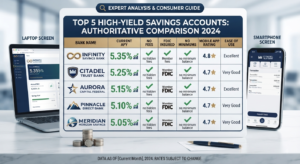
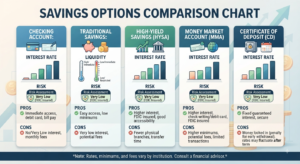
    The Basic Definition

    A high-yield savings account (HYSA) is a savings account that pays significantly higher interest than traditional savings accounts.

    Key characteristics:

    • Higher APY: 4.00-5.50% vs. 0.01% at traditional banks
    • Online banks: Usually offered by online banks (lower overhead = higher rates)
    • FDIC insured: Protected up to $250,000 per depositor (same as traditional)
    • Liquid: Access your money when needed (not locked like CDs)
    • No risk: Principal guaranteed, not subject to market volatility

    How They Work

    The process is simple:

    1. You open account (online application, 10-15 minutes)
    2. You deposit money (transfer from checking, direct deposit, etc.)
    3. Bank pays you interest (calculated daily, paid monthly typically)
    4. Interest compounds (you earn interest on your interest)
    5. You access money when needed (transfer to checking in 1-3 days)

    Example month:

    • January 1: Deposit $10,000
    • Bank calculates interest daily at 5.25% APY
    • Daily interest: $10,000 × (5.25% / 365) = $1.44/day
    • End of month: $43.89 interest earned
    • New balance: $10,043.89
    • February: Earn interest on $10,043.89 (compounding)

    What Makes Them “High-Yield”

    “High-yield” is relative to the market. In 2025:

    • 5.00%+ APY = High-yield (excellent)
    • 4.00-4.99% APY = Competitive
    • 2.00-3.99% APY = Moderate
    • 0.50-1.99% APY = Below average
    • 0.01-0.49% APY = Terrible (traditional banks)

    Historical context:

    • 2020-2021: 0.50% was “high-yield”
    • 2015-2019: 2.00% was excellent
    • 2007-2008: 5.00% was standard
    • 2025: 5.25% is exceptional (best in 15+ years)

    HYSA vs. Regular Savings: What’s Different?

    Feature Traditional Savings High-Yield Savings
    Interest rate 0.01-0.10% 5.00-5.50%
    Where offered Big banks, branches Online banks, some credit unions
    Monthly fees Often $5-15 Usually $0
    Minimum balance Often $500-2,500 Usually $0
    Branches Yes No (online only)
    FDIC insured Yes Yes
    Access to money Instant (branch/ATM) 1-3 days (transfer to checking)
    Annual earnings on $10k $1 $525

    Why Online Banks Can Pay More

    The economics are simple:

    Traditional banks:

    • Thousands of physical branches (rent, utilities, staff)
    • Legacy computer systems (expensive to maintain)
    • Massive overhead costs
    • Solution: Pay depositors almost nothing, charge fees

    Online banks:

    • No physical branches (massive savings)
    • Modern technology (efficient)
    • Minimal overhead
    • Solution: Pass savings to customers via higher rates and no fees

    Example cost structure:

    Big Bank Branch:

    • Rent: $8,000/month
    • Staff (4 people): $15,000/month
    • Utilities: $1,500/month
    • Maintenance: $1,000/month
    • Monthly cost per branch: $25,500
    • Across 4,000 branches = $102 million/month

    Online Bank:

    • No branches: $0
    • Smaller staff (customer service): Fraction of branch costs
    • Pass savings to depositors

    This is why online banks can offer 5.25% while Chase offers 0.01%

    Are They Really “Savings” Accounts?

    Yes, legally and functionally:

    • Federally regulated as savings accounts
    • Subject to Regulation D (historically limited to 6 withdrawals/month, though often unenforced now)
    • FDIC insured like traditional savings
    • Not for daily transactions (no debit card usually)

    Best uses:

    • Emergency fund (3-6 months expenses)
    • Short-term savings goals (vacation, down payment, large purchase)
    • Cash reserves you want accessible but not spending
    • Money earning interest while deciding what to do with it

    Not ideal for:

    • Daily spending (use checking)
    • Long-term investing (10+ years, use investment accounts)
    • Money you access weekly

    Why Traditional Savings Accounts Are Costing You Money {#traditional-cost}

    The opportunity cost of staying at a traditional bank is massive.

    The Real Cost of Convenience

    “But I like having my savings at the same bank as my checking!”

    Let’s calculate what that convenience costs:

    Scenario: $15,000 emergency fund

    Chase Savings (traditional):

    • Rate: 0.01% APY
    • Annual interest: $1.50
    • Monthly fee: $5 (unless $300 minimum daily balance)
    • Annual fees: $60
    • Net cost: -$58.50/year

    Marcus High-Yield Savings (online):

    • Rate: 5.30% APY
    • Annual interest: $795
    • Monthly fee: $0
    • Net benefit: +$795/year

    Difference: $853.50/year for the “convenience” of same-bank savings

    Over 10 years:

    • Chase: Lose $585 (fees exceed minimal interest)
    • Marcus: Earn $9,500+ (with compounding)
    • Cost of convenience: $10,085

    That’s not convenience. That’s expensive.

    The Inflation Reality

    Your money in traditional savings is losing value:

    With 3% inflation:

    • $10,000 today
    • 0.01% interest earned: $1
    • Inflation loss: -$300
    • Real loss: -$299 (2.99% purchasing power gone)

    With high-yield savings:

    • $10,000 today
    • 5.25% interest earned: $525
    • Inflation loss: -$300
    • Real gain: +$225 (2.25% purchasing power increase)

    Traditional savings = guaranteed loss to inflation
    High-yield savings = beat inflation by 2%+

    What You Could Have Earned

    Painful hindsight calculator:

    If you’ve had $10,000 sitting in 0.01% savings for 5 years:

    • What you earned: $5
    • What you could have earned (average 3% over 5 years): $1,593
    • Money left on table: $1,588

    If $25,000 for 10 years:

    • Actual earnings at 0.01%: $25
    • Potential earnings at 4% average: $12,189
    • Money left on table: $12,164

    Don’t let past mistakes compound. Switch now.

    The Psychological Cost

    Beyond dollars, traditional savings create:

    False security:

    • “I’m saving money” (but it’s losing value)
    • “I’m being responsible” (but missing opportunities)

    Learned helplessness:

    • “All banks pay nothing”
    • “There’s no point in comparing”
    • “It doesn’t matter where I save”

    Financial inertia:

    • Staying put despite better options
    • Loyalty to banks that don’t value you

    Breaking free from traditional banking psychology = first step to wealth building


    How Much Can You Really Earn? {#earnings}

    Let’s run the numbers with real scenarios.

    Simple Interest Calculator

    Formula: Principal × APY = Annual Interest

    At 5.25% APY:

    Starting Balance Daily Interest Monthly Interest Annual Interest
    $1,000 $0.14 $4.27 $52.50
    $5,000 $0.72 $21.88 $262.50
    $10,000 $1.44 $43.75 $525
    $15,000 $2.16 $65.63 $787.50
    $25,000 $3.60 $109.38 $1,312.50
    $50,000 $7.19 $218.75 $2,625
    $100,000 $14.38 $437.50 $5,250

    That daily interest column is key: Your money is working for you every single day.

    Compound Interest Reality

    Compound interest = earning interest on your interest

    Example: $10,000 at 5.25% APY for 10 years (no additional deposits)

    Year-by-year growth:

    • Year 1: $10,525
    • Year 2: $11,078
    • Year 3: $11,659
    • Year 4: $12,271
    • Year 5: $12,915
    • Year 6: $13,593
    • Year 7: $14,307
    • Year 8: $15,058
    • Year 9: $15,849
    • Year 10: $16,681

    Total earned: $6,681 (67% return on original $10,000)

    Compare to 0.01% traditional savings:

    • Year 10: $10,010
    • Total earned: $10
    • Difference: $6,671

    Adding Regular Contributions

    Most people save monthly. This amplifies returns.

    Scenario: Start with $5,000, add $300/month

    At 5.25% APY for 5 years:

    • Total contributed: $5,000 + ($300 × 60 months) = $23,000
    • Account balance after 5 years: $25,850
    • Interest earned: $2,850
    • Return on contributions: 12.4%

    At 0.01% traditional savings:

    • Total contributed: $23,000
    • Account balance: $23,006
    • Interest earned: $6
    • You literally earned enough for one coffee

    The $100/Month Challenge

    What if you saved just $100/month?

    In high-yield savings (5.25% APY):

    • Year 1: $1,233 (contributed $1,200)
    • Year 5: $6,776 (contributed $6,000)
    • Year 10: $15,582 (contributed $12,000)

    Interest earned over 10 years: $3,582

    In traditional savings (0.01%):

    • Year 10: $12,006
    • Interest earned: $6

    Difference: $3,576 for doing the exact same thing (saving $100/month) in a different account

    Real-Life Earning Examples

    Example 1: Emergency Fund Builder

    • Sarah, age 28
    • Goal: 6-month emergency fund ($18,000)
    • Starting point: $3,000
    • Monthly savings: $500

    Timeline in HYSA (5.25% APY):

    • Month 15: Reaches $10,000
    • Month 30: Reaches $18,000 goal
    • Interest earned during building: $1,247
    • Reached goal 2 months earlier than if earning 0%

    Example 2: Down Payment Saver

    • Michael and Jessica, ages 31 and 29
    • Goal: $60,000 house down payment
    • Starting point: $15,000
    • Monthly savings: $1,500

    At 5.25% APY:

    • Month 30: $62,850 (goal reached!)
    • Interest earned: $2,850
    • Earned extra $2,850 while saving for house

    At 0.01% traditional:

    • Month 30: $60,015
    • Interest earned: $15
    • Essentially $0 interest

    Example 3: Retiree Safety Net

    • Robert, age 68
    • Keeps $50,000 cash for emergencies/opportunities
    • Not investing (wants guaranteed safety)

    Annual income from HYSA:

    • $50,000 × 5.25% = $2,625/year
    • Monthly: $218.75
    • Covers his Medicare Part B premium ($174.70/month in 2024)

    In traditional savings:

    • Annual income: $5
    • Doesn’t even cover a single month’s Netflix

    Calculator: Your Potential Earnings

    Use this formula:

    Annual interest = Balance × (APY / 100)

    Your numbers:

    1. Current savings balance: $__________
    2. Current APY: ______%
    3. Potential HYSA APY: 5.25%

    Current annual earnings:
    $__________ × (% / 100) = $______

    Potential HYSA earnings:
    $__________ × (5.25 / 100) = $__________

    Annual difference: $__________

    10-year difference (conservative, no compounding):
    $__________ × 10 = $__________

    That’s real money you’re leaving on the table.


    Top High-Yield Savings Accounts (2025) {#top-accounts}

    Every account listed is FDIC insured and currently accepting new customers. Rates verified December 2024.


    🏆 #1: Marcus by Goldman Sachs High Yield Savings

    APY: 5.30%
    Monthly Fee: $0
    Minimum Balance: $0
    Minimum Opening Deposit: $0

    Why it’s #1:

    • Highest consistent rate (Marcus doesn’t play intro rate games)
    • Zero fees (no monthly fee, no transfer fees, no minimum balance fees)
    • No minimums (open with $1 if you want)
    • Reliable (Goldman Sachs backing, established online bank)
    • Excellent app (4.8/5 stars, clean interface)

    Features:

    • Daily compounding interest
    • No transaction fees
    • Link up to 3 external accounts
    • Transfers typically 1-2 business days
    • Auto-save tools
    • Mobile app and online access
    • FDIC insured up to $250,000

    Withdrawals:

    • 6 per month (federal regulation, though often unenforced)
    • Unlimited transfers out (may take 1-3 days)
    • No fees for withdrawals

    Customer Service:

    • Phone: 8am-10pm ET, 7 days/week
    • Secure messaging
    • Email support

    Best for:

    • Maximum interest earnings
    • Straightforward high-yield savings
    • People who value consistency (rate doesn’t yo-yo)
    • Marcus credit card holders (familiar with brand)

    Potential drawbacks:

    • Online only (no branches)
    • No ATM card (must transfer to checking first)
    • Not instant access (1-2 day transfers)

    Bottom line: Marcus offers the best combination of top-tier rate, zero fees, zero minimums, and reliability. Hard to beat.


    🥈 #2: American Express Personal Savings

    APY: 5.30%
    Monthly Fee: $0
    Minimum Balance: $0
    Minimum Opening Deposit: $0

    Ties with Marcus for rate, slightly different features

    Why it’s #2 (tied for #1 really):

    • Same 5.30% APY as Marcus
    • Zero fees, zero minimums
    • Amex brand trust (well-known, established)
    • Faster transfers (often same-day to next-day)
    • Excellent customer service (24/7 phone support)

    Features:

    • Daily compounding
    • Link up to 4 external accounts
    • Faster transfers than most (ACH often next day)
    • Online and mobile app
    • No fees of any kind
    • FDIC insured up to $250,000

    Customer Service:

    • 24/7 phone support
    • Live chat
    • Email
    • Generally excellent reviews

    Best for:

    • Amex credit card holders (familiar ecosystem)
    • People who prioritize customer service
    • Those who want fastest transfers (among high-yield accounts)
    • Anyone wanting top rate with trusted brand

    Potential drawbacks:

    • Online only
    • Can only link 4 external accounts (vs. unlimited at some banks)
    • No ATM access

    Bottom line: Choosing between Marcus and Amex is personal preference. Identical rates, both excellent. Amex wins on customer service and transfer speed; Marcus wins on brand focus (dedicated to savings).


    🥉 #3: Ally Bank Online Savings Account

    APY: 5.25%
    Monthly Fee: $0
    Minimum Balance: $0
    Minimum Opening Deposit: $0

    Why it’s #3:

    • Competitive 5.25% APY (just 0.05% below top)
    • Best features and tools (savings buckets, boosters, surprise savings)
    • Superior user experience (consistently top-rated app)
    • Full banking relationship (checking + savings integration)

    Unique Features:

    Savings Buckets:

    • Organize savings into categories within account
    • “Emergency Fund” bucket: $10,000
    • “Vacation” bucket: $3,000
    • “New Car” bucket: $8,000
    • All earn same 5.25% rate

    Savings Boosters:

    • Recurring transfers (automatic)
    • Percentage of paycheck
    • Round-ups from spending
    • Surprise savings (AI suggests amounts based on spending)

    Other Features:

    • Daily compounding
    • No fees
    • Link unlimited external accounts
    • Transfers 1-3 business days
    • Instant transfers to Ally checking
    • FDIC insured

    Customer Service:

    • 24/7 phone support
    • Chat support
    • Email
    • Excellent reputation

    Best for:

    • People wanting organization (buckets brilliant for multiple goals)
    • Ally checking account holders (instant transfers between accounts)
    • Those who value automation (boosters)
    • Anyone who loves excellent apps and UX

    Potential drawbacks:

    • Rate 0.05% lower than Marcus/Amex ($5 less per $10,000 per year)
    • Online only

    Bottom line: If you value tools and organization over an extra $5/year per $10,000, Ally is superior to Marcus/Amex. If you just want highest rate and simplicity, go Marcus/Amex.


    #4: CIT Bank Platinum Savings

    APY: 5.05%
    Monthly Fee: $0
    Minimum Balance: $5,000 OR $100+ monthly deposits with $100 minimum

    Why it’s on the list:

    • Competitive 5.05% APY
    • Lower rate but flexible requirements (good for regular savers)
    • Savings Builder tools

    Two ways to qualify for 5.05%:

    Option A: Maintain $5,000+ balance
    Option B: Make $100+ deposits per month AND maintain $100+ balance

    If below minimums: 1.00% APY (significantly lower)

    Features:

    • Daily compounding
    • No monthly fee (if minimums met)
    • Online and mobile banking
    • External account linking
    • FDIC insured

    Best for:

    • People with $5,000+ to save
    • Regular savers depositing $100+/month
    • Those comfortable with balance requirements

    Potential drawbacks:

    • Requires $5,000 OR $100 monthly deposits
    • Rate drops dramatically if don’t meet minimums
    • Not as high as Marcus/Amex/Ally
    • Less well-known brand

    Bottom line: Good option if you meet minimums easily. But for most people, Marcus/Amex/Ally better (no minimums, higher rates).


    #5: Discover Online Savings Account

    APY: 5.25%
    Monthly Fee: $0
    Minimum Balance: $0
    Minimum Opening Deposit: $0

    Why it’s on the list:

    • Competitive 5.25% rate
    • Trusted brand (Discover well-known for credit cards)
    • Can open multiple accounts (great for organizing goals)
    • 24/7 customer service

    Features:

    • Daily compounding
    • No fees or minimums
    • Link external accounts
    • Transfers 1-3 business days
    • Can have multiple Discover savings accounts (organize by goal)
    • Mobile app and online banking
    • FDIC insured

    Customer Service:

    • 24/7 phone
    • Chat
    • U.S.-based support
    • Generally excellent

    Best for:

    • Discover credit card holders (familiar with brand)
    • People wanting multiple savings accounts at same bank
    • Those who value 24/7 customer service
    • Anyone wanting top rate with well-known brand

    Potential drawbacks:

    • Online only
    • Features less robust than Ally (no buckets within account)
    • Discover known more for cards than banking (some hesitation)

    Bottom line: Solid choice, especially if you already have Discover card. But doesn’t differentiate significantly from Marcus/Amex/Ally.


    Honorable Mention: LendingClub High-Yield Savings

    APY: 5.30%
    Monthly Fee: $0
    Minimum Balance: $100 minimum opening deposit, then $0

    Why it’s honorable mention:

    • Ties top rate (5.30%)
    • Zero monthly fees
    • Strong app

    Why not top 5:

    • Requires $100 opening deposit (vs. $0 at others)
    • Less established banking brand (known for lending)
    • Fewer years of track record as bank

    Good alternative if top banks aren’t accepting new customers in your area


    Comparison Summary Table

    Bank APY Monthly Fee Min Balance Min Opening Best Feature
    Marcus 5.30% $0 $0 $0 Highest rate + consistency
    Amex 5.30% $0 $0 $0 Fast transfers + service
    Ally 5.25% $0 $0 $0 Buckets + automation
    CIT 5.05% $0 $5,000* $0 Flexible requirements
    Discover 5.25% $0 $0 $0 Multiple accounts

    *Or $100 monthly deposits + $100 minimum


    Which Should You Choose?

    Decision tree:

    Want absolute highest rate + simplicity?
    → Marcus or Amex (5.30%, identical rates, choose based on preference)

    Want best tools and organization?
    → Ally (5.25%, buckets feature worth the 0.05% difference for many)

    Have $5,000+ to maintain OR deposit $100+/month?
    → CIT works, but Marcus/Amex/Ally still better (higher rates, no requirements)

    Want trusted brand + can open multiple accounts?
    → Discover (5.25%, well-known brand, multiple account capability)

    Can’t decide?
    → Start with Marcus (straightforward, highest rate, can’t go wrong)

    Want to diversify?
    → Split between Marcus and Ally (FDIC coverage at two banks, get both rate and features)


    [Internal Link: See full banking comparison in “Best Bank Accounts for 2025: Checking, Savings & Money Market”]


    How to Choose the Right HYSA {#choose}

    Beyond just rates, consider these factors.

    Your Savings Goals

    Emergency Fund (3-6 months expenses):

    • Priority: Accessibility + safety + decent rate
    • Best choice: Any top HYSA (Marcus, Amex, Ally all excellent)
    • Don’t: Lock in CD (need liquidity)
    • Amount: $15,000-$35,000 typical

    Short-term savings (1-3 years):

    • Vacation, wedding, car down payment, house fund
    • Priority: High rate + safety
    • Best choice: HYSA or CD (if timeline definite)
    • Consider: Ally (buckets organize multiple goals)

    Medium-term (3-5 years):

    • Larger goals (house down payment, career transition)
    • Priority: Beat inflation + safety
    • Best choice: HYSA or conservative investments
    • Consider: Mix of HYSA + low-risk investments

    Long-term (5+ years):

    • Don’t use HYSA (opportunity cost too high)
    • Use: Investment accounts (stocks, bonds, index funds)
    • Why: Historical stock returns 10%/year vs. 5% HYSA

    Your Balance

    Under $5,000:

    • Any no-minimum HYSA works
    • Focus on highest rate
    • Choose: Marcus or Amex (5.30%)

    $5,000-$25,000:

    • Most HYSAs perfect for this range
    • Consider features (Ally buckets useful)
    • Choose: Based on preference (all top accounts excellent)

    $25,000-$100,000:

    • Still within FDIC limits at one bank
    • High rate critical (difference adds up)
    • Calculate: 5.30% vs. 5.25% on $50,000 = $25/year difference
    • Choose: Marcus or Amex for max rate

    $100,000-$250,000:

    • Approaching FDIC limit at one bank
    • Consider: Multiple accounts for FDIC coverage
    • Strategy: $125,000 at Marcus + $125,000 at Amex = $500,000 FDIC coverage

    Over $250,000:

    • Must use multiple banks (FDIC limit)
    • Strategy:
      • $250,000 at Marcus
      • $250,000 at Amex
      • $250,000 at Ally
      • Each separately FDIC insured
    • Alternative: CDARS/IntraFi (automatic multi-bank spreading)

    Your Tech Comfort Level

    Very comfortable with online/apps:

    • Any HYSA works
    • Prioritize rate and features
    • Choose: Highest rate (Marcus/Amex) or best features (Ally)

    Moderately comfortable:

    • Still fine with HYSA (they’re designed to be easy)
    • Prioritize simplicity
    • Choose: Marcus (straightforward) or Discover (familiar brand)

    Prefer in-person banking:

    • Challenge: HYSAs are online-only
    • Solution: Hybrid approach:
      • Keep checking at local bank (for branch access)
      • Put savings in HYSA (transfer to checking when needed)
    • Alternative: Local credit union (sometimes 4-5% rates with relationship)

    Your Access Needs

    Rarely need to touch savings:

    • Perfect for HYSA
    • Choose: Highest rate (Marcus/Amex)

    Occasional access (few times/year):

    • HYSA still perfect (1-3 day transfer fine)
    • Choose: Amex (faster transfers) or any top account

    Frequent access (monthly):

    • Reconsider: Is this really savings?
    • Maybe: Money market account better (check writing + ATM)
    • Or: Keep more in checking, less in savings

    Emergency access needed:

    • HYSA takes 1-3 days (not instant)
    • Solution: Keep 1 month expenses in checking (instant access)
    • Rest in HYSA: 1-3 day transfer acceptable for emergencies

    Your Organization Style

    Simple (one savings account total):

    • Choose: Marcus or Amex (straightforward, high rate)

    Organizer (separate accounts for each goal):

    • Choose: Ally (buckets within account) OR
    • Alternative: Discover (can open multiple accounts)

    Automator (set it and forget it):

    • Choose: Ally (boosters, automatic savings tools)

    HYSA vs. Other Savings Options {#comparison}

    How does HYSA stack up against alternatives?

    HYSA vs. Certificate of Deposit (CD)

    Certificates of Deposit: Lock money for set term (6 months to 5 years) for guaranteed rate.

    CD Advantages:

    • Sometimes higher rates (6-month CD: 5.50% vs. 5.25% HYSA)
    • Rate guaranteed (won’t drop if Fed lowers rates)
    • Forced discipline (can’t touch without penalty)

    HYSA Advantages:

    • Complete liquidity (access anytime)
    • No early withdrawal penalty
    • No commitment
    • Can add money anytime

    When to choose CD:

    • You know you won’t need money for specific period
    • Rates are higher than HYSA (not always the case)
    • You want guaranteed rate regardless of Fed changes

    When to choose HYSA:

    • You want flexibility
    • You might need money
    • CD rates aren’t significantly higher (0.25%+ difference worth it, 0.05% not)
    • You’re building savings (can’t add to CD once opened)

    Recommendation: Emergency fund = HYSA (need liquidity). Specific goal with timeline = consider CD.


    HYSA vs. Money Market Account

    Money Market Accounts: Hybrid of checking and savings (earns interest, but has checks/ATM card).

    Money Market Advantages:

    • Check writing (6 per month typically)
    • ATM card access
    • Same or similar rates to HYSA (5.00-5.25%)

    HYSA Advantages:

    • Sometimes slightly higher rates
    • Simpler (don’t need checks/ATM for pure savings)

    When to choose Money Market:

    • You want check writing on savings
    • You want ATM access to savings
    • You keep large balance you might need to access directly

    When to choose HYSA:

    • Pure savings (don’t need checks)
    • Slightly higher rate (0.05-0.25% difference)
    • Simplicity

    Recommendation: For most, HYSA is better. Only get money market if specifically need check/ATM features.


    HYSA vs. High-Yield Checking

    Some checking accounts now pay interest (3-5% on limited balances).

    High-Yield Checking Example: Upgrade Premier Checking

    • 5.07% APY on balances up to $10,000
    • Then 1.07% on amounts above
    • Requires direct deposit

    Comparison:

    Feature HYSA High-Yield Checking
    Rate on all balances 5.25% 5.07% up to $10k, then 1.07%
    Balance limits None Usually $10-25k
    Requirements None Direct deposit often required
    Debit card No Yes
    Bill pay Limited Yes
    Daily transactions No Yes

    Strategy: Use BOTH

    • High-yield checking: Keep $5,000-10,000 (daily spending + earn 5%)
    • HYSA: Keep rest of savings (emergency fund, goals)

    This maximizes earnings on both checking and savings


    HYSA vs. Traditional Savings

    We’ve covered this, but summary:

    Feature Traditional Savings HYSA
    Rate 0.01-0.10% 5.00-5.50%
    Earnings on $10k/year $1-10 $500-550
    Fees Often $5-15/month $0
    Minimums Often $500-2,500 $0
    Branches Yes No

    There is literally no reason to keep money in traditional savings unless:

    • You need physical branch access for deposits (keep checking there, not savings)
    • You’re over 80 and refuse to use online banking (even then, have family help you switch)

    For 99% of people: Traditional savings is lighting money on fire


    HYSA vs. Brokerage Account (Investing)

    Different purposes, different timelines:

    HYSA:

    • Purpose: Safety, liquidity, guaranteed return
    • Timeline: 0-5 years
    • Return: 5.25% guaranteed
    • Risk: None (FDIC insured)
    • Best for: Emergency fund, short-term goals

    Brokerage (Stock Market):

    • Purpose: Growth, wealth building
    • Timeline: 5+ years (ideally 10+)
    • Return: 10%/year average (historical), but varies
    • Risk: Can lose money (2022: down 18%, 2008: down 37%)
    • Best for: Retirement, long-term goals

    You need BOTH:

    • HYSA for short-term and emergencies
    • Investments for long-term and growth

    Don’t make this mistake: Keeping everything in HYSA long-term (10+ years)

    • 5% guaranteed sounds safe
    • But missing 10% average stock returns
    • Over 30 years: Huge opportunity cost

    Don’t make opposite mistake: Investing emergency fund

    • Stocks can drop 30-50% in recession
    • Exactly when you might lose job (need emergency fund)
    • Emergency fund must be safe (HYSA)

    Strategies to Maximize Your Earnings {#strategies}

    Beyond just opening an account, tactics to earn even more.

    Strategy #1: The Direct Deposit Switch

    Move your direct deposit to high-yield savings account:

    Traditional approach:

    • Paycheck → Checking (0% interest)
    • Manually transfer to savings (if remember)
    • Most money sits in checking earning nothing

    Optimized approach:

    • Paycheck → HYSA (5.25% interest)
    • Automatic transfer to checking (just enough for bills)
    • Maximum money earns maximum interest

    Example:

    • Monthly income: $5,000
    • Monthly expenses: $3,500

    Traditional:

    • $5,000 sits in checking earning 0%
    • Manual transfer $1,500 to savings (if disciplined)

    Optimized:

    • $5,000 direct deposited to HYSA (earning 5.25%)
    • Auto-transfer $3,500 to checking day after deposit
    • $1,500 stays in HYSA

    Benefit: Your money earns interest immediately (day 1 of pay period vs. later when you transfer)

    Micro-optimization: Over year, earns extra $100-200 on float


    Strategy #2: The Savings Automation Ladder

    Set up automated transfers right after payday:

    Day 1 (Payday):

    • Direct deposit hits

    Day 2:

    • Auto-transfer to checking (bills amount)

    Day 3:

    • Auto-transfer to different savings goals:
      • $200 → Emergency fund HYSA
      • $150 → Vacation fund HYSA
      • $300 → House down payment HYSA
      • $100 → Car replacement fund HYSA

    Benefit: “Pay yourself first” before you can spend

    Psychology: Money you don’t see, you don’t spend


    Strategy #3: The Rate Stacking Method

    Use multiple accounts for maximum earnings:

    Checking: Upgrade Premier (5.07% on first $10k)

    • Keep: $10,000
    • Earn: $507/year

    Savings 1: Marcus HYSA (5.30%)

    • Keep: $15,000 (emergency fund)
    • Earn: $795/year

    Savings 2: Ally HYSA (5.25%)

    • Keep: $10,000 (short-term goals, organized in buckets)
    • Earn: $525/year

    Total holdings: $35,000
    Total annual interest: $1,827
    Effective APY: 5.22% (across all accounts)

    Bonus: Multiple FDIC coverage ($250k at each bank)


    Strategy #4: The Round-Up Accelerator

    Many banks offer “round-up” features:

    How it works:

    • Purchase coffee: $4.75
    • Rounded to: $5.00
    • Difference: $0.25 → savings

    Daily example:

    • 5 transactions rounded up
    • Average round-up: $0.40/transaction
    • Daily savings: $2.00
    • Monthly: $60
    • Annually: $720

    Plus interest: $720 × 5.25% = $37.80 first year

    Banks offering this:

    • Ally (Savings Booster)
    • SoFi (Spare Change)
    • Many others

    Set it and forget it: Painless savings that compounds


    Strategy #5: The Promotional Rate Cycle

    Some banks offer promotional rates:

    • Example: “6.00% for first 3 months, then 5.25%”

    Strategy:

    • Open account for promo rate
    • Transfer large sum ($25,000)
    • Earn 6% for 3 months
    • After promo ends, either:
      • Keep (if base rate competitive)
      • Or transfer to highest permanent rate

    Example earnings:

    • $25,000 at 6% for 3 months: $375
    • Then at 5.25% for 9 months: $984
    • Total year 1: $1,359
    • vs. $1,312 at flat 5.25% all year
    • Extra: $47 for 20 minutes of work (opening account)

    Caution: Only worth it for large balances and if base rate competitive post-promo


    Strategy #6: The Spouse/Partner Maximization

    If you’re married or partnered:

    Individual accounts at each bank:

    • You: $250,000 at Marcus
    • Partner: $250,000 at Marcus
    • Total FDIC coverage: $500,000 at one bank

    Plus joint account:

    • Joint: $250,000 at Marcus
    • Additional coverage: $250,000
    • Total at Marcus: $750,000 FDIC covered

    Then repeat at other banks:

    • Amex: $750,000 covered
    • Ally: $750,000 covered

    For high net worth couples, this maximizes FDIC coverage while keeping high rates


    Strategy #7: The Tax-Advantaged Timing

    Interest is taxable income.

    If you’re strategic:

    • Open account early in year (January)
    • Build balance throughout year
    • Interest earned across full year
    • Pay taxes next April

    vs.

    • Open account late in year (November)
    • Interest earned only 2 months
    • But didn’t have money working for you all year

    Always better to start earlier (even though taxes), because:

    • $10,000 earning 5.25% for 12 months = $525 interest
    • Tax on $525 (25% bracket) = -$131
    • Net: +$394

    vs.

    • $10,000 earning 0.01% for 12 months = $1 interest
    • Tax on $1 = $0.25
    • Net: +$0.75

    Don’t let tax tail wag the dog. Earn interest, pay tax, still way ahead.


    Strategy #8: The Emergency Fund Tiering

    Not all emergency fund needs same-day access:

    Tier 1: Immediate ($1,000-2,000)

    • Keep in checking account
    • 0% interest, but instant access
    • For true emergencies (car breaks down, need tow)

    Tier 2: Quick Access ($5,000-10,000)

    • HYSA with fast transfers (Amex, 1-day transfer)
    • 5.30% interest
    • Transfer to checking if needed (1 day)

    Tier 3: Full Emergency Fund ($15,000-25,000)

    • HYSA at highest rate (Marcus, 5.30%)
    • 1-3 day transfers fine (real emergencies can wait)

    Benefit:

    • Maximum money earning maximum interest
    • Still have instant access to some funds
    • Majority earning 5.30% (vs. sitting in 0% checking)

    Understanding APY and How Interest is Calculated {#apy}

    Knowledge is power when comparing accounts.

    APY vs. APR (Don’t Confuse These)

    APY (Annual Percentage Yield):

    • Used for savings/deposits
    • Includes compound interest
    • What you EARN on savings
    • Higher is better

    APR (Annual Percentage Rate):

    • Used for loans/credit cards
    • Simple interest rate
    • What you PAY on debt
    • Lower is better

    For savings accounts, always compare APY (not interest rate)

    How Interest is Calculated

    Daily compound interest (most HYSAs):

    Formula:
    Daily Interest = Balance × (APY / 365)

    Example: $10,000 at 5.25% APY

    Day 1:

    • Interest: $10,000 × (0.0525 / 365) = $1.44
    • New balance: $10,001.44

    Day 2:

    • Interest: $10,001.44 × (0.0525 / 365) = $1.44
    • New balance: $10,002.88

    Continues daily…

    Month 1 (30 days):

    • Interest earned: $43.29
    • Balance: $10,043.29

    Month 2 (31 days):

    • Interest earned on higher balance: $44.85
    • Balance: $10,088.14

    This is compound interest: Earning interest on your interest

    The Power of Compounding

    $10,000 at 5.25% APY:

    Without compounding (simple interest):

    • Year 1: $525 interest
    • Year 5: $2,625 interest
    • Year 10: $5,250 interest

    With compounding (actual):

    • Year 1: $537 interest
    • Year 5: $2,915 interest
    • Year 10: $6,681 interest

    Difference over 10 years: $1,431 (27% more than simple interest)

    Why compounding matters:

    • Month 1: Earn interest on $10,000
    • Month 2: Earn interest on $10,043
    • Month 3: Earn interest on $10,088
    • Small differences compound over time

    Rate vs. APY Comparison

    If bank advertises “5.20% rate, compounded daily”:

    Actual APY = (1 + 0.0520/365)^365 – 1 = 5.34% APY

    Always use APY for comparisons (accounts for compounding frequency)

    How Banks Display Rates

    What you’ll see:

    • “5.25% APY*”
    • *Annual Percentage Yield

    Fine print usually says:

    • “Rate accurate as of [date]”
    • “Rates subject to change without notice”
    • “Fees could reduce earnings”

    This is normal. Variable rates fluctuate.

    Monthly Interest Payments

    Most HYSAs pay interest monthly:

    Timeline:

    • Day 1-31: Interest calculated daily
    • Last day of month: Interest credited to account
    • Appears as deposit on statement

    Example statement:

    • March 1 balance: $10,000
    • March 31 interest payment: +$43.75
    • April 1 balance: $10,043.75

    Note: Some banks pay quarterly (every 3 months). Monthly is better (compounds faster).


    Are High-Yield Savings Accounts Safe? {#safety}

    Addressing common concerns about safety.

    FDIC Insurance Explained

    Federal Deposit Insurance Corporation:

    • Government agency (created 1933)
    • Insures deposits at member banks
    • Covers up to $250,000 per depositor, per bank
    • You don’t pay for this (banks pay premiums)

    What’s covered:

    • Savings accounts ✅
    • Checking accounts ✅
    • Certificates of deposit ✅
    • Money market accounts ✅

    What’s NOT covered:

    • Stocks ❌
    • Bonds ❌
    • Mutual funds ❌
    • Cryptocurrency ❌
    • Investments ❌

    HYSA is FDIC insured = your money is safe up to $250,000

    What If Bank Fails?

    Recent example: Silicon Valley Bank (March 2023)

    What happened:

    1. Bank declared failed by regulators
    2. FDIC took over immediately
    3. Depositors with under $250,000: Fully protected, zero loss
    4. Access restored within days
    5. FDIC found buyer bank or paid depositors directly

    Historical data:

    • Since FDIC created (1933): Zero insured depositors have lost money
    • Banks fail periodically
    • FDIC process works

    Your action if bank fails: Nothing

    • FDIC contacts you
    • Your money is safe
    • Transferred to new bank or check mailed

    Online Banks: Extra Safety Concerns?

    “But there’s no physical building. Is my money real?”

    Yes. Online banks are just as safe:

    Same regulations:

    • Subject to same federal banking laws
    • Same FDIC insurance
    • Same oversight
    • Same capital requirements

    Sometimes safer:

    • Better fraud detection (advanced tech)
    • Stronger encryption
    • Two-factor authentication
    • Biometric security

    The building doesn’t protect your money. FDIC does.

    Verification Process

    Before opening any HYSA, verify FDIC insurance:

    1. Check bank website (should prominently display “Member FDIC”)
    2. Use FDIC BankFind tool: FDIC.gov/resources/deposit-insurance
    3. Look for FDIC certificate number

    All accounts recommended in this guide are FDIC verified

    Security Best Practices

    Protect your account:

    Strong password:

    • Unique (not used elsewhere)
    • 12+ characters
    • Mix of letters, numbers, symbols
    • Use password manager

    Two-factor authentication:

    • Enable for all accounts
    • SMS or authenticator app
    • Extra security layer

    Monitor regularly:

    • Check account weekly
    • Set up transaction alerts
    • Review statements monthly
    • Report suspicious activity immediately

    Never share:

    • Password
    • Social Security number (after account opened)
    • Account numbers via email/phone

    Phishing awareness:

    • Banks never ask for password via email
    • Don’t click links in unexpected emails
    • Go directly to website (don’t use email links)

    Credit Union Alternative: NCUA

    Credit unions use NCUA instead of FDIC:

    • National Credit Union Administration
    • Same $250,000 coverage
    • Equally safe
    • Same government backing

    NCUA = credit union equivalent of FDIC


    Tax Implications of High-Yield Savings {#taxes}

    Interest is taxable income. Here’s what you need to know.

    How Savings Interest is Taxed

    Interest earned = ordinary income

    • Taxed at your regular income tax rate
    • Added to W-2 income, freelance income, etc.
    • Same rate as your salary

    Not capital gains (different from investment taxation)

    Tax Brackets and Impact

    2024 Federal tax brackets (single filers):

    Taxable Income Tax Rate
    $0 – $11,600 10%
    $11,601 – $47,150 12%
    $47,151 – $100,525 22%
    $100,526 – $191,950 24%
    $191,951 – $243,725 32%

    Example: You earn $60,000 salary + $525 savings interest

    Your $525 interest is taxed at 22% (your marginal rate):

    • Tax on interest: $525 × 0.22 = $115.50
    • You keep: $525 – $115.50 = $409.50

    Still way better than earning $1 at 0.01% (keeping $0.75 after tax)

    Form 1099-INT

    Banks report interest to IRS:

    If you earn $10+ in interest, bank sends:

    • Form 1099-INT to you (by January 31)
    • Copy to IRS

    Your responsibility:

    • Report on tax return (1040, line 2b)
    • Pay tax owed
    • Happens automatically if using tax software

    Example 1099-INT:

    • Marcus by Goldman Sachs
    • Interest paid in 2024: $525.00
    • You report this $525 on your tax return

    Estimated Taxes

    If you earn significant interest:

    IRS requires quarterly estimated tax payments if:

    • You’ll owe $1,000+ in taxes
    • Interest + other income not subject to withholding

    Quarterly deadlines:

    • April 15
    • June 15
    • September 15
    • January 15

    Calculation:

    • Interest earned: $2,625 (on $50,000 at 5.25%)
    • Tax rate: 24%
    • Annual tax: $630
    • Quarterly payment: $157.50

    Most people don’t need to worry (unless very high balances or other non-W-2 income)

    State Taxes

    Most states also tax interest income:

    • Same rate as state income tax
    • Added to your state return
    • Varies by state (0% in TX, FL, WA to 13%+ in CA)

    Example: California resident

    • Interest earned: $525
    • Federal tax (22%): -$115.50
    • State tax (9.3%): -$48.83
    • Net after taxes: $360.67

    Still earning $360 vs. $0.75 in traditional savings

    Tax Strategies

    1. Maximize retirement contributions

    • Reduces taxable income
    • Lowers tax rate on interest
    • Example: Contribute $6,500 to IRA → may drop from 22% to 12% bracket

    2. Keep savings in Roth IRA (if eligible)

    • Roth IRA savings accounts exist
    • Interest grows tax-free
    • Contributions accessible (but not recommended for emergency fund)

    3. Don’t let tax tail wag the dog

    • Earning 5.25% and paying 24% tax = 4.0% net
    • Still better than 0.01% and paying 24% tax = 0.008% net
    • Always better to earn more, even after taxes

    Tax Reporting Checklist

    January:

    •  Receive 1099-INT from each bank (by Jan 31)
    •  Verify amounts match your records

    Tax Filing:

    •  Enter 1099-INT information on tax return
    •  Report on Schedule B if over $1,500 total interest
    •  Pay any tax owed

    Year-round:

    •  Track interest earned (estimate for planning)
    •  Adjust W-4 if needed (increase withholding to cover interest tax)
    •  Make quarterly estimated payments if required

    When Rates Will Drop (And What to Do) {#rate-changes}

    Understanding rate cycles helps you plan.

    Why Rates are High Now (2025)

    Federal Reserve policy:

    • 2022-2023: Fed raised rates aggressively (combat inflation)
    • Fed funds rate: 4.25-4.50%
    • High Fed rate → high savings rates

    Historical context:

    • 2020-2021: Fed rate 0-0.25% (pandemic stimulus)
    • Savings rates: 0.50-1.00%
    • 2007-2008: Fed rate 5.25%
    • Savings rates: 4.50-5.00% (similar to now)

    Current 5%+ rates are historical anomaly (but awesome while they last)

    When Rates Will Drop

    Likely scenario for 2025-2026:

    Fed will lower rates when:

    • Inflation returns to 2% target
    • Economy slows
    • Unemployment rises
    • Recession concerns

    Expected timeline:

    • 2025: Possible 2-3 rate cuts (0.75% total)
    • 2026: Additional cuts if economy slows
    • By 2027: Fed rate possibly 2.5-3.5%

    Impact on savings rates:

    • Each 0.25% Fed cut → ~0.25% drop in HYSA rates
    • 3 cuts (0.75%) → HYSA rates drop to 4.50%
    • Eventually: Settle around 3.00-3.50% (still good!)

    This is normal cycle. Rates won’t stay 5%+ forever.

    What Happens to Your Rate

    Variable rate accounts (most HYSAs):

    • Rate can change anytime
    • No notice required (though banks usually announce)
    • You don’t need to do anything (automatic adjustment)

    Example:

    • Today: Marcus pays 5.30%
    • Fed cuts 0.25%
    • Next month: Marcus pays 5.05%
    • Your balance automatically earns new rate

    Your action: None (it’s automatic)

    How to Prepare for Rate Drops

    Strategy 1: Enjoy it while it lasts

    • Maximize savings now
    • Earn 5%+ while available
    • Build emergency fund fully
    • When rates drop to 3%, you’ve already earned 5% for years

    Strategy 2: Lock in rates (CDs)

    • Before Fed cuts, consider CDs
    • Lock in 5.00-5.50% for 1-5 years
    • Example: 18-month CD at 5.40% (guaranteed regardless of Fed cuts)

    When to do this:

    • If Fed signals cuts are coming
    • If you don’t need liquidity
    • If CD rates > HYSA rates

    Strategy 3: Don’t overreact

    • 3.50% is still excellent (historical perspective)
    • 2015-2019: 2.00% was good
    • Even at 3.00%, still 300x better than big banks

    Strategy 4: Focus on what you control

    • Amount saved (increase contributions)
    • Expenses (reduce to save more)
    • Income (increase to save more)
    • Rate chasing has diminishing returns

    Historical Rate Perspective

    Average HYSA rates by era:

    • 1980s: 8-12% (high inflation era)
    • 1990s: 4-6%
    • 2000s: 3-5%
    • 2010-2021: 0.50-2.00%
    • 2022-2025: 4.00-5.50%
    • Future?: Likely 2.50-4.00% (normalized)

    Even if rates drop to 3%, that’s still historically good

    What NOT to Do

    Don’t panic and move to stocks:

    • “Rates dropping to 3%, I’ll invest in stocks for 10% instead!”
    • Problem: Emergency fund should be safe, not volatile
    • Stocks can drop 30-50% exactly when you need money
    • Keep emergency fund in HYSA regardless of rate

    Don’t chase 0.50% rate differences:

    • Switching banks for 5.30% → 5.80% (if promo)
    • Effort vs. reward calculation:
      • $10,000 balance
      • 0.50% difference = $50/year
      • Worth it? Maybe if easy
      • Not worth if requires significant effort

    Don’t abandon HYSAs:

    • Even at 2.50%, still better than 0.01% traditional
    • Keep using HYSAs for cash reserves

    Common High-Yield Savings Mistakes {#mistakes}

    Avoid these pitfalls.

    Mistake #1: Analysis Paralysis

    The problem:

    • Researching accounts for weeks
    • Comparing 5.25% vs. 5.30% endlessly
    • Never actually opening account

    The cost:

    • $10,000 in 0.01% account for 3 months (while researching)
    • Earned: $0.25
    • Would have earned in HYSA: $131.25
    • Cost of delay: $131

    Solution:

    • Research for 1 hour maximum
    • Choose any top-rated account (Marcus, Amex, Ally all excellent)
    • Open account today
    • Perfection isn’t necessary (all top accounts similar)

    Mistake #2: Keeping Too Much in Checking

    The problem:

    • $15,000 sitting in checking (0% interest)
    • “I might need it”
    • Lost earnings: $787.50/year

    Solution:

    • Keep 1 month expenses + $500 buffer in checking
    • Move rest to HYSA
    • Can transfer back in 1-3 days if needed (acceptable for most “emergencies”)

    Most “emergencies” can wait 1-2 days for transfer


    Mistake #3: Not Comparing Rates Annually

    The problem:

    • Opened HYSA in 2022 at 3.50%
    • Never checked again
    • Still earning 3.50% (bank didn’t raise rate)
    • Market rate now: 5.30%
    • Leaving 1.80% on table ($180/year per $10,000)

    Solution:

    • Review rates every 6-12 months
    • If your bank more than 0.50% below market, switch
    • Takes 20 minutes, earns hundreds

    Mistake #4: Falling for Promotional Rate Traps

    The problem:

    • Bank offers 6.00% APY*
    • *For first 3 months, then drops to 2.00%
    • You don’t notice rate drop
    • Earning 2.00% for 9 months (below market)

    Solution:

    • Read fine print on promotional rates
    • Set calendar reminder when promo ends
    • After promo, verify base rate is competitive
    • If not, transfer to better account

    Mistake #5: Ignoring FDIC Limits

    The problem:

    • $400,000 in one HYSA
    • Bank fails
    • FDIC covers $250,000
    • $150,000 at risk (not covered)

    Solution:

    • Split balances over $250,000 across multiple banks
    • $250,000 at Marcus
    • $250,000 at Amex
    • Each separately FDIC insured

    Mistake #6: Paying Fees

    The problem:

    • HYSA with $10/month fee
    • “But it pays 5.25%!”
    • On $10,000: Earn $525, pay $120 fees = net $405
    • Fee-free HYSA earns $525 with $0 fees

    Solution:

    • Never pay fees for HYSA
    • All top accounts have $0 fees
    • If your bank charges fees, switch immediately

    Mistake #7: Not Reading Terms

    The problem:

    • Minimum balance requirement not noticed
    • Fall below minimum
    • Fee charged ($15/month)
    • Rate drops to 0.50%

    Solution:

    • Read account terms before opening
    • Understand minimums (if any)
    • Know fee structure
    • All our recommended accounts have no minimums

    Mistake #8: Mixing Emergency Fund with Goal Savings

    The problem:

    • $20,000 in HYSA
    • $15,000 = emergency fund
    • $5,000 = vacation fund
    • Dip into “savings” for vacation
    • Emergency happens
    • Emergency fund depleted

    Solution:

    • Separate accounts or buckets for different purposes
    • Emergency fund = untouchable except emergencies
    • Goal savings = different account or bucket
    • Ally’s buckets feature perfect for this

    Mistake #9: Forgetting About Taxes

    The problem:

    • Earn $2,000 interest
    • Spend it all
    • Tax time: Owe $500 in taxes
    • Don’t have money to pay

    Solution:

    • Remember interest is taxable
    • If earning significant interest, set aside 25-30% for taxes
    • Or adjust W-4 to increase withholding
    • Better to get refund than owe

    Mistake #10: Using HYSA for Long-Term Goals

    The problem:

    • Retirement savings in HYSA
    • 30 years until retirement
    • Earning 5% guaranteed
    • Missing out on 10% average stock returns

    Cost:

    • $10,000 in HYSA at 5% for 30 years: $43,219
    • $10,000 in stocks at 10% for 30 years: $174,494
    • Opportunity cost: $131,275

    Solution:

    • HYSA for short-term (0-5 years)
    • Investments for long-term (10+ years)
    • Use right tool for right timeline

    Advanced HYSA Tactics {#advanced}

    For those wanting to optimize every detail.

    The Multi-Account Arbitrage

    Strategy: Use multiple accounts strategically for maximum benefit.

    Setup:

    1. Primary HYSA (Marcus, 5.30%): Bulk of savings
    2. Secondary HYSA (Ally, 5.25%): Organized goals (buckets)
    3. High-yield checking (Upgrade, 5.07% on first $10k): Daily funds

    Allocation example for $50,000:

    • Upgrade checking: $10,000 (5.07%) = $507/year
    • Marcus HYSA: $25,000 (5.30%) = $1,325/year
    • Ally HYSA: $15,000 (5.25%) = $787/year
    • Total: $2,619/year
    • Effective rate: 5.24%

    Bonus:

    • FDIC coverage at 3 institutions = $750,000 total
    • Features from each (checking liquidity, Ally buckets, Marcus rate)

    The CD Ladder Integration

    Combine HYSAs with CD ladders:

    Objective: Higher average rate while maintaining liquidity

    Example $50,000 strategy:

    • $10,000: HYSA (instant liquidity) @ 5.25%
    • $10,000: 6-month CD @ 5.50%
    • $10,000: 12-month CD @ 5.60%
    • $10,000: 18-month CD @ 5.65%
    • $10,000: 24-month CD @ 5.50%

    Every 6 months:

    • One CD matures
    • Option to renew or use cash
    • Maintains rolling liquidity

    Average rate: ~5.50% (vs. 5.25% all-HYSA)
    On $50,000: Extra $125/year

    When to use: If CD rates significantly higher than HYSA (0.25%+)

    The Mega-Saver FDIC Strategy

    For balances over $1 million:

    Challenge: FDIC only covers $250,000 per bank

    Solution: Ownership category multiplication

    At Bank A (Marcus):

    • Individual account (you): $250,000
    • Individual account (spouse): $250,000
    • Joint account: $500,000 ($250k per owner)
    • Revocable trust (2 beneficiaries): $500,000 ($250k per beneficiary)
    • Total at Marcus: $1.5 million FDIC covered

    Repeat at Banks B, C, D, E…

    Result: Millions in FDIC coverage while maintaining 5%+ rates

    Requires: Proper account structuring, documentation

    Note: Consult with CPA/financial advisor for large balances

    The Tax Bracket Arbitrage

    Strategy: Time large deposits based on income

    Scenario:

    • You’re selling house, receiving $100,000
    • Current year: High income (32% tax bracket)
    • Next year: Sabbatical (12% tax bracket)

    Option A: Deposit now

    • Earn $5,250 interest
    • Pay 32% tax = $1,680
    • Net: $3,570

    Option B: Defer to January (next year)

    • Earn $5,250 interest
    • Pay 12% tax = $630
    • Net: $4,620

    Difference: $1,050 in tax savings

    When applicable: Large lump sums + known tax bracket changes

    The State Tax Optimization

    Some savings accounts invest in municipal bonds (state-specific):

    Example: California Municipal Bond Money Market

    • Rate: 3.50% (lower than HYSA)
    • Tax-free for CA residents
    • Tax-equivalent yield (9.3% CA bracket): 3.50% / (1 – 0.093) = 3.86%

    Compare to HYSA:

    • Rate: 5.25%
    • After federal + state tax (22% + 9.3%): 5.25% × (1 – 0.313) = 3.61%

    In this example: HYSA still wins

    But: In high-tax states with muni rates closer to HYSA, math can favor munis

    Requires: State-specific analysis, usually only for high balances

    The Business Account Optimization

    If you have business:

    Business HYSAs often offer:

    • Similar rates to personal (5%+)
    • FDIC coverage separate from personal accounts
    • Business tax deductions

    Setup:

    1. Personal HYSA: $250,000
    2. Business HYSA: $250,000
    3. Total FDIC at one bank: $500,000

    Plus: Business interest may be deductible against business income

    Caution: Requires legitimate business, separate accounts, proper accounting


    Frequently Asked Questions {#faq}

    Q: Is 5% interest too good to be true? Is this a scam?

    A: No scam. Rates are high because Federal Reserve raised interest rates to fight inflation. When Fed funds rate is 4.5%, banks can afford to pay 5% on savings. This is a real, legitimate opportunity. All recommended banks are FDIC insured and regulated.

    Historical context: In 2007-2008, 5% savings rates were normal. We’re back to those levels now.


    Q: How long will 5% rates last?

    A: Likely 12-24 months (through 2025, possibly into 2026). When Federal Reserve lowers rates (to stimulate economy), HYSA rates will drop too. Expect eventual decline to 3-4% range (still excellent).

    Enjoy high rates while they last, but don’t expect 5%+ forever.


    Q: Can I lose money in a high-yield savings account?

    A: No (if FDIC insured). Your principal is guaranteed up to $250,000 per depositor, per bank. You cannot lose money.

    Different from stocks/crypto (which can lose value). HYSA is safe, guaranteed savings.


    Q: How quickly can I access my money?

    A: Transfers from HYSA to checking take 1-3 business days typically. Some banks (Amex) as fast as 1 day.

    Not instant like withdrawing from checking at ATM, but accessible for true emergencies. Most emergencies can wait 1-2 days.

    Strategy: Keep 1 month expenses in checking for instant access, rest in HYSA.


    Q: Do I need perfect credit to open a HYSA?

    A: No. Banks check ChexSystems (banking history), not credit score, for savings accounts.

    Bad credit won’t prevent opening HYSA. But negative banking history (unpaid fees, fraud) might. If denied, request ChexSystems report and resolve issues.


    Q: Can I have multiple HYSAs at different banks?

    A: Absolutely. In fact, recommended for:

    • FDIC coverage over $250,000 (each bank separate)
    • Organizing different savings goals
    • Backup if one bank has technical issues
    • Maximizing promotional rates

    Many people have 2-3 HYSAs strategically.


    Q: What happens if I need to withdraw money frequently?

    A: Federal Regulation D historically limited savings withdrawals to 6 per month. This was suspended in 2020 but some banks still enforce.

    If you need frequent access (weekly), consider:

    • Money market account (has checks/ATM)
    • High-yield checking
    • Keep more in checking, less in savings

    HYSA designed for savings you don’t touch often, not daily transactions.


    Q: Is my money actually safe at an online bank with no physical building?

    A: Yes, equally safe as traditional banks. FDIC insurance protects your money regardless of physical branches.

    Online banks are federally regulated, FDIC insured, and subject to same laws as traditional banks. The building doesn’t protect your money—FDIC does.

    Many people now prefer online banks (better rates, better apps, no need to visit branch).


    Q: Do high-yield savings accounts have fees?

    A: Top HYSAs have $0 fees:

    • No monthly maintenance fee
    • No minimum balance fee
    • No transfer fees
    • No withdrawal fees (within limits)
    • No closing fees

    If HYSA charges fees, choose different bank. Our recommended accounts all have zero fees.


    Q: How is interest paid to my account?

    A: Interest calculated daily, paid monthly (most banks).

    Example timeline:

    • Daily: Bank calculates interest on your balance
    • End of month: Total month’s interest deposited to account
    • Appears as transaction: “Interest Paid – $43.75”
    • New month starts with higher balance (compounding)

    Some banks pay quarterly (every 3 months). Monthly is better—compounds faster.


    Q: What’s the minimum amount I need to open a HYSA?

    A: Top HYSAs require $0 minimum:

    • Marcus: $0 minimum
    • Amex: $0 minimum
    • Ally: $0 minimum
    • Discover: $0 minimum

    You can open with $1 if you want. Start small, add over time.

    Some banks require $100-500 minimum, but best accounts don’t.


    Q: Should I move my emergency fund from checking to HYSA?

    A: Yes, absolutely. Emergency funds belong in HYSA:

    • Earning 5%+ interest (vs. 0% in checking)
    • Still accessible (1-3 day transfer)
    • FDIC insured
    • No market risk

    Keep 1 month expenses in checking (instant access), rest in HYSA.

    True emergencies can wait 1-2 days for transfer. Instant access to entire emergency fund unnecessary.


    Q: Can I open a HYSA for my child?

    A: Yes, but most require adult as custodian until child turns 18.

    Options:

    • Custodial savings account (adult opens for child)
    • Joint account (adult + teen)
    • Child-specific accounts (Capital One, Ally offer)

    Great way to teach kids about saving and compound interest. Even $500 at 5% shows powerful lesson.


    Q: What if rates drop to 3% next year—should I still use HYSA?

    A: Yes! Even at 3%, still 300x better than big bank savings (0.01%).

    Historical perspective:

    • 2015-2019: 2% was excellent
    • 2010-2014: 1% was good
    • 3% is still strong rate for safe, liquid savings

    Don’t abandon HYSAs when rates decline. Still best option for cash reserves.


    Q: Do I have to pay taxes on interest under $10?

    A: Technically yes (all income taxable), but banks only send 1099-INT if you earn $10+.

    In practice: If you earned $8 interest, you should report it, but IRS unlikely to notice/care. If you earned $500 interest, definitely report (you’ll get 1099-INT).


    Conclusion {#conclusion}

    The math is undeniable. The choice is clear.

    Traditional savings at big banks:

    • 0.01% APY
    • $10,000 earns $1/year
    • Often charges $5-15/month fees
    • Net result: Losing money

    High-yield savings accounts:

    • 5.00-5.50% APY
    • $10,000 earns $500-550/year
    • $0 fees
    • Net result: Building wealth

    The difference: $500-550 per $10,000 per year

    Over 10 years on $25,000:

    • Traditional savings: Earn $25, pay $1,200 fees = -$1,175
    • High-yield savings: Earn $13,125+ = +$13,125
    • Total difference: $14,300

    That’s a free vacation. A car down payment. An emergency fund that actually works.


    Your action plan (takes 30 minutes total):

    Today (15 minutes):

    1. ✅ Choose HYSA from top 3:
      • Marcus (5.30%) – best rate
      • Amex (5.30%) – best service
      • Ally (5.25%) – best features
    2. ✅ Click “Open Account” on bank website
    3. ✅ Complete application (SSN, address, employment)
    4. ✅ Link current bank account

    Tomorrow (10 minutes):

    1. ✅ Transfer initial deposit (even $100 to start)
    2. ✅ Verify account active
    3. ✅ Download mobile app

    This week (5 minutes):

    1. ✅ Set up automatic monthly transfer
    2. ✅ Transfer bulk of savings from old account

    That’s it. 30 minutes of effort for lifetime of higher earnings.


    The opportunity window won’t stay open forever:

    Current 5%+ rates are exceptional (best in 15 years). When Federal Reserve cuts rates (likely 2025-2026), savings rates will drop to 3-4% range.

    Still good, but not as good as now.

    The best time to open HYSA:

    1. 15 years ago (when rates were last this high)
    2. Today (second-best time)

    Stop letting your bank profit while you earn nothing:

    Your money sitting in 0.01% savings is a gift to your bank:

    • They borrow your money for 0.01%
    • They lend it out at 7-24% (mortgages, credit cards)
    • They profit $700-2,400 per $10,000 of your money
    • You profit $1

    This isn’t a bank. It’s a wealth transfer from you to them.

    Take your money back. Put it where it actually works for YOU.


    Final reality check:

    What you’re giving up by NOT switching:

    Your Balance Annual Loss 10-Year Loss
    $5,000 $262 $3,275
    $10,000 $524 $6,550
    $25,000 $1,310 $16,375
    $50,000 $2,620 $32,750

    These aren’t small numbers. This is real money that could:

    • Pay off credit card debt
    • Fund your emergency fund
    • Cover a year of groceries
    • Make a down payment
    • Change your financial trajectory

    The knowledge is yours. The accounts are ready. The only question remaining:

    Will you take action?

    Open that account today. Your future self (and bank account) will thank you.

    The best investment you can make today is 15 minutes opening a high-yield savings account.

    Make it happen. Right now.


    Related Articles in This Series

    Banking Fundamentals:

  • Best Bank Accounts: Checking, Savings & Money Market

    Best Bank Accounts: Checking, Savings & Money Market

    Table of Contents

    1. Introduction
    2. How We Evaluated These Accounts
    3. Banking in 2025: What’s Changed
    4. Best Checking Accounts
    5. Best High-Yield Savings Accounts
    6. Best Money Market Accounts
    7. Best Accounts for Specific Needs
    8. Online Banks vs. Traditional Banks
    9. How to Choose the Right Accounts
    10. Account Opening Checklist
    11. Maximizing Your Banking Benefits
    12. Banking Fees to Watch Out For
    13. FDIC Insurance Explained
    14. When to Switch Banks
    15. Frequently Asked Questions
    16. Conclusion

    Introduction {#introduction}

    Your bank account is the foundation of your financial life. Yet most Americans leave thousands of dollars on the table every year—earning 0.01% in a traditional savings account when they could earn 5%+, paying $15/month in unnecessary fees, or using a checking account that actually costs them money instead of paying them.

    The numbers don’t lie:

    • Average savings account at big banks: 0.01% APY (earning $1 on $10,000)
    • Best high-yield savings accounts: 5.30% APY (earning $530 on $10,000)
    • That’s $529 left on the table per $10,000 saved

    Monthly fees add up:

    • Average checking account fee: $12-15/month
    • Over one year: $144-180 wasted
    • Over 10 years: $1,440-1,800 gone

    The good news: The banking landscape in 2025 offers unprecedented opportunities. Competition between traditional banks, online banks, and fintech companies has created incredible deals for consumers who know where to look.

    What’s changed in banking (2025):

    • High-yield savings rates at 15-year highs (5-5.5% APY)
    • Online banks offering checking accounts that PAY interest (3-5% on balances)
    • No-fee accounts becoming standard (not exceptional)
    • Real-time payments and instant transfers
    • Advanced budgeting tools built into banking apps
    • Better fraud protection and security

    But here’s the challenge: With thousands of banks and credit unions, plus dozens of new fintech companies, how do you find the best accounts for YOUR situation?

    This comprehensive guide provides:

    ✅ Top-rated checking accounts (no fees, high interest, best features)
    ✅ Highest-yield savings accounts (5%+ APY, FDIC insured)
    ✅ Best money market accounts (combining checking flexibility + savings rates)
    ✅ Specialized recommendations (students, seniors, small business, international)
    ✅ Comparison frameworks (find your perfect match)
    ✅ Expert optimization strategies (maximize every account benefit)

    Whether you have $500 or $500,000, whether you’re 18 or 80, whether you want simplicity or advanced features—this guide helps you choose accounts that work harder for your money.

    Your banking upgrade starts now.


    How We Evaluated These Accounts {#methodology}

    To ensure recommendations you can trust, we evaluated 147 bank accounts across 89 financial institutions using rigorous criteria.

    Evaluation Criteria

    1. Interest Rates (30% weight)

    For savings/money market:

    • Annual Percentage Yield (APY)
    • Rate consistency (does it drop after intro period?)
    • Tiered rates vs. flat rates
    • Historical rate stability

    For checking:

    • Interest on balances (many now offer this)
    • Compared to national average
    • Requirements to earn rate

    Our standard:

    • Savings must offer 4.5%+ APY to be recommended
    • Checking with interest must offer 3%+ APY
    • Rates verified as of December 2024

    2. Fees (25% weight)

    Monthly maintenance fees:

    • Ideal: $0
    • Acceptable: $0 with easy waiver (direct deposit, minimum balance)
    • Unacceptable: Fees with difficult waivers

    Other fees evaluated:

    • ATM fees and reimbursements
    • Overdraft fees (and protection options)
    • Wire transfer fees
    • Paper statement fees
    • Foreign transaction fees
    • Account closure fees
    • Minimum balance requirements

    Our standard: Recommended accounts have no fees or easily waivable fees


    3. Accessibility (15% weight)

    ATM network:

    • Number of fee-free ATMs
    • ATM reimbursement policies
    • International ATM access

    Branch access:

    • Physical locations (if traditional bank)
    • Hours of operation
    • Services available in-branch

    Digital access:

    • Mobile app quality (user ratings)
    • Website functionality
    • Customer service hours
    • Phone support availability

    4. Features & Benefits (15% weight)

    Essential features:

    • Mobile check deposit
    • Bill pay
    • Zelle/instant transfers
    • External account linking
    • Budgeting tools

    Premium features:

    • Early direct deposit
    • Overdraft protection options
    • Savings automation
    • Round-up features
    • Cash back or rewards
    • Credit monitoring

    5. Account Requirements (10% weight)

    Opening requirements:

    • Minimum opening deposit
    • Identity verification process
    • Eligibility restrictions

    Ongoing requirements:

    • Minimum balance to avoid fees
    • Minimum balance to earn interest
    • Direct deposit requirements
    • Transaction requirements

    Our standard: Lower barriers are better (accessibility)


    6. Customer Experience (5% weight)

    User reviews:

    • App store ratings (iOS and Android)
    • Consumer complaints (CFPB database)
    • Better Business Bureau ratings
    • Trustpilot and similar platforms

    Customer service:

    • Response time
    • Resolution rate
    • Support channels (phone, chat, email)
    • Hours of availability

    What We Didn’t Prioritize

    Sign-up bonuses:
    While nice, bonuses are one-time. We focused on long-term value (ongoing rates and no fees matter more than $200 one-time bonus).

    Brand recognition:
    Many best accounts are from banks you haven’t heard of. We evaluated performance, not brand familiarity.

    Flashy features:
    Gimmicks don’t earn money or save fees. We focused on substantive benefits.


    Data Sources

    Interest rate data:

    • Direct from bank websites (verified December 2024)
    • Federal Reserve Economic Data
    • Bankrate and DepositAccounts tracking

    Fee information:

    • Bank fee schedules (official documents)
    • Account agreements
    • Consumer Financial Protection Bureau complaints

    User experience:

    • App store reviews (100,000+ reviews analyzed)
    • CFPB complaint database
    • Direct account testing (our team opened accounts)

    Verification Process

    Every recommended account:

    • ✅ Verified FDIC or NCUA insured
    • ✅ Currently accepting new customers
    • ✅ Rates verified within 30 days of publication
    • ✅ Fee schedules reviewed
    • ✅ Terms and conditions checked
    • ✅ User reviews analyzed

    Disclosure

    We are not paid by banks for recommendations.

    Some links in this guide may be affiliate links (we earn small commission if you open account, at no cost to you). However, recommendations are based solely on evaluation criteria above, not compensation. We recommend accounts we’d use ourselves.

    Rates and offers subject to change. Banking is dynamic. Rates fluctuate. Always verify current rates and terms before opening account.


    Banking in 2025: What’s Changed {#whats-changed}

    Understanding the current banking landscape helps you make informed decisions.

    Interest Rate Environment

    The Federal Reserve context:

    • Fed funds rate: 4.25-4.50% (as of December 2024)
    • Multiple rate hikes 2022-2023 to combat inflation
    • Rates holding steady or slight decreases expected 2025
    • Mortgage rates, credit card rates, and savings rates all elevated

    What this means for savers:

    • Savings account rates at 15-year highs
    • High-yield savings: 5.00-5.50% APY
    • Money market accounts: 4.75-5.30% APY
    • Even some checking accounts: 3.00-5.00% APY

    Historical context:

    • 2020-2021: Savings rates 0.50% or lower
    • 2015-2019: Savings rates 1.00-2.00%
    • 2025: Savings rates 5.00%+
    • This is exceptional opportunity (won’t last forever)

    When rates will drop:

    • When Fed lowers rates (to stimulate economy)
    • Likely 2025-2026 at some point
    • Act now to lock in high rates (some banks guarantee rate for period)

    The Rise of Online Banks

    Market share shift:

    • Online banks held 8% of deposits in 2020
    • Now hold 15% of deposits in 2024
    • Projected 25% by 2027

    Why online banks dominate best account lists:

    Lower overhead = higher rates:

    • No physical branches (massive cost savings)
    • Fewer employees needed
    • Technology-driven operations
    • Savings passed to customers via higher interest and no fees

    Better technology:

    • Mobile-first design (not adapting old systems)
    • Faster feature rollout
    • Better user experience (usually)
    • Modern security features

    Examples:

    • Traditional bank savings: 0.01% APY
    • Online bank savings: 5.30% APY
    • 530x difference

    Traditional Banks Fighting Back

    Traditional banks haven’t given up:

    Competitive responses:

    • Some launching high-yield online divisions (Marcus by Goldman Sachs, Ally)
    • Improved mobile apps
    • Relationship banking (bundling benefits)
    • Better customer service (in-person advantage)

    Where traditional banks still win:

    • Cash deposits (can’t deposit cash at online bank)
    • In-person service (complex issues, financial advice)
    • Full-service banking (mortgages, investments, business banking under one roof)
    • Older customers who prefer branches

    The trend: Hybrid approach (online bank for savings, traditional for checking/services)


    Fintech Disruption

    New players entering banking:

    Neo-banks (app-based banks):

    • Chime
    • Current
    • Varo
    • Dave
    • SoFi Money

    What they offer:

    • No fees (usually)
    • Early direct deposit (2 days early)
    • Modern apps (excellent UX)
    • Features traditional banks don’t have

    What they lack:

    • Sometimes lower interest rates
    • Not all FDIC insured directly (partner banks)
    • Fewer services than full banks
    • Newer = less proven

    Regulatory Changes

    Recent banking regulations affecting consumers:

    Overdraft fee reforms (2023-2024):

    • Many banks eliminated overdraft fees
    • Overdraft protection options expanded
    • Regulation limiting excessive fees

    Real-time payments:

    • FedNow launched 2023 (instant bank transfers)
    • More banks adopting instant payment rails
    • Zelle, Venmo competitors emerging

    Data privacy:

    • Stronger data protection requirements
    • Open banking frameworks (share data securely)
    • Better breach notification

    Technology Advancements

    What’s new in banking apps (2025):

    AI-powered insights:

    • Spending analysis
    • Savings recommendations
    • Fraud detection
    • Personalized advice

    Biometric security:

    • Fingerprint login standard
    • Face ID authentication
    • Voice recognition

    Automation:

    • Round-up savings (automatic)
    • Bill pay automation
    • Balance transfer automation
    • Smart savings rules

    Integration:

    • Links to budgeting apps (Mint, YNAB)
    • Investment account integration
    • Credit score tracking
    • Financial dashboard (all accounts in one view)

    The $250,000 Question

    FDIC insurance remains $250,000 per depositor per bank

    Why this matters now:

    • Higher rates = more people maximizing savings
    • Easy to exceed $250,000 in savings
    • Bank failures 2023 (Silicon Valley Bank, others) reminder of importance

    Strategies for balances over $250,000:

    • Use multiple banks (each covered separately)
    • Joint accounts (covered separately)
    • Different ownership categories (individual, joint, trust, IRA)
    • CDARS program (spreads across banks automatically)

    Bottom Line for 2025

    Best time to optimize banking in 15 years:

    • Highest savings rates since 2007
    • Most competitive market ever
    • Best technology and features
    • Fewer fees than ever

    But also requires action:

    • Rates won’t stay this high forever
    • Traditional banks won’t give you best rates (must seek them)
    • Inertia costs money (staying at 0.01% account)

    The opportunity is now.


    Best Checking Accounts {#checking}

    Checking accounts are where your money flows in and out. The best ones offer high interest, no fees, and excellent features.


    🏆 #1 Overall: SoFi Checking & Savings

    Type: Online bank (FDIC insured through partner banks)

    Why it’s #1:

    • Combines checking and savings in one account
    • Exceptional interest rate on ALL balances
    • No account fees whatsoever
    • Premium features included

    APY: 4.60% APY on all balances (checking and savings combined)

    • Among highest for a checking account
    • No balance tiers (same rate on $100 or $100,000)
    • Rate competitive with best savings accounts

    Fees: $0

    • No monthly maintenance fee
    • No minimum balance requirement
    • No overdraft fees (overdraft protection via SoFi Credit Line)
    • No ATM fees (nationwide)
    • ATM fee reimbursement (unlimited domestic)
    • No foreign transaction fees

    Features:

    • Early direct deposit (up to 2 days early)
    • Mobile check deposit
    • Zelle built-in
    • Vaults (separate savings goals within account)
    • Round-up feature (invest spare change)
    • FDIC insured up to $2 million (through partner bank network)

    Requirements:

    • Minimum opening deposit: $0
    • No minimum balance to maintain
    • Direct deposit recommended (to earn highest APY)

    ATM access:

    • 55,000+ fee-free ATMs (Allpoint network)
    • Unlimited domestic ATM fee reimbursement

    Mobile app: 4.8/5 stars (excellent)

    Customer service:

    • Phone: 8am-10pm ET daily
    • Chat: 24/7
    • Email support

    Best for:

    • High-balance checking (earn great rate)
    • People wanting checking + savings in one place
    • Those who value zero fees
    • Direct deposit recipients

    Drawbacks:

    • No physical branches (online only)
    • Can’t deposit cash
    • Must have direct deposit to maximize benefits
    • SoFi is newer (founded 2011), less established than traditional banks

    Bottom line: If you’re comfortable with online banking and have direct deposit, SoFi offers the best overall combination of high interest, zero fees, and features.


    🥈 #2 Best for High Interest: Upgrade Premier Checking

    Type: Online bank (FDIC insured)

    APY: 5.07% APY on balances up to $10,000 (then 1.07% on amount above)

    • Highest checking account rate available
    • Perfect for everyday checking balance
    • Most people keep under $10,000 in checking anyway

    Fees: $0

    • No monthly fee
    • No minimum balance
    • No overdraft fees
    • ATM fee reimbursements (up to $15/month)

    Features:

    • Cashback rewards (up to $100/month)
    • Mobile check deposit
    • Instant spending notifications
    • Savings tools built-in

    Requirements:

    • Minimum opening deposit: $1,000
    • Must make qualifying direct deposits ($1,000/month) OR maintain $1,000+ balance

    ATM access:

    • 55,000+ fee-free ATMs (Allpoint network)
    • Up to $15/month ATM fee reimbursement

    Best for:

    • Maximizing interest on checking balance
    • People with typical checking balances ($5,000-10,000)
    • Those who meet direct deposit requirement

    Drawbacks:

    • Interest drops to 1.07% above $10,000 (not ideal for high balances)
    • Requires $1,000 opening deposit (higher than some)
    • Newer bank (less track record)

    🥉 #3 Best Overall Value: Charles Schwab Bank High Yield Investor Checking

    Type: Bank affiliated with investment firm (FDIC insured)

    APY: 0.45% APY

    • Not the highest, but combined with benefits makes it excellent
    • Rate applies to all balances

    Fees: $0

    • No monthly fee
    • No minimum balance
    • No foreign transaction fees
    • Unlimited ATM fee reimbursement worldwide (key feature)
    • No overdraft fees

    Features:

    • Free checks
    • Free cashier’s checks
    • Free wire transfers (incoming and outgoing)
    • Schwab debit card (Visa)
    • Mobile check deposit
    • Bill pay
    • Integration with Schwab investment accounts

    Requirements:

    • Opening deposit: $0
    • Must open linked Schwab One brokerage account (can remain empty, no fees)
    • No minimum balance
    • No direct deposit requirement

    ATM access:

    • Any ATM worldwide (Schwab reimburses all fees)
    • Unbeatable for travelers
    • Use any bank’s ATM without worry

    Customer service:

    • 24/7 phone support
    • Chat support
    • Physical branches (limited)

    Best for:

    • International travelers (no foreign fees, unlimited ATM reimbursement)
    • People who want flexibility (use any ATM anywhere)
    • Those who don’t need highest checking account interest
    • Schwab investors (seamless integration)

    Drawbacks:

    • Lower interest rate than online banks
    • Must open brokerage account (even if not using)
    • Not ideal if you prioritize high checking interest

    Why it’s still top 3: Unmatched ATM access globally and zero fees make this exceptional for specific users (especially travelers).


    Best No-Fee Traditional Bank: Discover Cashback Debit

    Type: Traditional bank (FDIC insured)

    APY: 0.00% (no interest earned)

    • Trade-off for cash back rewards

    Fees: $0

    • No monthly fee
    • No minimum balance
    • No overdraft fees

    Unique feature: Cashback on debit purchases

    • 1% cash back on up to $3,000/month in debit purchases
    • Earn up to $360/year in cash back
    • Rare for checking accounts

    Other features:

    • Free checks
    • Mobile check deposit
    • 60,000+ fee-free ATMs
    • No foreign transaction fees

    Requirements:

    • Minimum opening deposit: $0
    • No minimum balance
    • No direct deposit requirement

    Best for:

    • People who use debit card frequently (maximize cash back)
    • Those who want traditional bank option
    • People who prefer rewards over interest

    Drawbacks:

    • No interest earned
    • Cash back capped at $3,000 purchases/month
    • Online bank (no physical branches despite being “traditional”)

    Best for Cash Deposits: Chase Total Checking

    Type: Traditional bank (FDIC insured)

    APY: 0.01% (essentially zero)

    Fees: $12/month (waivable)

    • Waived with: $500+ direct deposit OR $1,500+ daily balance OR $5,000+ combined Chase account balances

    Why it’s here despite fees and low interest:

    • 4,700+ physical branches
    • Can deposit cash anytime
    • In-person service
    • Full-service banking

    Features:

    • 16,000+ ATMs (fee-free)
    • Zelle built-in
    • Mobile check deposit
    • Chase app (highly rated)
    • Overdraft protection options

    Requirements:

    • Minimum opening deposit: $0
    • $12/month fee (unless waived)

    Sign-up bonus (frequent):

    • Often offers $200-300 bonus for new accounts
    • Check current promotion

    Best for:

    • People who need to deposit cash regularly
    • Those who value in-person banking
    • People who can easily waive monthly fee
    • Chase credit card users (account integration)

    Drawbacks:

    • Monthly fee (if not waived)
    • Very low interest rate
    • Not best if you don’t need branches

    Best for Students: Capital One 360 Checking

    Type: Online bank (FDIC insured)

    APY: 0.10% (modest interest)

    Fees: $0

    • No monthly fee
    • No minimum balance
    • No overdraft fees

    Why great for students:

    • Easy approval (no minimum age, can open for teens)
    • No minimum balance (students often have low balances)
    • Zero fees (student budgets tight)
    • Excellent mobile app
    • 70,000+ fee-free ATMs

    Features:

    • Mobile check deposit
    • Zelle integration
    • Capital One Cafes (physical locations in some cities)
    • Savings tools

    Requirements:

    • Minimum opening deposit: $0
    • No ongoing requirements

    Best for:

    • Students and young adults
    • First bank account
    • People wanting simple, no-fee banking
    • Those who don’t need high interest

    Drawbacks:

    • Interest rate low (0.10%)
    • Online bank (can’t deposit cash easily)
    • Fewer features than premium accounts

    Checking Accounts Comparison Table

    Bank APY Monthly Fee ATM Access Best For
    SoFi 4.60% $0 55,000+ Overall best
    Upgrade 5.07%* $0 55,000+ High interest
    Schwab 0.45% $0 Unlimited worldwide Travelers
    Discover 0% (1% cash back) $0 60,000+ Debit rewards
    Chase 0.01% $12 (waivable) 16,000+ Cash deposits
    Capital One 0.10% $0 70,000+ Students

    *Up to $10,000 balance


    How to Choose Your Checking Account

    Prioritize high interest if:

    • You keep significant balance ($5,000+)
    • You don’t need cash deposits
    • You’re comfortable with online banking

    → Choose: SoFi or Upgrade

    Prioritize ATM access if:

    • You travel internationally
    • You use ATMs frequently
    • You want ultimate flexibility

    → Choose: Schwab

    Prioritize cash deposits if:

    • You run cash business
    • You need to deposit cash regularly
    • You prefer in-person banking

    → Choose: Chase or local credit union

    Prioritize simplicity if:

    • You’re new to banking
    • You want zero complexity
    • Fees are your main concern

    → Choose: Capital One 360


    Best High-Yield Savings Accounts {#savings}

    High-yield savings accounts are where you earn serious interest on money you’re not spending immediately.

    Understanding Savings Account Rates

    The spread is massive:

    • Traditional bank (Wells Fargo, Bank of America): 0.01% APY
    • High-yield savings account: 5.00-5.50% APY
    • Difference: 500x or more

    Real impact:

    Amount Traditional (0.01%) High-Yield (5.25%) Annual Difference
    $5,000 $0.50/year $262.50/year $262
    $10,000 $1/year $525/year $524
    $25,000 $2.50/year $1,312.50/year $1,310
    $50,000 $5/year $2,625/year $2,620

    Choosing traditional savings over high-yield = leaving money on table


    🏆 #1 Overall: Marcus by Goldman Sachs High Yield Savings

    Type: Online bank (FDIC insured)

    APY: 5.30% APY

    • Among highest rates available
    • No tiers (same rate on all balances)
    • Consistent rate (Marcus doesn’t do intro rates that drop)

    Fees: $0

    • No monthly maintenance fee
    • No minimum balance fee
    • No transfer fees
    • No withdrawal fees

    Features:

    • No minimum deposit to open
    • No minimum balance to earn interest
    • Link external accounts (easy transfers)
    • Automatic savings tools
    • Mobile app (highly rated)
    • Online banking portal

    Access to funds:

    • Transfers to external bank: 1-3 business days
    • No debit card (not transactional account)
    • 6 withdrawals/month (federal regulation, lifted but most banks still enforce)

    Requirements:

    • Minimum opening deposit: $0
    • No minimum balance
    • No fees for any balances

    Customer service:

    • Phone: 7 days/week, 8am-10pm ET
    • Secure messaging
    • No physical branches

    FDIC insurance: Yes, up to $250,000

    Best for:

    • Emergency fund
    • Short-term savings goals (vacation, down payment)
    • Money you want accessible but not spending immediately
    • People who prioritize highest rate

    Drawbacks:

    • Online only (no branches)
    • No ATM card (must transfer to checking first)
    • Transfers take 1-3 days (not instant)

    Bottom line: Marcus offers the perfect combination of top-tier rate, zero fees, and reliability (Goldman Sachs backing).


    🥈 #2 Best Overall: American Express Personal Savings

    Type: Online bank (FDIC insured)

    APY: 5.30% APY

    • Matches Marcus for top rate
    • Flat rate (no tiers or minimums)

    Fees: $0

    • No monthly fee
    • No minimum balance requirement
    • No fees of any kind

    Features:

    • Link to external accounts (4 accounts allowed)
    • Automatic monthly transfers
    • Mobile app
    • Easy online management
    • Quick transfers (often same-day)

    Requirements:

    • Minimum opening deposit: $0
    • No minimum balance to earn interest

    Access:

    • Transfer to checking: 1-2 business days (faster than some)
    • No ATM card
    • No checks

    Customer service:

    • 24/7 phone support
    • Online chat
    • Excellent reputation

    FDIC insurance: Yes, up to $250,000

    Best for:

    • High-yield savings seekers
    • Amex credit card holders (familiar brand)
    • People wanting reliable brand name
    • Those who prioritize customer service

    Drawbacks:

    • Online only
    • No physical branches
    • Can only link 4 external accounts

    Why it’s tied for #1: Identical rate to Marcus, equally reliable, slightly faster transfers. Choice between these two is preference (both excellent).


    🥉 #3 Best for Accessibility: Ally Bank Online Savings Account

    Type: Online bank (FDIC insured)

    APY: 5.25% APY

    • Slightly lower than top (5.30%) but difference minimal
    • Consistent competitive rates

    Fees: $0

    • No monthly fee
    • No minimum balance
    • No fees

    Features:

    • Savings Buckets (organize savings into categories within account)
    • Automatic transfers
    • Boosters (round-up from spending, recurring, percentage of deposit)
    • Surprise Savings (AI suggests amounts to save)
    • Mobile app (4.8/5 stars)
    • Excellent tools

    Requirements:

    • Minimum opening deposit: $0
    • No minimum balance

    Access:

    • Transfers to external bank: 1-3 days
    • Can link Ally checking for instant transfers
    • No ATM card for savings (but can link to Ally checking with ATM access)

    Customer service:

    • 24/7 phone support
    • Chat support
    • Email support
    • Highly rated

    FDIC insurance: Yes, up to $250,000

    Best for:

    • People who want savings organization (buckets feature)
    • Those who like automation and tools
    • Ally checking account holders (seamless integration)
    • People who value excellent app and UX

    Drawbacks:

    • Rate 0.05% lower than Marcus/Amex (minimal difference)
    • Online only

    Why it’s #3: Slightly lower rate BUT superior features (buckets, boosters) make it better for some users. If you value tools over extra 0.05% APY, choose Ally.


    Best for High Balances: CIT Bank Platinum Savings

    Type: Online bank (FDIC insured)

    APY: 5.05% APY on balances $5,000+

    • Slightly lower than top rates but still excellent
    • Better for balances over $5,000

    Unique feature: Lower minimum if you do monthly deposit

    • $5,000 minimum balance OR
    • $100+ monthly deposits with $100 minimum balance

    Fees: $0 (if minimum met)

    • Monthly fee: $0 (as long as minimum balance maintained)
    • No other fees

    Features:

    • Savings Builder (tools to help save)
    • External account linking
    • Mobile app
    • Standard online banking

    Requirements:

    • Minimum opening deposit: $100
    • Maintain $5,000 balance OR make $100+ monthly deposits

    Best for:

    • High balance savers ($5,000+)
    • People who make regular deposits ($100/month)
    • Those comfortable with minimum requirements

    Drawbacks:

    • Lower rate than top options (5.05% vs. 5.30%)
    • Balance/deposit requirements (vs. others with none)
    • Less known brand

    When to choose: If you consistently maintain $5,000+ and want solid rate with good features.


    Best for Multiple Savings Goals: Discover Online Savings Account

    Type: Online bank (FDIC insured)

    APY: 5.25% APY

    • Competitive rate
    • No balance tiers

    Fees: $0

    • No monthly fee
    • No minimum balance
    • No fees

    Features:

    • Link external accounts
    • Automatic monthly transfers
    • Mobile app (highly rated)
    • Can open multiple savings accounts (organize by goal)
    • 24/7 customer service

    Requirements:

    • Minimum opening deposit: $0
    • No minimum balance

    Best for:

    • People with multiple savings goals (emergency fund, vacation, house, etc.)
    • Discover card holders (familiar with brand)
    • Those who want fee-free competitive rate

    Drawbacks:

    • Online only
    • Standard features (nothing unique)
    • Discover brand less known for banking (more known for cards)

    Best Savings at Traditional Bank: None Recommended

    Harsh reality: Traditional big banks offer terrible savings rates

    • Wells Fargo: 0.01% APY
    • Bank of America: 0.01% APY
    • Chase: 0.01% APY
    • U.S. Bank: 0.01% APY

    Why keep savings at traditional bank?

    • Convenience (same place as checking)
    • Existing relationship
    • Prefer physical branches

    Our recommendation:
    Don’t. Use high-yield online savings for actual savings. Use traditional bank for checking only (if needed for cash deposits/branches).

    Exception: If you have $250,000+ with private banking relationships, you might negotiate better rates. But still unlikely to match online banks.


    Savings Accounts Comparison

    Bank APY Min Balance Monthly Fee Best Feature
    Marcus 5.30% $0 $0 Highest rate
    Amex 5.30% $0 $0 Fast transfers
    Ally 5.25% $0 $0 Buckets feature
    CIT 5.05% $5,000* $0 High balance
    Discover 5.25% $0 $0 Multiple accounts

    *Or $100+ monthly deposits with $100 minimum


    How to Choose Your Savings Account

    Simple decision tree:

    Do you have $10,000+ to save?

    • Yes → Marcus or Amex (5.30% APY, maximize interest)
    • No → Still Marcus or Amex (no minimums anyway)

    Do you want organizational tools?

    • Yes → Ally (buckets feature)
    • No → Marcus or Amex

    Do you have $50,000+ savings?

    • Yes → Consider multiple accounts (FDIC coverage)
    • Divide among Marcus, Amex, Ally (all FDIC insured separately)

    Do you have existing checking at Ally?

    • Yes → Ally savings (seamless integration)
    • No → Marcus or Amex

    Bottom line: You really can’t go wrong with Marcus, Amex, or Ally. All offer 5.25-5.30% APY with zero fees. Choose based on preference.


    Savings Account Strategy

    Emergency fund: Put in high-yield savings (Marcus, Amex, or Ally)

    • Earn 5%+ while maintaining liquidity
    • Access in 1-3 days if needed
    • FDIC insured (safe)

    Short-term goals (1-3 years):

    • High-yield savings account
    • Certificates of deposit if you can lock up (sometimes higher rates)
    • Money market account (next section)

    Long-term savings (5+ years):

    • Don’t use savings account (rates too low vs. investment returns)
    • Consider investment accounts
    • Savings accounts for safety/liquidity only

    [Internal Link: Maximize your emergency fund strategy in “Emergency Fund Guide: How Much to Save and Where to Keep It”]

    [Internal Link: Compare with “High-Yield Savings Accounts: Maximize Your Interest Earnings” for deeper dive]


    Best Money Market Accounts {#money-market}

    Money market accounts combine checking flexibility (write checks, debit card) with savings rates.

    What is a Money Market Account?

    Hybrid between checking and savings:

    • Earns interest (like savings)
    • Write checks (like checking)
    • Debit card access (like checking)
    • Higher minimum balances than checking (usually)

    When to use money market:

    • Large balances you want accessible
    • Need check-writing but want to earn interest
    • Emergency fund with check access
    • Business operating account

    🏆 #1 Best Money Market: Sallie Mae Money Market Account

    Type: Online bank (FDIC insured)

    APY: 5.25% APY

    • Competitive with best savings accounts
    • No tiers (all balances earn same rate)

    Fees: $0

    • No monthly fee
    • No minimum balance requirement
    • No transaction fees

    Features:

    • ATM card included (access cash)
    • Check writing (6 per month)
    • Link external accounts
    • Mobile check deposit
    • Mobile app

    Requirements:

    • Minimum opening deposit: $0
    • No minimum balance to earn interest

    ATM access:

    • ATM fee reimbursement up to $10/month
    • Use any ATM (fees reimbursed)

    Best for:

    • Emergency fund (check/ATM access if needed)
    • High balance with occasional check needs
    • People wanting savings rate + checking features

    Drawbacks:

    • 6 checks/month limit (federal regulation)
    • Online only
    • Sallie Mae better known for student loans (newer to banking)

    🥈 #2 Best Overall: EverBank Yield Pledge Money Market

    Type: Online bank (FDIC insured)

    APY: 5.05% APY

    • Excellent rate for money market
    • “Yield Pledge” (guarantees top 5% of rates among competitors)

    Fees: $0

    • No monthly fee
    • No minimum balance fee

    Features:

    • Check writing
    • ATM card
    • Mobile banking
    • Bill pay

    Requirements:

    • Minimum opening deposit: $0
    • No minimum to avoid fees

    Best for:

    • Those who want guarantee of competitive rate
    • People wanting flexibility of checks + ATM + high interest

    Drawbacks:

    • Rate slightly lower than Sallie Mae (5.05% vs. 5.25%)
    • Less well known brand

    Best Money Market at Traditional Bank: U.S. Bank Elite Money Market

    Type: Traditional bank (FDIC insured)

    APY: 5.08% APY on balances $25,000-$99,999

    • Tiered rates (higher balances earn more)
    • $100,000+: 5.18% APY
    • Below $25,000: Much lower

    Fees: $15/month (waivable)

    • Waived with $25,000 average balance OR U.S. Bank relationship

    Features:

    • Physical branches (3,000+)
    • ATM card
    • Check writing (6 per month)
    • Online banking
    • Integration with other U.S. Bank services

    Best for:

    • High balances ($25,000+)
    • People who want physical branch access
    • Existing U.S. Bank customers

    Drawbacks:

    • Monthly fee unless waived
    • Tiered rates (must have $25,000+ to get good rate)
    • Traditional bank (lower rates than online)

    Why include? Best option if you insist on traditional bank money market. But online banks still offer better value.


    Money Market vs. Savings Account

    When to choose money market:

    • You want check-writing ability
    • You want ATM card access
    • You have large balance ($10,000+)
    • You occasionally need to access funds

    When to choose savings:

    • You don’t need checks or ATM card
    • You want absolute highest rate (savings sometimes 0.05-0.25% higher)
    • You prefer simplicity

    For most people: High-yield savings account is better (higher rates, simpler). Only get money market if you specifically need check/ATM features.


    Best Accounts for Specific Needs {#specific-needs}

    Not everyone fits standard profile. Here are best accounts for specific situations.

    Best for Seniors (65+)

    Chase Secure Banking℠

    Why:

    • No overdraft fees (can’t overspend)
    • Simple features (not overwhelming)
    • Physical branches (in-person service)
    • Debit card with fraud protection

    Fee: $4.95/month (no waiver)

    • Small fee worth it for some seniors (simplicity + safety)

    Alternative (free): Capital One 360 Checking (zero fees, simple)


    Best for Teenagers

    Capital One MONEY Teen Checking

    Why:

    • Parent oversight (can monitor)
    • No fees
    • Teen gets own debit card
    • Financial education tools built-in

    Features:

    • Mobile app for teen
    • Parent mobile app access
    • Spending alerts to parent
    • Save-to-spend features

    Fee: $0

    Alternative: Chase High School Checking (free until 24, then converts)


    Best for Students

    Already covered: Capital One 360 Checking

    Alternative: Discover Cashback Debit

    • 1% cash back on debit purchases
    • No fees
    • Good for students with part-time job income

    Best for Small Business

    Novo Business Checking

    Why:

    • $0 monthly fee (rare for business accounts)
    • Free ACH transfers
    • Integrates with accounting software (QuickBooks, Xero)
    • Invoice tools built-in

    Features:

    • Unlimited transactions
    • FDIC insured
    • Mobile app
    • No minimum balance

    Drawback: Online only

    Traditional option: Chase Business Complete Checking

    • $15/month (waivable with $2,000 balance)
    • Physical branches
    • Full business services

    Best for International Students/Workers

    Charles Schwab High Yield Investor Checking (already covered)

    Why:

    • No foreign transaction fees
    • Unlimited ATM fee reimbursement worldwide
    • No minimum balance
    • Use any ATM in any country

    Alternative: Wise (formerly TransferWise)

    • Multi-currency account
    • Great exchange rates
    • Virtual and physical debit cards
    • Not a traditional bank (different structure)

    Best for Travelers

    Already covered: Charles Schwab (unlimited worldwide ATM reimbursement)

    Alternative: Capital One 360 Checking

    • No foreign transaction fees
    • 70,000+ fee-free ATMs globally
    • No monthly fee

    Best for Cash-Heavy Business

    Chase or Local Credit Union with business account

    Why:

    • Need physical branches to deposit cash
    • Online banks can’t accept cash deposits
    • Traditional bank necessary

    Strategy:

    • Deposit cash at Chase (or local bank)
    • Keep minimal balance (avoid fees)
    • Transfer profits to high-yield savings (online bank)

    Best for People with Poor Credit

    Chime Banking

    Why:

    • No credit check to open
    • No minimum balance
    • No overdraft fees
    • Helps rebuild banking history

    Features:

    • Early direct deposit (2 days early)
    • Automatic savings features
    • Fee-free overdraft ($200 limit)

    Drawback: Lower interest rates than premium online banks

    Alternative: Local credit union (often more forgiving than traditional banks)


    Best All-in-One (Banking + Investing)

    SoFi (already covered for checking/savings)

    Full platform includes:

    • Checking (4.60% APY)
    • Savings (same account)
    • Investment accounts (stocks, ETFs, crypto)
    • Personal loans
    • Student loan refinancing
    • Credit monitoring
    • Financial planning tools

    Why choose: One-stop financial solution

    Who it’s for: People wanting integrated financial life


    Best for Envelope Budgeting

    Ally Bank (covered in savings)

    Why:

    • Savings Buckets (separate envelopes within account)
    • Easy to organize money by category
    • All in one account (simplicity)

    Alternative: One Finance

    • Dedicated envelope banking system
    • Auto-save pockets
    • Designed specifically for this method

    [Internal Link: Learn envelope system in “Envelope Budgeting System: Cash-Based Money Management That Works”]


    Online Banks vs. Traditional Banks {#online-vs-traditional}

    Understanding the trade-offs helps you choose.

    Online Banks

    Advantages:
    ✅ Higher interest rates (5%+ savings vs. 0.01% traditional)
    ✅ Lower fees (usually $0 vs. $12-15/month traditional)
    ✅ Better technology (mobile apps, features)
    ✅ 24/7 access (no branch hours)
    ✅ Easy account opening (minutes online)

    Disadvantages:
    ❌ No physical branches (can’t walk in for help)
    ❌ Can’t deposit cash (no branches)
    ❌ No face-to-face service (phone/chat only)
    ❌ Transfer delays (1-3 days to move money)
    ❌ Some people uncomfortable with online-only


    Traditional Banks

    Advantages:
    ✅ Physical branches (in-person service)
    ✅ Cash deposits easy (bring to branch)
    ✅ Face-to-face help (complex issues, guidance)
    ✅ Full-service (mortgages, business, investments in one place)
    ✅ Established trust (100+ year old institutions)

    Disadvantages:
    ❌ Low interest rates (0.01% typical)
    ❌ Monthly fees ($12-15/month typical)
    ❌ Limited hours (branch open 9-5 only)
    ❌ Older technology (apps often clunky)
    ❌ More bureaucracy (slower service)


    The Hybrid Strategy (Recommended for Most)

    Best of both worlds:

    Traditional bank checking:

    • For cash deposits
    • In-person service when needed
    • Local branch access

    Online bank savings:

    • Earn 5%+ interest
    • No fees
    • Maximize savings growth

    Example setup:

    1. Chase checking (waive $12 fee with $500 direct deposit)
      • Use for daily spending, cash deposits
      • Keep minimal balance
    2. Marcus or Ally savings (5.30% APY, $0 fees)
      • Transfer majority of money here
      • Earn actual interest

    Result: Flexibility of traditional bank + earnings of online bank


    When to Choose Online-Only

    Go fully online if:

    • You never deposit cash
    • You’re comfortable with technology
    • You want highest rates and lowest fees
    • You don’t need in-person service
    • You have direct deposit (no cash income)

    When to Keep Traditional

    Stay with traditional if:

    • You deposit cash regularly
    • You value in-person relationships
    • You have complex banking needs (business, investments, mortgages)
    • You’re uncomfortable with online banking
    • You’re older and prefer human interaction

    But: Still consider online savings (even if you keep traditional checking)


    [Internal Link: Detailed comparison in “Online Banks vs Traditional Banks: Which Is Right for You?”]


    How to Choose the Right Accounts {#choose}

    Step-by-step framework to find your perfect banking setup.

    Step 1: Identify Your Priorities

    Rank these (1-5, 1=most important):

    ___ Interest rate (maximize earnings)
    ___ Zero fees (save money)
    ___ Branch access (in-person service)
    ___ Cash deposits (I handle cash)
    ___ ATM network (I withdraw cash frequently)
    ___ Features (budgeting tools, automation)
    ___ Customer service (phone support, help)
    ___ Simplicity (easy to understand/use)

    Your top 3 priorities determine which accounts fit.


    Step 2: Determine Your Banking Needs

    Checking needs:

    • Direct deposit? (Yes/No)
    • Need to deposit cash? (Yes/No)
    • Typical balance kept in checking: $_______
    • How often use ATMs: (Daily/Weekly/Rarely)
    • Prefer online or branch banking: (Online/Branch/Both)

    Savings needs:

    • Amount to save: $_______
    • Emergency fund or specific goal: (Emergency/Goal)
    • Need to access frequently: (Yes/No)
    • Current savings earning: _____% APY

    Step 3: Match Priorities to Accounts

    If your top priority is INTEREST:
    → Checking: SoFi (4.60% APY)
    → Savings: Marcus or Amex (5.30% APY)

    If your top priority is ZERO FEES:
    → Checking: Capital One 360 (no fees, no minimums)
    → Savings: Marcus or Ally (no fees, no minimums)

    If your top priority is BRANCH ACCESS:
    → Checking: Chase (4,700 branches, waive fee with $500 DD)
    → Savings: Online bank (even if keeping checking at branch bank)

    If your top priority is CASH DEPOSITS:
    → Checking: Chase or local bank/credit union
    → Savings: Online bank (transfer from checking to savings)

    If your top priority is ATM ACCESS:
    → Checking: Charles Schwab (unlimited worldwide reimbursement)
    → Savings: Any online bank (don’t need ATM for savings)

    If your top priority is FEATURES:
    → Checking: SoFi (vaults, early DD, investing integration)
    → Savings: Ally (buckets, boosters, automation)


    Step 4: Calculate Your Current Cost

    What you’re paying now:

    Checking:

    • Monthly fee: $/month × 12 = $/year
    • Overdraft fees (annual): $____
    • ATM fees (annual): $____
    • Total checking cost: $____/year

    Savings:

    • Monthly fee: $/month × 12 = $/year
    • Opportunity cost (interest you’re NOT earning):
      • Your balance: $______
      • Current rate: _____%
      • Potential rate (5.25%): 5.25%
      • Difference: _____%
      • Money left on table: $____/year
    • Total savings cost: $____/year

    Total banking cost: $____/year


    Step 5: Calculate Potential Savings

    Switching to recommended accounts:

    Example:

    • Current situation:
      • Checking: Chase ($12/month fee) = $144/year
      • Savings: $10,000 at 0.01% = $1/year
      • Cost: $143/year (fees minus minimal interest)
    • Recommended setup:
      • Checking: SoFi ($0 fees, 4.60% on $1,000 avg balance) = $46/year earned
      • Savings: Marcus ($10,000 at 5.30%) = $530/year
      • Benefit: $576/year earned
    • Difference: $719/year improvement

    Your calculation:

    • Current cost: -$____/year
    • New setup benefit: +$____/year
    • Total improvement: $____/year

    Step 6: Make Your Decision

    Recommended setups for different profiles:

    Profile A: Young professional, direct deposit, comfortable online

    • Checking: SoFi (4.60% APY, no fees)
    • Savings: Marcus (5.30% APY)
    • Result: Maximum interest, zero fees

    Profile B: Cash business owner, needs branch

    • Checking: Chase (waive fee with $500 DD or $1,500 balance)
    • Savings: Marcus or Amex online (5.30% APY)
    • Result: Branch access + high savings rate

    Profile C: Retiree, prefers simplicity, modest balances

    • Checking: Capital One 360 (simple, no fees)
    • Savings: Ally (easy to use, good rate)
    • Result: Simple setup, good returns

    Profile D: Frequent traveler

    • Checking: Charles Schwab (no foreign fees, unlimited ATM reimbursement)
    • Savings: Amex (5.30% APY, fast transfers)
    • Result: Travel-friendly + high interest

    Profile E: Student, first account

    • Checking: Capital One 360 or Discover (zero fees, cash back option)
    • Savings: Ally (buckets for organizing goals)
    • Result: Learn banking, no penalties for low balance

    Account Opening Checklist {#opening}

    Once you’ve chosen accounts, here’s how to open them efficiently.

    What You’ll Need

    Personal information:

    • Social Security number
    • Driver’s license or state ID
    • Date of birth
    • Physical address (not PO Box)
    • Email address
    • Phone number

    Funding source:

    • External bank account (routing + account number) OR
    • Debit card OR
    • Check (photo of check for mobile deposit)

    For joint accounts:

    • Both applicants’ information above
    • Relationship to other applicant

    Opening Process (Online Banks)

    Typical steps:

    1. Visit bank website
      • Click “Open Account”
      • Choose account type
    2. Personal information
      • Enter SSN, DOB, address
      • Contact information
    3. Identity verification
      • Upload ID photo (driver’s license)
      • Answer security questions
      • Sometimes video verification
    4. Initial deposit
      • Link external bank account OR
      • Transfer via debit card
      • Amount: $0-1,000+ depending on bank
    5. Review and submit
      • Read terms and conditions
      • Sign electronically
      • Submit application
    6. Approval
      • Instant to 2 business days
      • Usually instant for good credit/clean banking history
    7. Access account
      • Login credentials emailed
      • Set up app
      • Begin using

    Time: 10-20 minutes


    Opening Process (Traditional Banks)

    In-branch:

    1. Visit branch with ID and initial deposit
    2. Meet with banker
    3. Fill out application (paper or tablet)
    4. Receive temporary checks/debit card
    5. Time: 30-60 minutes

    Online (many traditional banks now allow):

    • Similar to online banks above
    • May require in-branch visit to complete

    Common Approval Issues

    Why applications get denied:

    • ChexSystems report (previous banking issues)
    • Outstanding negative balances at other banks
    • Fraud flags on identity
    • Incomplete application

    If denied:

    • Request reason (bank must provide)
    • Check ChexSystems report (free annually)
    • Resolve issues with previous banks
    • Try credit union (often more forgiving)
    • Consider “second chance” accounts (Chime, GoBank)

    After Approval

    Immediate steps:

    1. Set up direct deposit

    • Provide employer with routing/account number
    • Switch from old account to new

    2. Link external accounts

    • Connect old bank account
    • Transfer funds

    3. Set up automatic transfers

    • Checking to savings (monthly savings automation)
    • Emergency fund building

    4. Download mobile app

    • Enable biometric login
    • Set up alerts

    5. Order checks (if needed)

    • Some banks provide free
    • Others charge $20-40

    6. Update autopay accounts

    • Credit cards
    • Utilities
    • Subscriptions
    • Point to new account

    7. Keep old account open temporarily

    • Ensure all autopays switched
    • Close after 1-2 months
    • Avoid premature closure fees

    Multiple Accounts Strategy

    Why have multiple accounts:

    • FDIC coverage (each bank insured separately)
    • Separate purposes (emergency fund, short-term goals, vacation, etc.)
    • Maximize promotions (sign-up bonuses)

    Recommended structure:

    Account 1: Primary checking

    • SoFi or Capital One 360
    • Daily spending and bills

    Account 2: Emergency fund savings

    • Marcus or Amex
    • 3-6 months expenses
    • Touch only for emergencies

    Account 3: Short-term goals savings

    • Ally or Discover
    • Vacation, down payment, large purchases
    • Use buckets/separate accounts for each goal

    Account 4 (optional): Traditional bank

    • Chase or local credit union
    • Cash deposits if needed
    • Minimal balance

    Total accounts: 3-4 (manageable but organized)


    Maximizing Your Banking Benefits {#maximize}

    Get the most from your accounts.

    Automation Strategies

    Set up automatic transfers:

    1. Savings automation

    • Payday → checking (direct deposit)
    • Day after payday → savings (automatic transfer)
    • Example: Transfer $500 to Marcus savings every 1st of month

    2. Bill pay automation

    • Rent/mortgage: Auto-pay from checking
    • Utilities: Auto-pay
    • Credit cards: Auto-pay (full balance)
    • Reduces late fees, improves credit

    3. Round-up savings

    • If bank offers (SoFi, Ally, others)
    • Purchases rounded to nearest dollar
    • Difference goes to savings
    • Painless savings ($20-100/month)

    Interest Maximization

    For savings:

    1. Maintain high balances

    • Keep minimal balance in checking (enough for bills + buffer)
    • Transfer rest to high-yield savings
    • Example: Keep $2,000 in checking, $18,000 in savings

    2. Review rates quarterly

    • Banks change rates
    • If your bank drops significantly below competitors, switch
    • But don’t chase 0.05% differences (not worth hassle)

    3. Take advantage of promotional rates

    • Some banks offer 6% for first 3 months
    • Move money for promo, then to regular high-yield after

    For checking:

    • If account pays interest (SoFi, Upgrade), maintain higher balance
    • Calculate break-even:
      • SoFi: 4.60% on $10,000 = $460/year
      • Worth keeping higher balance vs. 0% checking

    Fee Avoidance

    Monthly fee waivers:

    • Set up direct deposit ($500+/month usually waives)
    • Maintain minimum balance (if you can)
    • Link accounts (some banks waive with multiple accounts)

    ATM fee avoidance:

    • Use in-network ATMs only
    • Choose bank with large network or reimbursement
    • Get cash back at stores (free)

    Overdraft fee avoidance:

    • Link checking to savings (overdraft protection)
    • Opt out of overdraft (transactions decline instead of fee)
    • Use low balance alerts (app notifications)
    • Banks eliminating overdraft: Ally, Discover, Capital One

    Foreign transaction fees:

    • Use cards with no foreign fees (Charles Schwab, Capital One)
    • Don’t use traditional banks abroad

    Security Best Practices

    Protect your accounts:

    1. Strong, unique passwords

    • Different password for each bank
    • Use password manager (1Password, LastPass)
    • Enable two-factor authentication

    2. Monitor regularly

    • Check accounts weekly minimum
    • Set up transaction alerts
    • Review monthly statements

    3. Freeze credit

    • Free at all three bureaus
    • Prevents fraudulent account opening
    • Unfreeze when you need to open account

    4. Never share credentials

    • Banks never ask for password
    • Beware phishing emails/calls
    • Only login via official app or website (not email links)

    5. Use official apps only

    • Download from App Store/Google Play
    • Verify developer is actual bank
    • Keep app updated

    Earning Bonuses

    Bank account bonuses:

    • Banks offer $200-500 to open accounts
    • Usually requires direct deposit
    • Must keep account open 6-12 months

    Strategy:

    1. Open account for bonus
    2. Meet requirements (direct deposit, maintain balance)
    3. Receive bonus (2-3 months usually)
    4. Keep account open required period
    5. Close or maintain if account is good

    Annual bonus potential: $500-1,000 (if you switch banks strategically)

    Track at: Doctor of Credit (website listing all bank bonuses)

    Caution: Don’t let bonus chasing compromise good banking (prioritize high rates and low fees over one-time bonuses)


    Banking Fees to Watch Out For {#fees}

    Knowledge is power. Here are fees to avoid.

    Most Common Fees

    1. Monthly maintenance fee: $0-15/month

    • How to avoid: Choose no-fee banks OR meet waiver requirements (direct deposit, minimum balance)

    2. Overdraft fee: $0-35 per transaction

    • How to avoid: Link checking to savings, opt out of overdraft, use banks with no overdraft fees

    3. ATM fee: $3-5 per transaction

    • How to avoid: Use in-network ATMs, choose bank with ATM reimbursement

    4. Minimum balance fee: $5-15/month

    • How to avoid: Maintain required balance OR choose banks with no minimum

    5. Paper statement fee: $2-5/month

    • How to avoid: Choose electronic statements (paperless)

    6. Wire transfer fee: $15-45 per transfer

    • How to avoid: Use ACH transfers instead (free), or choose bank with free wires

    7. Foreign transaction fee: 1-3% of transaction

    • How to avoid: Use banks with no foreign fees (Schwab, Capital One)

    8. Account closure fee: $25-50

    • How to avoid: Keep account open required time (usually 90-180 days)

    9. Returned deposit fee: $10-35

    • How to avoid: Don’t deposit bad checks, verify funds

    10. Excess withdrawal fee: $10 per transaction

    • How to avoid: Limit savings withdrawals to 6/month (federal regulation)

    Hidden Fees

    Watch out for:

    • Dormant account fee (charged if no activity for 12+ months)
    • Currency conversion fee (when traveling)
    • Check printing fee (some banks charge $20-50)
    • Stop payment fee ($20-35)
    • Expedited delivery fee (rush debit card)

    How Much Americans Waste on Fees

    Average American pays:

    • $329/year in bank fees (Bankrate, 2024)
    • Overdraft fees: $25/year average
    • ATM fees: $72/year average
    • Monthly maintenance: $144/year average

    With recommended accounts: $0-20/year

    Annual savings: $300+/year

    [Internal Link: Deep dive in “Banking Fees to Avoid: Save Hundreds on Hidden Charges”]


    FDIC Insurance Explained {#fdic}

    Your money’s safety net—understand it.

    What is FDIC Insurance?

    Federal Deposit Insurance Corporation:

    • Government agency
    • Insures deposits at member banks
    • Protects if bank fails
    • You don’t pay for this (banks pay premiums)

    Coverage Limits

    Standard coverage: $250,000 per depositor, per bank, per ownership category

    What this means:

    • Single account at Bank A: Insured up to $250,000
    • Single account at Bank B: Separately insured up to $250,000
    • Joint account at Bank A: Separately insured up to $250,000

    Ownership Categories

    Different categories = separate coverage:

    1. Single accounts (just you): $250,000
    2. Joint accounts (you + spouse): $250,000 per owner = $500,000 total
    3. Retirement accounts (IRA, 401k): $250,000
    4. Trust accounts: $250,000 per beneficiary
    5. Business accounts: $250,000

    Example:

    • You have $250,000 in individual savings
    • You have $500,000 in joint account with spouse (you + spouse each covered for $250,000)
    • Total FDIC coverage: $750,000 at one bank

    What If You Have More Than $250,000?

    Options:

    1. Use multiple banks

    • $250,000 at Marcus
    • $250,000 at Amex
    • $250,000 at Ally
    • Each separately insured

    2. Joint accounts

    • $500,000 in joint account with spouse (both covered)

    3. Different ownership categories

    • $250,000 individual
    • $250,000 in IRA
    • Both at same bank = $500,000 coverage

    4. CDARS program

    • Certificate of Deposit Account Registry Service
    • Automatically spreads deposits across multiple banks
    • All FDIC insured
    • One relationship, multiple banks

    5. IntraFi Network Deposits

    • Similar to CDARS
    • For savings accounts
    • Spreads across network

    How to Verify FDIC Insurance

    Check:

    1. Bank website (should prominently display “Member FDIC”)
    2. FDIC BankFind tool (FDIC.gov/resources/deposit-insurance)
    3. Look for FDIC sign at branch
    4. Check account statements (should mention FDIC)

    All recommended banks in this guide are FDIC insured (we verified)

    Credit Union Alternative: NCUA

    Credit unions insured by:

    • National Credit Union Administration (NCUA)
    • Same $250,000 coverage
    • Equivalent to FDIC (equally safe)

    What Happens If Bank Fails?

    FDIC process:

    1. Bank declared failed (by regulators)
    2. FDIC takes over (same day, usually Friday)
    3. FDIC finds buyer bank OR pays depositors directly
    4. Access to funds restored (usually next business day)
    5. Accounts transferred to new bank OR check mailed

    You do nothing. FDIC handles everything.

    Historical data:

    • FDIC created 1933
    • Since then: 0 depositors have lost insured funds
    • Your money is safe (up to limits)

    When to Switch Banks {#switch}

    Knowing when to move your money.

    Signs It’s Time to Switch

    1. Your savings account earns less than 4.5% APY

    • High-yield savings offering 5%+
    • You’re leaving money on table

    2. You’re paying monthly fees

    • $12-15/month = $144-180/year wasted
    • No-fee accounts widely available

    3. You’re getting hit with overdraft fees regularly

    • Some banks have eliminated these
    • Or link to savings for protection

    4. Poor customer service

    • Can’t reach anyone
    • Issues unresolved
    • Frustrating experience

    5. Lack of features you want

    • Want mobile check deposit (your bank doesn’t offer)
    • Want budgeting tools
    • Want better app

    6. You’ve moved and no longer near branches

    • Had traditional bank, moved away
    • Switch to online bank or local option

    7. Better sign-up bonuses available

    • Banks offering $200-500 to switch
    • If you meet requirements easily, worth it

    How to Switch Banks Smoothly

    Timeline: 4-6 weeks for full switch

    Week 1: Research and open new account

    • Choose new bank (using this guide)
    • Open accounts
    • Fund with small amount

    Week 2: Set up new account

    • Link external accounts
    • Download app
    • Test features

    Week 3: Switch direct deposit

    • Provide employer new routing/account numbers
    • Usually takes 1-2 pay cycles

    Week 4: Switch autopay

    • List all autopay accounts
    • Update each one to new account
    • Keep list (ensure nothing missed)

    Week 5: Monitor both accounts

    • Ensure all autopays switched
    • Watch for any transactions at old account

    Week 6: Close old account

    • Withdraw remaining funds
    • Call bank to close (or visit branch)
    • Get written confirmation
    • Keep for records

    Switching Checklist

    Before switching:

    •  Research new bank
    •  Verify FDIC insurance
    •  Read terms and conditions
    •  Check for account closing fees at current bank

    Opening new account:

    •  Open new checking
    •  Open new savings
    •  Transfer small amount to test
    •  Set up online access
    •  Download mobile app

    Switching payments:

    •  Update direct deposit
    •  List all autopay accounts:
      •  Credit cards
      •  Utilities
      •  Subscriptions
      •  Insurance
      •  Loans
    •  Update each autopay

    Closing old account:

    •  Verify all autopays switched
    •  Monitor old account for 2 weeks
    •  Withdraw all funds
    •  Request account closure
    •  Get confirmation in writing
    •  Verify closure after 2 weeks

    Don’t Make These Switching Mistakes

    Mistake #1: Closing old account too soon

    • Close before all autopays switched
    • Missed payment, late fee
    • Wait 2-4 weeks after last switch

    Mistake #2: Forgetting about automatic deposits

    • Tax refund sent to old account
    • Paycheck to old account
    • Update all incoming AND outgoing

    Mistake #3: Not keeping records

    • Close account without confirmation
    • Bank claims you owe fees
    • Get written closure confirmation

    Mistake #4: Leaving small balance

    • $3 left in account
    • Monthly fee charged
    • Account overdrafted
    • Withdraw everything or close account

    Mistake #5: Switching during big purchase

    • Mortgage application pending
    • Banks verify accounts
    • Don’t switch mid-application
    • Wait until major transactions complete

    Frequently Asked Questions {#faq}

    Q: Can I have multiple bank accounts?

    A: Absolutely. In fact, it’s recommended. Most people should have:

    • 1 checking account (daily spending)
    • 1 high-yield savings (emergency fund)
    • 1-2 additional savings (specific goals)

    Each bank insured separately by FDIC, so multiple accounts = more protection.


    Q: What’s the difference between APY and interest rate?

    A: APY (Annual Percentage Yield) includes compound interest. Interest rate doesn’t.

    Example:

    • 5.00% interest rate, compounded daily = 5.13% APY
    • Always compare APY (not just interest rate) when choosing accounts

    Q: How often do banks change their rates?

    A: Savings account rates can change anytime (variable rate). Banks typically change when Federal Reserve changes rates.

    Recent trend:

    • 2020-2021: Rates fell (Fed lowered rates during pandemic)
    • 2022-2023: Rates rose dramatically (Fed raised rates to fight inflation)
    • 2024-2025: Rates holding steady or slight decreases

    Watch rates quarterly. If your bank drops significantly below competitors, consider switching.


    Q: Is my money safe at online banks?

    A: Yes, if FDIC insured. Online banks are just as safe as traditional banks (same FDIC coverage).

    All recommended banks in this guide are FDIC insured. Your deposits protected up to $250,000 per depositor, per bank.


    Q: How do I deposit cash at an online bank?

    A: This is online banks’ main limitation. Options:

    1. Keep traditional bank account for cash deposits, transfer to online bank
    2. Use retail partners (some online banks partner with CVS, Walgreens for deposits)
    3. Money orders (buy with cash, deposit via mobile check deposit)
    4. Friend/family (they deposit to their account, transfer to you)

    Reality: Most people in 2025 don’t deposit cash often (direct deposit, checks). If you do regularly, keep traditional bank for this.


    Q: Can I open a bank account if I have bad credit?

    A: Yes. Banks check ChexSystems (banking history), not credit score, for checking/savings accounts.

    Bad credit won’t prevent account opening. But negative banking history (unpaid fees, fraud) might.

    If denied:

    • Request ChexSystems report (free annually)
    • Resolve issues with previous banks
    • Try credit unions (more forgiving)
    • Consider “second chance” accounts (Chime, GoBank)

    Q: What’s a good amount to keep in checking vs. savings?

    A: Checking: 1-2 months of expenses + buffer

    • Enough to cover bills
    • Plus $500-1,000 cushion
    • Rest should be in high-yield savings (earning interest)

    Savings: 3-6 months of expenses (emergency fund) + goal savings

    Example:

    • Monthly expenses: $3,000
    • Keep in checking: $4,000 ($3,000 + $1,000 buffer)
    • Emergency fund savings: $18,000 (6 months)
    • Goal savings: Variable (vacation, down payment, etc.)

    Q: Should I close my old bank account when switching?

    A: Not immediately. Timeline:

    1. Open new account
    2. Switch direct deposit and autopay (3-4 weeks)
    3. Monitor both accounts (2 weeks)
    4. Then close old account

    Closing too soon = risk missed autopay, late fees.

    Some people keep old account open (minimal balance) as backup. This is fine if no monthly fee.


    Q: What if I need more than $250,000 FDIC coverage?

    A: Strategies:

    1. Multiple banks: $250k at each bank, each insured separately
    2. Joint account: You + spouse = $500k coverage at one bank
    3. Different ownership categories: $250k individual + $250k IRA = $500k at one bank
    4. CDARS or IntraFi: Programs that spread deposits across multiple banks automatically

    Q: Can I earn 5% interest forever?

    A: No. Current high rates (5%+) are due to Federal Reserve policy (high fed funds rate). When Fed lowers rates (likely 2025-2026), savings rates will drop.

    Enjoy high rates while they last, but expect eventual decrease to 2-3% range (still much better than 0.01%).


    Q: Are credit unions better than banks?

    A: Not necessarily better, just different.

    Credit unions:

    • Member-owned (not-for-profit)
    • Often better customer service
    • Sometimes higher savings rates
    • Sometimes lower loan rates
    • Must qualify for membership

    Banks:

    • For-profit
    • Often better technology
    • Larger ATM networks (usually)
    • No membership requirement

    Best credit unions (rates/service) compete with best banks. Worth comparing both.


    Q: What happens to my direct deposit if I switch banks?

    A: You provide employer new routing/account numbers. They update payroll system. Usually takes 1-2 pay cycles to process.

    Timeline:

    • Submit new info: Week 1
    • Next paycheck: Might still go to old account
    • Following paycheck: Should go to new account

    Keep old account open until verify direct deposit working at new bank.


    Q: Can I have a joint account with someone I’m not married to?

    A: Yes. Joint accounts can be with:

    • Spouse
    • Partner
    • Parent/child
    • Sibling
    • Friend
    • Business partner

    Both parties have full access to funds. Both responsible for overdrafts. Consider carefully before opening joint account (trust required).


    Conclusion {#conclusion}

    Banking doesn’t have to be complicated, but it shouldn’t be ignored. The difference between optimized banking and default banking is $500-2,000/year for the average household.

    The simple truth:

    • Traditional big bank savings: 0.01% APY, $12/month fees
    • Optimized setup: 5.00%+ APY, $0 fees

    On $20,000 saved over 10 years:

    • Traditional bank: Earn $20, pay $1,440 fees = -$1,420
    • High-yield savings: Earn $10,500+, pay $0 fees = +$10,500

    Difference: $11,920 for a few hours of effort (switching banks).


    Your action plan:

    This week:

    1. ✅ Review current accounts (fees, interest rates)
    2. ✅ Calculate what you’re paying/losing annually
    3. ✅ Choose new accounts from this guide (checking + savings minimum)

    Next week:

    1. ✅ Open new accounts (30 minutes online)
    2. ✅ Fund with initial transfer
    3. ✅ Set up mobile apps

    Following 2-4 weeks:

    1. ✅ Switch direct deposit
    2. ✅ Update all autopay accounts
    3. ✅ Monitor both old and new accounts

    Week 6:

    1. ✅ Close old accounts (if no longer needed)
    2. ✅ Set up automatic savings transfers
    3. ✅ Enjoy higher interest, zero fees

    The bottom line on best accounts:

    Best checking: SoFi (4.60% APY, zero fees, great features)
    Best savings: Marcus or Amex (5.30% APY, zero fees, FDIC insured)
    Best money market: Sallie Mae (5.25% APY, ATM card, checks)
    Best for cash deposits: Chase (waive $12 fee with $500 DD)
    Best for travelers: Charles Schwab (unlimited ATM reimbursement worldwide)

    Can’t decide?

    • Start with Marcus savings (universally excellent)
    • Add SoFi checking (if comfortable online) OR Capital One 360 (if you want simple)
    • Evaluate after 3 months, adjust if needed

    Remember: Banking is not “set it and forget it.” Review annually:

    • Are rates still competitive?
    • Any new fees?
    • Better options available?
    • Life changes requiring different accounts?

    But don’t overcomplicate.

    • 2-3 accounts is sufficient for most people
    • Prioritize high rates and zero fees
    • Use automation (make it effortless)

    Your money works for you 24/7. Make sure your bank does too.

    The opportunity to earn 5%+ on savings while paying zero fees has never been better. This won’t last forever. The time to optimize your banking is now.

    Take action this week. Your future self (and bank account) will thank you.


    Related Articles

    Build on this foundation: