
Table of Contents
- Introduction
- What is a High-Yield Savings Account?
- Why Traditional Savings Accounts Are Costing You Money
- How Much Can You Really Earn?
- Top High-Yield Savings Accounts (2025)
- How to Choose the Right HYSA
- HYSA vs. Other Savings Options
- Strategies to Maximize Your Earnings
- Understanding APY and How Interest is Calculated
- Are High-Yield Savings Accounts Safe?
- Tax Implications of High-Yield Savings
- When Rates Will Drop (And What to Do)
- Common High-Yield Savings Mistakes
- Advanced HYSA Tactics
- Frequently Asked Questions
- Conclusion
Introduction {#introduction}
If your savings account earned you less than $50 last year, you’re being robbed—not by a criminal, but by your own bank.
The harsh reality of traditional savings:
- Average savings account at big banks: 0.01% APY
- $10,000 saved for one year: Earns $1
- That’s not a typo. One dollar.
Meanwhile, high-yield savings accounts in 2025:
- Top rates: 5.00-5.50% APY
- $10,000 saved for one year: Earns $500-550
- 550x more than traditional savings
The difference isn’t small—it’s life-changing:
| Your Savings | Traditional Bank (0.01%) | High-Yield Account (5.25%) | Money Left Behind |
|---|---|---|---|
| $5,000 | $0.50/year | $262.50/year | $262 |
| $10,000 | $1/year | $525/year | $524 |
| $25,000 | $2.50/year | $1,312.50/year | $1,310 |
| $50,000 | $5/year | $2,625/year | $2,620 |
Over 10 years, $25,000 in savings:
- Traditional: Earn $25, potential fees -$120 = -$95
- High-yield: Earn $13,125+ (with compounding) = +$13,125
- Difference: $13,220 for doing literally nothing except choosing the right account
But here’s what most people don’t know:
High-yield savings accounts aren’t just for rich people or financial experts. They’re:
- Free to open (most require $0 minimum)
- FDIC insured (just as safe as traditional banks)
- Easy to access (transfer to checking in 1-3 days)
- Available to anyone with a Social Security number
The question isn’t “Should I get a high-yield savings account?”
The question is “Why haven’t I done this already?”
In this comprehensive guide, you’ll discover:
✅ The absolute best high-yield savings accounts in 2025 (verified rates, no hype)
✅ How to calculate exactly what you’re losing in your current account
✅ Step-by-step process to switch (takes 15 minutes)
✅ Strategies to earn even more (beyond just choosing the right account)
✅ What to watch out for (the fine print that matters)
✅ When rates will drop (and how to prepare)
Whether you have $500 or $500,000 to save, this guide shows you how to make every dollar work harder.
Your money should be earning you money. Let’s make that happen.
What is a High-Yield Savings Account? {#what-is}
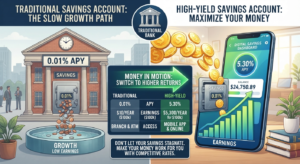 Before diving into specific accounts, let’s understand what makes these accounts “high-yield.”
The Basic Definition
A high-yield savings account (HYSA) is a savings account that pays significantly higher interest than traditional savings accounts.
Key characteristics:
- Higher APY: 4.00-5.50% vs. 0.01% at traditional banks
- Online banks: Usually offered by online banks (lower overhead = higher rates)
- FDIC insured: Protected up to $250,000 per depositor (same as traditional)
- Liquid: Access your money when needed (not locked like CDs)
- No risk: Principal guaranteed, not subject to market volatility
How They Work
The process is simple:
- You open account (online application, 10-15 minutes)
- You deposit money (transfer from checking, direct deposit, etc.)
- Bank pays you interest (calculated daily, paid monthly typically)
- Interest compounds (you earn interest on your interest)
- You access money when needed (transfer to checking in 1-3 days)
Example month:
- January 1: Deposit $10,000
- Bank calculates interest daily at 5.25% APY
- Daily interest: $10,000 × (5.25% / 365) = $1.44/day
- End of month: $43.89 interest earned
- New balance: $10,043.89
- February: Earn interest on $10,043.89 (compounding)
What Makes Them “High-Yield”
“High-yield” is relative to the market. In 2025:
- 5.00%+ APY = High-yield (excellent)
- 4.00-4.99% APY = Competitive
- 2.00-3.99% APY = Moderate
- 0.50-1.99% APY = Below average
- 0.01-0.49% APY = Terrible (traditional banks)
Historical context:
- 2020-2021: 0.50% was “high-yield”
- 2015-2019: 2.00% was excellent
- 2007-2008: 5.00% was standard
- 2025: 5.25% is exceptional (best in 15+ years)
HYSA vs. Regular Savings: What’s Different?
| Feature | Traditional Savings | High-Yield Savings |
|---|---|---|
| Interest rate | 0.01-0.10% | 5.00-5.50% |
| Where offered | Big banks, branches | Online banks, some credit unions |
| Monthly fees | Often $5-15 | Usually $0 |
| Minimum balance | Often $500-2,500 | Usually $0 |
| Branches | Yes | No (online only) |
| FDIC insured | Yes | Yes |
| Access to money | Instant (branch/ATM) | 1-3 days (transfer to checking) |
| Annual earnings on $10k | $1 | $525 |
Why Online Banks Can Pay More
The economics are simple:
Traditional banks:
- Thousands of physical branches (rent, utilities, staff)
- Legacy computer systems (expensive to maintain)
- Massive overhead costs
- Solution: Pay depositors almost nothing, charge fees
Online banks:
- No physical branches (massive savings)
- Modern technology (efficient)
- Minimal overhead
- Solution: Pass savings to customers via higher rates and no fees
Example cost structure:
Big Bank Branch:
- Rent: $8,000/month
- Staff (4 people): $15,000/month
- Utilities: $1,500/month
- Maintenance: $1,000/month
- Monthly cost per branch: $25,500
- Across 4,000 branches = $102 million/month
Online Bank:
- No branches: $0
- Smaller staff (customer service): Fraction of branch costs
- Pass savings to depositors
This is why online banks can offer 5.25% while Chase offers 0.01%
Are They Really “Savings” Accounts?
Yes, legally and functionally:
- Federally regulated as savings accounts
- Subject to Regulation D (historically limited to 6 withdrawals/month, though often unenforced now)
- FDIC insured like traditional savings
- Not for daily transactions (no debit card usually)
Best uses:
- Emergency fund (3-6 months expenses)
- Short-term savings goals (vacation, down payment, large purchase)
- Cash reserves you want accessible but not spending
- Money earning interest while deciding what to do with it
Not ideal for:
- Daily spending (use checking)
- Long-term investing (10+ years, use investment accounts)
- Money you access weekly
Why Traditional Savings Accounts Are Costing You Money {#traditional-cost}
The opportunity cost of staying at a traditional bank is massive.
The Real Cost of Convenience
“But I like having my savings at the same bank as my checking!”
Let’s calculate what that convenience costs:
Scenario: $15,000 emergency fund
Chase Savings (traditional):
- Rate: 0.01% APY
- Annual interest: $1.50
- Monthly fee: $5 (unless $300 minimum daily balance)
- Annual fees: $60
- Net cost: -$58.50/year
Marcus High-Yield Savings (online):
- Rate: 5.30% APY
- Annual interest: $795
- Monthly fee: $0
- Net benefit: +$795/year
Difference: $853.50/year for the “convenience” of same-bank savings
Over 10 years:
- Chase: Lose $585 (fees exceed minimal interest)
- Marcus: Earn $9,500+ (with compounding)
- Cost of convenience: $10,085
That’s not convenience. That’s expensive.
The Inflation Reality
Your money in traditional savings is losing value:
With 3% inflation:
- $10,000 today
- 0.01% interest earned: $1
- Inflation loss: -$300
- Real loss: -$299 (2.99% purchasing power gone)
With high-yield savings:
- $10,000 today
- 5.25% interest earned: $525
- Inflation loss: -$300
- Real gain: +$225 (2.25% purchasing power increase)
Traditional savings = guaranteed loss to inflation
High-yield savings = beat inflation by 2%+
What You Could Have Earned
Painful hindsight calculator:
If you’ve had $10,000 sitting in 0.01% savings for 5 years:
- What you earned: $5
- What you could have earned (average 3% over 5 years): $1,593
- Money left on table: $1,588
If $25,000 for 10 years:
- Actual earnings at 0.01%: $25
- Potential earnings at 4% average: $12,189
- Money left on table: $12,164
Don’t let past mistakes compound. Switch now.
The Psychological Cost
Beyond dollars, traditional savings create:
False security:
- “I’m saving money” (but it’s losing value)
- “I’m being responsible” (but missing opportunities)
Learned helplessness:
- “All banks pay nothing”
- “There’s no point in comparing”
- “It doesn’t matter where I save”
Financial inertia:
- Staying put despite better options
- Loyalty to banks that don’t value you
Breaking free from traditional banking psychology = first step to wealth building
How Much Can You Really Earn? {#earnings}
Let’s run the numbers with real scenarios.
Simple Interest Calculator
Formula: Principal × APY = Annual Interest
At 5.25% APY:
| Starting Balance | Daily Interest | Monthly Interest | Annual Interest |
|---|---|---|---|
| $1,000 | $0.14 | $4.27 | $52.50 |
| $5,000 | $0.72 | $21.88 | $262.50 |
| $10,000 | $1.44 | $43.75 | $525 |
| $15,000 | $2.16 | $65.63 | $787.50 |
| $25,000 | $3.60 | $109.38 | $1,312.50 |
| $50,000 | $7.19 | $218.75 | $2,625 |
| $100,000 | $14.38 | $437.50 | $5,250 |
That daily interest column is key: Your money is working for you every single day.
Compound Interest Reality
Compound interest = earning interest on your interest
Example: $10,000 at 5.25% APY for 10 years (no additional deposits)
Year-by-year growth:
- Year 1: $10,525
- Year 2: $11,078
- Year 3: $11,659
- Year 4: $12,271
- Year 5: $12,915
- Year 6: $13,593
- Year 7: $14,307
- Year 8: $15,058
- Year 9: $15,849
- Year 10: $16,681
Total earned: $6,681 (67% return on original $10,000)
Compare to 0.01% traditional savings:
- Year 10: $10,010
- Total earned: $10
- Difference: $6,671
Adding Regular Contributions
Most people save monthly. This amplifies returns.
Scenario: Start with $5,000, add $300/month
At 5.25% APY for 5 years:
- Total contributed: $5,000 + ($300 × 60 months) = $23,000
- Account balance after 5 years: $25,850
- Interest earned: $2,850
- Return on contributions: 12.4%
At 0.01% traditional savings:
- Total contributed: $23,000
- Account balance: $23,006
- Interest earned: $6
- You literally earned enough for one coffee
The $100/Month Challenge
What if you saved just $100/month?
In high-yield savings (5.25% APY):
- Year 1: $1,233 (contributed $1,200)
- Year 5: $6,776 (contributed $6,000)
- Year 10: $15,582 (contributed $12,000)
Interest earned over 10 years: $3,582
In traditional savings (0.01%):
- Year 10: $12,006
- Interest earned: $6
Difference: $3,576 for doing the exact same thing (saving $100/month) in a different account
Real-Life Earning Examples
Example 1: Emergency Fund Builder
- Sarah, age 28
- Goal: 6-month emergency fund ($18,000)
- Starting point: $3,000
- Monthly savings: $500
Timeline in HYSA (5.25% APY):
- Month 15: Reaches $10,000
- Month 30: Reaches $18,000 goal
- Interest earned during building: $1,247
- Reached goal 2 months earlier than if earning 0%
Example 2: Down Payment Saver
- Michael and Jessica, ages 31 and 29
- Goal: $60,000 house down payment
- Starting point: $15,000
- Monthly savings: $1,500
At 5.25% APY:
- Month 30: $62,850 (goal reached!)
- Interest earned: $2,850
- Earned extra $2,850 while saving for house
At 0.01% traditional:
- Month 30: $60,015
- Interest earned: $15
- Essentially $0 interest
Example 3: Retiree Safety Net
- Robert, age 68
- Keeps $50,000 cash for emergencies/opportunities
- Not investing (wants guaranteed safety)
Annual income from HYSA:
- $50,000 × 5.25% = $2,625/year
- Monthly: $218.75
- Covers his Medicare Part B premium ($174.70/month in 2024)
In traditional savings:
- Annual income: $5
- Doesn’t even cover a single month’s Netflix
Calculator: Your Potential Earnings
Use this formula:
Annual interest = Balance × (APY / 100)
Your numbers:
- Current savings balance: $__________
- Current APY: ______%
- Potential HYSA APY: 5.25%
Current annual earnings:
$__________ × (% / 100) = $______
Potential HYSA earnings:
$__________ × (5.25 / 100) = $__________
Annual difference: $__________
10-year difference (conservative, no compounding):
$__________ × 10 = $__________
That’s real money you’re leaving on the table.
Top High-Yield Savings Accounts (2025) {#top-accounts}
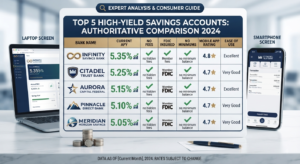
Every account listed is FDIC insured and currently accepting new customers. Rates verified December 2024.
🏆 #1: Marcus by Goldman Sachs High Yield Savings
APY: 5.30%
Monthly Fee: $0
Minimum Balance: $0
Minimum Opening Deposit: $0
Why it’s #1:
- Highest consistent rate (Marcus doesn’t play intro rate games)
- Zero fees (no monthly fee, no transfer fees, no minimum balance fees)
- No minimums (open with $1 if you want)
- Reliable (Goldman Sachs backing, established online bank)
- Excellent app (4.8/5 stars, clean interface)
Features:
- Daily compounding interest
- No transaction fees
- Link up to 3 external accounts
- Transfers typically 1-2 business days
- Auto-save tools
- Mobile app and online access
- FDIC insured up to $250,000
Withdrawals:
- 6 per month (federal regulation, though often unenforced)
- Unlimited transfers out (may take 1-3 days)
- No fees for withdrawals
Customer Service:
- Phone: 8am-10pm ET, 7 days/week
- Secure messaging
- Email support
Best for:
- Maximum interest earnings
- Straightforward high-yield savings
- People who value consistency (rate doesn’t yo-yo)
- Marcus credit card holders (familiar with brand)
Potential drawbacks:
- Online only (no branches)
- No ATM card (must transfer to checking first)
- Not instant access (1-2 day transfers)
Bottom line: Marcus offers the best combination of top-tier rate, zero fees, zero minimums, and reliability. Hard to beat.
🥈 #2: American Express Personal Savings
APY: 5.30%
Monthly Fee: $0
Minimum Balance: $0
Minimum Opening Deposit: $0
Ties with Marcus for rate, slightly different features
Why it’s #2 (tied for #1 really):
- Same 5.30% APY as Marcus
- Zero fees, zero minimums
- Amex brand trust (well-known, established)
- Faster transfers (often same-day to next-day)
- Excellent customer service (24/7 phone support)
Features:
- Daily compounding
- Link up to 4 external accounts
- Faster transfers than most (ACH often next day)
- Online and mobile app
- No fees of any kind
- FDIC insured up to $250,000
Customer Service:
- 24/7 phone support
- Live chat
- Generally excellent reviews
Best for:
- Amex credit card holders (familiar ecosystem)
- People who prioritize customer service
- Those who want fastest transfers (among high-yield accounts)
- Anyone wanting top rate with trusted brand
Potential drawbacks:
- Online only
- Can only link 4 external accounts (vs. unlimited at some banks)
- No ATM access
Bottom line: Choosing between Marcus and Amex is personal preference. Identical rates, both excellent. Amex wins on customer service and transfer speed; Marcus wins on brand focus (dedicated to savings).
🥉 #3: Ally Bank Online Savings Account
APY: 5.25%
Monthly Fee: $0
Minimum Balance: $0
Minimum Opening Deposit: $0
Why it’s #3:
- Competitive 5.25% APY (just 0.05% below top)
- Best features and tools (savings buckets, boosters, surprise savings)
- Superior user experience (consistently top-rated app)
- Full banking relationship (checking + savings integration)
Unique Features:
Savings Buckets:
- Organize savings into categories within account
- “Emergency Fund” bucket: $10,000
- “Vacation” bucket: $3,000
- “New Car” bucket: $8,000
- All earn same 5.25% rate
Savings Boosters:
- Recurring transfers (automatic)
- Percentage of paycheck
- Round-ups from spending
- Surprise savings (AI suggests amounts based on spending)
Other Features:
- Daily compounding
- No fees
- Link unlimited external accounts
- Transfers 1-3 business days
- Instant transfers to Ally checking
- FDIC insured
Customer Service:
- 24/7 phone support
- Chat support
- Excellent reputation
Best for:
- People wanting organization (buckets brilliant for multiple goals)
- Ally checking account holders (instant transfers between accounts)
- Those who value automation (boosters)
- Anyone who loves excellent apps and UX
Potential drawbacks:
- Rate 0.05% lower than Marcus/Amex ($5 less per $10,000 per year)
- Online only
Bottom line: If you value tools and organization over an extra $5/year per $10,000, Ally is superior to Marcus/Amex. If you just want highest rate and simplicity, go Marcus/Amex.
#4: CIT Bank Platinum Savings
APY: 5.05%
Monthly Fee: $0
Minimum Balance: $5,000 OR $100+ monthly deposits with $100 minimum
Why it’s on the list:
- Competitive 5.05% APY
- Lower rate but flexible requirements (good for regular savers)
- Savings Builder tools
Two ways to qualify for 5.05%:
Option A: Maintain $5,000+ balance
Option B: Make $100+ deposits per month AND maintain $100+ balance
If below minimums: 1.00% APY (significantly lower)
Features:
- Daily compounding
- No monthly fee (if minimums met)
- Online and mobile banking
- External account linking
- FDIC insured
Best for:
- People with $5,000+ to save
- Regular savers depositing $100+/month
- Those comfortable with balance requirements
Potential drawbacks:
- Requires $5,000 OR $100 monthly deposits
- Rate drops dramatically if don’t meet minimums
- Not as high as Marcus/Amex/Ally
- Less well-known brand
Bottom line: Good option if you meet minimums easily. But for most people, Marcus/Amex/Ally better (no minimums, higher rates).
#5: Discover Online Savings Account
APY: 5.25%
Monthly Fee: $0
Minimum Balance: $0
Minimum Opening Deposit: $0
Why it’s on the list:
- Competitive 5.25% rate
- Trusted brand (Discover well-known for credit cards)
- Can open multiple accounts (great for organizing goals)
- 24/7 customer service
Features:
- Daily compounding
- No fees or minimums
- Link external accounts
- Transfers 1-3 business days
- Can have multiple Discover savings accounts (organize by goal)
- Mobile app and online banking
- FDIC insured
Customer Service:
- 24/7 phone
- Chat
- U.S.-based support
- Generally excellent
Best for:
- Discover credit card holders (familiar with brand)
- People wanting multiple savings accounts at same bank
- Those who value 24/7 customer service
- Anyone wanting top rate with well-known brand
Potential drawbacks:
- Online only
- Features less robust than Ally (no buckets within account)
- Discover known more for cards than banking (some hesitation)
Bottom line: Solid choice, especially if you already have Discover card. But doesn’t differentiate significantly from Marcus/Amex/Ally.
Honorable Mention: LendingClub High-Yield Savings
APY: 5.30%
Monthly Fee: $0
Minimum Balance: $100 minimum opening deposit, then $0
Why it’s honorable mention:
- Ties top rate (5.30%)
- Zero monthly fees
- Strong app
Why not top 5:
- Requires $100 opening deposit (vs. $0 at others)
- Less established banking brand (known for lending)
- Fewer years of track record as bank
Good alternative if top banks aren’t accepting new customers in your area
Comparison Summary Table
| Bank | APY | Monthly Fee | Min Balance | Min Opening | Best Feature |
|---|---|---|---|---|---|
| Marcus | 5.30% | $0 | $0 | $0 | Highest rate + consistency |
| Amex | 5.30% | $0 | $0 | $0 | Fast transfers + service |
| Ally | 5.25% | $0 | $0 | $0 | Buckets + automation |
| CIT | 5.05% | $0 | $5,000* | $0 | Flexible requirements |
| Discover | 5.25% | $0 | $0 | $0 | Multiple accounts |
*Or $100 monthly deposits + $100 minimum
Which Should You Choose?
Decision tree:
Want absolute highest rate + simplicity?
→ Marcus or Amex (5.30%, identical rates, choose based on preference)
Want best tools and organization?
→ Ally (5.25%, buckets feature worth the 0.05% difference for many)
Have $5,000+ to maintain OR deposit $100+/month?
→ CIT works, but Marcus/Amex/Ally still better (higher rates, no requirements)
Want trusted brand + can open multiple accounts?
→ Discover (5.25%, well-known brand, multiple account capability)
Can’t decide?
→ Start with Marcus (straightforward, highest rate, can’t go wrong)
Want to diversify?
→ Split between Marcus and Ally (FDIC coverage at two banks, get both rate and features)
[Internal Link: See full banking comparison in “Best Bank Accounts for 2025: Checking, Savings & Money Market”]
How to Choose the Right HYSA {#choose}
Beyond just rates, consider these factors.
Your Savings Goals
Emergency Fund (3-6 months expenses):
- Priority: Accessibility + safety + decent rate
- Best choice: Any top HYSA (Marcus, Amex, Ally all excellent)
- Don’t: Lock in CD (need liquidity)
- Amount: $15,000-$35,000 typical
Short-term savings (1-3 years):
- Vacation, wedding, car down payment, house fund
- Priority: High rate + safety
- Best choice: HYSA or CD (if timeline definite)
- Consider: Ally (buckets organize multiple goals)
Medium-term (3-5 years):
- Larger goals (house down payment, career transition)
- Priority: Beat inflation + safety
- Best choice: HYSA or conservative investments
- Consider: Mix of HYSA + low-risk investments
Long-term (5+ years):
- Don’t use HYSA (opportunity cost too high)
- Use: Investment accounts (stocks, bonds, index funds)
- Why: Historical stock returns 10%/year vs. 5% HYSA
Your Balance
Under $5,000:
- Any no-minimum HYSA works
- Focus on highest rate
- Choose: Marcus or Amex (5.30%)
$5,000-$25,000:
- Most HYSAs perfect for this range
- Consider features (Ally buckets useful)
- Choose: Based on preference (all top accounts excellent)
$25,000-$100,000:
- Still within FDIC limits at one bank
- High rate critical (difference adds up)
- Calculate: 5.30% vs. 5.25% on $50,000 = $25/year difference
- Choose: Marcus or Amex for max rate
$100,000-$250,000:
- Approaching FDIC limit at one bank
- Consider: Multiple accounts for FDIC coverage
- Strategy: $125,000 at Marcus + $125,000 at Amex = $500,000 FDIC coverage
Over $250,000:
- Must use multiple banks (FDIC limit)
- Strategy:
- $250,000 at Marcus
- $250,000 at Amex
- $250,000 at Ally
- Each separately FDIC insured
- Alternative: CDARS/IntraFi (automatic multi-bank spreading)
Your Tech Comfort Level
Very comfortable with online/apps:
- Any HYSA works
- Prioritize rate and features
- Choose: Highest rate (Marcus/Amex) or best features (Ally)
Moderately comfortable:
- Still fine with HYSA (they’re designed to be easy)
- Prioritize simplicity
- Choose: Marcus (straightforward) or Discover (familiar brand)
Prefer in-person banking:
- Challenge: HYSAs are online-only
- Solution: Hybrid approach:
- Keep checking at local bank (for branch access)
- Put savings in HYSA (transfer to checking when needed)
- Alternative: Local credit union (sometimes 4-5% rates with relationship)
Your Access Needs
Rarely need to touch savings:
- Perfect for HYSA
- Choose: Highest rate (Marcus/Amex)
Occasional access (few times/year):
- HYSA still perfect (1-3 day transfer fine)
- Choose: Amex (faster transfers) or any top account
Frequent access (monthly):
- Reconsider: Is this really savings?
- Maybe: Money market account better (check writing + ATM)
- Or: Keep more in checking, less in savings
Emergency access needed:
- HYSA takes 1-3 days (not instant)
- Solution: Keep 1 month expenses in checking (instant access)
- Rest in HYSA: 1-3 day transfer acceptable for emergencies
Your Organization Style
Simple (one savings account total):
- Choose: Marcus or Amex (straightforward, high rate)
Organizer (separate accounts for each goal):
- Choose: Ally (buckets within account) OR
- Alternative: Discover (can open multiple accounts)
Automator (set it and forget it):
- Choose: Ally (boosters, automatic savings tools)
HYSA vs. Other Savings Options {#comparison}
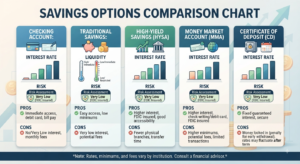
How does HYSA stack up against alternatives?
HYSA vs. Certificate of Deposit (CD)
Certificates of Deposit: Lock money for set term (6 months to 5 years) for guaranteed rate.
CD Advantages:
- Sometimes higher rates (6-month CD: 5.50% vs. 5.25% HYSA)
- Rate guaranteed (won’t drop if Fed lowers rates)
- Forced discipline (can’t touch without penalty)
HYSA Advantages:
- Complete liquidity (access anytime)
- No early withdrawal penalty
- No commitment
- Can add money anytime
When to choose CD:
- You know you won’t need money for specific period
- Rates are higher than HYSA (not always the case)
- You want guaranteed rate regardless of Fed changes
When to choose HYSA:
- You want flexibility
- You might need money
- CD rates aren’t significantly higher (0.25%+ difference worth it, 0.05% not)
- You’re building savings (can’t add to CD once opened)
Recommendation: Emergency fund = HYSA (need liquidity). Specific goal with timeline = consider CD.
HYSA vs. Money Market Account
Money Market Accounts: Hybrid of checking and savings (earns interest, but has checks/ATM card).
Money Market Advantages:
- Check writing (6 per month typically)
- ATM card access
- Same or similar rates to HYSA (5.00-5.25%)
HYSA Advantages:
- Sometimes slightly higher rates
- Simpler (don’t need checks/ATM for pure savings)
When to choose Money Market:
- You want check writing on savings
- You want ATM access to savings
- You keep large balance you might need to access directly
When to choose HYSA:
- Pure savings (don’t need checks)
- Slightly higher rate (0.05-0.25% difference)
- Simplicity
Recommendation: For most, HYSA is better. Only get money market if specifically need check/ATM features.
HYSA vs. High-Yield Checking
Some checking accounts now pay interest (3-5% on limited balances).
High-Yield Checking Example: Upgrade Premier Checking
- 5.07% APY on balances up to $10,000
- Then 1.07% on amounts above
- Requires direct deposit
Comparison:
| Feature | HYSA | High-Yield Checking |
|---|---|---|
| Rate on all balances | 5.25% | 5.07% up to $10k, then 1.07% |
| Balance limits | None | Usually $10-25k |
| Requirements | None | Direct deposit often required |
| Debit card | No | Yes |
| Bill pay | Limited | Yes |
| Daily transactions | No | Yes |
Strategy: Use BOTH
- High-yield checking: Keep $5,000-10,000 (daily spending + earn 5%)
- HYSA: Keep rest of savings (emergency fund, goals)
This maximizes earnings on both checking and savings
HYSA vs. Traditional Savings
We’ve covered this, but summary:
| Feature | Traditional Savings | HYSA |
|---|---|---|
| Rate | 0.01-0.10% | 5.00-5.50% |
| Earnings on $10k/year | $1-10 | $500-550 |
| Fees | Often $5-15/month | $0 |
| Minimums | Often $500-2,500 | $0 |
| Branches | Yes | No |
There is literally no reason to keep money in traditional savings unless:
- You need physical branch access for deposits (keep checking there, not savings)
- You’re over 80 and refuse to use online banking (even then, have family help you switch)
For 99% of people: Traditional savings is lighting money on fire
HYSA vs. Brokerage Account (Investing)
Different purposes, different timelines:
HYSA:
- Purpose: Safety, liquidity, guaranteed return
- Timeline: 0-5 years
- Return: 5.25% guaranteed
- Risk: None (FDIC insured)
- Best for: Emergency fund, short-term goals
Brokerage (Stock Market):
- Purpose: Growth, wealth building
- Timeline: 5+ years (ideally 10+)
- Return: 10%/year average (historical), but varies
- Risk: Can lose money (2022: down 18%, 2008: down 37%)
- Best for: Retirement, long-term goals
You need BOTH:
- HYSA for short-term and emergencies
- Investments for long-term and growth
Don’t make this mistake: Keeping everything in HYSA long-term (10+ years)
- 5% guaranteed sounds safe
- But missing 10% average stock returns
- Over 30 years: Huge opportunity cost
Don’t make opposite mistake: Investing emergency fund
- Stocks can drop 30-50% in recession
- Exactly when you might lose job (need emergency fund)
- Emergency fund must be safe (HYSA)
Strategies to Maximize Your Earnings {#strategies}
Beyond just opening an account, tactics to earn even more.
Strategy #1: The Direct Deposit Switch
Move your direct deposit to high-yield savings account:
Traditional approach:
- Paycheck → Checking (0% interest)
- Manually transfer to savings (if remember)
- Most money sits in checking earning nothing
Optimized approach:
- Paycheck → HYSA (5.25% interest)
- Automatic transfer to checking (just enough for bills)
- Maximum money earns maximum interest
Example:
- Monthly income: $5,000
- Monthly expenses: $3,500
Traditional:
- $5,000 sits in checking earning 0%
- Manual transfer $1,500 to savings (if disciplined)
Optimized:
- $5,000 direct deposited to HYSA (earning 5.25%)
- Auto-transfer $3,500 to checking day after deposit
- $1,500 stays in HYSA
Benefit: Your money earns interest immediately (day 1 of pay period vs. later when you transfer)
Micro-optimization: Over year, earns extra $100-200 on float
Strategy #2: The Savings Automation Ladder
Set up automated transfers right after payday:
Day 1 (Payday):
- Direct deposit hits
Day 2:
- Auto-transfer to checking (bills amount)
Day 3:
- Auto-transfer to different savings goals:
- $200 → Emergency fund HYSA
- $150 → Vacation fund HYSA
- $300 → House down payment HYSA
- $100 → Car replacement fund HYSA
Benefit: “Pay yourself first” before you can spend
Psychology: Money you don’t see, you don’t spend
Strategy #3: The Rate Stacking Method
Use multiple accounts for maximum earnings:
Checking: Upgrade Premier (5.07% on first $10k)
- Keep: $10,000
- Earn: $507/year
Savings 1: Marcus HYSA (5.30%)
- Keep: $15,000 (emergency fund)
- Earn: $795/year
Savings 2: Ally HYSA (5.25%)
- Keep: $10,000 (short-term goals, organized in buckets)
- Earn: $525/year
Total holdings: $35,000
Total annual interest: $1,827
Effective APY: 5.22% (across all accounts)
Bonus: Multiple FDIC coverage ($250k at each bank)
Strategy #4: The Round-Up Accelerator
Many banks offer “round-up” features:
How it works:
- Purchase coffee: $4.75
- Rounded to: $5.00
- Difference: $0.25 → savings
Daily example:
- 5 transactions rounded up
- Average round-up: $0.40/transaction
- Daily savings: $2.00
- Monthly: $60
- Annually: $720
Plus interest: $720 × 5.25% = $37.80 first year
Banks offering this:
- Ally (Savings Booster)
- SoFi (Spare Change)
- Many others
Set it and forget it: Painless savings that compounds
Strategy #5: The Promotional Rate Cycle
Some banks offer promotional rates:
- Example: “6.00% for first 3 months, then 5.25%”
Strategy:
- Open account for promo rate
- Transfer large sum ($25,000)
- Earn 6% for 3 months
- After promo ends, either:
- Keep (if base rate competitive)
- Or transfer to highest permanent rate
Example earnings:
- $25,000 at 6% for 3 months: $375
- Then at 5.25% for 9 months: $984
- Total year 1: $1,359
- vs. $1,312 at flat 5.25% all year
- Extra: $47 for 20 minutes of work (opening account)
Caution: Only worth it for large balances and if base rate competitive post-promo
Strategy #6: The Spouse/Partner Maximization
If you’re married or partnered:
Individual accounts at each bank:
- You: $250,000 at Marcus
- Partner: $250,000 at Marcus
- Total FDIC coverage: $500,000 at one bank
Plus joint account:
- Joint: $250,000 at Marcus
- Additional coverage: $250,000
- Total at Marcus: $750,000 FDIC covered
Then repeat at other banks:
- Amex: $750,000 covered
- Ally: $750,000 covered
For high net worth couples, this maximizes FDIC coverage while keeping high rates
Strategy #7: The Tax-Advantaged Timing
Interest is taxable income.
If you’re strategic:
- Open account early in year (January)
- Build balance throughout year
- Interest earned across full year
- Pay taxes next April
vs.
- Open account late in year (November)
- Interest earned only 2 months
- But didn’t have money working for you all year
Always better to start earlier (even though taxes), because:
- $10,000 earning 5.25% for 12 months = $525 interest
- Tax on $525 (25% bracket) = -$131
- Net: +$394
vs.
- $10,000 earning 0.01% for 12 months = $1 interest
- Tax on $1 = $0.25
- Net: +$0.75
Don’t let tax tail wag the dog. Earn interest, pay tax, still way ahead.
Strategy #8: The Emergency Fund Tiering
Not all emergency fund needs same-day access:
Tier 1: Immediate ($1,000-2,000)
- Keep in checking account
- 0% interest, but instant access
- For true emergencies (car breaks down, need tow)
Tier 2: Quick Access ($5,000-10,000)
- HYSA with fast transfers (Amex, 1-day transfer)
- 5.30% interest
- Transfer to checking if needed (1 day)
Tier 3: Full Emergency Fund ($15,000-25,000)
- HYSA at highest rate (Marcus, 5.30%)
- 1-3 day transfers fine (real emergencies can wait)
Benefit:
- Maximum money earning maximum interest
- Still have instant access to some funds
- Majority earning 5.30% (vs. sitting in 0% checking)
Understanding APY and How Interest is Calculated {#apy}
Knowledge is power when comparing accounts.
APY vs. APR (Don’t Confuse These)
APY (Annual Percentage Yield):
- Used for savings/deposits
- Includes compound interest
- What you EARN on savings
- Higher is better
APR (Annual Percentage Rate):
- Used for loans/credit cards
- Simple interest rate
- What you PAY on debt
- Lower is better
For savings accounts, always compare APY (not interest rate)
How Interest is Calculated
Daily compound interest (most HYSAs):
Formula:
Daily Interest = Balance × (APY / 365)
Example: $10,000 at 5.25% APY
Day 1:
- Interest: $10,000 × (0.0525 / 365) = $1.44
- New balance: $10,001.44
Day 2:
- Interest: $10,001.44 × (0.0525 / 365) = $1.44
- New balance: $10,002.88
Continues daily…
Month 1 (30 days):
- Interest earned: $43.29
- Balance: $10,043.29
Month 2 (31 days):
- Interest earned on higher balance: $44.85
- Balance: $10,088.14
This is compound interest: Earning interest on your interest
The Power of Compounding
$10,000 at 5.25% APY:
Without compounding (simple interest):
- Year 1: $525 interest
- Year 5: $2,625 interest
- Year 10: $5,250 interest
With compounding (actual):
- Year 1: $537 interest
- Year 5: $2,915 interest
- Year 10: $6,681 interest
Difference over 10 years: $1,431 (27% more than simple interest)
Why compounding matters:
- Month 1: Earn interest on $10,000
- Month 2: Earn interest on $10,043
- Month 3: Earn interest on $10,088
- Small differences compound over time
Rate vs. APY Comparison
If bank advertises “5.20% rate, compounded daily”:
Actual APY = (1 + 0.0520/365)^365 – 1 = 5.34% APY
Always use APY for comparisons (accounts for compounding frequency)
How Banks Display Rates
What you’ll see:
- “5.25% APY*”
- *Annual Percentage Yield
Fine print usually says:
- “Rate accurate as of [date]”
- “Rates subject to change without notice”
- “Fees could reduce earnings”
This is normal. Variable rates fluctuate.
Monthly Interest Payments
Most HYSAs pay interest monthly:
Timeline:
- Day 1-31: Interest calculated daily
- Last day of month: Interest credited to account
- Appears as deposit on statement
Example statement:
- March 1 balance: $10,000
- March 31 interest payment: +$43.75
- April 1 balance: $10,043.75
Note: Some banks pay quarterly (every 3 months). Monthly is better (compounds faster).
Are High-Yield Savings Accounts Safe? {#safety}
Addressing common concerns about safety.
FDIC Insurance Explained
Federal Deposit Insurance Corporation:
- Government agency (created 1933)
- Insures deposits at member banks
- Covers up to $250,000 per depositor, per bank
- You don’t pay for this (banks pay premiums)
What’s covered:
- Savings accounts ✅
- Checking accounts ✅
- Certificates of deposit ✅
- Money market accounts ✅
What’s NOT covered:
- Stocks ❌
- Bonds ❌
- Mutual funds ❌
- Cryptocurrency ❌
- Investments ❌
HYSA is FDIC insured = your money is safe up to $250,000
What If Bank Fails?
Recent example: Silicon Valley Bank (March 2023)
What happened:
- Bank declared failed by regulators
- FDIC took over immediately
- Depositors with under $250,000: Fully protected, zero loss
- Access restored within days
- FDIC found buyer bank or paid depositors directly
Historical data:
- Since FDIC created (1933): Zero insured depositors have lost money
- Banks fail periodically
- FDIC process works
Your action if bank fails: Nothing
- FDIC contacts you
- Your money is safe
- Transferred to new bank or check mailed
Online Banks: Extra Safety Concerns?
“But there’s no physical building. Is my money real?”
Yes. Online banks are just as safe:
Same regulations:
- Subject to same federal banking laws
- Same FDIC insurance
- Same oversight
- Same capital requirements
Sometimes safer:
- Better fraud detection (advanced tech)
- Stronger encryption
- Two-factor authentication
- Biometric security
The building doesn’t protect your money. FDIC does.
Verification Process
Before opening any HYSA, verify FDIC insurance:
- Check bank website (should prominently display “Member FDIC”)
- Use FDIC BankFind tool: FDIC.gov/resources/deposit-insurance
- Look for FDIC certificate number
All accounts recommended in this guide are FDIC verified
Security Best Practices
Protect your account:
Strong password:
- Unique (not used elsewhere)
- 12+ characters
- Mix of letters, numbers, symbols
- Use password manager
Two-factor authentication:
- Enable for all accounts
- SMS or authenticator app
- Extra security layer
Monitor regularly:
- Check account weekly
- Set up transaction alerts
- Review statements monthly
- Report suspicious activity immediately
Never share:
- Password
- Social Security number (after account opened)
- Account numbers via email/phone
Phishing awareness:
- Banks never ask for password via email
- Don’t click links in unexpected emails
- Go directly to website (don’t use email links)
Credit Union Alternative: NCUA
Credit unions use NCUA instead of FDIC:
- National Credit Union Administration
- Same $250,000 coverage
- Equally safe
- Same government backing
NCUA = credit union equivalent of FDIC
Tax Implications of High-Yield Savings {#taxes}
Interest is taxable income. Here’s what you need to know.
How Savings Interest is Taxed
Interest earned = ordinary income
- Taxed at your regular income tax rate
- Added to W-2 income, freelance income, etc.
- Same rate as your salary
Not capital gains (different from investment taxation)
Tax Brackets and Impact
2024 Federal tax brackets (single filers):
| Taxable Income | Tax Rate |
|---|---|
| $0 – $11,600 | 10% |
| $11,601 – $47,150 | 12% |
| $47,151 – $100,525 | 22% |
| $100,526 – $191,950 | 24% |
| $191,951 – $243,725 | 32% |
Example: You earn $60,000 salary + $525 savings interest
Your $525 interest is taxed at 22% (your marginal rate):
- Tax on interest: $525 × 0.22 = $115.50
- You keep: $525 – $115.50 = $409.50
Still way better than earning $1 at 0.01% (keeping $0.75 after tax)
Form 1099-INT
Banks report interest to IRS:
If you earn $10+ in interest, bank sends:
- Form 1099-INT to you (by January 31)
- Copy to IRS
Your responsibility:
- Report on tax return (1040, line 2b)
- Pay tax owed
- Happens automatically if using tax software
Example 1099-INT:
- Marcus by Goldman Sachs
- Interest paid in 2024: $525.00
- You report this $525 on your tax return
Estimated Taxes
If you earn significant interest:
IRS requires quarterly estimated tax payments if:
- You’ll owe $1,000+ in taxes
- Interest + other income not subject to withholding
Quarterly deadlines:
- April 15
- June 15
- September 15
- January 15
Calculation:
- Interest earned: $2,625 (on $50,000 at 5.25%)
- Tax rate: 24%
- Annual tax: $630
- Quarterly payment: $157.50
Most people don’t need to worry (unless very high balances or other non-W-2 income)
State Taxes
Most states also tax interest income:
- Same rate as state income tax
- Added to your state return
- Varies by state (0% in TX, FL, WA to 13%+ in CA)
Example: California resident
- Interest earned: $525
- Federal tax (22%): -$115.50
- State tax (9.3%): -$48.83
- Net after taxes: $360.67
Still earning $360 vs. $0.75 in traditional savings
Tax Strategies
1. Maximize retirement contributions
- Reduces taxable income
- Lowers tax rate on interest
- Example: Contribute $6,500 to IRA → may drop from 22% to 12% bracket
2. Keep savings in Roth IRA (if eligible)
- Roth IRA savings accounts exist
- Interest grows tax-free
- Contributions accessible (but not recommended for emergency fund)
3. Don’t let tax tail wag the dog
- Earning 5.25% and paying 24% tax = 4.0% net
- Still better than 0.01% and paying 24% tax = 0.008% net
- Always better to earn more, even after taxes
Tax Reporting Checklist
January:
- Receive 1099-INT from each bank (by Jan 31)
- Verify amounts match your records
Tax Filing:
- Enter 1099-INT information on tax return
- Report on Schedule B if over $1,500 total interest
- Pay any tax owed
Year-round:
- Track interest earned (estimate for planning)
- Adjust W-4 if needed (increase withholding to cover interest tax)
- Make quarterly estimated payments if required
When Rates Will Drop (And What to Do) {#rate-changes}
Understanding rate cycles helps you plan.
Why Rates are High Now (2025)
Federal Reserve policy:
- 2022-2023: Fed raised rates aggressively (combat inflation)
- Fed funds rate: 4.25-4.50%
- High Fed rate → high savings rates
Historical context:
- 2020-2021: Fed rate 0-0.25% (pandemic stimulus)
- Savings rates: 0.50-1.00%
- 2007-2008: Fed rate 5.25%
- Savings rates: 4.50-5.00% (similar to now)
Current 5%+ rates are historical anomaly (but awesome while they last)
When Rates Will Drop
Likely scenario for 2025-2026:
Fed will lower rates when:
- Inflation returns to 2% target
- Economy slows
- Unemployment rises
- Recession concerns
Expected timeline:
- 2025: Possible 2-3 rate cuts (0.75% total)
- 2026: Additional cuts if economy slows
- By 2027: Fed rate possibly 2.5-3.5%
Impact on savings rates:
- Each 0.25% Fed cut → ~0.25% drop in HYSA rates
- 3 cuts (0.75%) → HYSA rates drop to 4.50%
- Eventually: Settle around 3.00-3.50% (still good!)
This is normal cycle. Rates won’t stay 5%+ forever.
What Happens to Your Rate
Variable rate accounts (most HYSAs):
- Rate can change anytime
- No notice required (though banks usually announce)
- You don’t need to do anything (automatic adjustment)
Example:
- Today: Marcus pays 5.30%
- Fed cuts 0.25%
- Next month: Marcus pays 5.05%
- Your balance automatically earns new rate
Your action: None (it’s automatic)
How to Prepare for Rate Drops
Strategy 1: Enjoy it while it lasts
- Maximize savings now
- Earn 5%+ while available
- Build emergency fund fully
- When rates drop to 3%, you’ve already earned 5% for years
Strategy 2: Lock in rates (CDs)
- Before Fed cuts, consider CDs
- Lock in 5.00-5.50% for 1-5 years
- Example: 18-month CD at 5.40% (guaranteed regardless of Fed cuts)
When to do this:
- If Fed signals cuts are coming
- If you don’t need liquidity
- If CD rates > HYSA rates
Strategy 3: Don’t overreact
- 3.50% is still excellent (historical perspective)
- 2015-2019: 2.00% was good
- Even at 3.00%, still 300x better than big banks
Strategy 4: Focus on what you control
- Amount saved (increase contributions)
- Expenses (reduce to save more)
- Income (increase to save more)
- Rate chasing has diminishing returns
Historical Rate Perspective
Average HYSA rates by era:
- 1980s: 8-12% (high inflation era)
- 1990s: 4-6%
- 2000s: 3-5%
- 2010-2021: 0.50-2.00%
- 2022-2025: 4.00-5.50%
- Future?: Likely 2.50-4.00% (normalized)
Even if rates drop to 3%, that’s still historically good
What NOT to Do
Don’t panic and move to stocks:
- “Rates dropping to 3%, I’ll invest in stocks for 10% instead!”
- Problem: Emergency fund should be safe, not volatile
- Stocks can drop 30-50% exactly when you need money
- Keep emergency fund in HYSA regardless of rate
Don’t chase 0.50% rate differences:
- Switching banks for 5.30% → 5.80% (if promo)
- Effort vs. reward calculation:
- $10,000 balance
- 0.50% difference = $50/year
- Worth it? Maybe if easy
- Not worth if requires significant effort
Don’t abandon HYSAs:
- Even at 2.50%, still better than 0.01% traditional
- Keep using HYSAs for cash reserves
Common High-Yield Savings Mistakes {#mistakes}
Avoid these pitfalls.
Mistake #1: Analysis Paralysis
The problem:
- Researching accounts for weeks
- Comparing 5.25% vs. 5.30% endlessly
- Never actually opening account
The cost:
- $10,000 in 0.01% account for 3 months (while researching)
- Earned: $0.25
- Would have earned in HYSA: $131.25
- Cost of delay: $131
Solution:
- Research for 1 hour maximum
- Choose any top-rated account (Marcus, Amex, Ally all excellent)
- Open account today
- Perfection isn’t necessary (all top accounts similar)
Mistake #2: Keeping Too Much in Checking
The problem:
- $15,000 sitting in checking (0% interest)
- “I might need it”
- Lost earnings: $787.50/year
Solution:
- Keep 1 month expenses + $500 buffer in checking
- Move rest to HYSA
- Can transfer back in 1-3 days if needed (acceptable for most “emergencies”)
Most “emergencies” can wait 1-2 days for transfer
Mistake #3: Not Comparing Rates Annually
The problem:
- Opened HYSA in 2022 at 3.50%
- Never checked again
- Still earning 3.50% (bank didn’t raise rate)
- Market rate now: 5.30%
- Leaving 1.80% on table ($180/year per $10,000)
Solution:
- Review rates every 6-12 months
- If your bank more than 0.50% below market, switch
- Takes 20 minutes, earns hundreds
Mistake #4: Falling for Promotional Rate Traps
The problem:
- Bank offers 6.00% APY*
- *For first 3 months, then drops to 2.00%
- You don’t notice rate drop
- Earning 2.00% for 9 months (below market)
Solution:
- Read fine print on promotional rates
- Set calendar reminder when promo ends
- After promo, verify base rate is competitive
- If not, transfer to better account
Mistake #5: Ignoring FDIC Limits
The problem:
- $400,000 in one HYSA
- Bank fails
- FDIC covers $250,000
- $150,000 at risk (not covered)
Solution:
- Split balances over $250,000 across multiple banks
- $250,000 at Marcus
- $250,000 at Amex
- Each separately FDIC insured
Mistake #6: Paying Fees
The problem:
- HYSA with $10/month fee
- “But it pays 5.25%!”
- On $10,000: Earn $525, pay $120 fees = net $405
- Fee-free HYSA earns $525 with $0 fees
Solution:
- Never pay fees for HYSA
- All top accounts have $0 fees
- If your bank charges fees, switch immediately
Mistake #7: Not Reading Terms
The problem:
- Minimum balance requirement not noticed
- Fall below minimum
- Fee charged ($15/month)
- Rate drops to 0.50%
Solution:
- Read account terms before opening
- Understand minimums (if any)
- Know fee structure
- All our recommended accounts have no minimums
Mistake #8: Mixing Emergency Fund with Goal Savings
The problem:
- $20,000 in HYSA
- $15,000 = emergency fund
- $5,000 = vacation fund
- Dip into “savings” for vacation
- Emergency happens
- Emergency fund depleted
Solution:
- Separate accounts or buckets for different purposes
- Emergency fund = untouchable except emergencies
- Goal savings = different account or bucket
- Ally’s buckets feature perfect for this
Mistake #9: Forgetting About Taxes
The problem:
- Earn $2,000 interest
- Spend it all
- Tax time: Owe $500 in taxes
- Don’t have money to pay
Solution:
- Remember interest is taxable
- If earning significant interest, set aside 25-30% for taxes
- Or adjust W-4 to increase withholding
- Better to get refund than owe
Mistake #10: Using HYSA for Long-Term Goals
The problem:
- Retirement savings in HYSA
- 30 years until retirement
- Earning 5% guaranteed
- Missing out on 10% average stock returns
Cost:
- $10,000 in HYSA at 5% for 30 years: $43,219
- $10,000 in stocks at 10% for 30 years: $174,494
- Opportunity cost: $131,275
Solution:
- HYSA for short-term (0-5 years)
- Investments for long-term (10+ years)
- Use right tool for right timeline
Advanced HYSA Tactics {#advanced}
For those wanting to optimize every detail.
The Multi-Account Arbitrage
Strategy: Use multiple accounts strategically for maximum benefit.
Setup:
- Primary HYSA (Marcus, 5.30%): Bulk of savings
- Secondary HYSA (Ally, 5.25%): Organized goals (buckets)
- High-yield checking (Upgrade, 5.07% on first $10k): Daily funds
Allocation example for $50,000:
- Upgrade checking: $10,000 (5.07%) = $507/year
- Marcus HYSA: $25,000 (5.30%) = $1,325/year
- Ally HYSA: $15,000 (5.25%) = $787/year
- Total: $2,619/year
- Effective rate: 5.24%
Bonus:
- FDIC coverage at 3 institutions = $750,000 total
- Features from each (checking liquidity, Ally buckets, Marcus rate)
The CD Ladder Integration
Combine HYSAs with CD ladders:
Objective: Higher average rate while maintaining liquidity
Example $50,000 strategy:
- $10,000: HYSA (instant liquidity) @ 5.25%
- $10,000: 6-month CD @ 5.50%
- $10,000: 12-month CD @ 5.60%
- $10,000: 18-month CD @ 5.65%
- $10,000: 24-month CD @ 5.50%
Every 6 months:
- One CD matures
- Option to renew or use cash
- Maintains rolling liquidity
Average rate: ~5.50% (vs. 5.25% all-HYSA)
On $50,000: Extra $125/year
When to use: If CD rates significantly higher than HYSA (0.25%+)
The Mega-Saver FDIC Strategy
For balances over $1 million:
Challenge: FDIC only covers $250,000 per bank
Solution: Ownership category multiplication
At Bank A (Marcus):
- Individual account (you): $250,000
- Individual account (spouse): $250,000
- Joint account: $500,000 ($250k per owner)
- Revocable trust (2 beneficiaries): $500,000 ($250k per beneficiary)
- Total at Marcus: $1.5 million FDIC covered
Repeat at Banks B, C, D, E…
Result: Millions in FDIC coverage while maintaining 5%+ rates
Requires: Proper account structuring, documentation
Note: Consult with CPA/financial advisor for large balances
The Tax Bracket Arbitrage
Strategy: Time large deposits based on income
Scenario:
- You’re selling house, receiving $100,000
- Current year: High income (32% tax bracket)
- Next year: Sabbatical (12% tax bracket)
Option A: Deposit now
- Earn $5,250 interest
- Pay 32% tax = $1,680
- Net: $3,570
Option B: Defer to January (next year)
- Earn $5,250 interest
- Pay 12% tax = $630
- Net: $4,620
Difference: $1,050 in tax savings
When applicable: Large lump sums + known tax bracket changes
The State Tax Optimization
Some savings accounts invest in municipal bonds (state-specific):
Example: California Municipal Bond Money Market
- Rate: 3.50% (lower than HYSA)
- Tax-free for CA residents
- Tax-equivalent yield (9.3% CA bracket): 3.50% / (1 – 0.093) = 3.86%
Compare to HYSA:
- Rate: 5.25%
- After federal + state tax (22% + 9.3%): 5.25% × (1 – 0.313) = 3.61%
In this example: HYSA still wins
But: In high-tax states with muni rates closer to HYSA, math can favor munis
Requires: State-specific analysis, usually only for high balances
The Business Account Optimization
If you have business:
Business HYSAs often offer:
- Similar rates to personal (5%+)
- FDIC coverage separate from personal accounts
- Business tax deductions
Setup:
- Personal HYSA: $250,000
- Business HYSA: $250,000
- Total FDIC at one bank: $500,000
Plus: Business interest may be deductible against business income
Caution: Requires legitimate business, separate accounts, proper accounting
Frequently Asked Questions {#faq}
Q: Is 5% interest too good to be true? Is this a scam?
A: No scam. Rates are high because Federal Reserve raised interest rates to fight inflation. When Fed funds rate is 4.5%, banks can afford to pay 5% on savings. This is a real, legitimate opportunity. All recommended banks are FDIC insured and regulated.
Historical context: In 2007-2008, 5% savings rates were normal. We’re back to those levels now.
Q: How long will 5% rates last?
A: Likely 12-24 months (through 2025, possibly into 2026). When Federal Reserve lowers rates (to stimulate economy), HYSA rates will drop too. Expect eventual decline to 3-4% range (still excellent).
Enjoy high rates while they last, but don’t expect 5%+ forever.
Q: Can I lose money in a high-yield savings account?
A: No (if FDIC insured). Your principal is guaranteed up to $250,000 per depositor, per bank. You cannot lose money.
Different from stocks/crypto (which can lose value). HYSA is safe, guaranteed savings.
Q: How quickly can I access my money?
A: Transfers from HYSA to checking take 1-3 business days typically. Some banks (Amex) as fast as 1 day.
Not instant like withdrawing from checking at ATM, but accessible for true emergencies. Most emergencies can wait 1-2 days.
Strategy: Keep 1 month expenses in checking for instant access, rest in HYSA.
Q: Do I need perfect credit to open a HYSA?
A: No. Banks check ChexSystems (banking history), not credit score, for savings accounts.
Bad credit won’t prevent opening HYSA. But negative banking history (unpaid fees, fraud) might. If denied, request ChexSystems report and resolve issues.
Q: Can I have multiple HYSAs at different banks?
A: Absolutely. In fact, recommended for:
- FDIC coverage over $250,000 (each bank separate)
- Organizing different savings goals
- Backup if one bank has technical issues
- Maximizing promotional rates
Many people have 2-3 HYSAs strategically.
Q: What happens if I need to withdraw money frequently?
A: Federal Regulation D historically limited savings withdrawals to 6 per month. This was suspended in 2020 but some banks still enforce.
If you need frequent access (weekly), consider:
- Money market account (has checks/ATM)
- High-yield checking
- Keep more in checking, less in savings
HYSA designed for savings you don’t touch often, not daily transactions.
Q: Is my money actually safe at an online bank with no physical building?
A: Yes, equally safe as traditional banks. FDIC insurance protects your money regardless of physical branches.
Online banks are federally regulated, FDIC insured, and subject to same laws as traditional banks. The building doesn’t protect your money—FDIC does.
Many people now prefer online banks (better rates, better apps, no need to visit branch).
Q: Do high-yield savings accounts have fees?
A: Top HYSAs have $0 fees:
- No monthly maintenance fee
- No minimum balance fee
- No transfer fees
- No withdrawal fees (within limits)
- No closing fees
If HYSA charges fees, choose different bank. Our recommended accounts all have zero fees.
Q: How is interest paid to my account?
A: Interest calculated daily, paid monthly (most banks).
Example timeline:
- Daily: Bank calculates interest on your balance
- End of month: Total month’s interest deposited to account
- Appears as transaction: “Interest Paid – $43.75”
- New month starts with higher balance (compounding)
Some banks pay quarterly (every 3 months). Monthly is better—compounds faster.
Q: What’s the minimum amount I need to open a HYSA?
A: Top HYSAs require $0 minimum:
- Marcus: $0 minimum
- Amex: $0 minimum
- Ally: $0 minimum
- Discover: $0 minimum
You can open with $1 if you want. Start small, add over time.
Some banks require $100-500 minimum, but best accounts don’t.
Q: Should I move my emergency fund from checking to HYSA?
A: Yes, absolutely. Emergency funds belong in HYSA:
- Earning 5%+ interest (vs. 0% in checking)
- Still accessible (1-3 day transfer)
- FDIC insured
- No market risk
Keep 1 month expenses in checking (instant access), rest in HYSA.
True emergencies can wait 1-2 days for transfer. Instant access to entire emergency fund unnecessary.
Q: Can I open a HYSA for my child?
A: Yes, but most require adult as custodian until child turns 18.
Options:
- Custodial savings account (adult opens for child)
- Joint account (adult + teen)
- Child-specific accounts (Capital One, Ally offer)
Great way to teach kids about saving and compound interest. Even $500 at 5% shows powerful lesson.
Q: What if rates drop to 3% next year—should I still use HYSA?
A: Yes! Even at 3%, still 300x better than big bank savings (0.01%).
Historical perspective:
- 2015-2019: 2% was excellent
- 2010-2014: 1% was good
- 3% is still strong rate for safe, liquid savings
Don’t abandon HYSAs when rates decline. Still best option for cash reserves.
Q: Do I have to pay taxes on interest under $10?
A: Technically yes (all income taxable), but banks only send 1099-INT if you earn $10+.
In practice: If you earned $8 interest, you should report it, but IRS unlikely to notice/care. If you earned $500 interest, definitely report (you’ll get 1099-INT).
Conclusion {#conclusion}
The math is undeniable. The choice is clear.
Traditional savings at big banks:
- 0.01% APY
- $10,000 earns $1/year
- Often charges $5-15/month fees
- Net result: Losing money
High-yield savings accounts:
- 5.00-5.50% APY
- $10,000 earns $500-550/year
- $0 fees
- Net result: Building wealth
The difference: $500-550 per $10,000 per year
Over 10 years on $25,000:
- Traditional savings: Earn $25, pay $1,200 fees = -$1,175
- High-yield savings: Earn $13,125+ = +$13,125
- Total difference: $14,300
That’s a free vacation. A car down payment. An emergency fund that actually works.
Your action plan (takes 30 minutes total):
Today (15 minutes):
- ✅ Choose HYSA from top 3:
- Marcus (5.30%) – best rate
- Amex (5.30%) – best service
- Ally (5.25%) – best features
- ✅ Click “Open Account” on bank website
- ✅ Complete application (SSN, address, employment)
- ✅ Link current bank account
Tomorrow (10 minutes):
- ✅ Transfer initial deposit (even $100 to start)
- ✅ Verify account active
- ✅ Download mobile app
This week (5 minutes):
- ✅ Set up automatic monthly transfer
- ✅ Transfer bulk of savings from old account
That’s it. 30 minutes of effort for lifetime of higher earnings.
The opportunity window won’t stay open forever:
Current 5%+ rates are exceptional (best in 15 years). When Federal Reserve cuts rates (likely 2025-2026), savings rates will drop to 3-4% range.
Still good, but not as good as now.
The best time to open HYSA:
- 15 years ago (when rates were last this high)
- Today (second-best time)
Stop letting your bank profit while you earn nothing:
Your money sitting in 0.01% savings is a gift to your bank:
- They borrow your money for 0.01%
- They lend it out at 7-24% (mortgages, credit cards)
- They profit $700-2,400 per $10,000 of your money
- You profit $1
This isn’t a bank. It’s a wealth transfer from you to them.
Take your money back. Put it where it actually works for YOU.
Final reality check:
What you’re giving up by NOT switching:
| Your Balance | Annual Loss | 10-Year Loss |
|---|---|---|
| $5,000 | $262 | $3,275 |
| $10,000 | $524 | $6,550 |
| $25,000 | $1,310 | $16,375 |
| $50,000 | $2,620 | $32,750 |
These aren’t small numbers. This is real money that could:
- Pay off credit card debt
- Fund your emergency fund
- Cover a year of groceries
- Make a down payment
- Change your financial trajectory
The knowledge is yours. The accounts are ready. The only question remaining:
Will you take action?
Open that account today. Your future self (and bank account) will thank you.
The best investment you can make today is 15 minutes opening a high-yield savings account.
Make it happen. Right now.
Related Articles in This Series
Banking Fundamentals:
- Best Bank Accounts for 2025: Checking, Savings & Money Market – Complete banking guide and account comparisons
Leave a Reply