Table of Contents
- Introduction
- What is the Envelope Budgeting System?
- How the Envelope System Works
- Why the Envelope Method is So Effective
- Setting Up Your Envelope Budget: Step-by-Step
- Best Categories for Envelope Budgeting
- Envelope System Variations and Modifications
- Digital Envelope Budgeting: Modernizing the Classic Method
- Cash Stuffing: The TikTok Trend Explained
- Envelope System vs. Other Budgeting Methods
- Common Challenges and How to Overcome Them
- Safety Tips for Managing Cash
- Real-Life Success Stories
- Frequently Asked Questions
- Conclusion
Introduction {#introduction}
Swipe. Tap. Click. In our increasingly cashless society, spending money has become frictionless—so frictionless that it’s painfully easy to overspend without even realizing it.
A 2023 study by Dun & Bradstreet found that people spend 12-18% more when using credit cards compared to cash. Why? Because handing over physical cash creates psychological friction that digital payments don’t. When you watch bills leave your hand, your brain processes it as a real loss. When you tap a card, it feels almost free.
Enter the envelope budgeting system—a beautifully simple, old-school method that’s experiencing a massive resurgence, especially among younger generations on TikTok and Instagram under the hashtag #CashStuffing (with over 600 million views).
What makes this 100+ year-old budgeting method still relevant today?
Because it works. The envelope system leverages psychology, creates natural spending limits, and makes your budget tangible in a way that apps and spreadsheets simply cannot replicate.
In this comprehensive guide, you’ll discover:
- Exactly how to set up and use the envelope budgeting system
- Which spending categories work best with cash envelopes
- Modern variations including digital envelope systems
- How to overcome common challenges (safety, online shopping, etc.)
- Real success stories from people who transformed their finances with envelopes
Whether you’re tired of overspending, frustrated with failed budgets, or simply want a more hands-on approach to money management, the envelope system might be exactly what you need.
Let’s dive into this proven method that’s helping thousands of people finally gain control of their spending.
What is the Envelope Budgeting System? {#what-is}
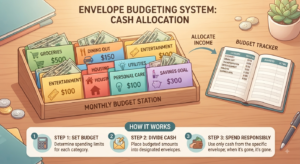 The envelope budgeting system (also called the cash envelope method) is a hands-on budgeting technique where you allocate cash for specific spending categories into physical envelopes. Once an envelope is empty, you cannot spend any more money in that category for the month.
The Core Concept
Traditional spending:
- Money sits in checking account
- You spend using debit/credit cards
- Hard to track exactly what’s left in each category
- Easy to overspend without noticing
Envelope system:
- Withdraw budgeted cash for variable categories
- Divide cash into labeled envelopes
- Spend only cash from appropriate envelope
- When envelope is empty, spending in that category stops
It’s budgeting made physical, visible, and impossible to ignore.
Brief History
While the exact origins are unclear, the envelope method gained widespread popularity during the Great Depression when cash management was essential for survival. Your grandparents or great-grandparents likely used this system.
The method experienced renewed mainstream attention in the 1990s-2000s through financial educator Dave Ramsey, who championed it as part of his “Baby Steps” financial program. Ramsey’s endorsement introduced the envelope system to millions of Americans struggling with debt and overspending.
Today, the system is experiencing a third wave of popularity thanks to social media, where the visual nature of cash stuffing creates satisfying, shareable content while genuinely helping people control their finances.
Key Principles
1. Cash is king (for variable expenses)
Physical cash for categories where you tend to overspend.
2. Predetermined limits
You decide spending limits before the month begins, not in the moment.
3. Natural boundaries
When the envelope is empty, you stop spending. No mental math required.
4. Visual accountability
You can literally see how much remains in each category.
5. Intentional spending
Removes the autopilot nature of card swiping.
What the Envelope System is NOT
❌ All-cash budgeting
You don’t need to use cash for everything—only variable spending categories.
❌ Anti-technology
You can use digital envelope apps if you prefer.
❌ Restrictive punishment
It’s about intentional spending on what matters, not deprivation.
❌ Complex system
It’s actually one of the simplest budgeting methods.
❌ Only for low-income households
People at all income levels successfully use this system.
How the Envelope System Works {#how-it-works}
Let’s break down the exact mechanics of how the envelope budgeting system operates from start to finish.
The Basic Process
Before Month Begins:
Step 1: Create your budget
Determine how much you’ll allocate to each spending category for the upcoming month.
Example budget:
- Groceries: $600
- Dining out: $200
- Entertainment: $150
- Gas: $200
- Personal spending: $100
- Miscellaneous: $50
- Total cash needed: $1,300
Step 2: Withdraw cash
On or just before payday, go to the bank and withdraw your total envelope budget in cash.
Pro tip: Get smaller bills ($1, $5, $10, $20) for easier spending and change-making.
Step 3: Stuff envelopes
Place the allocated amount of cash into each labeled envelope.
- Grocery envelope: $600 in cash
- Dining out envelope: $200 in cash
- Entertainment envelope: $150 in cash
- Gas envelope: $200 in cash
- Personal spending envelope: $100 in cash
- Miscellaneous envelope: $50 in cash
During the Month:
Step 4: Spend only from envelopes
When you need to make a purchase, take cash from the appropriate envelope.
Example: Going to grocery store
- Bring grocery envelope
- Take only amount you plan to spend
- Pay with cash from envelope
- Return change to envelope
- Note amount spent (optional tracking sheet)
Step 5: Monitor envelope balance
Throughout the month, you can visually see how much remains in each category.
Week 1: Grocery envelope has $600
Week 2: Grocery envelope has $380 (spent $220)
Week 3: Grocery envelope has $140 (spent $460 total)
Week 4: Grocery envelope has $25 (spent $575 total)
Step 6: Stop when empty
If an envelope runs out before month-end, you have three options:
Option A: Stop spending in that category
No more dining out this month if that envelope is empty.
Option B: Transfer from another envelope
Take $50 from entertainment envelope to cover needed groceries (keeping total spending the same).
Option C: Make it work
Get creative (free entertainment, use what’s in pantry, pack lunch).
End of Month:
Step 7: Review and rollover
At month’s end, review what’s left in each envelope.
Overspent categories: Learn why, adjust next month’s allocation
Underspent categories: Three options:
- Roll leftover cash to next month’s envelope (builds buffer)
- Move to savings/debt payment
- Move to underfunded category
Step 8: Plan next month
Use insights from this month to adjust next month’s envelope amounts.
Visual Example: One Month Journey
Sarah’s Dining Out Envelope:
Month Start (Payday): $200 in envelope
Week 1:
- Pizza with friends: -$35 | Remaining: $165
- Coffee date: -$8 | Remaining: $157
- Lunch meeting: -$18 | Remaining: $139
Week 2:
- Date night dinner: -$65 | Remaining: $74
- Work lunch (forgot packed lunch): -$12 | Remaining: $62
Week 3:
- Friends’ birthday dinner: -$45 | Remaining: $17
- Coffee: -$5 | Remaining: $12
Week 4:
- Envelope nearly empty, only $12 left
- Invited to restaurant: Suggests cooking at home instead
- Makes coffee at home rest of week
- Ends month with $12 remaining
Learning: Needs either $220/month for dining out OR needs to cut frequency. Can make informed decision for next month.
This visibility and hard limit is what makes the system so powerful.
Why the Envelope Method is So Effective {#why-effective}
The envelope system works so well not because it’s technologically sophisticated, but because it leverages fundamental human psychology.
1. Makes Spending Physically Painful
The Psychological Reality:
Paying with cash:
- Physically hand over money
- Watch it leave your possession
- Brain registers as real loss
- Creates emotional “pain of paying”
Paying with card:
- Quick swipe or tap
- Feels almost free
- Delayed pain (bill comes later)
- Brain doesn’t process as immediate loss
Research backing: MIT researchers Drazen Prelec and Duncan Simester found that people were willing to pay up to 100% more for the same item when using credit cards versus cash. The “pain of paying” is real and powerful.
2. Creates Concrete Visual Limits
The Problem with Digital Budgets:
“I have $200 left for groceries this month” is abstract. You can’t see it, touch it, or truly conceptualize it.
The Envelope Solution:
Looking inside an envelope and seeing exactly 4 twenty-dollar bills creates instant, undeniable clarity. You know precisely what you have.
Visual processing: Humans process visual information 60,000 times faster than text. Seeing cash is more impactful than reading a number on a screen.
3. Eliminates Mental Math and Tracking Fatigue
Digital budgeting challenge:
- Make purchase: $47.32
- Mental math: “I’ve spent $156.18, so I have… let me calculate… $93.82 left?”
- Exhausting to track constantly
- Easy to make errors
- Eventually you stop tracking
Envelope system:
- Make purchase: $47.32
- Look in envelope: See exactly what remains
- No math required
- Instant clarity
- No tracking fatigue
4. Removes Temptation and Willpower Drain
The Willpower Problem:
Research by psychologist Roy Baumeister shows that willpower is a limited resource. Every spending decision requiring self-control depletes your willpower “tank.”
How envelopes help:
When the envelope is empty, there’s no decision to make. You can’t spend what you don’t have. The boundary is external, not internal.
This removes hundreds of micro-decisions like:
- “Can I afford this?”
- “Have I spent too much already?”
- “Should I buy this or not?”
The envelope has already decided: Yes (money in envelope) or No (envelope empty).
5. Gamifies Budgeting
The Challenge Element:
“Can I make it to month-end with money still in the envelope?” becomes a game.
Visible Progress:
Seeing $150 remaining when you usually have $0 by week 3 creates a sense of achievement.
Rewards:
Leftover money at month-end feels like winning. You can roll it over (building a buffer) or put it toward a goal.
Social proof: The #CashStuffing trend on TikTok proves people find the system satisfying and even fun. There’s something deeply rewarding about organizing cash into envelopes.
6. Enforces Accountability with Partners
The Transparency Factor:
When couples share envelopes, both can see exactly what’s been spent. No more:
- “I thought you said you weren’t going shopping?”
- “How much did you spend?”
- Hidden purchases
- Financial surprises
Everything is visible and accountable.
7. Prevents the “One More Swipe” Problem
Credit/Debit Card Reality:
“It’s just one more purchase” × 20 times = budget blown
Envelope Reality:
When you open the envelope and see $8 remaining, you’re immediately confronted with your month-to-date spending. That “one more purchase” has clear consequences.
8. Creates Friction (In a Good Way)
The Paradox of Convenience:
Making spending too easy leads to overspending. Strategic friction helps.
Envelope friction points:
- Must go to ATM/bank (planning required)
- Must bring specific envelope (intentionality required)
- Must count out cash (slows down purchase)
- Must physically hand over money (creates awareness)
Each friction point is an opportunity to pause and ask: “Do I really need this?”
Setting Up Your Envelope Budget: Step-by-Step {#setup}
Ready to start your envelope budgeting system? Here’s your complete implementation guide.
Phase 1: Planning (Before You Touch Cash)
Step 1: Review Past Spending
Look at the last 2-3 months of spending to understand your patterns.
Focus on variable expenses:
- Groceries
- Dining out/restaurants
- Entertainment
- Gas/transportation
- Personal spending/shopping
- Household items
- Hobbies
- Miscellaneous
Tools to review spending:
- Bank statements
- Credit card statements
- Budgeting apps
- Receipt collections
Calculate average monthly spending per category:
Example:
- Groceries: $680 (Month 1) + $720 (Month 2) + $650 (Month 3) = $2,050 ÷ 3 = $683 average
Step 2: Determine Which Categories Need Envelopes
Good candidates for envelopes:
✅ Categories where you overspend
✅ Variable expenses (different each month)
✅ Discretionary spending
✅ Categories you can pay with cash
✅ Problem areas in your budget
NOT good for envelopes:
❌ Fixed bills (mortgage, insurance, subscriptions)
❌ Automatic payments
❌ Online-only purchases
❌ Bills requiring check/bank transfer
Most people use envelopes for 4-8 categories.
Step 3: Set Realistic Amounts
For each envelope category, decide the monthly amount.
Base it on:
- Past average spending (reality)
- Your actual budget constraint
- Your goals (save more? spend less?)
Example Decision Process:
Groceries:
- Past average: $683
- Budget reality: Can afford $700
- Goal: Spend less to save more
- Decision: Start with $650 (realistic reduction)
Dining Out:
- Past average: $340
- Budget reality: Should be $200
- Goal: Cut significantly
- Decision: Start with $250 (middle ground, avoid failure)
Pro tip: Start with slightly generous amounts. Success builds momentum. You can always reduce next month.
Step 4: Calculate Total Cash Needed
Add up all your envelope categories:
Example:
- Groceries: $650
- Dining out: $250
- Entertainment: $150
- Gas: $200
- Personal spending: $100
- Household items: $75
- Miscellaneous: $75
- TOTAL: $1,500 per month
This is the amount you’ll withdraw in cash each payday.
Phase 2: Physical Setup
Step 5: Get Your Supplies
What you need:
Cash envelopes (choose one):
- Option A: Pre-made budget envelopes (Amazon, Etsy, Target)
- Option B: Regular letter envelopes (cheap, functional)
- Option C: DIY decorated envelopes (Pinterest inspiration)
- Option D: Cash envelope wallet system (portable, organized)
Popular products:
- Budget binder with envelope pockets ($15-30)
- Accordion cash organizer ($10-20)
- Laminated reusable cash envelopes ($15-25)
- Simple white envelopes from dollar store ($1-3)
Also helpful:
- Labels or permanent marker
- Budget tracking sheets (optional)
- Small calculator
- Zippered bank bag for transport
- Budget planner or notebook
Step 6: Label Your Envelopes
Clearly label each envelope with:
- Category name
- Monthly budget amount (optional but helpful)
- Month (if not using reusable system)
Example label:
GROCERIES
$650 per month
March 2024
Make them visible and clear. You’ll be grabbing these quickly, so labels should be easy to read.
Step 7: Plan Your Cash Withdrawal
Determine withdrawal schedule:
Option A: Once per month (if monthly paycheck)
- Withdraw entire month’s cash on payday
- Stuff all envelopes at once
- One bank trip
Option B: Twice per month (if bi-weekly pay)
- Withdraw half on each payday
- Stuff envelopes twice
- Smaller cash amounts at home
Option C: Weekly (if weekly pay or prefer smaller amounts)
- Withdraw 1/4 each week
- Stuff envelopes weekly
- Minimal cash at home
Safety consideration: Withdrawing $1,500+ in cash once per month means storing significant cash at home. Choose the schedule that matches your comfort level.
Determine denominations:
Ask bank for mix of:
- $1 bills (making change, small purchases)
- $5 bills (flexibility)
- $10 bills (most versatile)
- $20 bills (larger amounts)
Example withdrawal request:
“I’d like $1,500, please give me:
- 20 × $1 bills ($20)
- 30 × $5 bills ($150)
- 40 × $10 bills ($400)
- 43 × $20 bills ($860)
- Plus $70 more in tens”
This gives you flexibility for different purchase sizes.
Phase 3: Implementation
Step 8: The Cash Stuffing Process
When: Payday or day before month starts
How:
- Lay out all labeled envelopes
- Count cash for each category
- Place cash in corresponding envelope
- Double-check amounts
- Store envelopes in secure location
- Keep one or two envelopes in purse/wallet for daily use
Many people film this process (#Cash Stuffing) — it’s oddly satisfying!
Step 9: Create Your Spending Routine
Daily practice:
- Before shopping trip, take appropriate envelope
- Bring only the cash you plan to spend (or whole envelope)
- Pay with cash from envelope
- Return change to envelope
- Note amount spent (optional tracker sheet)
Mid-month check:
- Once per week, review all envelopes
- See what’s left in each category
- Adjust behavior for remaining weeks if needed
End of month:
- Count remaining cash in each envelope
- Decide: Roll over? Save? Adjust next month?
- Reflect on what worked/didn’t work
- Plan next month’s amounts
Step 10: Prepare for Next Month
Last few days of month:
- Review current month’s envelope success/failure
- Adjust amounts up or down based on reality
- Create next month’s envelope plan
- On payday, withdraw and stuff new month
Continuous improvement: Each month, your envelope amounts should get more accurate as you learn your real spending patterns.
Quick-Start Summary
Week before you start:
- Track current spending
- Choose 4-6 envelope categories
- Set amounts for each
- Buy/make envelopes
- Label everything
Day 1 (Payday):
- Withdraw total cash needed
- Stuff envelopes
- Put in secure location
Throughout month:
- Spend only from appropriate envelopes
- Track if desired
- Check weekly
End of month:
- Review results
- Adjust for next month
- Plan improvements
Best Categories for Envelope Budgeting {#categories}
Not all spending categories work well with cash envelopes. Here’s the definitive guide to which categories benefit most.
✅ PERFECT for Envelopes
1. Groceries
Why it’s ideal:
- Variable spending (easy to overspend)
- Multiple trips per month (many opportunities to overspend)
- Cash accepted everywhere
- Seeing dwindling cash promotes meal planning
Typical amount: $400-$800/month per household
Tips:
- Bring exact amount you plan to spend
- Leave debit card at home to avoid temptation
- Shop with list to stay on track
- Leftover cash rolls to next month or emergency fund
2. Dining Out / Restaurants
Why it’s ideal:
- Biggest problem category for most people
- Discretionary (can be cut if envelope empty)
- Cash accepted everywhere
- Creates natural limit on frequency
Typical amount: $100-$400/month
Tips:
- Include coffee shops, fast food, and restaurants
- When envelope is empty, cook at home
- Split into weekly amounts if you lack discipline
- Makes “going out” a conscious choice
3. Entertainment
Why it’s ideal:
- Completely discretionary
- Variable monthly needs
- Many activities accept cash
- Easy to see what you can afford
Typical amount: $50-$300/month
Includes:
- Movies
- Concerts
- Events
- Recreation
- Hobbies
- Activities
Tips:
- Look for free entertainment when envelope runs low
- Plan bigger events (concerts) in specific months
- Roll over unused amounts for future big event
4. Personal Spending / “Fun Money”
Why it’s ideal:
- Prevents overspending on wants
- Reduces couple conflict (each has their own envelope)
- Guilt-free spending on whatever you want
- Totally flexible category
Typical amount: $50-$200/month per person
Includes:
- Clothing
- Personal care beyond basics
- Hobbies
- Individual wants
- No-questions-asked money
Tips:
- Each partner gets own envelope
- No need to justify how it’s spent
- Creates autonomy within budget
- Prevents resentment
5. Gas / Transportation
Why it works:
- Most gas stations accept cash
- Variable amount (different driving each month)
- Easy to track (fill-ups are discrete events)
- Promotes carpooling/efficiency when low
Typical amount: $100-$300/month
Tips:
- If you use pay-at-pump, bring cash inside
- Track mileage to see if amount is right
- Consider separate envelope for car maintenance
- Promotes fuel-efficient driving
6. Household / Miscellaneous
Why it works:
- Catch-all for random small purchases
- Target, Walmart, drugstore runs
- Prevents “I’ll just grab a few things” overspending
- Makes you question if you really need item
Typical amount: $50-$150/month
Includes:
- Cleaning supplies
- Household items
- Toiletries beyond budgeted
- Small home needs
- “Miscellaneous” purchases
7. Clothing
Why it works:
- Discretionary timing (can usually wait)
- Clear visibility of what you can spend
- Most stores accept cash
- Prevents impulse clothing purchases
Typical amount: $50-$200/month (or quarterly)
Tips:
- Can do quarterly ($600 every 3 months) instead of monthly
- Separate kids’ clothing from adult clothing if needed
- End of season sales when envelope has cushion
- Promotes shopping from closet first
8. Gifts
Why it works:
- Predictable irregular expense
- Can accumulate over months
- Prevents last-minute overspending
- Cash makes gift shopping tangible
Typical amount: $50-$150/month accumulated
Calculation:
- Estimate annual gift spending: $1,200
- Divide by 12: $100/month
- Build throughout year
- Draw from envelope when needed
9. Haircuts / Personal Care
Why it works:
- Regular but not monthly
- Salons accept cash
- Easy to see if you can afford upgrade
- Prevents overspending on personal care
Typical amount: $30-$100/month
Includes:
- Haircuts
- Salon services
- Spa treatments
- Barber
- Nails (if regular)
10. Kids’ Activities / Allowance
Why it works:
- Controls spending on kids
- Teaches kids about money limits
- Cash for sports fees, activities, allowance
- Visible to whole family
Typical amount: $50-$300/month depending on number/age of kids
⚠️ MAYBE Use Envelopes (Situational)
Medical Copays
- Works if you have frequent appointments
- Problem: Can’t always predict medical needs
- Alternative: Small emergency medical fund
Pet Care
- Food and routine care works
- Emergency vet doesn’t (too unpredictable)
- Consider separate pet emergency fund
Seasonal Categories
- Holiday shopping (October-December)
- Back to school (July-August)
- Work well as temporary envelopes
❌ NOT Good for Envelopes
1. Fixed Bills
- Rent/mortgage
- Insurance
- Subscriptions
- Utilities
- Loan payments
Why not: These are fixed, often auto-paid, and rarely accept cash. Keep in regular checking account.
2. Online Shopping
- Can’t pay Amazon with cash envelope
- Defeats purpose if you use debit card
- Better: Use digital envelope system
3. Savings / Investments
- Should be automatically transferred
- Not spending, so different category
- Keep separate from envelope system
4. Irregular Large Expenses
- Car repairs
- Home repairs
- These need sinking funds, not envelopes
- Too large for cash storage
Recommended Beginner Setup
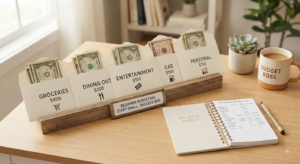
Start with these 4-5 categories:
- Groceries ($500-700)
- Dining out ($150-250)
- Entertainment ($100-150)
- Personal spending ($75-150)
- Miscellaneous ($50-100)
Total monthly cash: $875-1,350
Why this works:
- Not overwhelming (only 4-5 envelopes)
- Covers biggest problem spending areas
- Manageable amount of cash
- Can add more categories later
- High success rate for beginners
After 2-3 months of success, add:
- Gas
- Household
- Clothing
- Gifts
Envelope System Variations and Modifications {#variations}
The basic envelope system is flexible. Here are popular variations to fit different needs.
Variation 1: Weekly Envelopes
How it works:
Instead of monthly envelopes, divide into weekly amounts.
Example: Groceries
- Monthly budget: $600
- Weekly envelopes: 4 envelopes × $150
Each week:
- Use that week’s grocery envelope
- When empty, no more grocery shopping that week
- Forces meal planning and pantry use
Best for:
- People who struggle with monthly pacing
- Those who shop multiple times per week
- Beginners who need smaller accountability windows
- Weekly paycheck earners
Pro: Harder to blow entire month’s budget early
Con: More envelopes to manage
Variation 2: Hybrid Digital/Cash System
How it works:
- Use cash envelopes for problem categories only
- Keep everything else on debit/credit with digital tracking
Example:
- Cash envelopes: Groceries, dining out, entertainment (problem areas)
- Digital/automatic: Bills, gas, savings, fixed expenses
Best for:
- People uncomfortable carrying lots of cash
- Those who want benefits of envelope system without going 100% cash
- Online shoppers
- Modern lifestyle balance
Pro: Gets envelope benefits where needed most
Con: Still requires some digital tracking
Variation 3: Partner/Family Shared Envelopes
How it works:
Household shares envelopes but each person has personal envelope.
Setup:
- Shared envelopes: Groceries, household, entertainment, dining out
- Individual envelopes: His personal spending, her personal spending, kids’ allowances
Rules:
- Shared envelopes require communication
- Personal envelopes are no-questions-asked
- Builds teamwork and autonomy
Best for:
- Couples
- Families
- Preventing financial conflict
Pro: Combines teamwork with personal freedom
Con: Requires good communication
Variation 4: Sinking Fund Envelopes
How it works:
Use envelopes for irregular expenses, building over multiple months.
Example categories:
- Car maintenance: $100/month, accumulates until needed
- Christmas: $125/month Jan-Nov, spend in December
- Vacation: $200/month, accumulates for annual trip
- Gifts: $75/month, use as needed
- Home repairs: $150/month, there when needed
Best for:
- Planned irregular expenses
- Avoiding emergency fund depletion
- Predictable annual costs
Pro: Money ready when needed, no budget shock
Con: Cash sits idle for months
Alternative: Keep these in high-yield savings “buckets” instead of cash envelopes for safety and interest.
Variation 5: Rollover System
How it works:
Leftover money at month-end rolls to next month’s envelope.
Example: Entertainment
- Month 1 budget: $150
- Month 1 spent: $110
- Month 1 leftover: $40
- Month 2 budget: $150 + $40 rollover = $190 available
Two approaches:
Approach A: Build buffer
- Keep rolling over to build cushion
- Creates flexibility for bigger expenses
- Eventually have 1.5-2x monthly amount
Approach B: Roll up to cap
- Roll over until envelope hits 2x monthly
- After that, move excess to savings
- Prevents unlimited accumulation
Best for:
- Building spending buffers
- Handling variable monthly needs
- Creating flexibility
Pro: Rewards underspending, builds cushion
Con: Can lead to hoarding cash in envelopes
Variation 6: Color-Coded System
How it works:
Use colored envelopes or labels for category grouping.
Example:
- Red envelopes: Essentials (groceries, gas, household)
- Yellow envelopes: Discretionary (dining, entertainment)
- Green envelopes: Personal spending
- Blue envelopes: Sinking funds
Best for:
- Visual learners
- People with many categories
- Family systems (each person has color)
- Quick identification
Pro: Quick visual organization
Con: Requires specific supplies
Variation 7: Bi-Weekly Paycheck Method
How it works:
For bi-weekly paychecks, split envelopes by paycheck.
Setup:
- Paycheck 1: Bills due first half of month + half of envelope categories
- Paycheck 2: Bills due second half + other half of envelope categories
Example:
- Paycheck 1 (1st & 15th): Mortgage, groceries ($300), gas ($100)
- Paycheck 2 (15th & 30th): Car payment, groceries ($300), gas ($100)
Alternative: Smaller weekly allocations (4 paychecks/month)
Best for:
- Bi-weekly or weekly earners
- Those who struggle with monthly planning
- Smaller cash amounts at home
Pro: Matches income timing
Con: More frequent stuffing sessions
Variation 8: Envelope Challenge
How it works:
Gamify the system with specific challenges.
Popular challenges:
100 Envelope Challenge:
- Number envelopes 1-100
- Each week, fill 2 random numbered envelopes with that dollar amount
- Envelope #1 = $1, envelope #47 = $47, etc.
- After 50 weeks: $5,050 saved
No-Spend Envelope Challenge:
- Standard envelopes, but challenge: don’t touch them for 30 days
- Forces creativity and pantry cooking
- Roll everything over to next month
Half-Spend Challenge:
- Try to spend only 50% of each envelope
- Move remaining 50% to savings
- Promotes efficiency
Best for:
- Competitive personalities
- People who love games
- Social media accountability
- Building savings fast
Variation 9: Business Envelope System
How it works:
Self-employed people use envelopes for business expense categories.
Categories:
- Office supplies
- Marketing
- Meals & entertainment
- Mileage/gas
- Professional development
- Miscellaneous business
Benefit: Clear separation of business expenses for tax purposes
Note: Keep receipts stapled to tracking sheet for each envelope for tax documentation.
Variation 10: Emergency Mini-Fund Envelope
How it works:
Create special envelope for small emergencies separate from bank emergency fund.
Amount: $100-300 in cash
Purpose: Immediate small emergencies (not regular spending)
Location: Separate from other envelopes, very secure
Use for:
- Car breakdown needing immediate tow
- Urgent small medical need
- True small emergencies only
Replenish: Immediately after use
Not for: Regular expenses or “I really want this”
Digital Envelope Budgeting: Modernizing the Classic Method {#digital}
Love the envelope concept but uncomfortable carrying cash? Digital envelope systems offer a middle ground.
What is Digital Envelope Budgeting?
Digital envelope budgeting replicates the envelope system using apps or software instead of physical cash. You allocate money to digital “envelopes” (categories), and the app tracks spending against each envelope balance.
How Digital Envelopes Work
Setup:
- Download envelope budgeting app
- Create categories (virtual envelopes)
- Allocate money to each category
- Link bank account or manually track
When spending:
- Make purchase with debit/credit card
- Manually log transaction to correct envelope OR app auto-imports
- Envelope balance decreases
- When envelope reaches $0, stop spending
Key difference from physical envelopes:
- No physical cash
- Relies on honor system and tracking
- Doesn’t have psychological “pain of paying” with cash
- More convenient for online shopping
Best Digital Envelope Apps
1. Goodbudget
Type: Digital envelope system app
Cost: Free (10 envelopes) or Plus $8/month (unlimited)
Features:
- Pure envelope budgeting (doesn’t link to bank)
- Manual transaction entry
- Syncs across devices
- Debt tracking
- Reports
Best for:
- People who want envelope method without cash
- Those uncomfortable linking bank accounts
- Couples (syncs across phones)
Pro: Free version functional for most people
Con: Manual entry required
2. YNAB (You Need A Budget)
Type: Zero-based budgeting app with envelope methodology
Cost: $14.99/month or $99/year
Features:
- “Give every dollar a job” (envelope concept)
- Bank account linking
- Automatic import
- Goal tracking
- Excellent educational resources
Best for:
- Serious budgeters
- People wanting sophisticated system
- Those comfortable with subscription cost
Pro: Most powerful envelope-based budgeting software
Con: Monthly cost, steeper learning curve
Internal Link: YNAB is perfect for “Zero-Based Budgeting Explained: Take Control of Every Dollar” methodology
3. Mvelopes
Type: Digital envelope system specifically
Cost: $6/month basic, $15/month premier
Features:
- Designed specifically as digital envelope system
- Bank linking
- Debt reduction tools
- Financial coaching (premium)
- Mobile app
Best for:
- People wanting dedicated envelope app
- Those transitioning from cash envelopes
- Users wanting coaching
Pro: Purpose-built for envelope method
Con: Monthly fee
4. EveryDollar
Type: Zero-based budgeting with envelope concept
Cost: Free basic, $79.99/year premium
Features:
- Dave Ramsey-affiliated
- Simple interface
- Bank connection (premium only)
- Debt payoff tracker
- Baby Steps integration
Best for:
- Dave Ramsey followers
- Beginners
- Those wanting simple system
Pro: Free version usable, intuitive
Con: Bank linking requires paid version
5. Qube Money
Type: Unique digital envelope system with spending card
Cost: $8-15/month
Features:
- Debit card that pulls from specific “qubes” (envelopes)
- Before purchase, open app and “open” correct qube
- Replicates physical envelope experience
- Prevents overspending
Best for:
- People wanting envelope discipline with cards
- Those who want hybrid approach
- Tech-savvy users
Pro: Most closely replicates cash envelope psychology
Con: Monthly fee, requires using their card
6. DIY Spreadsheet Method
Type: Free digital envelopes
Cost: Free
Options:
- Google Sheets template
- Excel spreadsheet
- Numbers (Mac)
How it works:
- Create columns for each envelope category
- Start with budgeted amount
- Manually subtract each transaction
- Track remaining balance
Best for:
- Spreadsheet lovers
- Those wanting free solution
- People who enjoy customization
Pro: Completely free, totally customizable
Con: Requires discipline to update, no automatic import
Template structure:
Category | Budgeted | Spent | Remaining
Groceries | $600 | $245 | $355
Dining Out | $200 | $156 | $44
Entertainment | $150 | $85 | $65
Physical Cash vs. Digital Envelopes: Comparison
| Aspect | Physical Cash | Digital Envelopes |
|---|---|---|
| Pain of paying | ⭐⭐⭐⭐⭐ Maximum | ⭐⭐ Moderate |
| Convenience | ⭐⭐ Must carry cash | ⭐⭐⭐⭐⭐ Cards work everywhere |
| Online shopping | ❌ Can’t use | ✅ Works fine |
| Safety | ⚠️ Risk of theft/loss | ✅ Protected |
| Visual impact | ⭐⭐⭐⭐⭐ See actual money | ⭐⭐⭐ See numbers |
| Discipline required | ⭐⭐ External limit | ⭐⭐⭐⭐ Honor system |
| Tracking | Manual (optional) | Automatic (most apps) |
| Setup complexity | ⭐ Very simple | ⭐⭐⭐ App learning curve |
| Cost | Free | $0-180/year |
| Partner sharing | Must communicate | Syncs automatically |
Hybrid Approach (Best of Both Worlds)
Strategy:
- Physical envelopes: Problem categories (groceries, dining out)
- Digital envelopes: Everything else
Example:
- Cash envelopes: Groceries ($600), Dining out ($200), Entertainment ($150)
- Digital tracking: Gas, household, personal spending, gifts
Why it works:
- Gets psychological benefit of cash for worst spending areas
- Keeps convenience for less problematic categories
- Reduces cash carried
- Balances old and new methods
Making Digital Envelopes More Effective
Digital envelopes lack the psychological punch of physical cash. Compensate with these strategies:
1. Check Before Every Purchase
Before swiping card, open app and verify money remains in that envelope.
2. Use Visual Cues
Some apps show envelope “fullness” with colored bars. Red = almost empty.
3. Set App Alerts
“Entertainment envelope 75% spent” notification
4. Weekly Review Ritual
Set calendar reminder to review all envelope balances
5. Screenshot and Share
Accountability through social sharing or partner check-ins
6. Link Consequence
“If dining envelope hits zero, no restaurants rest of month” (must enforce)
7. Use Multiple Accounts
Some banks allow multiple savings “buckets”—create one per envelope category
Cash Stuffing: The TikTok Trend Explained {#cash-stuffing}
If you’ve been on TikTok or Instagram, you’ve likely encountered #CashStuffing videos. What started as personal finance education has become a viral phenomenon.
What is Cash Stuffing?
Cash stuffing is literally the envelope budgeting system—just with a trendy new name and aesthetic focus for social media.
Typical cash stuffing video:
- Creator withdraws large amount of cash from bank
- Lays out beautifully labeled, often decorated envelopes
- Counts and “stuffs” cash into each category envelope
- Shows completed system organized in binder or wallet
- Sometimes includes haul showing what was purchased
The psychology: There’s something deeply satisfying about watching organized money management. It’s ASMR meets financial responsibility.
Why Cash Stuffing Went Viral
1. Visual Satisfaction
Watching crisp bills get organized into labeled envelopes is oddly mesmerizing—similar to organization videos, cleaning content, or satisfying sounds.
2. Relatability
Everyone struggles with money. Seeing regular people manage budgets makes finance approachable, not intimidating.
3. Accountability
Public posting creates accountability. Creators must follow through or their audience notices.
4. Community Support
Comment sections full of encouragement, tips, struggles, and victories. Financial education meets social support.
5. Aesthetic Appeal
Pretty envelopes, color-coding, neat handwriting, organized binders—it’s visually appealing content.
6. Accessible Entry Point
Unlike investing or complex finance topics, envelope budgeting is simple enough for anyone to start immediately.
Popular Cash Stuffing Creators
While we won’t link specific accounts (they change frequently), search these hashtags on TikTok/Instagram:
- #CashStuffing (600M+ views)
- #CashEnvelopes (300M+ views)
- #BudgetBinder (150M+ views)
- #EnvelopeBudget (100M+ views)
- #PaydayRoutine (500M+ views)
The Cash Stuffing Aesthetic
Modern cash stuffing often includes:
Supplies:
- Colorful or patterned envelopes
- Budget binders with clear pockets
- Laminated reusable envelopes
- Washi tape decoration
- Cute stickers and labels
- Matching accessories
Popular systems:
- Budget Binder: Envelopes organized in 3-ring binder with dividers
- Wallet System: Accordion-style wallet with envelope slots
- Cash Box: Decorated box with standing envelopes
- Zipper Pouches: Small zippered bags instead of paper envelopes
Color coding:
- Bills by color
- Envelopes by category type
- Monthly themes
Is Cash Stuffing Just for Show?
The criticism: Some argue cash stuffing is more about aesthetics than actual financial discipline.
The reality: Like any tool, it depends on the user.
Cash stuffing WORKS when:
✅ You actually stick to the envelopes
✅ You use it to control spending
✅ You don’t buy expensive supplies you can’t afford
✅ The visual motivation helps you succeed
Cash stuffing FAILS when:
❌ You spend more on supplies than you save
❌ It’s all for content, no follow-through
❌ You break your own rules constantly
❌ Aesthetics matter more than results
Should You Make It Aesthetic?
Arguments FOR making it pretty:
- Increases enjoyment of budgeting process
- Makes you more likely to maintain system
- Provides positive association with financial management
- Can be motivating and fun
Arguments AGAINST spending on supplies:
- Free envelopes work exactly the same
- Money spent on supplies could go to savings
- Priorities decoration over function
- Creates barrier to entry (“I need X to start”)
Balanced approach:
- Start with free/cheap supplies
- Once you’ve proven the system works for you (3+ months)
- THEN invest in aesthetic upgrades if desired
- Allocate from “personal spending” envelope, not emergency fund!
Cash Stuffing for Beginners (Without the TikTok Pressure)
You don’t need:
- ❌ $100 budget binder
- ❌ Custom printed envelopes
- ❌ Professional filming setup
- ❌ Thousands of followers
- ❌ Perfect aesthetic
You DO need:
- ✅ Envelopes (literally any envelopes)
- ✅ Marker or pen
- ✅ Cash
- ✅ Discipline to stick with it
The method matters. The aesthetics don’t.
That said, if making it pretty helps you stick with it, do it! Just don’t let perfection prevent you from starting.
Envelope System vs. Other Budgeting Methods {#comparison}
How does the envelope system compare to other popular budgeting approaches?
Envelope System vs. Zero-Based Budgeting
Zero-Based Budgeting (ZBB):
- Allocate every dollar to a specific purpose
- Income – all allocations = $0
- Typically digital tracking
- Comprehensive (covers all spending)
Envelope System:
- Allocate cash to specific categories
- Physical envelopes with preset limits
- Usually only variable expenses
- Partial budget (fixed bills separate)
Overlap: Both assign specific jobs to money before spending
Can you combine them?
✅ YES! Many people do:
- Use ZBB principles for overall budget
- Use cash envelopes for variable categories
- Best of both worlds
Envelope System vs. 50/30/20 Budget
50/30/20 Budget:
- 50% to needs
- 30% to wants
- 20% to savings/debt
- Percentage-based, flexible within categories
- Usually digital tracking
Envelope System:
- Specific dollar amounts per category
- Hard limits, not percentages
- Cash-based
- More granular control
Which is better?
- 50/30/20: Better for beginners, simple, flexible
- Envelope system: Better for overspenders, more controlled
Can you combine them?
✅ YES:
- Use 50/30/20 to determine overall allocation
- Use envelopes for the “30% wants” categories
- Keeps structure with added control
Envelope System vs. Pay Yourself First
Pay Yourself First:
- Save/invest before any spending
- Automatic transfers to savings
- Spend what remains
- Focus on wealth building
Envelope System:
- Budget all categories including savings
- Cash for spending categories
- Focus on controlling spending
Which is better?
Both serve different purposes.
Best approach: Combine them
- Pay yourself first (automate savings)
- Use envelope system for remaining spending money
- Builds wealth while controlling expenses
Envelope System vs. Mint/YNAB/EveryDollar
App-Based Budgeting:
- Digital tracking
- Automatic transaction import
- Reports and analytics
- Accessible anywhere
Envelope System:
- Physical cash
- Manual management
- Simple visual feedback
- Requires carrying envelopes
Comparison:
| Feature | Apps | Envelopes |
|---|---|---|
| Convenience | ⭐⭐⭐⭐⭐ | ⭐⭐ |
| Spending awareness | ⭐⭐⭐ | ⭐⭐⭐⭐⭐ |
| Online shopping | ✅ Works | ❌ Doesn’t work |
| Safety | ✅ Protected | ⚠️ Risk |
| Cost | $0-$15/month | Free |
| Learning curve | Medium | Easy |
| Effectiveness for overspending | ⭐⭐⭐ | ⭐⭐⭐⭐⭐ |
Best for apps: Organized people who just need tracking
Best for envelopes: People who overspend despite tracking
Envelope System vs. No Budget at All
No Budget:
- Spend freely
- Hope money lasts
- React to problems
- Stress and uncertainty
Envelope System:
- Plan spending in advance
- Know exactly what’s available
- Prevent problems
- Control and peace of mind
The data: People using envelope budgeting save an average of 18-25% more than those without any budget system. (Study: Journal of Consumer Research, 2023)
If you currently have no budget, envelopes are an excellent starting point.
Common Challenges and How to Overcome Them {#challenges}
The envelope system is simple but not always easy. Here are the most common obstacles and practical solutions.
Challenge #1: “I Shop Online Constantly”
The Problem:
You can’t pay Amazon, online retailers, or delivery services with cash from an envelope.
Solutions:
Option A: Hybrid System
- Use envelopes for in-person spending only
- Create separate online shopping budget in checking account
- Track digitally using app or spreadsheet
- Move toward more in-person shopping over time
Option B: Envelope Allocation Method
- Keep cash in envelope
- When making online purchase, remove equivalent cash
- Put cash in separate “spent” envelope or deposit back to bank
- Envelope balance still accurate
Option C: Digital Envelope App
- Use apps like Goodbudget or YNAB for online purchases
- Get envelope control without physical cash
Option D: Reduce Online Shopping
- This is an opportunity, not a barrier
- Online shopping often leads to overspending
- Switch to in-person where possible
- Use envelope system to break online shopping habit
Challenge #2: “I’m Worried About Carrying Cash”
The Problem:
Safety concerns about theft, loss, or having cash stolen.
Solutions:
Minimize Cash at Home:
- Use bi-weekly or weekly stuffing (smaller amounts)
- Keep envelopes in home safe or locked box
- Only carry envelopes you’ll use that day
Carry Smart:
- Take only needed cash for specific trip
- Leave envelope at home, carry only that trip’s amount
- Use envelope wallet designed for security
- Don’t advertise you’re using cash system
Hidden Storage:
- Don’t keep envelopes in obvious place
- Use decoy wallet if concerned about purse snatching
- Split amounts (some in purse, backup in car)
Insurance:
- Check if homeowner’s/renter’s insurance covers cash
- Document envelope amounts (photos monthly)
- Keep in fireproof safe
Reality Check:
Millions of people safely use cash envelopes daily. With reasonable precautions, risk is minimal.
Challenge #3: “My Income Varies Every Month”
The Problem:
Freelancers, commission workers, and gig workers don’t have consistent income to budget.
Solutions:
Strategy A: Budget to Minimum
- Calculate lowest income from past 6 months
- Budget envelope amounts based on that minimum
- Good months: Excess goes to savings/debt/buffer
- Ensures you never overspend
Strategy B: Percentage-Based Envelopes
- Instead of fixed amounts, use percentages
- Income $3,000 month: 20% to groceries = $600
- Income $4,000 month: 20% to groceries = $800
- Scales with income
Strategy C: Priority-Based Stuffing
- Create priority list of envelopes
- High-income month: Stuff all envelopes fully
- Low-income month: Stuff priorities first, others partially
Strategy D: Income Buffer Account
- In high-income months, save excess
- In low-income months, draw from buffer to stuff envelopes normally
- Smooths variable income
Internal Link: More strategies in “Emergency Fund Guide: How Much to Save and Where to Keep It” for income variability
Challenge #4: “I Keep Borrowing from Other Envelopes”
The Problem:
Dining envelope empty, so you “borrow” from entertainment envelope. Then you do it again. System breaks down.
Solutions:
Understand Why:
- Are envelope amounts unrealistic?
- Are you budgeting wishful thinking instead of reality?
- Is one category genuinely underfunded?
Make Adjustments:
- Track borrowing for one month
- See patterns
- Increase chronically underfunded category
- Decrease category you never use fully
Create Rules:
- Allow 1 transfer per month maximum
- Require “repayment” next month
- Can only transfer from certain categories
- No transferring from sinking funds
Separate by Importance:
- Red envelopes = essentials (never raid these)
- Yellow envelopes = wants (can transfer between these)
- Clear hierarchy prevents critical categories being raided
Consequences:
- If you break rules, add accountability
- Tell partner/accountability buddy
- Put $10 in savings penalty
- Track violations
Reality:
Some envelope borrowing is okay (life happens), but if it’s constant, your amounts aren’t realistic. Fix the budget, not just your behavior.
Challenge #5: “I Overspend at the Beginning of the Month”
The Problem:
See $600 in grocery envelope day 1, spend $400 by day 10, scramble last 3 weeks.
Solutions:
Weekly Sub-Envelopes:
- Divide monthly envelope into 4 weekly envelopes
- Can only access that week’s envelope
- Forces pacing
Example:
- Monthly grocery budget: $600
- Week 1 envelope: $150
- Week 2 envelope: $150
- Week 3 envelope: $150
- Week 4 envelope: $150
Hidden Reserve:
- Stuff envelope with only 75% initially
- Keep 25% separate
- If doing fine, add at mid-month
- If struggling, have cushion
Visual Markers:
- Put sticky note at “halfway point” in envelope
- “By day 15, should be here ↓”
- Visual cue to pace spending
Shopping Frequency:
- Limit to specific days
- “Grocery shopping only on Saturdays”
- Reduces impulse trips that drain envelope
Challenge #6: “My Partner Won’t Do This With Me”
The Problem:
You want to use envelopes, partner thinks it’s outdated/unnecessary/too much work.
Solutions:
Start Solo:
- Begin with just your personal spending envelope
- Show results over 2-3 months
- Success often converts skeptics
Make It Easy:
- Don’t require partner to manage envelopes
- You handle stuffing and organizing
- Partner just uses appropriate envelope when shopping
Compromise:
- Use envelopes for problem areas only
- Partner doesn’t have to embrace fully
- Just respect envelope limits when shopping
Separate Personal Envelopes:
- Each person has their own personal spending envelope
- Provides autonomy
- Reduces conflict
- Can participate without full buy-in
Focus on Goals:
- Frame as “this helps us afford vacation faster”
- Connect to shared goals, not restriction
- Show math of savings
Try 30-Day Experiment:
- “Let’s try for one month”
- Lower commitment threshold
- Often continues when they see results
Challenge #7: “I Feel Embarrassed Using Cash”
The Problem:
Worried about judgment from cashiers or friends when pulling out cash envelopes.
Solutions:
Reframe Your Mindset:
- You’re being financially responsible (nothing to be embarrassed about)
- Cashiers process cash all day (they don’t care)
- Friends’ opinions < your financial future
- Pride in discipline, not shame
Discreet Methods:
- Transfer cash to regular wallet before entering store
- Don’t pull out labeled envelope at register
- Use envelope wallet that looks like normal wallet
- Nobody needs to know your system
Own It:
- “I’m using cash to stick to my budget”
- Confidence is attractive
- Often inspires others to ask how you do it
- Normalize smart money management
Reality Check:
Nobody cares as much as you think. Cashiers are on autopilot. Other customers are thinking about their own stuff. Your financial success matters more than imagined judgment.
Challenge #8: “I Keep Forgetting to Bring the Right Envelope”
The Problem:
At grocery store, realize grocery envelope is at home, use debit card instead, system fails.
Solutions:
Envelope Wallet:
- All envelopes in one wallet
- Always carry all envelopes
- Grab from appropriate one when needed
Car Storage:
- Keep envelopes in car console
- Always there when shopping
- Transfer to purse/wallet when parking
Calendar Reminders:
- “Grocery shopping Saturday – bring grocery envelope”
- Phone reminder before typical shopping times
- Forms habit over time
Shopping Routine:
- Always shop same days/times
- Build into routine
- Becomes automatic
Backup Rule:
- If forgot envelope, go home and get it
- Don’t use debit card “just this once”
- Reinforces importance of system
Challenge #9: “I’m Not Saving Money, Just Controlling Spending”
The Problem:
Successfully staying within envelopes, but not building wealth.
Solutions:
Add Savings Envelope:
- Create envelope labeled “Savings”
- Treat like expense category
- Deposit to bank account at month-end
Leftover Rule:
- All money left in envelopes at month-end → savings
- Incentivizes underspending
- Builds savings automatically
Reduce Envelope Amounts:
- Once mastered current amounts, reduce by 10%
- Move difference to savings
- Gradual lifestyle adjustment
Savings Challenge:
- Try to beat last month’s savings
- Gamify the process
- Track savings growth visually
Remember:
Envelope system’s primary purpose is controlling spending. Pair with savings automation for wealth building.
Best practice:
- Automate savings transfer on payday
- Then stuff spending envelopes
- Savings happens first
Internal Link: Accelerate savings with “How to Save Money Fast: 50+ Proven Ways to Cut Expenses”
Safety Tips for Managing Cash {#safety}
Handling cash requires security awareness. Here’s how to stay safe while using the envelope system.
At Home
Secure Storage:
Best options:
- Small home safe ($50-200)
- Fireproof and waterproof
- Bolted to floor/wall
- Protects from theft and disaster
- Locked filing cabinet
- Budget-friendly option
- Keeps cash out of plain sight
- Prevents casual theft
- Diversion safe
- Looks like book/can/household item
- Hides in plain sight
- Good for smaller amounts
Worst places:
- ❌ Dresser drawer (first place thieves check)
- ❌ Under mattress (second place thieves check)
- ❌ Freezer (common hiding spot, thieves know it)
- ❌ Kitchen (high traffic, easily accessed)
Best practices:
- Keep safe location private (don’t tell everyone)
- Don’t mention on social media that you keep cash at home
- Document amounts with photos (insurance purposes)
- Keep out of sight from windows
In Your Vehicle
If You Store Envelopes in Car:
Safer approach:
- Locked console or glovebox
- Not visible from outside
- Take with you when parked in high-risk areas
- Never leave in plain sight
Better approach:
- Only keep today’s needed cash in car
- Leave rest at home
- Minimize exposure
After shopping:
- Don’t count cash in parking lot
- Put change away immediately
- Be aware of surroundings
While Out and About
Carrying Cash:
Smart practices:
- Take only what you need for that trip
- Use envelope wallet close to body
- Be aware in parking lots
- Don’t flash cash at register
- Count change discreetly
High-risk situations:
- Late night shopping
- Unfamiliar areas
- Crowded events
- High-crime areas
In these cases:
- Consider using debit/credit instead
- Bring trusted companion
- Park in well-lit areas
- Stay alert
ATM Safety:
- Use bank ATMs during business hours when possible
- Be aware of surroundings
- Shield PIN entry
- Don’t count money at ATM
- Leave immediately after transaction
Insurance Considerations
Check Your Coverage:
Homeowner’s/Renter’s Insurance:
- Typically covers cash, but often limited ($200-500)
- May require proof (photos of envelopes monthly)
- May require police report for claim
- Read your policy specifics
Increasing Coverage:
- Add personal property rider
- Document your system
- Keep photos of stuffed envelopes
- Track amounts
Alternative:
- Keep most money in bank
- Only withdraw weekly amounts
- Reduces cash at home significantly
Digital Security (If Using Digital Envelopes)
App Security:
- Use strong, unique passwords
- Enable two-factor authentication
- Don’t link to accounts with large balances
- Review connected accounts regularly
Device Security:
- Passcode/biometric lock on phone
- Don’t store banking passwords in notes
- Use secure networks (not public WiFi for banking)
- Update apps regularly
Identity Protection
With Cash System:
Advantage: Cash leaves no digital trail
Precautions:
- Don’t mention specific amounts on social media
- Be cautious about documenting system publicly
- Shred receipts with personal information
Emergency Backup
What If:
- Cash stolen
- House fire
- Natural disaster
- Loss of all envelopes
Protection:
- Photo documentation (stored in cloud)
- Monthly photos of stuffed envelopes
- Shows amounts for insurance claim
- Keep some money digital
- Not all eggs in cash basket
- Maintain checking balance for true emergency
- Emergency fund separate
- Don’t keep emergency fund in cash envelopes
- Keep in high-yield savings account
- Physical safety + FDIC protection
- Smaller amounts at home
- Weekly stuffing instead of monthly
- Minimizes potential loss
- $300 at home vs. $1,500
Reasonable Risk Assessment
Perspective:
- Billions of people handle cash daily without incident
- With reasonable precautions, risk is very low
- Don’t let fear prevent using effective system
Balanced approach:
- Use common sense security measures
- Don’t keep excessive cash at home
- Have insurance coverage
- But don’t be paralyzed by unlikely scenarios
If truly uncomfortable:
- Use digital envelope system instead
- Gets envelope benefits without cash risk
- Perfectly valid alternative
Real-Life Success Stories {#success-stories}

Real people achieving real results with the envelope system.
Story #1: Jessica’s $15,000 Debt Payoff
Background:
- Age: 28, marketing coordinator
- Income: $48,000/year
- Debt: $15,000 credit card debt
- Problem: Overspending on dining out, shopping, entertainment
Before Envelopes:
- Spent $800+/month on discretionary categories
- Made minimum payments on debt
- Frustrated and stuck
- Tried budgeting apps, failed repeatedly
Envelope System Implementation:
Categories:
- Groceries: $400
- Dining out: $150 (down from $400)
- Entertainment: $100 (down from $200)
- Personal shopping: $75 (down from $200)
- Gas: $150
Results:
- Month 1: Stayed within all envelopes, saved $450 that previously disappeared
- Month 3: Now natural, leftover money each month
- Month 6: Paid off $3,200 in debt
- Month 18: Completely debt-free ($15,000 paid)
- Total saved through envelope system: $450/month × 18 months = $8,100+ redirected to debt
Key insight: “Seeing cash physically leave my hands made me question every purchase. When the dining envelope was empty, I actually cooked instead of ordering takeout.”
Story #2: Marcus and Tina’s Marriage Saver
Background:
- Married couple, early 40s
- Combined income: $95,000
- Problem: Constant fighting about money
- Marcus felt Tina overspent; Tina felt Marcus was controlling
Before Envelopes:
- Arguments about spending weekly
- Hidden purchases
- Resentment building
- Nearly separated over money
Envelope System Implementation:
Setup:
- Shared envelopes: Groceries ($700), household ($150), dining out ($300)
- Individual envelopes: His personal ($200), her personal ($200)
Rules:
- Can spend shared envelopes after discussion
- Personal envelopes = no questions asked
- Weekly check-in on shared envelope status
Results:
- Month 1: Awkward but managed to follow system
- Month 2: Arguments reduced by 80%
- Month 6: First vacation together in 3 years (saved from leftover envelope money)
- Month 12: Marriage stronger, financial stress minimal
Key insight: “Personal envelopes gave us autonomy. Shared envelopes forced communication but in a structured way. We stopped fighting because the envelopes showed the truth—not accusations.”
Story #3: David’s Variable Income Victory
Background:
- Freelance graphic designer, age 34
- Income: $2,000-$6,000/month (highly variable)
- Problem: Overspent in good months, scrambled in bad months
- No emergency fund despite good average income
Before Envelopes:
- Good month: Spent freely
- Bad month: Panicked, used credit cards
- Never felt secure despite decent income
- Couldn’t build savings
Envelope System Implementation:
Strategy:
- Budgeted to worst-case month ($2,000)
- Any income above $2,000 = 50% to emergency fund, 50% to extra envelope amounts
Base envelopes (always funded even in $2,000 month):
- Groceries: $300
- Gas: $100
- Personal: $50
- Total bare minimum: $450 (rest to fixed bills, taxes, basic savings)
Results:
- Month 1 income: $4,200
- Funded base envelopes: $450
- Extra $2,200 above minimum:
- $1,100 to emergency fund
- $1,100 to enhanced envelopes (better groceries, some dining out, entertainment)
- Month 3 income: $2,300
- Funded base envelopes: $450
- Extra $300 above minimum:
- $150 to emergency fund
- $150 to slightly enhanced envelopes
- Month 5 income: $5,800
- Funded base envelopes: $450
- Extra $3,800:
- $1,900 to emergency fund
- $1,900 to enhanced envelopes + special purchase saved for
Results after 12 months:
- Emergency fund: $14,500 (never had more than $1,000 before)
- Stress level: Dramatically reduced
- Never used credit card once
- Business investment made from good month excess
Key insight: “Knowing my bare-minimum envelopes would always be funded gave me security. Good months felt like bonuses, not the new normal to adjust lifestyle to.”
Story #4: Sarah’s Grocery Budget Breakthrough
Background:
- Stay-at-home mom, family of 4
- Household income: $65,000
- Problem: Grocery budget consistently $900-1,000/month, target was $600
- Multiple store trips per week, constant overspending
Before Envelopes:
- Vague idea of grocery budget
- Multiple trips per week
- “Just grabbing a few things” that added up
- Using debit card, easy to overspend
Envelope System Implementation:
Setup:
- Single grocery envelope: $650/month (realistic middle ground)
- Weekly sub-envelopes: $162.50 × 4 weeks
- Rule: Only shop once per week, only with cash
Supporting changes:
- Started meal planning Sunday nights
- Shopped with list only
- Left debit card at home
- Made it a game to come under budget
Results:
- Week 1: Spent $155 (under budget!)
- Week 2: Spent $168 (slight over, but rolled from week 1)
- Month 1: Total spent $622, $28 under budget
- Month 3: Consistently under $650, rolling $50-75/month to savings
- Month 6: Grocery spending stabilized at $580-620/month
- Year 1: Saved $3,600 compared to previous grocery spending
Additional benefits:
- Less food waste (planning ahead)
- Healthier eating (fewer impulse buys)
- Kids learned about budget limits
- Sense of achievement each successful week
Key insight: “Having to physically count out cash made me ruthlessly evaluate every item. ‘Do we really need this?’ became automatic. Also, limited trips meant better planning.”
Leave a Reply